1

Code Enforcement Jobs in Georgia (NOW HIRING)

City Fire Chief

Quitman, GA · On-site

$50K - $65K/yr

Maintenance of apparatus, fire prevention, records maintenance, code enforcement and quarters upkeep. Day to day supervision of training, work schedules and records filed monthly as required by ...

Building Inspector

Lagrange, GA · On-site

$20.72/hr

... code enforcement principles and practices a Skill in the use of computers and job-related software programs a Skill in conducting investigations and collecting evidence a Skill in the enforcement of ...

Building Inspector

Lagrange, GA · On-site

$20.72/hr

... code enforcement principles and practices a Skill in the use of computers and job-related software programs a Skill in conducting investigations and collecting evidence a Skill in the enforcement of ...

Field Inspector - GA

Douglas, GA · Remote

$30 - $45/hr

Associate degree preferred (High School Graduate minimum). * 3-5 Years' experience in construction/code enforcement and or working with ICC codes and building materials. * Must be able to work ...

Field Inspector - GA

Douglas, GA · Remote

$30 - $45/hr

Associate degree preferred (High School Graduate minimum). * 3-5 Years' experience in construction/code enforcement and or working with ICC codes and building materials. * Must be able to work ...

next page

Showing results 1-20

Code Enforcement information

See Georgia salary details

$24.1K

$50.6K

$79.4K

How much do code enforcement jobs pay per year?

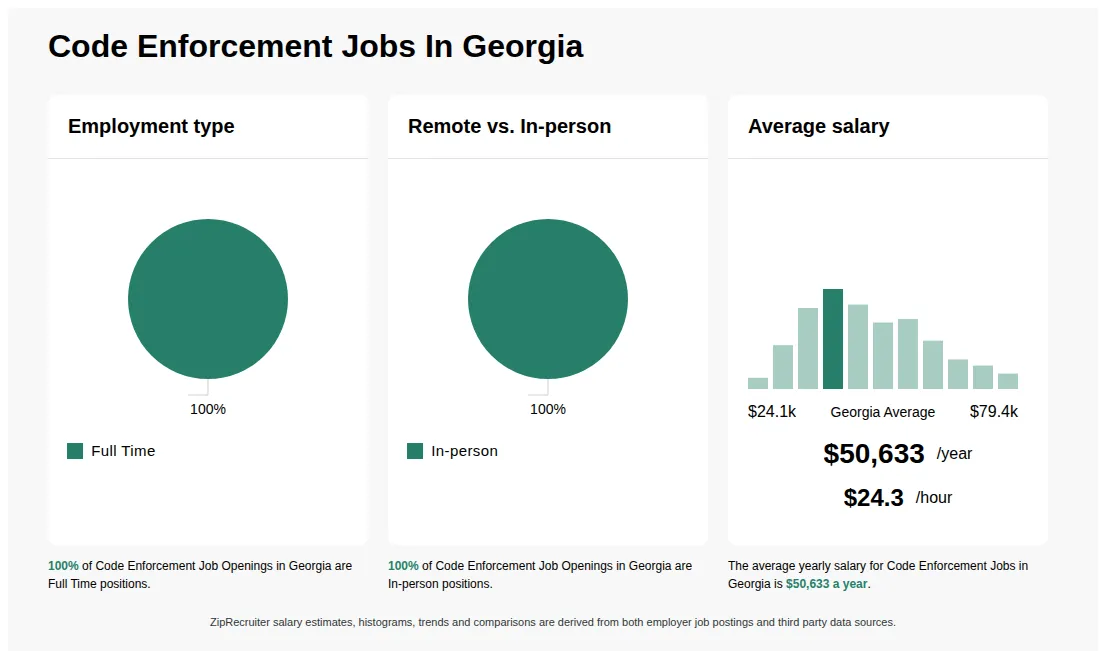
As of Jun 1, 2026, the average yearly pay for code enforcement in Georgia is $50,633.00, according to ZipRecruiter salary data. Most workers in this role earn between $39,700.00 and $58,300.00 per year, depending on experience, location, and employer.

What are the key skills and qualifications needed to thrive as a Code Enforcement Officer, and why are they important?

To thrive as a Code Enforcement Officer, you need a solid understanding of local codes and ordinances, investigative techniques, and often a background in public administration or criminal justice. Familiarity with inspection software, record management systems, and sometimes certification such as the ICC (International Code Council) certification is typical. Strong communication, conflict resolution, and attention to detail are vital soft skills for interacting with the public and resolving disputes. These abilities are crucial for ensuring community safety, upholding local standards, and maintaining positive relationships with residents.

What are some common challenges faced by code enforcement officers in their daily work?

Code enforcement officers frequently encounter challenges such as handling confrontational situations with property owners, staying updated with evolving local codes and ordinances, and managing a high volume of cases efficiently. They often need to balance regulatory compliance with diplomacy, as building positive relationships with the community is crucial. Additionally, officers must document violations thoroughly and collaborate with other municipal departments, such as zoning, fire, or public health, to resolve complex issues.

What are code enforcement officers and what do they do?

Code enforcement officers are professionals responsible for ensuring that local laws, ordinances, and regulations related to building codes, zoning, property maintenance, and public safety are followed. They inspect properties, investigate complaints, and work with property owners to resolve violations. Their goal is to maintain community standards, protect public health and safety, and improve neighborhood quality. Code enforcement officers may issue warnings, citations, or even initiate legal proceedings if violations are not corrected.

What is the difference between Code Enforcement vs Building Inspector?

AspectCode EnforcementBuilding Inspector
Required credentialsTypically requires a high school diploma or equivalent; some roles may need certifications in code enforcement or related fieldsRequires a high school diploma; certifications in building inspection or related areas are common
Work environmentFieldwork and office work; inspecting properties for code violationsPrimarily fieldwork; inspecting new and existing structures for compliance
Employer and industry usageMunicipalities, counties, government agenciesMunicipalities, counties, government agencies
Common search and comparison intentUnderstanding roles related to code compliance and enforcementUnderstanding building inspection processes and requirements

Both roles are essential in ensuring safety and compliance within communities. While Code Enforcement focuses on violations of codes and ordinances, Building Inspectors primarily verify that construction and renovations meet building codes. They often work together but have distinct responsibilities within the regulatory framework.

What are the most commonly searched types of Code Enforcement jobs in Georgia? The most popular types of Code Enforcement jobs in Georgia are:
What cities in Georgia are hiring for Code Enforcement jobs? Cities in Georgia with the most Code Enforcement job openings:
Infographic showing various Code Enforcement job openings in Georgia as of May 2026, with employment types broken down into 2% As Needed, 68% Full Time, and 30% Part Time. Highlights an 97% Physical, and 3% Remote job distribution, with an average salary of $50,633 per year, or $24.3 per hour.
Future Police Officer (Cadet)

Future Police Officer (Cadet)

CITY OF GRIFFIN

Griffin, GA

Full-time

Posted yesterday


Job description

Upon completion of the Georgia Public Safety Training Center's Basic Law Enforcement Training, which is a rigorous program that consists of 408 course hours and takes twelve weeks to complete, an individual will receive the Georgia Peace Officer Certifcation. Upon receiving that, an individual will provide for public safety by maintaining order, responding to emergencies, protecting people and property, enforcing motor vehicle and criminal laws, and promoting good community relations. Essential duties include:

  • Patrols an assigned area to detect and deter crime; answers calls for service; conducts foot patrol in high crime areas.
  • Conducts traffic stops and enforces state laws and local ordinances.
  • Assists stranded motorists
  • Investigates reported crimes; investigates traffic accidents.
  • Interviews witnesses, suspects and victims.
  • Obtains search and arrest warrants; assists in conducting search warrants; serves arrest warrants.
  • Makes arrests and transports prisoners to jail facilities.
  • Secures crime scenes and collects evidence.
  • Conducts security checks on banks, residences, schools and local businesses.
  • Resolves conflicts and disputes within the community.
  • Assists other departments or agencies as needed.
  • Completes a variety of reports, including daily and monthly reports, incident and accident reports, citations and summonses, false alarm reports, arrest and booking reports, and case files.
  • Attends court and offers testimony.
  • Completes required training.
  • Assists with security and traffic control at special events.
  • Transports inmates.
  • Provides escort for city workers to the bank.
  • Conducts surveillance in areas of high drug activity.
  • Maintains assigned vehicle and equipment.
  • Performs animal control and code enforcement duties as assigned.