1

Civil Rights Investigator Jobs (NOW HIRING)

Civil Rights Attorney

San Diego, CA · On-site

$80K - $95K/yr

Civil Rights Attorney Work Location: San Diego, CA Term: Full-time, occasional evening and weekends ... Review and investigate an array of legal claims brought by an incredibly diverse community.

Civil Rights Attorney

San Diego, CA · On-site

$80K - $95K/yr

Civil Rights Attorney Work Location: San Diego, CA Term: Full-time, occasional evening and weekends ... Review and investigate an array of legal claims brought by an incredibly diverse community.

next page

Showing results 1-20

Civil Rights Investigator information

See salary details

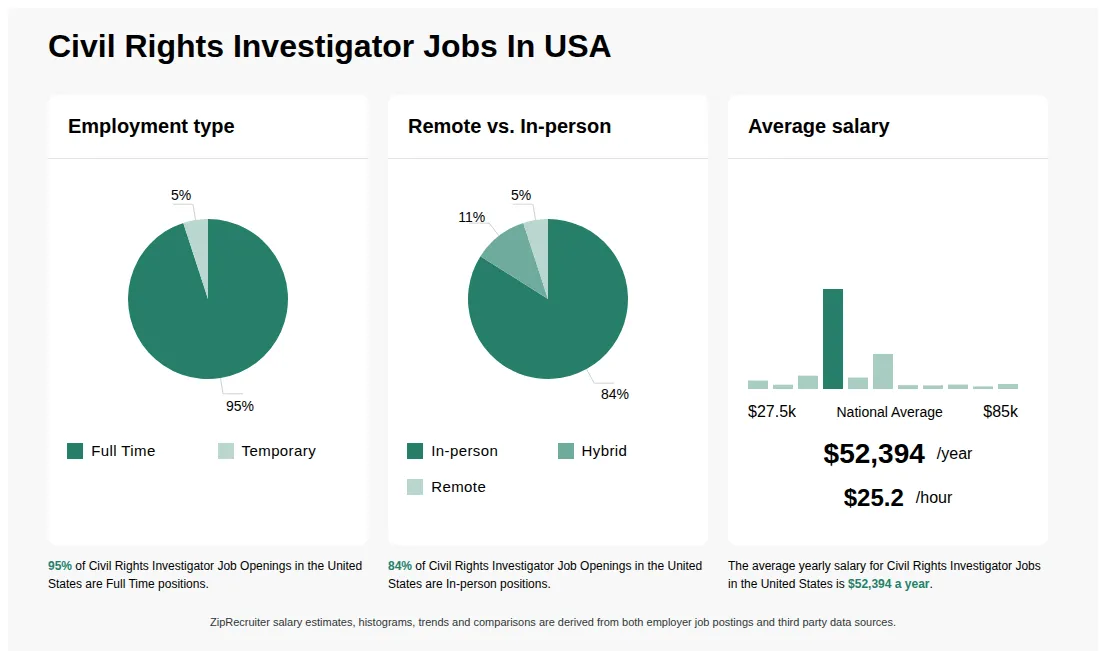
$27.5K

$52.4K

$85K

How much do civil rights investigator jobs pay per year?

As of Jun 26, 2026, the average yearly pay for civil rights investigator in the United States is $52,394.00, according to ZipRecruiter salary data. Most workers in this role earn between $46,500.00 and $57,000.00 per year, depending on experience, location, and employer.

What are Civil Rights Investigators?

Civil Rights Investigators are professionals who investigate complaints and allegations of discrimination or civil rights violations in areas such as employment, housing, education, or public services. They gather evidence, interview witnesses, review relevant documents, and make findings or recommendations based on their investigations. Their work helps ensure that organizations and institutions comply with federal, state, or local civil rights laws. Civil Rights Investigators often work for government agencies, educational institutions, or private organizations dedicated to upholding equal rights.

What are some common challenges faced by Civil Rights Investigators during the investigative process?

Civil Rights Investigators often encounter challenges such as obtaining cooperation from reluctant witnesses, handling sensitive or emotionally charged situations, and managing complex case documentation. They must maintain objectivity and confidentiality while navigating legal and organizational protocols. Additionally, balancing multiple cases and tight deadlines requires strong organizational skills and resilience, as well as the ability to work collaboratively with legal teams, advocacy groups, and affected individuals.

What are the key skills and qualifications needed to thrive as a Civil Rights Investigator, and why are they important?

To thrive as a Civil Rights Investigator, you need a strong understanding of civil rights laws, investigative techniques, and analytical skills, usually supported by a degree in law, criminal justice, or a related field. Familiarity with case management software, legal research databases, and evidence documentation tools is typically required. Exceptional interpersonal communication, attention to detail, and the ability to handle sensitive situations with discretion are crucial soft skills. These abilities are important to ensure thorough, fair investigations and to uphold justice and compliance with civil rights regulations.
More about Civil Rights Investigator jobs
What cities are hiring for Civil Rights Investigator jobs? Cities with the most Civil Rights Investigator job openings:
What are the most commonly searched types of Civil Rights Investigator jobs? The most popular types of Civil Rights Investigator jobs are:
What states have the most Civil Rights Investigator jobs? States with the most job openings for Civil Rights Investigator jobs include:
Infographic showing various Civil Rights Investigator job openings in the United States as of June 2026, with employment types broken down into 55% Full Time, and 45% Part Time. Highlights an 91% Physical, 3% Hybrid, and 6% Remote job distribution, with an average salary of $52,394 per year, or $25.2 per hour.

Civil Rights Housing Analyst

City of Davenport

Davenport, IA • On-site

Full-time

Posted 29 days ago


Job description

Definition The Davenport Civil Rights Commission is the employer for this position. Under the direction of the Civil Rights Director, responsible for managing a variety of administrative duties requiring knowledge and skills relating to fair housing investigation and enforcement; provide technical and administrative support for confidential and sensitive civil rights matters by conducting fair housing complaint investigations, and ensuring compliance with civil rights laws and regulations within the Davenport Civil Rights agency. This position conducts complex fair housing investigations and provides education to the community.

Responsibilities include creating educational materials such as brochures, posters, flyers, advertisements, and other public or media communications; preparing reports for HUD; researching funding opportunities and tracking proposal deadlines; and writing, editing, and proofreading proposals and reports for corporate, foundation, and government funders. Examples Of Duties Fair Housing Investigations and Education: Conducts investigations of fair housing complaints, including interviews, research, and fact-finding. Educates the community on fair housing rights and policies.

Develops informational materials such as brochures, posters, flyers, ads, and other media. Civil Rights Complaint Management: Receives, investigates, and resolves internal and public complaints of discrimination. Applies current civil rights laws and policies to case facts, ensuring compliance with state and federal regulations.

Maintains confidentiality of sensitive and confidential information throughout investigations. Legal and Technical Support: Conducts legal research, interprets civil rights legislation and case law. Drafts findings, administrative rules, and recommendations.

Provides technical support and guidance to commissions, boards, and the public regarding policies, procedures, and resources. Reporting and Administration: Prepares reports for HUD, corporate, foundation, and government funders. Researches funding sources, proposal requirements, and submission deadlines; maintains report calendar.

Monitors and oversees budget for state and federal contracts. Community and Commission Support: Represents the Commission in public engagements, meetings, hearings and presentations. Provides updates and technical support to ensure community engagement and policy compliance.

Ongoing Professional Responsibilities: Stays current with civil rights priorities, legislation, and enforcement regulations. Successfully conciliates civil rights complaints and implements best practices in enforcement and education. Qualifications MINIMUM QUALIFICATIONS: Requires a bachelor's degree majoring in business, public administration, human services, social sciences, or legal studies PLUS two years of experience completing fair housing investigation reports, interpreting state/federal fair housing laws, conducting criminal or civil discrimination investigations into housing discrimination, analyzing and/or auditing organizational policies, investigating discrimination complaints, or any combination thereof; OR six years of experience completing fair housing investigation reports, interpreting state/federal fair housing laws, conducting criminal or civil discrimination fair housing investigations, analyzing and/or auditing organizational policies, investigating discrimination complaints, or any combination thereof.

PREFERRED QUALIFICATIONS: 5-10 years of related professional experience working in fair housing law enforcement, with experience conducting civil rights investigations, writing reports of legal findings of fact and conclusions of law. Experience working in local government serving racially and ethnically diverse populations in a predominantly white community. Bilingual or multilingual fluency.

Knowledge and Skills Comprehensive knowledge of fair housing laws, regulations, policies, and related state and federal programs. Law and Government - Knowledge of local, state, and federal civil rights laws, rules, and regulations, court procedures, legal precedent, and executive orders. Customer Service and Collaboration - Knowledge of principles and processes for providing customer services and collaborating with partners and leaders working toward goals and achievements.

This includes needs assessment, meeting quality standards for services, and evaluation of outcomes and satisfaction. Organizational Systems and Structure Analysis - Knowledge of how systemic and structural policies and procedures impact outcomes; and skill at making recommendations to promote equitable and unbiased changes. Sociology and Anthropology - Knowledge of group behavior and dynamics, societal trends and influences, human migrations, ethnicity, cultures and their history and origins.

Active Listening and Learning - Listening to others, not interrupting, and asking good questions; and figuring out how to use new ideas or things. Effective Communication Skills - Ability to communicate and mediate values and conflicts using knowledge of communication styles and learning techniques in a manner to promote understanding and useable information in the promotion of diversity, equity, and inclusion. Critical Thinking and Complex Problem Solving - Noticing a problem, thinking about the pros and cons, and picking the best options to solve a problem.

Social Perceptiveness and Monitoring - Understanding people's reactions; and tracking how well others are doing to make improvements. Judgment and Decision Making - Noticing a problem and figuring out the best way to solve it. Inductive and Deductive Reasoning - Making or using general rules or coming up with answers from lots of detailed information to solve problems.