1

Chief Risk Officer Jobs (NOW HIRING)

The Chief Risk Officer role sits at the intersection of business decision-making, risk ownership, insurance strategy, and technology risk. It is not a traditional compliance or audit role. The focus ...

The Chief Risk Officer role sits at the intersection of business decision-making, risk ownership, insurance strategy, and technology risk. It is not a traditional compliance or audit role. The focus ...

The Chief Risk Officer role sits at the intersection of business decision-making, risk ownership, insurance strategy, and technology risk. It is not a traditional compliance or audit role. The focus ...

We are hiring a Chief Risk Officer (CRO) to serve as the group independent risk leader across MoonPay's global operations. This is a rare opportunity to build and scale a risk function from first ...

The Chief Risk Officer role sits at the intersection of business decision-making, risk ownership, insurance strategy, and technology risk. It is not a traditional compliance or audit role. The focus ...

We are hiring a Chief Risk Officer (CRO) to serve as the group independent risk leader across MoonPay's global operations. This is a rare opportunity to build and scale a risk function from first ...

We are hiring a Chief Risk Officer (CRO) to serve as the group independent risk leader across MoonPay's global operations. This is a rare opportunity to build and scale a risk function from first ...

next page

Showing results 1-20

Chief Risk Officer information

See salary details

$99K

$191.8K

$384K

How much do chief risk officer jobs pay per year?

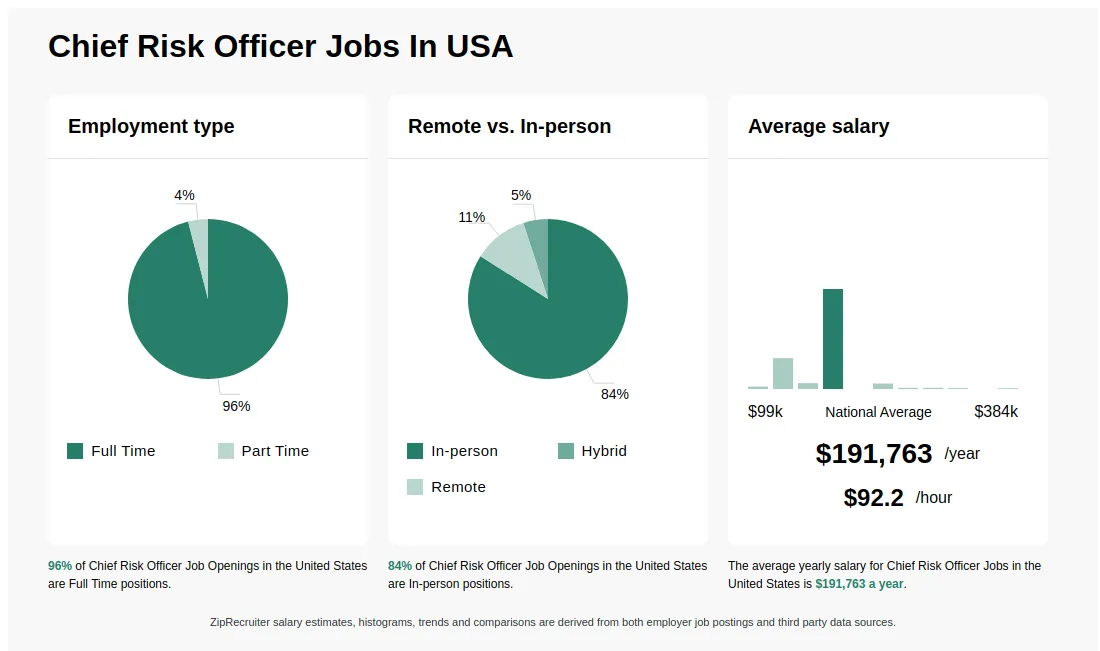
As of Jul 8, 2026, the average yearly pay for chief risk officer in the United States is $191,763.00, according to ZipRecruiter salary data. Most workers in this role earn between $168,500.00 and $190,500.00 per year, depending on experience, location, and employer.

What Is a Chief Risk Officer?

A chief risk officer (CRO) oversees financial risks for a business or other organization. As a CRO, your job duties involve identifying business risks, developing risk management policies, and performing risk assessments of new projects. You usually collaborate with all departments in your organization, as well as stakeholders and board members, to determine suitable levels of financial risk. It is essential to monitor company policies to ensure that all projects meet industry standards and government regulations. Chief risk officers may also be in charge of internal auditing, IT security, and insurance needs.

What is the difference between Chief Risk Officer vs Risk Manager?

AspectChief Risk OfficerRisk Manager
CredentialsTypically requires advanced degrees (MBA, Master’s in Risk Management) and professional certifications (FRM, CRM)Often holds a bachelor’s degree; certifications like CRM or FRM are common but not always required
Work EnvironmentExecutive-level, strategic planning, overseeing entire risk management frameworkOperational role, implementing risk policies, analyzing specific risks
Industry UsageUsed across finance, insurance, corporate sectors at the executive levelFound in various industries, focusing on day-to-day risk assessment and mitigation

The Chief Risk Officer (CRO) is a senior executive responsible for the overall risk management strategy of an organization, requiring advanced credentials and strategic oversight. In contrast, a Risk Manager handles specific risk assessments and mitigation activities, often with less seniority and fewer certifications. Both roles are vital but differ in scope, responsibilities, and level of seniority.

What is a Chief Risk Officer?

A Chief Risk Officer (CRO) is a senior executive responsible for identifying, assessing, and mitigating risks that could impact an organization’s operations or objectives. The CRO oversees risk management strategies, ensures compliance with regulatory requirements, and works closely with other executives to develop policies that protect the company from financial, operational, and reputational harm. This role is especially important in industries such as finance, insurance, and healthcare, where risk management is critical to organizational success.

What are some common challenges a Chief Risk Officer faces in aligning risk management strategies across different departments?

A Chief Risk Officer (CRO) often encounters challenges in ensuring that risk management policies are consistently implemented across departments with varying objectives and risk appetites. Communication gaps, differing priorities, and varying levels of risk awareness can make it difficult to create a unified risk culture. CROs must work closely with department heads to tailor risk strategies that align with business goals while maintaining compliance and minimizing exposure. Building strong relationships and fostering ongoing education are key to overcoming these challenges and promoting effective enterprise-wide risk management.

What are the key skills and qualifications needed to thrive as a Chief Risk Officer, and why are they important?

To thrive as a Chief Risk Officer, you need deep expertise in risk management, financial analysis, regulatory compliance, and typically an advanced degree in finance, law, or business. Familiarity with risk assessment software, governance frameworks (such as COSO or ISO 31000), and relevant certifications like FRM or CRM is highly valued. Strategic thinking, leadership, and strong communication skills enable effective collaboration across executive teams and clear risk reporting. These capabilities are vital for identifying threats, safeguarding organizational assets, and ensuring sound decision-making in a complex regulatory environment.
What cities are hiring for Chief Risk Officer jobs? Cities with the most Chief Risk Officer job openings:
Who are the top companies hiring for Chief Risk Officer jobs? The top employers for Chief Risk Officer jobs are:
What states have the most Chief Risk Officer jobs? States with the most job openings for Chief Risk Officer jobs include:
Infographic showing various Chief Risk Officer job openings in the United States as of July 2026, with employment types broken down into 96% Full Time, and 4% Part Time. Highlights an 83% In-person, and 17% Remote job distribution, with an average salary of $191,763 per year, or $92.2 per hour.

Chief Risk & Regulatory Strategy Officer (Temple)

The Credit Union Connection, LLC.

Temple, TX • On-site

Full-time

This job post has expired today. Applications are no longer accepted.


Job description

The Credit Union Connection, LLC. is looking for a Chief Risk Officer (CRO) to lead their enterprise risk management and compliance efforts. The CRO will act as the primary liaison for state regulatory examinations and advise the CEO and Board on regulatory and legislative developments.

Ideal candidates will have at least 10 years of leadership experience in financial services and a bachelor’s degree. A strong background in risk management and BSA/AML compliance is highly valued. This is a key executive role in promoting a risk-aware culture throughout the organization.

#J-18808-Ljbffr