The Chief Credit Officer (CCO) is responsible for the overall credit quality, risk management, and loan portfolio performance of the Bank including retail and commercial. This position provides ...
The Chief Credit Officer (CCO) is responsible for the overall credit quality, risk management, and loan portfolio performance of the Bank including retail and commercial. This position provides ...

Chief Credit Officer
Valdosta, GA · On-site
Work with Chief Lending Officer to ensure the competency and accountability of lending staff ... Credit * Drug Screen
Chief Credit Officer
Valdosta, GA · On-site
Work with Chief Lending Officer to ensure the competency and accountability of lending staff ... Credit * Drug Screen
SVP, Chief Credit Officer
Manhattan, NY · On-site
$180 - $260/hr
The Chief Credit Officer also partners with the President to prepare agendas and materials for the Internal Loan Committee. The incoming Chief Credit Officer will join LIIF at a moment of significant ...
New
SVP, Chief Credit Officer
Manhattan, NY · On-site
$180 - $260/hr
The Chief Credit Officer also partners with the President to prepare agendas and materials for the Internal Loan Committee. The incoming Chief Credit Officer will join LIIF at a moment of significant ...
New
$180 - $260/hr
The Chief Credit Officer also partners with the President to prepare agendas and materials for the Internal Loan Committee. The incoming Chief Credit Officer will join LIIF at a moment of significant ...
New
$180 - $260/hr
The Chief Credit Officer also partners with the President to prepare agendas and materials for the Internal Loan Committee. The incoming Chief Credit Officer will join LIIF at a moment of significant ...
New
2605-3 Credit Admin Officer
Chattanooga, TN · On-site
$60 - $80/hr
Goals and Objectives * Assist Credit Department and Chief Credit Officer with maintaining asset quality standards of Tower Community Bank. * Maintain relationship between lenders and credit ...
New
2605-3 Credit Admin Officer
Chattanooga, TN · On-site
$60 - $80/hr
Goals and Objectives * Assist Credit Department and Chief Credit Officer with maintaining asset quality standards of Tower Community Bank. * Maintain relationship between lenders and credit ...
New

SVP, Chief Credit Officer
Manhattan, NY · On-site
$300 - $420/hr
The Chief Credit Officer also partners with the President to prepare agendas and materials for the Internal Loan Committee. The incoming Chief Credit Officer will join LIIF at a moment of significant ...
SVP, Chief Credit Officer
Manhattan, NY · On-site
$300 - $420/hr
The Chief Credit Officer also partners with the President to prepare agendas and materials for the Internal Loan Committee. The incoming Chief Credit Officer will join LIIF at a moment of significant ...
Chief Credit Officer
Valdosta, GA · On-site
Work with Chief Lending Officer to ensure the competency and accountability of lending staff ... Credit * Drug Screen
Chief Credit Officer
Valdosta, GA · On-site
Work with Chief Lending Officer to ensure the competency and accountability of lending staff ... Credit * Drug Screen

Chief Credit Officer
Irvine, CA · On-site +1
$300K - $375K/yr
The Chief Credit Officer (CCO) is a vital executive leader responsible for overseeing the organization's credit operations while ensuring alignment with business goals and regulatory compliance. This ...
Quick apply
Chief Credit Officer
Irvine, CA · On-site +1
$300K - $375K/yr
The Chief Credit Officer (CCO) is a vital executive leader responsible for overseeing the organization's credit operations while ensuring alignment with business goals and regulatory compliance. This ...

Chief Credit Officer
Washington, DC · Hybrid
$160K - $200K/yr
Reporting to the CEO and serving on the senior leadership team, the CCO owns CFE's credit policies, underwriting standards, approval processes, risk-rating discipline, and reporting on loan portfolio ...
Chief Credit Officer
Washington, DC · Hybrid
$160K - $200K/yr
Reporting to the CEO and serving on the senior leadership team, the CCO owns CFE's credit policies, underwriting standards, approval processes, risk-rating discipline, and reporting on loan portfolio ...
Chief Credit Officer
Washington, DC · On-site
$160K - $200K/yr
Reporting to the CEO and serving on the senior leadership team, the CCO owns CFE's credit policies, underwriting standards, approval processes, risk-rating discipline, and reporting on loan portfolio ...
Chief Credit Officer
Washington, DC · On-site
$160K - $200K/yr
Reporting to the CEO and serving on the senior leadership team, the CCO owns CFE's credit policies, underwriting standards, approval processes, risk-rating discipline, and reporting on loan portfolio ...

AVP/Senior Credit Officer
Olney, IL · On-site
$115K - $125K/yr
CREDIT REPORTS TO: VP/CHIEF CREDIT OFFICER FLSA STATUS: EXEMPT TYPE OF POSITION: FULL-TIME JOB SUMMARY The Senior Credit Officer serves as a key leader within the Credit Department and is a strategic ...
Quick apply
AVP/Senior Credit Officer
Olney, IL · On-site
$115K - $125K/yr
CREDIT REPORTS TO: VP/CHIEF CREDIT OFFICER FLSA STATUS: EXEMPT TYPE OF POSITION: FULL-TIME JOB SUMMARY The Senior Credit Officer serves as a key leader within the Credit Department and is a strategic ...
SVP, Chief Credit Officer
Manhattan, NY · On-site
The Senior Vice President, Chief Credit Officer (CCO) is responsible for overseeing all credit and portfolio risk management functions for LIIF's national lending platform. Reporting to the President ...
Quick apply
SVP, Chief Credit Officer
Manhattan, NY · On-site
The Senior Vice President, Chief Credit Officer (CCO) is responsible for overseeing all credit and portfolio risk management functions for LIIF's national lending platform. Reporting to the President ...
Chief Credit Officer
Toms River, NJ · On-site
$150 - $200/hr
Position Overview A growing financial services organization is seeking a Chief Credit Officer to lead underwriting, credit risk, and portfolio management functions. This executive-level role will be ...
Chief Credit Officer
Toms River, NJ · On-site
$150 - $200/hr
Position Overview A growing financial services organization is seeking a Chief Credit Officer to lead underwriting, credit risk, and portfolio management functions. This executive-level role will be ...
The Chief Credit Officer also partners with the President to prepare agendas and materials for the Internal Loan Committee. The incoming Chief Credit Officer will join LIIF at a moment of significant ...
The Chief Credit Officer also partners with the President to prepare agendas and materials for the Internal Loan Committee. The incoming Chief Credit Officer will join LIIF at a moment of significant ...
AVP/Senior Credit Officer
Olney, IL · On-site
$115K - $125K/yr
CREDIT REPORTS TO: VP/CHIEF CREDIT OFFICER FLSA STATUS: EXEMPT TYPE OF POSITION: FULL-TIME JOB SUMMARY The Senior Credit Officer serves as a key leader within the Credit Department and is a strategic ...
AVP/Senior Credit Officer
Olney, IL · On-site
$115K - $125K/yr
CREDIT REPORTS TO: VP/CHIEF CREDIT OFFICER FLSA STATUS: EXEMPT TYPE OF POSITION: FULL-TIME JOB SUMMARY The Senior Credit Officer serves as a key leader within the Credit Department and is a strategic ...

Join to apply for the Deputy Chief Credit Officer role at Metropolitan Commercial Bank Join to apply for the Deputy Chief Credit Officer role at Metropolitan Commercial Bank Get AI-powered advice on ...
Join to apply for the Deputy Chief Credit Officer role at Metropolitan Commercial Bank Join to apply for the Deputy Chief Credit Officer role at Metropolitan Commercial Bank Get AI-powered advice on ...
Deputy Chief Credit Officer (New York)
Manhattan, NY · On-site
$275K - $300K/yr
Reporting to the Chief Credit Officer, this individual ensures sound credit practices, supports strategic business growth within acceptable risk limits, and maintains a high-quality credit portfolio.
Deputy Chief Credit Officer (New York)
Manhattan, NY · On-site
$275K - $300K/yr
Reporting to the Chief Credit Officer, this individual ensures sound credit practices, supports strategic business growth within acceptable risk limits, and maintains a high-quality credit portfolio.
AVP/Senior Credit Officer
Olney, IL · On-site
$115K - $125K/yr
CREDIT REPORTS TO: VP/CHIEF CREDIT OFFICER FLSA STATUS: EXEMPT TYPE OF POSITION: FULL-TIME JOB SUMMARY The Senior Credit Officer serves as a key leader within the Credit Department and is a strategic ...
AVP/Senior Credit Officer
Olney, IL · On-site
$115K - $125K/yr
CREDIT REPORTS TO: VP/CHIEF CREDIT OFFICER FLSA STATUS: EXEMPT TYPE OF POSITION: FULL-TIME JOB SUMMARY The Senior Credit Officer serves as a key leader within the Credit Department and is a strategic ...

The Chief Credit Officer is responsible for maintaining the overall quality of the loan portfolio, ensuring compliance with regulatory expectations, strengthening credit risk management practices ...
New
The Chief Credit Officer is responsible for maintaining the overall quality of the loan portfolio, ensuring compliance with regulatory expectations, strengthening credit risk management practices ...
New

Chief Credit Officer - Job # 3413
Bridgeport, CT · On-site
$175K/yr
Chief Credit Officer - To $175K - Bridgeport, CT - Job # 3413 Who We Are: The Symicor Group is a boutique talent acquisition firm based in Lincolnshire, IL & Rockport, TX. Our nationally unique value ...
Quick apply
Chief Credit Officer - Job # 3413
Bridgeport, CT · On-site
$175K/yr
Chief Credit Officer - To $175K - Bridgeport, CT - Job # 3413 Who We Are: The Symicor Group is a boutique talent acquisition firm based in Lincolnshire, IL & Rockport, TX. Our nationally unique value ...
Chief Credit Officer information
See salary details
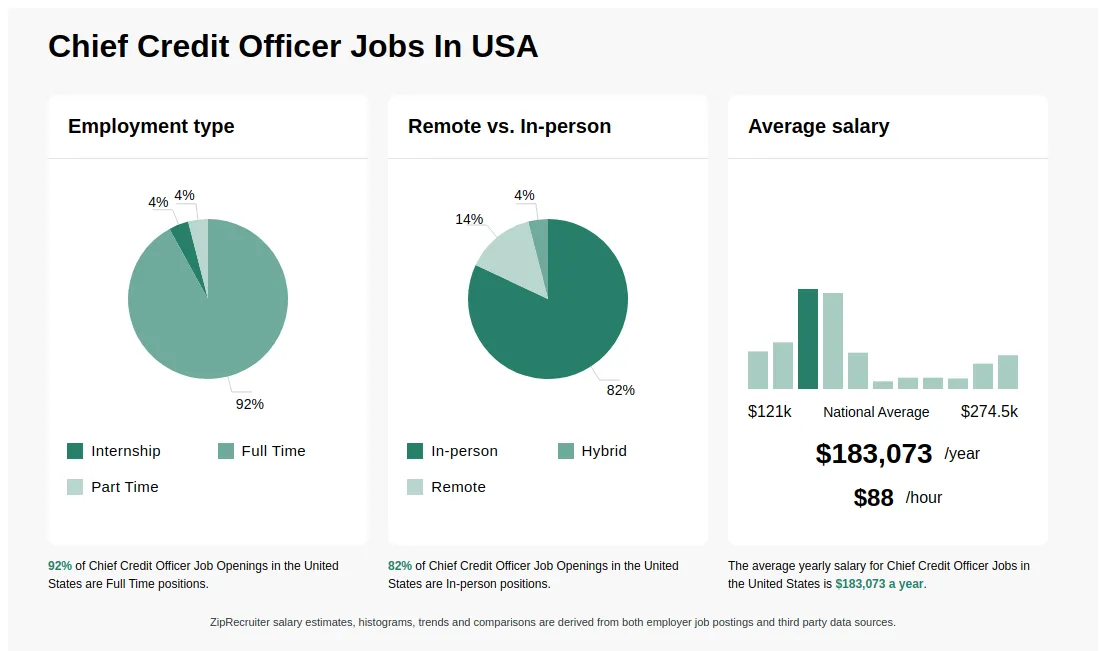
$121K - $135K
9% of jobs
$135K - $148.9K
12% of jobs
$151.2K is the 25th percentile. Wages below this are outliers.
$148.9K - $162.9K
24% of jobs
The median wage is $165.6K / yr.
$162.9K - $176.8K
24% of jobs
$186K is the 75th percentile. Wages above this are outliers.
$176.8K - $190.8K
8% of jobs
$190.8K - $204.7K
1% of jobs
$204.7K - $218.7K
2% of jobs
$218.7K - $232.6K
2% of jobs
$232.6K - $246.6K
2% of jobs
$246.6K - $260.5K
6% of jobs
$260.5K - $274.5K
8% of jobs
$121K
$183.1K
$274.5K
How much do chief credit officer jobs pay per year?
As of Sep 4, 2026, the average yearly pay for chief credit officer in the United States is $183,073.00, according to ZipRecruiter salary data. Most workers in this role earn between $150,000.00 and $210,000.00 per year, depending on experience, location, and employer.
What does a Chief Credit Officer do?
A Chief Credit Officer (CCO) is a senior executive responsible for overseeing an organization's credit risk management strategies and policies. They ensure that the company’s credit portfolio aligns with business objectives while minimizing risk exposure. The CCO leads teams that evaluate, approve, and monitor loans or credit lines, and develops procedures to assess borrower creditworthiness. They also work closely with other executives to set credit limits and ensure regulatory compliance. Their role is crucial in maintaining the financial health and stability of the organization.
What does a Chief Credit Officer do?
The Chief Credit Officer (CCO) is the person responsible for managing the risk associated with the distribution of bank loans. The CCO’s responsibilities include overseeing collections and loan procedures, and processing mitigation of the risks surrounding a loan portfolio. The CCO will work with management to ensure all internal documentation is in compliance with government regulations. They are also responsible for all the decisions of the lending department of a bank or lending institution. Employers typically require a bachelor’s degree plus 8-10 years of experience in lending, loan review, and compliance. Skills in financial management, problem-solving, and communication help secure the best jobs.
What are the key skills and qualifications needed to thrive as a Chief Credit Officer, and why are they important?
To thrive as a Chief Credit Officer, you need a deep understanding of credit risk management, financial analysis, and lending regulations, usually backed by a degree in finance or a related field and significant experience in credit operations. Familiarity with credit scoring models, risk assessment software, and regulatory compliance tools is typically required, and certifications such as CFA or FRM can be advantageous. Strong leadership, strategic decision-making, and excellent communication skills are essential for guiding teams and influencing organizational credit policy. These competencies are crucial to effectively manage credit risk, support business objectives, and ensure regulatory compliance across the organization.
What are some of the common challenges a Chief Credit Officer faces when balancing risk management and business growth objectives?
A Chief Credit Officer often encounters the challenge of maintaining a healthy balance between minimizing credit risk and supporting the organization’s growth initiatives. This involves setting robust credit policies that protect the company while still enabling sales teams to pursue new business opportunities. Navigating changing market conditions, regulatory requirements, and evolving customer profiles requires strategic judgment and effective collaboration with other departments such as risk, compliance, and business development. Regular communication with executive leadership is key to aligning credit strategies with overall business goals.
What is the difference between Chief Credit Officer vs Credit Analyst?
| Aspect | Chief Credit Officer | Credit Analyst |
|---|---|---|
| Credentials | Typically requires a bachelor’s degree in finance, accounting, or related field; often advanced certifications like CFA or CPA | Usually holds a bachelor’s degree in finance, economics, or related field; certifications like CFA can be advantageous |
| Work Environment | Executive-level setting, overseeing credit policies and risk management across the organization | Analytical setting, assessing individual credit applications and financial data |
| Industry Usage | Commonly found in banking, financial services, and large corporations | Widely used in banking, lending institutions, and credit departments |
The Chief Credit Officer focuses on strategic credit risk management at an organizational level, while the Credit Analyst evaluates individual creditworthiness. Both roles require financial expertise, but differ in scope and responsibility.
More about Chief Credit Officer jobs
What cities are hiring for Chief Credit Officer jobs?
Cities with the most Chief Credit Officer job openings:
What are the most commonly searched types of Chief Credit Officer jobs?
The most popular types of Chief Credit Officer jobs are:
Who are the top companies hiring for Chief Credit Officer jobs?
The top employers for Chief Credit Officer jobs are:
What states have the most Chief Credit Officer jobs?
States with the most job openings for Chief Credit Officer jobs include:
What job categories do people searching Chief Credit Officer jobs look for?
The top searched job categories for Chief Credit Officer jobs are:
What are popular job titles related to Chief Credit Officer jobs?
For Chief Credit Officer jobs, the most frequently searched job titles are:
Full-time
Posted 17 days ago
Job description
Description
#J-18808-LjbffrSummary: The Chief Credit Officer (CCO) is responsible for the overall credit quality, risk management, and loan portfolio performance of the Bank including retail and commercial. This position provides strategic leadership and oversight of all credit-related functions, ensuring safe and sound lending practices, regulatory compliance, and alignment with the Bank’s risk appetite. The CCO partners with executive management and the Board of Directors to support sustainable loan growth while maintaining strong asset quality.
Key Responsibilities- Responsible for the overall credit risk and overseeing the entire credit function of the Bank. This includes both retail and commercial lending.
- Leads the development and ongoing refinement of loan policies and procedures to ensure regulatory compliance and alignment with industry best practices.
- Ensures credit processes are efficient, scalable, and responsive to support timely decision-making in a competitive market.
- Provides strategic oversight of the loan portfolio, including performance, trends, concentrations, risk grading, exceptions, and overall credit quality.
- Oversees portfolio analytics and reporting, delivering clear and actionable insights to executive management and the Board of Directors on a regular basis.
- Ensures underwriting standards, appraisal requirements, and other credit administration practices align with regulatory requirements in partnership with the Chief Compliance Officer.
- Directs the Bank’s independent loan review process and ensures timely identification and response to emerging credit risks.
- Provides leadership in problem loan identification and resolution, including oversight of workout strategies to minimize risk and loss.
- Chairs or oversees asset quality meetings to evaluate portfolio health and drive strategies to reduce criticized and classified assets.
- Collaborates with commercial lending, credit, wealth, and treasury teams to support sound, profitable loan growth consistent with the Bank’s risk appetite.
- Reviews and recommends credit relationships and loan requests before presenting loans to the loan committee. Serves as Chair of Loan Committee.
- Serves as the primary credit liaison with regulators, auditors, and external reviewers. This also includes examinations and audits.
- Monitors economic, industry, and market conditions to assess potential impacts on the loan portfolio and credit strategy.
- Other tasks as assigned.
- Commercial Credit Manager
- Loan Portfolio Manager
- Commercial Processor Supervisor
- Mortgage Underwriting Supervisor
Strong knowledge of credit risk management, underwriting, and regulatory expectations. Strong leadership skills and the ability to develop people within the department. Excellent organizational, written, and oral communication skills. Highly effective people skills with individuals at all levels, and the ability to work in a team environment. Strong decision making, problem solving, and negotiation skills. Technologically proficient with various business software suites and Microsoft Office Suite.
Education And/or ExperienceBachelor’s degree in business administration, Finance, Accounting, or equivalent experience. Completion of master’s level business degree and/or degree from the Graduate School of Banking preferred. Ten to fifteen years of cumulative credit analysis, commercial lending, and management experience required. Experience as a Senior Credit or Chief Credit Officer preferred.
Certificates, Licenses, RegistrationsProfessional certifications preferred but not required.
Work EnvironmentGeneral office working conditions exist. Employee may experience sustained moderate/high periods of activity with multiple tasks being performed. They may experience communication with a variety of internal and external sources under favorable and unfavorable conditions. Noise level in the work environment is usually minimal. Occasional travel to various branches, travel to current and prospective customer meetings, seminars/training, as well as other bank related meetings and events.