
In parallel, the individual will build and lead an integrated Biometrics function by providing strategic oversight and line management of Clinical Data Management while partnering closely with ...
In parallel, the individual will build and lead an integrated Biometrics function by providing strategic oversight and line management of Clinical Data Management while partnering closely with ...

Biometrics I2 Analyst
$67K - $70K/yr
Analyzes friendly and adversary biometric systems to understand their capabilities, vulnerabilities, and to inform the U.S. Defense Acquisition Community. Supports the production and coordination of ...
Biometrics I2 Analyst
$67K - $70K/yr
Analyzes friendly and adversary biometric systems to understand their capabilities, vulnerabilities, and to inform the U.S. Defense Acquisition Community. Supports the production and coordination of ...

Senior Biometrics Engineer
$105K - $145K/yr
Join a dynamic, fast-paced MITRE team in supporting the sponsor to develop biometric related applications and support research activities. Key Functions: In this role, you will apply your software ...
Senior Biometrics Engineer
$105K - $145K/yr
Join a dynamic, fast-paced MITRE team in supporting the sponsor to develop biometric related applications and support research activities. Key Functions: In this role, you will apply your software ...
Biometrics I2 Analyst
Quantico, VA · On-site
$67K - $70K/yr
Analyzes friendly and adversary biometric systems to understand their capabilities, vulnerabilities, and to inform the U.S. Defense Acquisition Community. Supports the production and coordination of ...
Biometrics I2 Analyst
Quantico, VA · On-site
$67K - $70K/yr
Analyzes friendly and adversary biometric systems to understand their capabilities, vulnerabilities, and to inform the U.S. Defense Acquisition Community. Supports the production and coordination of ...

Head of Biometrics
$310K - $395K/yr
In your role as Head of Biometrics , you will be responsible for leading all biostatistics and statistical programming activities across Treeline's clinical and translational development programs.
Head of Biometrics
$310K - $395K/yr
In your role as Head of Biometrics , you will be responsible for leading all biostatistics and statistical programming activities across Treeline's clinical and translational development programs.

Principal Biometrics Software Engineer
$131K - $237K/yr
Biometric Integration: Design and implement software modules to integrate various biometric modalities (facial recognition, fingerprint, iris scan) with existing applications and systems using ...
New
Principal Biometrics Software Engineer
$131K - $237K/yr
Biometric Integration: Design and implement software modules to integrate various biometric modalities (facial recognition, fingerprint, iris scan) with existing applications and systems using ...
New
Biometrics Software Engineer (SME)
$154K - $278K/yr
Biometric Integration: Design and implement software modules to integrate various biometric modalities (facial recognition, fingerprint, iris scan) with existing applications and systems using ...
New
Biometrics Software Engineer (SME)
$154K - $278K/yr
Biometric Integration: Design and implement software modules to integrate various biometric modalities (facial recognition, fingerprint, iris scan) with existing applications and systems using ...
New
Head of Biometrics
Watertown, MA · On-site
$310K - $395K/yr
In your role as Head of Biometrics , you will be responsible for leading all biostatistics and statistical programming activities across Treeline's clinical and translational development programs.
Head of Biometrics
Watertown, MA · On-site
$310K - $395K/yr
In your role as Head of Biometrics , you will be responsible for leading all biostatistics and statistical programming activities across Treeline's clinical and translational development programs.

Biometrics Intelligence Analyst, Advisor
Mclean, VA · On-site
$104K - $166K/yr
The Biometric Intelligence Analyst must be comfortable fusing disparate information into concise products for use throughout the U.S. Government. * The Biometric Intelligence Analyst will be ...
Biometrics Intelligence Analyst, Advisor
Mclean, VA · On-site
$104K - $166K/yr
The Biometric Intelligence Analyst must be comfortable fusing disparate information into concise products for use throughout the U.S. Government. * The Biometric Intelligence Analyst will be ...
Biometrics Intelligence Analyst, Advisor
Mclean, VA · On-site
$104K - $166K/yr
The Biometric Intelligence Analyst must be comfortable fusing disparate information into concise products for use throughout the U.S. Government. * The Biometric Intelligence Analyst will be ...
Biometrics Intelligence Analyst, Advisor
Mclean, VA · On-site
$104K - $166K/yr
The Biometric Intelligence Analyst must be comfortable fusing disparate information into concise products for use throughout the U.S. Government. * The Biometric Intelligence Analyst will be ...

Amentum has a new and exciting opportunity for a Biometrics Intelligence Analyst in our Intelligence and Cyber Group in McLean, VA. This contract provides and sustains counterterrorism awareness for ...
Amentum has a new and exciting opportunity for a Biometrics Intelligence Analyst in our Intelligence and Cyber Group in McLean, VA. This contract provides and sustains counterterrorism awareness for ...
Biometrics Intelligence Analyst, Advisor
Mclean, VA · On-site
$104K - $166K/yr
The Biometric Intelligence Analyst must be comfortable fusing disparate information into concise products for use throughout the U.S. Government. * The Biometric Intelligence Analyst will be ...
Biometrics Intelligence Analyst, Advisor
Mclean, VA · On-site
$104K - $166K/yr
The Biometric Intelligence Analyst must be comfortable fusing disparate information into concise products for use throughout the U.S. Government. * The Biometric Intelligence Analyst will be ...

Reporting to the Chief Medical Officer, the SVP Biometrics will be accountable for biometrics activities for all programs from IND-enabling to registration and launch. This includes leadership of the ...
Reporting to the Chief Medical Officer, the SVP Biometrics will be accountable for biometrics activities for all programs from IND-enabling to registration and launch. This includes leadership of the ...
SVP Biometrics
San Diego, CA · On-site +1
Reporting to the Chief Medical Officer, the SVP Biometrics will be accountable for biometrics activities for all programs from IND-enabling to registration and launch. This includes leadership of the ...
SVP Biometrics
San Diego, CA · On-site +1
Reporting to the Chief Medical Officer, the SVP Biometrics will be accountable for biometrics activities for all programs from IND-enabling to registration and launch. This includes leadership of the ...

Amentum has a new and exciting opportunity for a Biometrics Intelligence Analyst in our Intelligence and Cyber Group in McLean, VA. This contract provides and sustains counterterrorism awareness for ...
Amentum has a new and exciting opportunity for a Biometrics Intelligence Analyst in our Intelligence and Cyber Group in McLean, VA. This contract provides and sustains counterterrorism awareness for ...
Reporting to the Chief Medical Officer, the SVP Biometrics will be accountable for biometrics activities for all programs from IND-enabling to registration and launch. This includes leadership of the ...
Quick apply
Reporting to the Chief Medical Officer, the SVP Biometrics will be accountable for biometrics activities for all programs from IND-enabling to registration and launch. This includes leadership of the ...

Serves as the team leader by overseeing the biometrics project team. Facilitates team building and communication. Acts as a liaison and facilitator between other departments within the Company for ...
Serves as the team leader by overseeing the biometrics project team. Facilitates team building and communication. Acts as a liaison and facilitator between other departments within the Company for ...
SVP Biometrics
San Francisco, CA · On-site
Reporting to the Chief Medical Officer, the SVP Biometrics will be accountable for biometrics activities for all programs from IND-enabling to registration and launch. This includes leadership of the ...
Quick apply
SVP Biometrics
San Francisco, CA · On-site
Reporting to the Chief Medical Officer, the SVP Biometrics will be accountable for biometrics activities for all programs from IND-enabling to registration and launch. This includes leadership of the ...

The Director, Business Systems - Biometrics, will partner with Biometrics colleagues (Biostatistics, Statistical Programming, and Data Management), and technical teams to define requirements and ...
The Director, Business Systems - Biometrics, will partner with Biometrics colleagues (Biostatistics, Statistical Programming, and Data Management), and technical teams to define requirements and ...
Biometrics Technician with Security Clearance
Spokane, WA · On-site
$35 - $41/hr
The candidate will conduct biometric collection and analysis in support of the customer's mission area. The individual will perform the day-to-day operation of a complex computer-based biometric and ...
Biometrics Technician with Security Clearance
Spokane, WA · On-site
$35 - $41/hr
The candidate will conduct biometric collection and analysis in support of the customer's mission area. The individual will perform the day-to-day operation of a complex computer-based biometric and ...
Biometrics information
See salary details
$16.35 - $23.03
8% of jobs
$23.03 - $29.72
0% of jobs
$33.41 is the 25th percentile. Wages below this are outliers.
$29.72 - $36.41
30% of jobs
The median wage is $41.66 / hr.
$36.41 - $43.09
15% of jobs
$43.09 - $49.78
8% of jobs
$49.78 - $56.47
1% of jobs
$56.47 - $63.16
0% of jobs
$63.16 - $69.84
8% of jobs
$69.84 - $76.53
1% of jobs
$78.76 is the 75th percentile. Wages above this are outliers.
$76.53 - $83.22
9% of jobs
$83.22 - $89.90
19% of jobs
$16
$54
$89
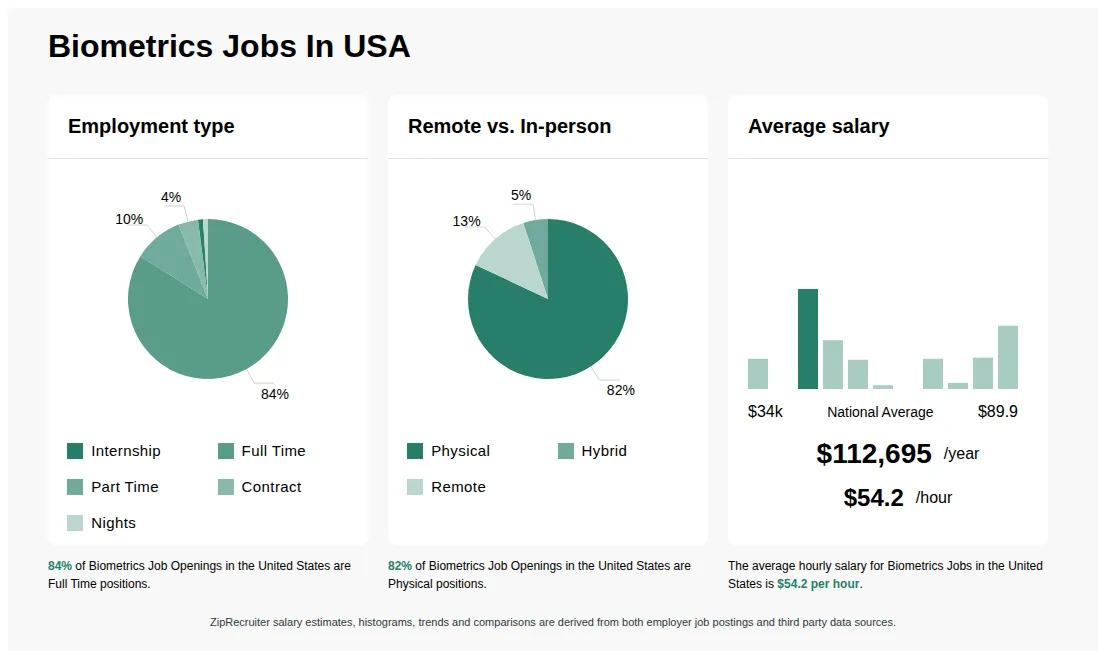
How much do biometrics jobs pay per hour?
As of Jul 18, 2026, the average hourly pay for biometrics in the United States is $54.18, according to ZipRecruiter salary data. Most workers in this role earn between $34.38 and $81.49 per hour, depending on experience, location, and employer.
What is a Biometrics job?
A biometrics job involves working with technologies that measure and analyze biological data, such as fingerprints, facial recognition, iris scans, and voice recognition. Professionals in this field develop, implement, and maintain biometric systems used in security, healthcare, law enforcement, and identity verification. Their responsibilities often include data analysis, algorithm development, system testing, and ensuring compliance with privacy regulations. Biometrics specialists may work for government agencies, private companies, or research institutions.
What is a biometric job?
A biometric job involves working with biometric systems that identify or verify individuals based on physical or behavioral traits, such as fingerprints, facial recognition, or iris scans. These roles often require knowledge of security protocols, biometric technologies, and data privacy regulations, and may involve tasks like system development, maintenance, or analysis.
What are the key skills and qualifications needed to thrive in the Biometrics position, and why are they important?
To thrive in a Biometrics role, you need expertise in statistics, data analysis, computer programming (such as Python or R), and a relevant degree in biometrics, statistics, mathematics, or a related field. Familiarity with biometric data collection technologies, statistical software (like SAS or SPSS), and data management systems is often required, and professional certifications in biometrics or data analysis may be advantageous. Strong problem-solving skills, attention to detail, and clear communication are crucial soft skills for excelling in this position. These skills ensure accurate analysis and interpretation of biometric data, which are vital for research integrity and decision-making in industries like healthcare, security, and technology.
What kinds of jobs need to run fingerprinting?
Biometrics professionals and security personnel often run fingerprinting as part of background checks, identity verification, or access control processes. These jobs include law enforcement, security screening, biometric technicians, and certain healthcare or government roles that require fingerprint-based identification or clearance. Familiarity with fingerprinting techniques and relevant certifications are typically required for these positions.
What are some typical projects or responsibilities for someone working in biometrics?
Professionals in biometrics often work on projects such as designing and analyzing clinical trials, developing algorithms for identity verification, or managing large datasets of biological or behavioral information. Daily responsibilities can include collecting and validating data, applying statistical methods to interpret results, preparing technical reports, and collaborating with cross-disciplinary teams such as engineers, IT specialists, or healthcare professionals. You may be involved in implementing new biometric technologies or improving the accuracy and reliability of existing systems. These tasks require a combination of technical expertise and teamwork skills, making the role both challenging and dynamic.
What jobs pay 4000 a week without a degree?
Biometrics-related roles that can pay around $4,000 weekly without a degree typically include specialized positions such as biometric technicians, security system installers, or freelance biometric consultants, often requiring technical skills, certifications, or experience. High-paying opportunities may also be found in sales or consulting roles within the biometric industry, especially for those with expertise and a strong professional network.
How to become a biometric?
To become a biometric professional, typically a background in fields like computer science, engineering, or cybersecurity is required. Gaining skills in biometric technologies such as fingerprint, facial recognition, or iris scanning, along with relevant certifications or training, can improve job prospects. Entry-level roles often require a bachelor's degree and familiarity with biometric tools and security protocols.
More about Biometrics jobs
What cities are hiring for Biometrics jobs? Cities with the most Biometrics job openings:
What are the most commonly searched types of Biometrics jobs? The most popular types of Biometrics jobs are:
What states have the most Biometrics jobs? States with the most job openings for Biometrics jobs include:
What job categories do people searching Biometrics jobs look for? The top searched job categories for Biometrics jobs are:
Job description
Reports To: VP of Clinical Development
Position Summary
Prime Medicine is seeking an experienced Senior Director, Biometrics to serve as the senior biostatistics leader for the organization while providing strategic and operational leadership for the broader Biometrics function, including Clinical Data Management, in support of our gene editing clinical programs.
This individual will provide statistical expertise across Prime's clinical portfolio, including input on study design, protocol development, dose-escalation strategy, interim analyses, regulatory interactions, and submission planning. In parallel, the individual will build and lead an integrated Biometrics function by providing strategic oversight and line management of Clinical Data Management while partnering closely with Clinical Development, Clinical Operations, Regulatory Affairs, Medical Writing, Translational Medicine and other functions.
This role requires both strategic vision and hands-on oversight, particularly in a lean, fast-moving biotech environment. Although responsible for the broader Biometrics function, this position is first and foremost a senior biostatistics leadership role requiring deep expertise in clinical trial design, statistical methodology, regulatory interactions, and quantitative decision-making across clinical development. This is a high visibility role with significant influence on clinical development decisions.
Key Responsibilities
Biometrics Strategy & Leadership
- Provide overall biometrics leadership across Prime Medicine's clinical programs, spanning:
- Biostatistics
- Data Management
- Statistical programming (via vendors)
- Define and implement biometrics strategies appropriate for early- and mid-stage gene therapy development, including:
- Study design and statistical approaches
- Endpoint selection and estimands
- Data standards and quality frameworks
- Serve as the primary biometrics representative on cross-functional program and study teams.
Lead Biostatistician Responsibilities
Function as the lead statistician across Prime's clinical development portfolio, providing scientific and strategic statistical leadership from protocol concept through regulatory submission.
- Provide strategic input into:
- Clinical trial design
- Sample size and power considerations
- Randomization and statistical analysis plans (SAPs)
- As needed, data extraction and compilation for publications and external presentation activities
- Review, approve, and oversee key statistical deliverables, including:
- SAPs
- Interim and final analyses, including supporting SRC and DMC outputs
- Clinical Study Reports (statistical sections)
- Support regulatory interactions by contributing to:
- IND/CTA submissions
- Health authority briefing packages
- Responses to regulatory questions related to study design and analyses
Data Management Oversight
Provide strategic leadership and line management for the Clinical Data Management function, ensuring close integration between data management and statistical activities.
- Oversee data management strategy and execution, including:
- CRF design and database build
- Data cleaning, validation, and lock
- Data standards (e.g., CDISC/SDTM/ADaM expectations)
- Ensure data quality, integrity, and inspection readiness across all clinical programs.
- Provide input into protocol development and study start-up activities to ensure efficient data collection
- Partner with Clinical Operations and vendors to proactively identify and resolve data-related risks.
Vendor Management & Operational Execution
- Lead vendor selection, onboarding, and governance for biometrics-related CROs and service providers.
- Provide active oversight of vendor performance, timelines, quality, and budgets.
- Ensure clear scopes of work, deliverable expectations, and communication pathways.
- Act as the escalation point for biometrics-related issues and drive timely resolution.
- Ensure biometrics deliverables are aligned with clinical, regulatory, and program objectives.
- Contribute to inspection readiness activities and support audits as needed.
Function Building & Future Growth
- Establish scalable biometrics SOPs/processes, standards, and best practices appropriate for a growing organization.
- Contribute to longer-term planning for internal capability development, including future team growth as the pipeline expands.
- Mentor and guide internal team members or matrixed contributors as applicable.
Qualifications
Required
- Advanced degree in Statistics, Biostatistics, Mathematics, or a related quantitative field.
- 10+ years of experience in biometrics (biostatistics and/or data management) within biotech or pharmaceutical development.
- Demonstrated experience supporting clinical development programs, including regulatory submissions, ideally with experience supporting early-phase (FIH) through later stage programs.
- Experience serving as the lead statistician for clinical studies and regulatory submissions.
- Strong understanding of clinical trial design, statistical principles, and data management practices especially in rare disease and/or gene and cell therapies.
- Proven experience leading biometrics through CRO/vendor models.
- Deep familiarity with regulatory expectations (FDA, EMA, ICH) related to biometrics.
- Experience leading or managing Clinical Data Management is strongly preferred but is not required.
- Excellent leadership, communication, and cross-functional collaboration skills.

About Prime Medicine
Sourced by ZipRecruiter
Industry
Biotechnology research and development
Company size
51 - 200 Employees
Headquarters location
Cambridge, MA, US
Year founded
2019