... Biomedical Engineering preventative maintenance program About Us Texas Children's presence in Austin helps support a pediatric population of more than half a million and keeps kids healthy and happy ...
... Biomedical Engineering preventative maintenance program About Us Texas Children's presence in Austin helps support a pediatric population of more than half a million and keeps kids healthy and happy ...

The Dialysis Biomedical Engineer Technician position is for our Friendswood Clinic, located at 3324 FM 528 Rd, Friendswood, TX 77546, and our Space City Clinic, located at 3402 Burke Rd Ste 100 ...
The Dialysis Biomedical Engineer Technician position is for our Friendswood Clinic, located at 3324 FM 528 Rd, Friendswood, TX 77546, and our Space City Clinic, located at 3402 Burke Rd Ste 100 ...
Responsibilities The Dialysis Biomedical Engineer Technician position is for our Friendswood Clinic, located at 3324 FM 528 Rd, Friendswood, TX 77546, and our Space City Clinic, located at 3402 Burke ...
Responsibilities The Dialysis Biomedical Engineer Technician position is for our Friendswood Clinic, located at 3324 FM 528 Rd, Friendswood, TX 77546, and our Space City Clinic, located at 3402 Burke ...

Description The Department of Biomedical Engineering is dedicated to developing solutions for human health by educating the next generation of biomedical engineers, cultivating leaders, and nurturing ...
Description The Department of Biomedical Engineering is dedicated to developing solutions for human health by educating the next generation of biomedical engineers, cultivating leaders, and nurturing ...
Description The Department of Biomedical Engineering is dedicated to developing solutions for human health by educating the next generation of biomedical engineers, cultivating leaders, and nurturing ...
Description The Department of Biomedical Engineering is dedicated to developing solutions for human health by educating the next generation of biomedical engineers, cultivating leaders, and nurturing ...
Description The Department of Biomedical Engineering is dedicated to developing solutions for human health by educating the next generation of biomedical engineers, cultivating leaders, and nurturing ...
Description The Department of Biomedical Engineering is dedicated to developing solutions for human health by educating the next generation of biomedical engineers, cultivating leaders, and nurturing ...
Description The Department of Biomedical Engineering is dedicated to developing solutions for human health by educating the next generation of biomedical engineers, cultivating leaders, and nurturing ...
Description The Department of Biomedical Engineering is dedicated to developing solutions for human health by educating the next generation of biomedical engineers, cultivating leaders, and nurturing ...

At Houston Methodist, the Biomedical Clinical Engineer position is responsible for assuring the safe and effective use of medical equipment in the hospital by applying and implementing medical ...
At Houston Methodist, the Biomedical Clinical Engineer position is responsible for assuring the safe and effective use of medical equipment in the hospital by applying and implementing medical ...
Biomed Clinical Engineer
Houston, TX · On-site
At Houston Methodist, the Biomedical Clinical Engineer position is responsible for assuring the safe and effective use of medical equipment in the hospital by applying and implementing medical ...
Biomed Clinical Engineer
Houston, TX · On-site
At Houston Methodist, the Biomedical Clinical Engineer position is responsible for assuring the safe and effective use of medical equipment in the hospital by applying and implementing medical ...
Biomed Clinical Engineer
Houston, TX · On-site
At Houston Methodist, the Biomedical Clinical Engineer position is responsible for assuring the safe and effective use of medical equipment in the hospital by applying and implementing medical ...
Biomed Clinical Engineer
Houston, TX · On-site
At Houston Methodist, the Biomedical Clinical Engineer position is responsible for assuring the safe and effective use of medical equipment in the hospital by applying and implementing medical ...

Sr Biomedical Equipment Technician
Houston, TX · On-site
$37.40 - $55.63/hr
Associates Other in Electrical Engineering, Biomedical or Mechanical Engineering or related field, or equivalent military education, graduate of technical program, or equivalent training validated ...
Sr Biomedical Equipment Technician
Houston, TX · On-site
$37.40 - $55.63/hr
Associates Other in Electrical Engineering, Biomedical or Mechanical Engineering or related field, or equivalent military education, graduate of technical program, or equivalent training validated ...

Assistant Professor, Tenure-Track, Biomedical Engineering: Biomaterials or Biomechanics
Waco, TX · On-site
Description The Biomedical Engineering (BME) program at Baylor University seeks candidates for a tenure-track position at the rank of Assistant Professor beginning August 2027. Baylor is investing in ...
Assistant Professor, Tenure-Track, Biomedical Engineering: Biomaterials or Biomechanics
Waco, TX · On-site
Description The Biomedical Engineering (BME) program at Baylor University seeks candidates for a tenure-track position at the rank of Assistant Professor beginning August 2027. Baylor is investing in ...

Biomedical Supervisor
Houston, TX · On-site
The Biomedical Supervisor will provide leadership to the Biomedical Engineering Team and organize the workflow for efficient technical service delivery. This role will establish performance ...
Biomedical Supervisor
Houston, TX · On-site
The Biomedical Supervisor will provide leadership to the Biomedical Engineering Team and organize the workflow for efficient technical service delivery. This role will establish performance ...
Description The Department of Biomedical Engineering is dedicated to developing solutions for human health by educating the next generation of biomedical engineers, cultivating leaders, and nurturing ...
Description The Department of Biomedical Engineering is dedicated to developing solutions for human health by educating the next generation of biomedical engineers, cultivating leaders, and nurturing ...
Biomedical Equipment Manager
Tyler, TX · On-site
$100K - $110K/yr
The Healthcare Technology Manager will lead the Biomedical Engineering team. This role will organize the workflow to provide efficient customer service and establish performance improvement ...
Biomedical Equipment Manager
Tyler, TX · On-site
$100K - $110K/yr
The Healthcare Technology Manager will lead the Biomedical Engineering team. This role will organize the workflow to provide efficient customer service and establish performance improvement ...
Biomedical Supervisor
Houston, TX · On-site
The Biomedical Supervisor will provide leadership to the Biomedical Engineering Team and organize the workflow for efficient technical service delivery. This role will establish performance ...
Biomedical Supervisor
Houston, TX · On-site
The Biomedical Supervisor will provide leadership to the Biomedical Engineering Team and organize the workflow for efficient technical service delivery. This role will establish performance ...
Biomedical Equipment Manager
Tyler, TX · On-site
$100K - $110K/hr
The Healthcare Technology Manager will lead the Biomedical Engineering team. This role will organize the workflow to provide efficient customer service and establish performance improvement ...
Biomedical Equipment Manager
Tyler, TX · On-site
$100K - $110K/hr
The Healthcare Technology Manager will lead the Biomedical Engineering team. This role will organize the workflow to provide efficient customer service and establish performance improvement ...

For those with biomedical engineering backgrounds wanting to explore the research field, travel the US, and be part of a team bringing pharmaceutical and medical devices to market - this is the right ...
For those with biomedical engineering backgrounds wanting to explore the research field, travel the US, and be part of a team bringing pharmaceutical and medical devices to market - this is the right ...
For those with biomedical engineering backgrounds wanting to explore the research field, travel the US, and be part of a team bringing pharmaceutical and medical devices to market - this is the right ...
For those with biomedical engineering backgrounds wanting to explore the research field, travel the US, and be part of a team bringing pharmaceutical and medical devices to market - this is the right ...
Biomedical Technician / Equipment Support Specialist - Information Systems
Houston, TX · On-site
$24 - $32/hr
Experience within a medical center and Biomedical Engineering department * OR, Experience working in or with the Veterans Health Administration (VHA) * OR, Understanding of VISN, VA medical center ...
Biomedical Technician / Equipment Support Specialist - Information Systems
Houston, TX · On-site
$24 - $32/hr
Experience within a medical center and Biomedical Engineering department * OR, Experience working in or with the Veterans Health Administration (VHA) * OR, Understanding of VISN, VA medical center ...
Biomedical Engineer information
See Texas salary details
$38.2K - $46.6K
6% of jobs
$46.6K - $55K
12% of jobs
$55K - $63.4K
5% of jobs
$67.5K is the 25th percentile. Wages below this are outliers.
$63.4K - $71.7K
3% of jobs
$71.7K - $80.1K
13% of jobs
$80.1K - $88.5K
7% of jobs
The median wage is $89.9K / yr.
$88.5K - $96.9K
19% of jobs
$104K is the 75th percentile. Wages above this are outliers.
$96.9K - $105.3K
11% of jobs
$105.3K - $113.7K
12% of jobs
$113.7K - $122K
4% of jobs
$122K - $130.4K
7% of jobs
$38.2K
$88.3K
$130.4K
How much do biomedical engineer jobs pay per year?
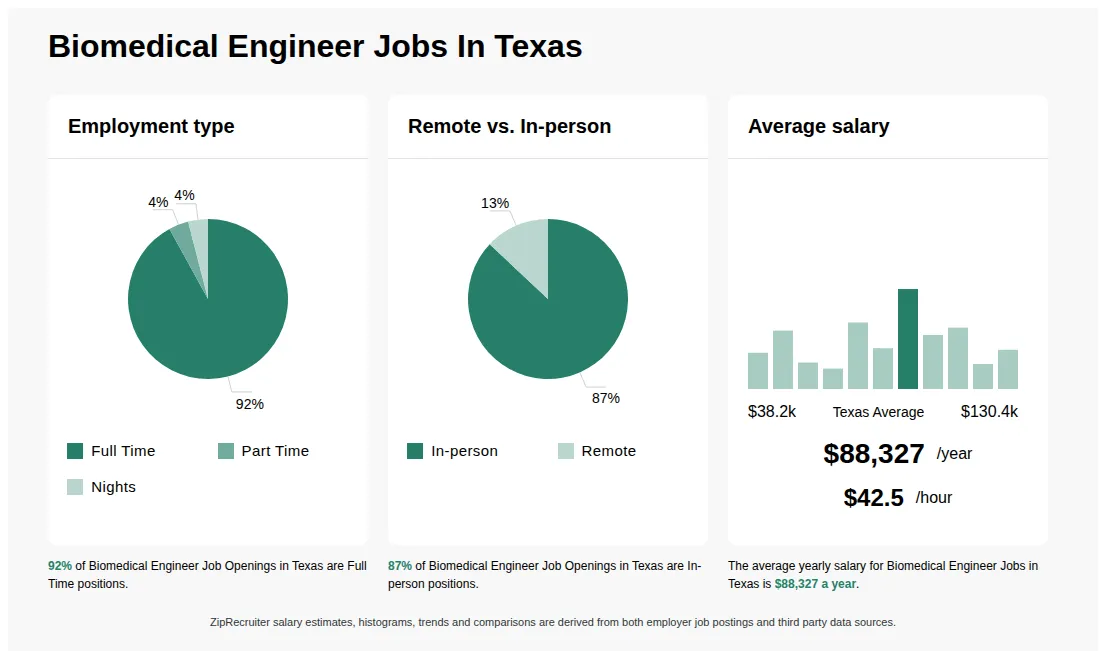
As of Sep 14, 2026, the average yearly pay for biomedical engineer in Texas is $88,327.00, according to ZipRecruiter salary data. Most workers in this role earn between $69,400.00 and $108,100.00 per year, depending on experience, location, and employer.
What is a biomedical engineer?
Biomedical engineers are professionals who apply principles of engineering and biological sciences to design, develop, and maintain equipment, devices, computer systems, and software used in healthcare. They work to improve the quality and effectiveness of patient care by creating technologies such as artificial organs, medical imaging devices, and prosthetics. Biomedical engineers often collaborate with doctors, researchers, and other engineers to solve clinical problems and advance medical technology. Their work can be found in hospitals, research facilities, manufacturing companies, and regulatory agencies.
What do biomedical engineers do?
A Biomedical Engineer is an expert in the fields of medicine and biological sciences. They use their extensive knowledge base to develop different kinds of equipment and devices with the end goal of improving the effectiveness of patient care. Biomedical Engineers are critical thinkers and analysts. Their time is spent brainstorming solutions to medical problems and designing new devices, such as diagnostic machinery and even equipment for artificial body part generation. It is the job of a Biomedical Engineer to maintain the equipment they develop and to train other clinicians on proper usage and upkeep. In addition to the hands-on aspect of this career, Biomedical Engineers also dedicate time to researching medical dilemmas, studying up on biological discoveries, and assisting in the development of new scientific advances.
What are the key skills and qualifications needed to thrive as a biomedical engineer, and why are they important?
To thrive as a Biomedical Engineer, you need a solid background in biology, engineering principles, mathematics, and often at least a bachelor's degree in biomedical engineering or a related field. Familiarity with CAD software, medical imaging systems, and regulatory standards such as FDA guidelines is typically required. Strong problem-solving, communication, and teamwork skills help you collaborate with healthcare professionals and translate technical solutions into clinical practice. These competencies are crucial for developing safe, effective medical devices and technologies that improve patient outcomes.
What are some common challenges biomedical engineers face when working on interdisciplinary teams?
Biomedical engineers frequently collaborate with professionals from diverse backgrounds, including clinicians, software developers, and regulatory specialists. One common challenge is effectively communicating technical concepts to non-engineers and aligning project goals across disciplines. Navigating differing priorities and timelines can also require strong project management and interpersonal skills. Emphasizing clear communication and a willingness to learn from other fields helps biomedical engineers successfully contribute to innovative healthcare solutions.
What is the difference between Biomedical Engineer vs Mechanical Engineer?
| Aspect | Biomedical Engineer | Mechanical Engineer |
|---|---|---|
| Required Credentials | Bachelor's in Biomedical Engineering or related field; often licensed or certified | Bachelor's in Mechanical Engineering; licensure varies by role |
| Work Environment | Hospitals, medical device companies, research labs | Manufacturing, automotive, aerospace, research facilities |
| Industry Usage | Healthcare, medical device development, biotech | Automotive, aerospace, energy, manufacturing |
Biomedical Engineers focus on designing and improving medical devices and healthcare solutions, working mainly in healthcare settings. Mechanical Engineers have a broader scope, working on machinery, systems, and products across various industries. While both roles require engineering degrees, their work environments and industry applications differ significantly.
Do biomedical engineers get paid a lot?
Biomedical engineers typically earn competitive salaries that vary based on experience, education, and location. According to industry data, the median annual wage is around $90,000, with higher earnings possible for those with advanced degrees or specialized skills in medical device design or research. The profession often requires knowledge of engineering principles, biology, and medical technology.
What type of jobs do biomedical engineers do?
Biomedical engineers design and develop medical devices, equipment, and software used in healthcare, such as imaging systems, prosthetics, and diagnostic tools. They often work in research labs, hospitals, or manufacturing environments, applying engineering principles to improve patient care and medical technology. Strong knowledge of biology, engineering, and computer skills are essential for these roles.
More about Biomedical Engineer jobs
What are the most commonly searched types of Biomedical Engineer jobs in Texas?
The most popular types of Biomedical Engineer jobs in Texas are:
What are popular job titles related to Biomedical Engineer jobs in Texas?
For Biomedical Engineer jobs in Texas, the most frequently searched job titles are:
What job categories do people searching Biomedical Engineer jobs in Texas look for?
The top searched job categories for Biomedical Engineer jobs in Texas are:
What cities in Texas are hiring for Biomedical Engineer jobs?
Cities in Texas with the most Biomedical Engineer job openings:
What are popular job titles related to Biomedical Engineer jobs in TX?
For Biomedical Engineer jobs in TX, the most frequently searched job titles are:

Senior Biomedical Equipment Technician
Austin, TX • On-site
Texas Children's Hospital
Full-time
Re-posted 27 days ago
Texas Children's Hospital rating

8.3
Based on 177 frontline employees who took The Breakroom Quiz
Job description
We are searching for a Senior Biomedical Technician for our Austin, TX Campus -- someone who works well in a fast-paced setting. In this position, you will perform preventative maintenance and repair work on a wide variety of medical equipment, some complex devices, systems, and networks.
Think you've got what it takes?
Qualifications
• High school diploma or equivalent required
• Bachelor's or associate's degree in electronics or biomedical technology preferred
• 8 years' experience in servicing biomedical equipment in a hospital, industrial or military setting
• Other electronic equipment service experience can be considered
• A bachelor's degree may substitute for four years of experience
• An associate's degree may substitute for two years of experience
Specifics on Skills needed
• Performs inspections and preventive maintenance on hospital equipment
• Provides in-depth troubleshooting on devices, systems, and networks
• Participates in project planning, tasks, and leadership as needed
• Acts as technical resource on standalone devices and small system components
• Initiates incident investigation upon notification of incident in compliance with Departmental documentation policy
• Participates in quality control checks on all group technical work output
• Documents all work and materials used in compliance with the departmental record keeping system daily achieving the departmental labor recovery target
• Identify equipment within technical area that has not had its preventative maintenance procedure reviewed recently, or equipment that is new to the Biomedical Engineering preventative maintenance program
About Us
Texas Children's presence in Austin helps support a pediatric population of more than half a million and keeps kids healthy and happy from birth to adulthood. Texas Children's first health care location in Austin, Texas Children's Urgent Care West Gate, opened in March 2018, providing high quality pediatric-focused care after hours and on weekends. There are now more than 15 Texas Children's Pediatric primary care practices in the greater Austin area providing full-service family care including routine childhood immunizations, well visits, and sick care. Our Specialty Care Center in Austin includes a multidisciplinary group of pediatric specialists committed to providing comprehensive care across a wide spectrum of services. Texas Children's Hospital North Austin, is our new state-of-the-art facility providing world-class pediatric and maternal care to Austin families.
To join our community of more than 15,000 dedicated team members, visit texaschildrenspeople.org.
Texas Children's is proud to be an equal opportunity employer. All applicants and employees are considered and evaluated for positions at Texas Children's without regard to mental or physical disability, race, color, religion, gender, national origin, age, genetic information, military or veteran status, sexual orientation, gender identity, marital status or any other protected Federal, State/Province or Local status unrelated to the performance of the work involved.
What Texas Children's Hospital employees say
Pay
Benefits
Hours and flexibility
Workplace
Get the full story on Breakroom