1

Biomedical Engineer Jobs (NOW HIRING)

Vision insurance iQuasar LLC is seeking a Biomedical Engineer . We strive to provide the next generation of cutting-edge technologies. Our growth means exciting career opportunities for talented ...

Vision insurance iQuasar LLC is seeking a Biomedical Engineer . We strive to provide the next generation of cutting-edge technologies. Our growth means exciting career opportunities for talented ...

The Biomedical Engineer is responsible for overseeing small- to medium-scale healthcare technology projects within the U.S. Department of Veterans Affairs (VA). The role requires strong project ...

The Biomedical Engineer is responsible for overseeing small- to medium-scale healthcare technology projects within the U.S. Department of Veterans Affairs (VA). The role requires strong project ...

next page

Showing results 1-20

Biomedical Engineer information

See salary details

$41K

$94.8K

$140K

How much do biomedical engineer jobs pay per year?

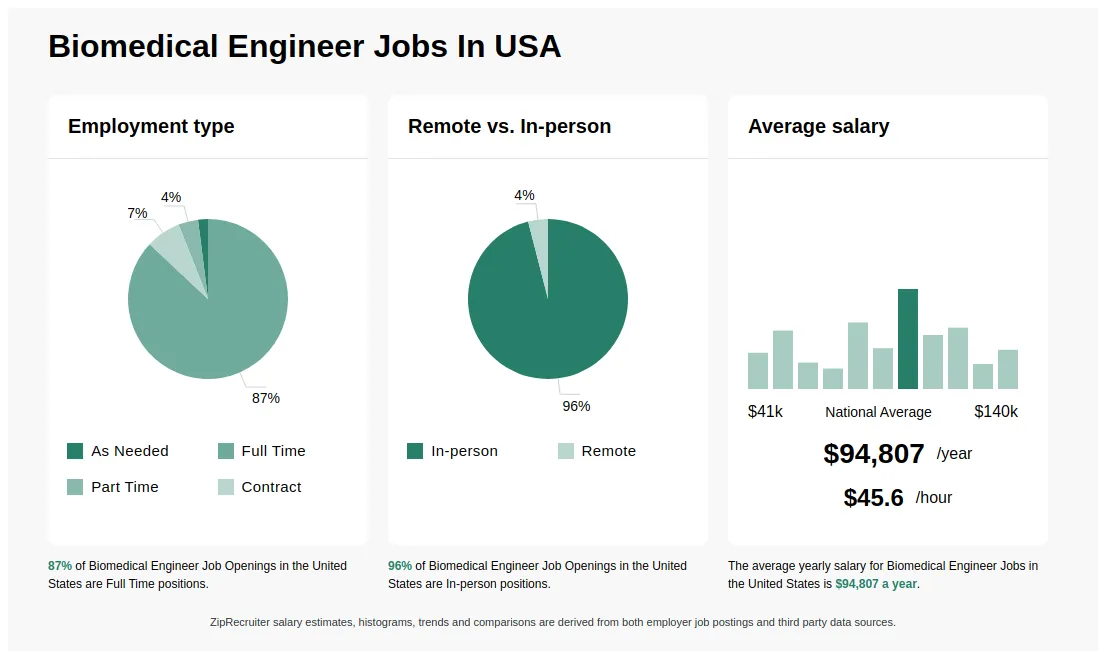
As of Jun 4, 2026, the average yearly pay for biomedical engineer in the United States is $94,807.00, according to ZipRecruiter salary data. Most workers in this role earn between $74,500.00 and $116,000.00 per year, depending on experience, location, and employer.

What Do Biomedical Engineers Do?

A Biomedical Engineer is an expert in the fields of medicine and biological sciences. They use their extensive knowledge base to develop different kinds of equipment and devices with the end goal of improving the effectiveness of patient care. Biomedical Engineers are critical thinkers and analysts. Their time is spent brainstorming solutions to medical problems and designing new devices, such as diagnostic machinery and even equipment for artificial body part generation. It is the job of a Biomedical Engineer to maintain the equipment they develop and to train other clinicians on proper usage and upkeep. In addition to the hands-on aspect of this career, Biomedical Engineers also dedicate time to researching medical dilemmas, studying up on biological discoveries, and assisting in the development of new scientific advances.

What are the key skills and qualifications needed to thrive as a Biomedical Engineer, and why are they important?

To thrive as a Biomedical Engineer, you need a solid background in biology, engineering principles, mathematics, and often at least a bachelor's degree in biomedical engineering or a related field. Familiarity with CAD software, medical imaging systems, and regulatory standards such as FDA guidelines is typically required. Strong problem-solving, communication, and teamwork skills help you collaborate with healthcare professionals and translate technical solutions into clinical practice. These competencies are crucial for developing safe, effective medical devices and technologies that improve patient outcomes.

What are some common challenges biomedical engineers face when working on interdisciplinary teams?

Biomedical engineers frequently collaborate with professionals from diverse backgrounds, including clinicians, software developers, and regulatory specialists. One common challenge is effectively communicating technical concepts to non-engineers and aligning project goals across disciplines. Navigating differing priorities and timelines can also require strong project management and interpersonal skills. Emphasizing clear communication and a willingness to learn from other fields helps biomedical engineers successfully contribute to innovative healthcare solutions.

What are biomedical engineers?

Biomedical engineers are professionals who apply principles of engineering and biological sciences to design, develop, and maintain equipment, devices, computer systems, and software used in healthcare. They work to improve the quality and effectiveness of patient care by creating technologies such as artificial organs, medical imaging devices, and prosthetics. Biomedical engineers often collaborate with doctors, researchers, and other engineers to solve clinical problems and advance medical technology. Their work can be found in hospitals, research facilities, manufacturing companies, and regulatory agencies.

What is the difference between Biomedical Engineer vs Mechanical Engineer?

AspectBiomedical EngineerMechanical Engineer
Required CredentialsBachelor's in Biomedical Engineering or related field; often licensed or certifiedBachelor's in Mechanical Engineering; licensure varies by role
Work EnvironmentHospitals, medical device companies, research labsManufacturing, automotive, aerospace, research facilities
Industry UsageHealthcare, medical device development, biotechAutomotive, aerospace, energy, manufacturing

Biomedical Engineers focus on designing and improving medical devices and healthcare solutions, working mainly in healthcare settings. Mechanical Engineers have a broader scope, working on machinery, systems, and products across various industries. While both roles require engineering degrees, their work environments and industry applications differ significantly.

What cities are hiring for Biomedical Engineer jobs? Cities with the most Biomedical Engineer job openings:
What are the most commonly searched types of Biomedical Engineer jobs? The most popular types of Biomedical Engineer jobs are:
Who are the top companies hiring for Biomedical Engineer jobs? The top employers for Biomedical Engineer jobs are:
What states have the most Biomedical Engineer jobs? States with the most job openings for Biomedical Engineer jobs include:
Infographic showing various Biomedical Engineer job openings in the United States as of May 2026, with employment types broken down into 2% Internship, 1% As Needed, 46% Full Time, 15% Part Time, 2% Temporary, and 34% Contract. Highlights an 86% Physical, 2% Hybrid, and 12% Remote job distribution, with an average salary of $94,807 per year, or $45.6 per hour.

$64.44K/yr

Other

Posted 7 days ago


Job description

Biomedical Engineer
The incumbent will provide professional engineering support to a complex, highly technical, and service oriented Biomedical Engineering Program. The Biomedical Program includes medical technology assessment, strategic planning, acquisition support, implementation, coordination, equipment management, and ongoing maintenance support.Qualifications:Basic Requirements:
  • United States Citizenship: Non-citizens may only be appointed when it is not possible to recruit qualified citizens in accordance with VA Policy.
  • Education and/or Experience: The individual must meet either item (1) or (2) below to meet this requirement:
  1. Bachelor's Degree or Higher in Engineering. To be creditable, the curriculum must be from a school of engineering with at least one curriculum accredited by the Accreditation Board for Engineering and Technology (ABET), as a professional engineering curriculum. Examples of acceptable engineering degrees include: Biomedical Engineering, Clinical Engineering, Bioengineering, Biomechanical Engineering, Electrical Engineering, Mechanical Engineering, and Biochemical Engineering. OR,
  2. Certification as a Certified Clinical Engineer (CCE) and a bachelor's degree.
  • English Language Proficiency: Biomedical Engineers must be proficient in spoken and written English.
May qualify based on being covered by the Grandfathering Provision as described in the VA Qualification Standard for this occupation (only applicable to current VHA employees who are in this occupation and meet the criteria).
Grade Determinations:GS-7 Biomedical Engineer
Experience: None beyond the basic requirements.
GS-9 Biomedical Engineer
Experience: At least one year of specialized experience equivalent to the next lower level, GS-7.
OR
Education: Master's degree in Biomedical Engineering, or a related field of study OR Bachelor's degree, plus two full years of progressively higher level graduate education in a related field of study, that demonstrates the KSAs for the GS-9 level assignment. TRANSCRIPTS REQUIRED
AND
Demonstrated Knowledge, Skills, and Abilities: In addition to the experience above, the candidate must demonstrate all of the following KSAs:
i. Knowledge of the principles, theories, concepts, and practices of the Biomedical Engineering profession.
ii. Ability to interpret relevant codes, regulations, guidelines, and standards, and make recommendations to ensure compliance with medical center programs.
iii. Ability to understand the operational needs of clinical services in the health care system.
iv. Ability to prepare material on current technical topics and trends, for presentation to other technical staff and mid-level hospital management, and the ability to keep abreast of changes in technology.
GS-11 Biomedical Engineer
Experience: At least one year of experience equivalent to the next lower level, GS-9, and must fully meet the KSAs at that level.
OR
Education: Ph.D., or equivalent doctoral degree in Biomedical Engineering, or a related field of engineering OR Bachelor's degree, plus three full years of progressively higher level graduate education in a related field of study. TRANSCRIPTS REQUIRED
AND
Demonstrated Knowledge, Skills, and Abilities: In addition to the experience above, the candidate must demonstrate all of the following KSAs:
i. Ability to implement and/or sustain an equipment management or biomedical research program that meets The Joint Commission (TJC), National Fire Protection Association (NFPA), or other applicable regulatory requirements.
ii. Ability to develop material for a continuing education program for clinical or research staff, that address the principles and application of medical technology, and/or biomedical theory used in healthcare.
iii. Ability to advise staff on emerging medical technology, or research procedures, while keeping abreast of changes in such technology, and utilizing the information to solve biomedical engineering problems.
iv. Knowledge of basic project management principles, as applied to the healthcare setting and medical equipment, and information system implementation.
GS-12 Biomedical Engineer
Experience: Completion of at least one year of specialized experience equivalent to the next lower level, GS-11, or completion of a post-doctoral research fellowship in the field of biomedical engineering, and must fully meet the KSAs at that level.
AND
Demonstrated Knowledge, Skills, and Abilities: In addition to the experience above, the candidate must demonstrate all of the following KSAs:
i. Ability to conduct a medical equipment management or biomedical research program that is compliant with applicable healthcare standards and regulatory agencies.
ii. Ability to develop a curriculum for a continuing education program, that address the safe and effective use of medical technology, and/or research devices.
iii. Ability to manage a recall and safety alert program for medical devices, including medical device hazard investigations, to assure compliance with patient safety goals, SMDA, and TJC requirements.
iv. Ability to conduct capital asset and infrastructure planning for medical equipment spanning initial concept, installation, and effective implementation of complex medical equipment.
v. Ability to function as the subject matter expert in the field of biomedical engineering, directly supporting specialized clinical technology, including service, system administration, training, quality assurance, and life-cycle management.
vi. Ability to effectively advise clinical and administrative staff on medical technology, including existing and emerging technology, which addresses viability, long-term suitability, compatibility, and/or safety.
vii. Knowledge of concepts related to computer based medical systems, networking protocols, and information security as it applies to medical technology within VHA.
viii. Skill in communicating and working collaboratively with key stakeholders, including technical and professional staff at various levels of the organization.
ix. Ability to apply project management principles to deployment of medical equipment and health information technologies.
Reference: For more information on this qualification standard, please visit https://www.va.gov/ohrm/QualificationStandards/.
The full performance level of this vacancy is GS-12. The actual grade at which an applicant may be selected for this vacancy is in the range of GS-7 to GS-12.
Physical Requirements: You will be asked to participate in a pre-employment examination or evaluation as part of the pre-employment process for this position. Questions about physical demands or environmental factors may be addressed at the time of evaluation or examination.
Grandfathering Provision. All persons employed in VHA in this occupation, on the effective date of this qualification standard, are considered to have met all qualification requirements for the title, series and grade held, including positive education, and/or certification/registration that are part of the basic requirements of the occupation. For employees who do not meet all the basic requirements in this standard, but who met the qualifications applicable to the position at the time they were appointed to it, the following provisions apply:
(1) Such employees in an occupation that does not require a certification/registration, may be reassigned, promoted, or demoted within the occupation.(2) Employees who are appointed on a temporary basis, prior to the effective date of the qualification standard, may not have their temporary appointment extended, or be reappointed on a temporary, or permanent basis, until they fully meet the basic requirements of the standard.
(3) Employees initially grandfathered into this occupation, who subsequently obtain additional education and/or certification/registration, that meet all the basic requirements of this qualification standard, must maintain the required credentials as a condition of employment in the occupation.
(4) If an employee, who was retained in an occupation listed in 38 U.S.C. 7401(3) under this provision, leaves that occupation, the employee loses protected status, and must meet the full VA qualification standard requirements in effect at the time of reentry to the occupation.Education:Important: A transcript must be submitted with your application.
Note:
Only education or degrees recognized by the U.S. Department of Education from accredited colleges, universities, schools, or institutions may be used to qualify for Federal employment. You can verify your education here: http://ope.ed.gov/accreditation/. If you are using foreign education to meet qualification requirements, you must send a Certificate of Foreign Equivalency with your transcript in order to receive credit for that education. For further information, visit: https://sites.ed.gov/international/recognition-of-foreign-qualifications/.Employment Type: OTHER