1

Biomedical Engineer Jobs (NOW HIRING)

Senior Biomedical Engineer Works closely with and have impact on: Global Quality, Global Regulatory, Operations Reports to: Director of Biomedical Research Function: Research & Development Work ...

Biomedical Engineer

Rockville, MD · On-site

$65K - $108K/yr

The Biomedical Engineer shall provide reports of maintenance on all NCATS active instruments as required and respond to instruments. This is a full-time, on-site opportunity in Rockville, MD.

The Biomedical Engineer I will assist in all aspects of design, development, testing, manufacturing, and support of a medical imaging device for the company's operations within the US. This will ...

Biomedical Engineer

Boston, MA · On-site

$64.97 - $74.50/hr

Biomedical Engineer Location : Boston, MA Work schedule: Mon - Fri 8am - 5pm Pay Range : $60.00 - $74.50/hr Type :Contract, Potential for extension or conversion to permanent Overview Global pharma ...

Biomedical Engineer

Chicago, IL · On-site

$30 - $40/hr

Minimum 3 years' experience working with biomedical equipment in a clinical engineering environment. Benefits: * Paid Sick Time - effective 90 days after employment * Paid Vacation Time - effective ...

The Biomedical Engineer shall provide reports of maintenance on all NCATS active instruments as required and respond to instruments. This is a full-time, on-site opportunity in Rockville, MD.

Biomedical Engineer

Rockville, MD · On-site

$65K - $108K/yr

We are currently searching for Biomedical Engineer to help maintain, perform repairs, and troubleshoot for the National Center for Advancing Translational Sciences (NCATS) laboratory equipment used ...

Biomedical Engineer

Chicago, IL · On-site

$30 - $40/hr

Minimum 3 years' experience working with biomedical equipment in a clinical engineering environment. Benefits: * Paid Sick Time - effective 90 days after employment * Paid Vacation Time - effective ...

As a Biomedical Engineer, you will play a pivotal role in managing our medical equipment program and ensuring the safety, functionality, and compliance of medical technology within our healthcare ...

$55K - $78K/yr

Maintains responsibility for biomedical engineering design in support of projects. Provides full range of professional biomedical engineering services in all phases of research, design, and ...

Biomedical Engineer PRN Department: BioMed Ask your recruiter about our new market leading rates! **PRN POSITIONS REQUIRE A MINIMUM OF 2 SHIFTS/MONTH** General Description: Performs advanced and ...

next page

Showing results 1-20

Biomedical Engineer information

See salary details

$41K

$94.8K

$140K

How much do biomedical engineer jobs pay per year?

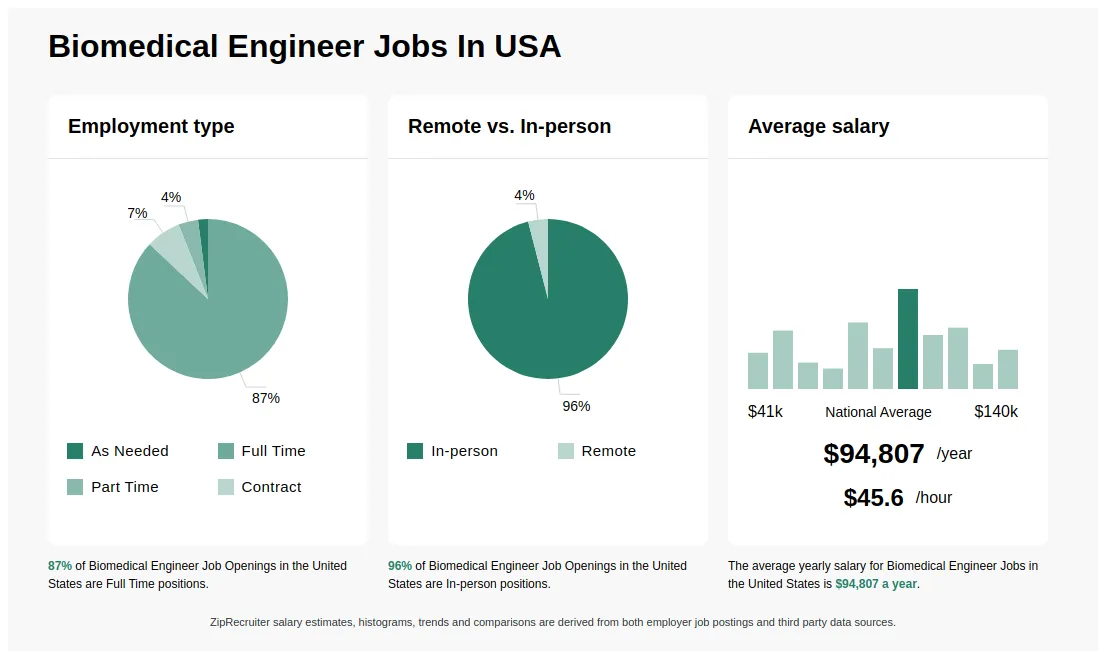
As of Jun 24, 2026, the average yearly pay for biomedical engineer in the United States is $94,807.00, according to ZipRecruiter salary data. Most workers in this role earn between $74,500.00 and $116,000.00 per year, depending on experience, location, and employer.

What engineers make $500,000?

Highly experienced biomedical engineers working in senior roles, management, or specialized fields such as medical device development can earn salaries approaching or exceeding $500,000 annually, especially with bonuses and stock options. Achieving this level typically requires advanced degrees, extensive experience, and leadership responsibilities within the industry.

What type of jobs do biomedical engineers do?

Biomedical engineers design and develop medical devices, equipment, and software used in healthcare, such as imaging systems, prosthetics, and diagnostic tools. They often work in research labs, hospitals, or manufacturing environments, applying engineering principles to improve patient care and medical technology. Strong knowledge of biology, engineering, and computer skills are essential for these roles.

What can I work with a biomedical engineering degree?

A biomedical engineer can work in designing medical devices, developing healthcare technologies, and improving clinical equipment. They often work in hospitals, research labs, or manufacturing settings, utilizing skills in biology, engineering, and computer-aided design. Certifications and knowledge of regulatory standards can enhance employment opportunities.

What are biomedical engineers?

Biomedical engineers are professionals who apply principles of engineering and biological sciences to design, develop, and maintain equipment, devices, computer systems, and software used in healthcare. They work to improve the quality and effectiveness of patient care by creating technologies such as artificial organs, medical imaging devices, and prosthetics. Biomedical engineers often collaborate with doctors, researchers, and other engineers to solve clinical problems and advance medical technology. Their work can be found in hospitals, research facilities, manufacturing companies, and regulatory agencies.

What Do Biomedical Engineers Do?

A Biomedical Engineer is an expert in the fields of medicine and biological sciences. They use their extensive knowledge base to develop different kinds of equipment and devices with the end goal of improving the effectiveness of patient care. Biomedical Engineers are critical thinkers and analysts. Their time is spent brainstorming solutions to medical problems and designing new devices, such as diagnostic machinery and even equipment for artificial body part generation. It is the job of a Biomedical Engineer to maintain the equipment they develop and to train other clinicians on proper usage and upkeep. In addition to the hands-on aspect of this career, Biomedical Engineers also dedicate time to researching medical dilemmas, studying up on biological discoveries, and assisting in the development of new scientific advances.

What are some common challenges biomedical engineers face when working on interdisciplinary teams?

Biomedical engineers frequently collaborate with professionals from diverse backgrounds, including clinicians, software developers, and regulatory specialists. One common challenge is effectively communicating technical concepts to non-engineers and aligning project goals across disciplines. Navigating differing priorities and timelines can also require strong project management and interpersonal skills. Emphasizing clear communication and a willingness to learn from other fields helps biomedical engineers successfully contribute to innovative healthcare solutions.

What is the difference between Biomedical Engineer vs Mechanical Engineer?

AspectBiomedical EngineerMechanical Engineer
Required CredentialsBachelor's in Biomedical Engineering or related field; often licensed or certifiedBachelor's in Mechanical Engineering; licensure varies by role
Work EnvironmentHospitals, medical device companies, research labsManufacturing, automotive, aerospace, research facilities
Industry UsageHealthcare, medical device development, biotechAutomotive, aerospace, energy, manufacturing

Biomedical Engineers focus on designing and improving medical devices and healthcare solutions, working mainly in healthcare settings. Mechanical Engineers have a broader scope, working on machinery, systems, and products across various industries. While both roles require engineering degrees, their work environments and industry applications differ significantly.


What are the key skills and qualifications needed to thrive as a Biomedical Engineer, and why are they important?

To thrive as a Biomedical Engineer, you need a solid background in biology, engineering principles, mathematics, and often at least a bachelor's degree in biomedical engineering or a related field. Familiarity with CAD software, medical imaging systems, and regulatory standards such as FDA guidelines is typically required. Strong problem-solving, communication, and teamwork skills help you collaborate with healthcare professionals and translate technical solutions into clinical practice. These competencies are crucial for developing safe, effective medical devices and technologies that improve patient outcomes.

Can a Biomedical Engineer make 200k?

Biomedical engineers can earn salaries approaching or exceeding $200,000 annually, primarily with extensive experience, advanced degrees, or specialized skills in areas like medical device development or management. High salaries are more common in senior roles, leadership positions, or in certain geographic regions with higher living costs. Certifications and expertise in regulatory standards can also contribute to higher compensation.
What cities are hiring for Biomedical Engineer jobs? Cities with the most Biomedical Engineer job openings:
What are the most commonly searched types of Biomedical Engineer jobs? The most popular types of Biomedical Engineer jobs are:
Who are the top companies hiring for Biomedical Engineer jobs? The top employers for Biomedical Engineer jobs are:
What states have the most Biomedical Engineer jobs? States with the most job openings for Biomedical Engineer jobs include:
Infographic showing various Biomedical Engineer job openings in the United States as of June 2026, with employment types broken down into 50% Full Time, and 50% Contract. Highlights an 50% In-person, and 50% Remote job distribution, with an average salary of $94,807 per year, or $45.6 per hour.

Senior Biomedical Engineer

BioTalent

Anaheim, CA • On-site

Other

Posted 5 days ago


Job description

Job Title: Senior Biomedical Engineer

Works closely with and have impact on: Global Quality, Global Regulatory, Operations

Reports to: Director of Biomedical Research

Function: Research & Development

Work Location/Site: Irvine, CA


Role Overvie

wThe Senior Biomedical Engineer is a subject matter expert for biocompatibility of ophthalmic medical devices, with a primary focus on intraocular lenses (IOLs). This role requires in-depth expertise in ISO 11979-5 and the ISO 10993 series, combined with a strong background in materials science, analytical chemistry, and chemistry-based testing. The individual will function as a contributor, providing scientific leadership to support product development, regulatory compliance, and biocompatibility related activities


.
Duties and Responsibiliti

  • esServe as the biocompatibility subject matter expert for intraocular lenses (IOLs) and associated delivery system
  • s.Develop and execute biological evaluation strategies in accordance with ISO 10993-1, ISO 11979-5, and related standard
  • s.Design, review, and interpret analytical and chemistry-based testing data (e.g., GC-MS, HPLC, LC-UV) and translate results into regulatory-relevant conclusion
  • s.Manage and technically oversee external CROs, including protocol review, study oversight, and report revie
  • w.Perform biological evaluations, risk assessments, safety risk impact assessments (SRIAs), and gap assessments to identify testing needs, scientific rationales, and risk mitigation
  • s.Collaborate cross-functionally with R&D, Regulatory Affairs, Quality, Manufacturing, and Supplier Quality team
  • s.Write and review detailed technical reports to support global biocompatibility related matters ensuring scientific rigor, clarity, and compliance with regulatory standards and internal quality system


s.
Requireme

ntsExperie

  • nceMinimum of 5–7 years of experience in biomedical research, medical device biocompatibility, or related fiel
  • ds.Direct experience supporting biocompatibility assessments for implantable medical devices, preferably ophthalmic devic
  • es.Hands-on experience with analytical and chemistry-based testing in support of biocompatibility (e.g., E&L, material characterizatio
  • n).Experience authoring protocols, technical reports, and regulatory-facing documentati


on.
Skills/Accreditat

  • ionsExpert-level proficiency in ISO 11979-5 and ISO 10993 series standa
  • rds.Strong background in materials science, polymer chemistry, and analytical scien
  • ces.Experience with analytical techniques such as GC-MS, HPLC, LC-UV, ICP-MS,
  • etc.Excellent technical writing and report authoring ski
  • lls.Strong risk assessment, critical thinking, and problem-solving abilit
  • ies.Excellent communication and cross-functional collaboration ski


lls.
Academic Qualifica

  • tionsMaster's degree or PhD in Materials Science, Biomedical Engineering, Chemistry, Analytical Sciences, or a closely related f
  • ield.Advanced academic training with a strong emphasis on chemistry and analytical techniques is requ


ired.
Travel Requir

  • emen


tsNone