2

Remote Biomedical Engineer Jobs (NOW HIRING)

Job Title Biomedical Engineer Job Type Full-Time Education Bachelor's Degree Location Remote (Virtual) - US - US (Primary) Category Healthcare Salary Grade Travel 0 - 10% THIS ROLE IS CONTINGENT ON ...

The Biomedical Engineer is responsible for overseeing small- to medium-scale healthcare technology projects within the U.S. Department of Veterans Affairs (VA). The role requires strong project ...

Biomedical Engineer Location: Hartford, CT Duration: 12 Months Remote 80-100% travel Required Candidates will need a COI to work at various institutions on behalf of the client. Candidates will pay ...

The Biomedical / Clinical Engineer supports the planning, acquisition, implementation, and optimization of medical equipment and clinical systems to ensure safe, effective, and reliable operation in ...

As a Biomedical Engineer, you will play a pivotal role in managing our medical equipment program and ensuring the safety, functionality, and compliance of medical technology within our healthcare ...

Senior Biomedical Engineer

Houston, TX · On-site +1

$99K - $137K/yr

There is an opportunity for a suitably qualified biomedical engineer to join the business at this ... Remote working is another option. Salary & Benefits * Competitive salary offered based on ...

next page

Showing results 1-20

Remote Biomedical Engineer information

See salary details

$41K

$94.8K

$140K

How much do remote biomedical engineer jobs pay per year?

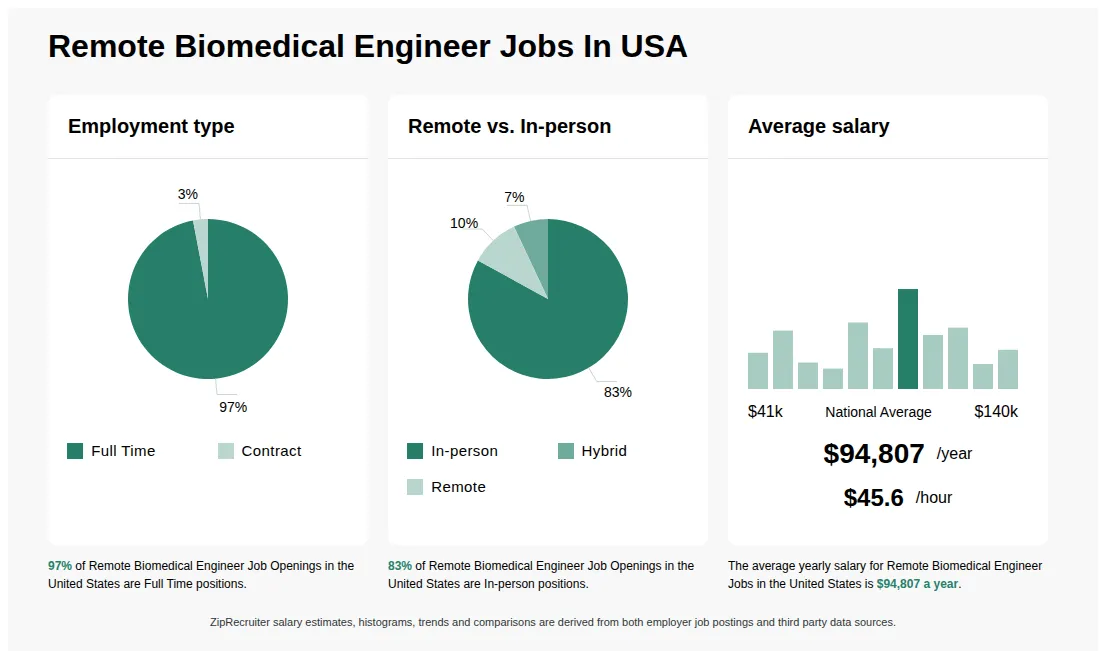
As of Jun 11, 2026, the average yearly pay for remote biomedical engineer in the United States is $94,807.00, according to ZipRecruiter salary data. Most workers in this role earn between $74,500.00 and $116,000.00 per year, depending on experience, location, and employer.

What are the main challenges faced by remote biomedical engineers, and how can they be addressed?

Remote biomedical engineers often encounter challenges such as limited hands-on access to equipment, coordinating with geographically dispersed teams, and ensuring effective communication with stakeholders. To address these, engineers rely on virtual collaboration platforms, detailed documentation processes, and proactive engagement with both technical and non-technical colleagues. It's important to develop strong time-management habits and seek regular feedback to stay aligned with project goals. As remote work becomes more common, employers are increasingly providing advanced digital tools and resources to help remote biomedical engineers stay productive and connected.

What is a Remote Biomedical Engineer job?

A Remote Biomedical Engineer designs, develops, and maintains medical devices and healthcare technology while working from a remote location. They collaborate with healthcare professionals, manufacturers, and research teams to ensure the safety and efficiency of biomedical equipment. Responsibilities may include troubleshooting medical devices, conducting virtual testing, and ensuring regulatory compliance. Remote Biomedical Engineers use digital tools to analyze data, provide technical support, and contribute to advancements in healthcare technology. This role requires strong problem-solving skills, technical expertise, and effective communication to work with cross-functional teams remotely.

What are the key skills and qualifications needed to thrive in the Remote Biomedical Engineer position, and why are they important?

To thrive as a Remote Biomedical Engineer, you need a degree in biomedical engineering or a related field along with solid analytical, problem-solving, and project management skills. Familiarity with CAD software, medical device regulations (such as FDA or ISO standards), and experience with remote collaboration tools are highly beneficial. Excellent written and verbal communication, self-motivation, and adaptability are critical soft skills for working effectively without direct supervision. These abilities enable successful design, troubleshooting, and support of biomedical devices while collaborating remotely across multidisciplinary teams and meeting regulatory requirements.

More about Remote Biomedical Engineer jobs
What cities are hiring for Remote Biomedical Engineer jobs? Cities with the most Remote Biomedical Engineer job openings:
What are the most commonly searched types of Biomedical Engineer jobs? The most popular types of Biomedical Engineer jobs are:
What states have the most Remote Biomedical Engineer jobs? States with the most job openings for Remote Biomedical Engineer jobs include:
Infographic showing various Remote Biomedical Engineer job openings in the United States as of June 2026, with employment types broken down into 75% Full Time, and 25% Contract. Highlights an 100% Remote job distribution, with an average salary of $94,807 per year, or $45.6 per hour.
Biomedical Engineer

Full-time

Posted 27 days ago


Job description

Job Title
Biomedical Engineer
Job Type
Full-Time
Education
Bachelor's Degree
Location
Remote (Virtual) - US - US (Primary)
Category
Healthcare
Salary Grade
Travel
0 - 10%
Job Description
THIS ROLE IS CONTINGENT ON AN ANTICIPATED CONTRACT AWARD. SUBMITTING AN APPLICATION ALLOWS YOU TO BE CONSIDERED FOR THE POSITION UPON AWARD.
The Biomedical Engineer / Clinical Engineer will provide subject matter expertise in patient safety and medical device management to support the VA's Healthcare Technology Management (HTM) Program Office. This role is critical to ensuring compliance with patient safety goals, regulatory requirements, and industry standards across the Veterans Health Administration (VHA).
Key Responsibilities
  • Manage recall and safety alert programs for medical devices, including hazard investigations, ensuring compliance with Safe Medical Devices Act (SMDA) and The Joint Commission (TJC) requirements.
  • Conduct medical equipment management programs compliant with healthcare standards and regulatory agencies.
  • Support incident investigations involving medical equipment and develop preventive strategies to mitigate risks.
  • Collaborate with HTM Program Office and field-based stakeholders to implement best practices for patient safety and medical device reliability.
  • Provide expertise in networking protocols, information security, and computer-based medical systems as they relate to medical technology.
  • Assist in developing and maintaining Medical Equipment Management Plans (MEMPs) and related policies.
  • Ensure adherence to VA, federal, and international standards, including ISO requirements.

Required Qualifications
  • Education: Bachelor's degree or higher in Engineering OR Certification as a Clinical Engineer (CCE).
  • Experience:
    • 5+ years of experience managing medical device recall and safety alert programs.
    • Demonstrated competency in medical device hazard investigations and compliance with patient safety goals.
    • Proven ability to communicate and collaborate effectively with technical and professional staff at all levels of a healthcare organization.
  • Technical Knowledge:
    • Computer-based medical systems, networking protocols, and information security principles.
    • Regulatory requirements and ISO standards applicable to medical technology.
Additional Information
  • Travel: Up to 30 trips per year may be required (4-5 days per trip).
  • Security Clearance: Background investigation and VA Contractor PIV badge required prior to commencement of work.
  • Contract Type: Firm fixed-price deliverables-based contract.
  • Performance Period: Base period of 12 months with four 12-month option periods.