Cybersecurity Engineer
Campus, IL · On-site
Responsibilities The Cybersecurity Engineer position is within the Systems Security Engineering and Research team (6230) within the Office of the Chief Information Security Officer (6200). We invite ...
Campus, IL · On-site
Responsibilities The Cybersecurity Engineer position is within the Systems Security Engineering and Research team (6230) within the Office of the Chief Information Security Officer (6200). We invite ...
Campus, IL · On-site
Responsibilities The Cybersecurity Engineer position is within the Systems Security Engineering and Research team (6230) within the Office of the Chief Information Security Officer (6200). We invite ...
Pasadena, CA · On-site
Responsibilities The Cybersecurity Engineer position is within the Systems Security Engineering and Research team (6230) within the Office of the Chief Information Security Officer (6200). We invite ...
Pasadena, CA · On-site
Responsibilities The Cybersecurity Engineer position is within the Systems Security Engineering and Research team (6230) within the Office of the Chief Information Security Officer (6200). We invite ...
Arlington, VA · On-site
The Cybersecurity Engineer will design and manage cybersecurity solutions, ensuring compliance with federal requirements and integrating security throughout the DevSecOps lifecycle. Responsibilities ...
Arlington, VA · On-site
The Cybersecurity Engineer will design and manage cybersecurity solutions, ensuring compliance with federal requirements and integrating security throughout the DevSecOps lifecycle. Responsibilities ...
Lafayette, CO · On-site
About the role The Cybersecurity Engineer we hire for this role will work to identify and mitigate cybersecurity vulnerabilities for a ground system for a new United States Space Force (USSF ...
Lafayette, CO · On-site
About the role The Cybersecurity Engineer we hire for this role will work to identify and mitigate cybersecurity vulnerabilities for a ground system for a new United States Space Force (USSF ...
Our Cybersecurity Engineers work on firm-wide defenses, provide expertise and advice to other groups, lead employee cybersecurity awareness efforts, and handle some of the event analysis and incident ...
Our Cybersecurity Engineers work on firm-wide defenses, provide expertise and advice to other groups, lead employee cybersecurity awareness efforts, and handle some of the event analysis and incident ...
Erlanger, KY · On-site
The Cybersecurity Engineer is responsible for supporting and enhancing Toyota Boshoku America's (TBA) cybersecurity program across its North and South American operations, including the United States ...
New
Erlanger, KY · On-site
The Cybersecurity Engineer is responsible for supporting and enhancing Toyota Boshoku America's (TBA) cybersecurity program across its North and South American operations, including the United States ...
New
Washington, DC · Hybrid
Ardent is seeking a Cybersecurity Engineer to join our team. This position is based in Washington, DC and may require a combination of on-site and remote support depending on program needs. Position ...
Washington, DC · Hybrid
Ardent is seeking a Cybersecurity Engineer to join our team. This position is based in Washington, DC and may require a combination of on-site and remote support depending on program needs. Position ...
Huntsville, AL · On-site
IronMountain Solutions is seeking a Cybersecurity Engineer to provide aviation weapon-system cybersecurity support for the MV-75 Program. This role involves advising on cybersecurity risk posture ...
Huntsville, AL · On-site
IronMountain Solutions is seeking a Cybersecurity Engineer to provide aviation weapon-system cybersecurity support for the MV-75 Program. This role involves advising on cybersecurity risk posture ...
Arlington, VA · On-site
The Cybersecurity Engineer will design and manage cybersecurity solutions, ensuring compliance with federal requirements and integrating security into the DevSecOps lifecycle. Responsibilities : • ...
Arlington, VA · On-site
The Cybersecurity Engineer will design and manage cybersecurity solutions, ensuring compliance with federal requirements and integrating security into the DevSecOps lifecycle. Responsibilities : • ...
New York, NY · On-site
Our Cybersecurity Engineers work on firm-wide defenses, provide expertise and advice to other groups, lead employee cybersecurity awareness efforts, and handle some of the event analysis and incident ...
New York, NY · On-site
Our Cybersecurity Engineers work on firm-wide defenses, provide expertise and advice to other groups, lead employee cybersecurity awareness efforts, and handle some of the event analysis and incident ...
Lead Cybersecurity Engineer The Lead Cybersecurity Engineer shall have a bachelor's degree in Information Technology, Engineering, or a related field with a minimum of 10 years of progressive ...
Lead Cybersecurity Engineer The Lead Cybersecurity Engineer shall have a bachelor's degree in Information Technology, Engineering, or a related field with a minimum of 10 years of progressive ...
Princeton, NJ · On-site
Cybersecurity Engineer Location: Princeton, NJ, Philadelphia, PA, New York City, NY, Boston, MA, Hartford, CT. Contact: 12+ Months Looking for W2 candidates. No C2C Job Summary: We are seeking an IAM ...
Princeton, NJ · On-site
Cybersecurity Engineer Location: Princeton, NJ, Philadelphia, PA, New York City, NY, Boston, MA, Hartford, CT. Contact: 12+ Months Looking for W2 candidates. No C2C Job Summary: We are seeking an IAM ...
This role will support cybersecurity engineering, risk management, and security modernization efforts across enterprise healthcare systems and infrastructure environments supporting Veteran health ...
This role will support cybersecurity engineering, risk management, and security modernization efforts across enterprise healthcare systems and infrastructure environments supporting Veteran health ...
The Cyber Security Engineer designs, operates, and maintains highly secure communications and network environments, conducts in-depth security assessments, performs incident response and threat ...
The Cyber Security Engineer designs, operates, and maintains highly secure communications and network environments, conducts in-depth security assessments, performs incident response and threat ...
The Cybersecurity Engineer provides technical cybersecurity support across the DLA EFM portfolio, ensuring compliance with DoD and federal security requirements while supporting the design ...
The Cybersecurity Engineer provides technical cybersecurity support across the DLA EFM portfolio, ensuring compliance with DoD and federal security requirements while supporting the design ...
Arlington, VA · On-site
The Cybersecurity Engineer will design and manage cybersecurity solutions, ensuring compliance with federal standards and integrating security throughout the DevSecOps lifecycle. Responsibilities ...
Arlington, VA · On-site
The Cybersecurity Engineer will design and manage cybersecurity solutions, ensuring compliance with federal standards and integrating security throughout the DevSecOps lifecycle. Responsibilities ...
Arlington, VA · On-site
The Cybersecurity Engineer will design and manage cybersecurity solutions, ensuring compliance with federal requirements while integrating security into the DevSecOps lifecycle. Responsibilities ...
Arlington, VA · On-site
The Cybersecurity Engineer will design and manage cybersecurity solutions, ensuring compliance with federal requirements while integrating security into the DevSecOps lifecycle. Responsibilities ...
Top Secret/SCI w/Polygraph VMR Strategic Solutions is seeking a Cybersecurity Engineer who possesses a profound grasp of intermediate cyber engineering and cybersecurity concepts. This role requires ...
Quick apply
Top Secret/SCI w/Polygraph VMR Strategic Solutions is seeking a Cybersecurity Engineer who possesses a profound grasp of intermediate cyber engineering and cybersecurity concepts. This role requires ...
Saint Louis, MO · On-site
$80K - $115K/yr
Maryville University is seeking a Cybersecurity Engineer who is passionate about protecting digital environments, solving complex technical challenges, and advancing cybersecurity in an innovative ...
Saint Louis, MO · On-site
$80K - $115K/yr
Maryville University is seeking a Cybersecurity Engineer who is passionate about protecting digital environments, solving complex technical challenges, and advancing cybersecurity in an innovative ...
Seaside, CA · On-site
The Cyber Security Engineer designs, operates, and maintains highly secure communications and network environments, conducts in-depth security assessments, performs incident response and threat ...
Seaside, CA · On-site
The Cyber Security Engineer designs, operates, and maintains highly secure communications and network environments, conducts in-depth security assessments, performs incident response and threat ...
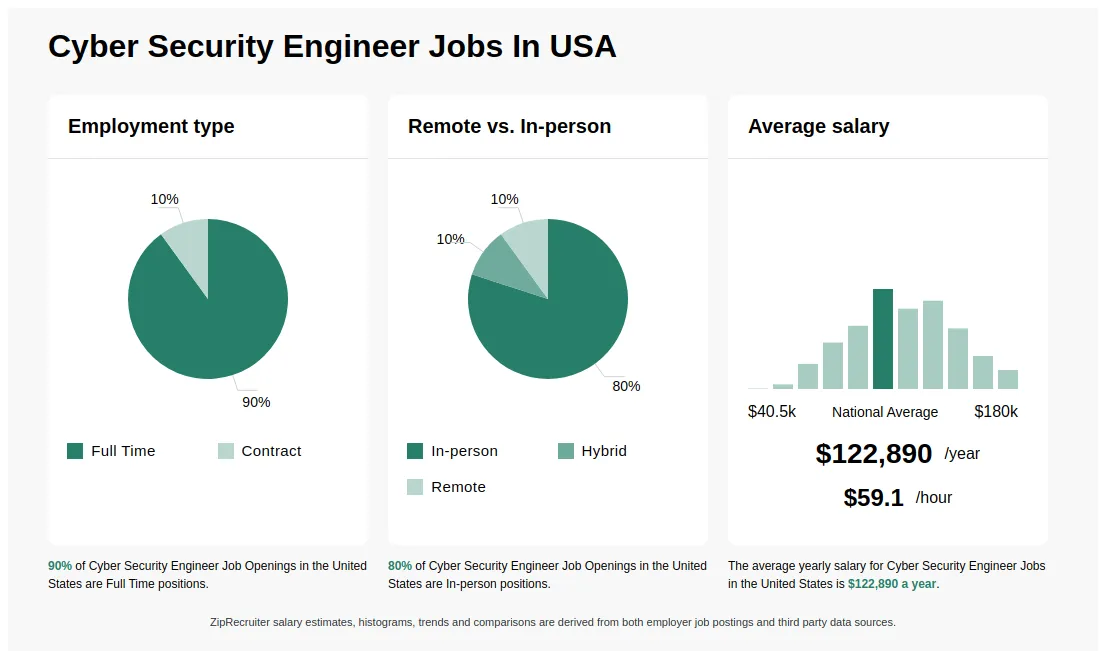
$40.5K - $53.2K
0% of jobs
$53.2K - $65.9K
0% of jobs
$65.9K - $78.5K
4% of jobs
$78.5K - $91.2K
9% of jobs
$103.4K is the 25th percentile. Wages below this are outliers.
$91.2K - $103.9K
13% of jobs
$103.9K - $116.6K
20% of jobs
The median wage is $120K / yr.
$116.6K - $129.3K
16% of jobs
$139.2K is the 75th percentile. Wages above this are outliers.
$129.3K - $142K
17% of jobs
$142K - $154.6K
12% of jobs
$154.6K - $167.3K
6% of jobs
$167.3K - $180K
3% of jobs
$40.5K
$122.9K
$180K
| Aspect | Cyber Security Engineer | Network Security Analyst |
|---|---|---|
| Certifications | CompTIA Security+, CISSP, CEH | CompTIA Security+, Cisco CCNA Security |
| Work Environment | Designs security systems, develops security solutions | Monitors network traffic, analyzes security threats |
| Employer & Industry Usage | Tech firms, finance, government agencies | IT departments, cybersecurity firms |
Cyber Security Engineers focus on designing and implementing security systems, while Network Security Analysts monitor and analyze network traffic for threats. Both roles require similar certifications and are vital in protecting organizational assets, often working within the same industries.
A cyber security engineer—also know as a cyber security analyst—helps prevent attacks on databases and networks of companies using hardware, firewalls, and encryption. The responsibilities of this job are to monitor activity, install software, conduct maintenance on various computer systems, and lead response efforts in the event of a cyber attack. Cyber security engineers also work with other security professionals from other businesses to share information on potential threats and vulnerabilities.

Full-time
Medical, Dental, Vision, Retirement, PTO
Posted 21 days ago
New ideas are all around us, but only a few will change the world. That's our focus at JPL. We ask the biggest questions, then search the universe for answers-literally. We build upon ideas that have guided generations, then share our discoveries to inspire generations to come. Your mission-your opportunity-is to seek out the answers that bring us one step closer. If you're driven to discover, create, and inspire something that lasts a lifetime and beyond, you're ready for JPL.
Located in Pasadena, California, JPL has a campus-like environment situated on 177 acres in the foothills of the San Gabriel Mountains and offers a work environment unlike any other: we inspire passion, foster innovation, build collaboration, and reward excellence.
Responsibilities
The Cybersecurity Engineer position is within the Systems Security Engineering and Research team (6230) within the Office of the Chief Information Security Officer (6200).
We invite you to join our team as a Cybersecurity Engineer, contributing to the development of advanced security capabilities within missioncritical embedded platforms.
In this role, you will design and implement novel security mechanisms that safeguard network data flows within embedded systems supporting authentication and encryption applications. You will also assess how these mechanisms interact with and strengthen antitamper technologies.
This position requires conducting foundational research in embeddedsystem security, with focus areas that include authentication, encryption, system monitoring, and antitamper protection. Key responsibilities include:
Required qualifications:
Preferredqualifications:
JPL has a catalog of benefits and perks that span from the traditional to the unique. This includes a variety of health, dental, vision, wellbeing, and retirement plans, paid time off, learning, rideshare, childcare, flexible schedule, parental leave and many more. Our focus is on work-life balance, and living healthy, fulfilling lives as we Dare Mighty Things Together. For benefits eligible positions, benefits are effective the first day of the month coincident with or immediately following the employee's start date.
For further benefits information click Benefits and Perks
The hiring range displayed below is specifically for those who will work in or reside in the location listed. In extending an offer, Jet Propulsion Laboratory considers factors including, but not limited to, the candidate's job related skills, experience, knowledge, and relevant education/training.
The typical full time equivalent annual hiring range for this job in Pasadena, California.
$189,696 - $245,856JPL is an Equal Opportunity Employer. All qualified applicants will receive consideration for employment without regard to sex, race, color, religion, national origin, citizenship, ancestry, age, marital status, physical or mental disability, medical condition, genetic information, pregnancy or perceived pregnancy, gender, gender identity, gender expression, sexual orientation, protected military or veteran status or any other characteristic or condition protected by Federal, state or local law.
In addition, JPL is a VEVRAA Federal Contractor.
EEO is the Law.
EEO is the Law Supplement
Pay Transparency Nondiscrimination Provision
The Jet Propulsion Laboratory is a federal facility. Due to rules imposed by NASA, JPL will not accept applications from citizens of designated countries or those born in a designated country unless they are U.S. Citizens, Legal Permanent Residents of the U.S or have other protected status under 8 U.S.C. 1324b(a)(3). The Designated Countries List is available here.

Sourced by ZipRecruiter