The Junior Cybersecurity Engineer oversees security plans and details security policies, developing and implementing security measures to protect information and network infrastructure.
The Junior Cybersecurity Engineer oversees security plans and details security policies, developing and implementing security measures to protect information and network infrastructure.

They are seeking a Junior Cyber Security Engineer to support the Missile Defense Agency on the Integrated Research and Development for Enterprise Solutions contract, focusing on cyber security ...
They are seeking a Junior Cyber Security Engineer to support the Missile Defense Agency on the Integrated Research and Development for Enterprise Solutions contract, focusing on cyber security ...

Junior Cyber Security Engineer
Colorado Springs, CO · On-site
$60K - $80K/yr
We are seeking a Junior Cyber Security Engineer to support the Missile Defense Agency (MDA) on the Integrated Research and Development for Enterprise Solutions (IRES) contract. What You'll Be Doing
Junior Cyber Security Engineer
Colorado Springs, CO · On-site
$60K - $80K/yr
We are seeking a Junior Cyber Security Engineer to support the Missile Defense Agency (MDA) on the Integrated Research and Development for Enterprise Solutions (IRES) contract. What You'll Be Doing
Junior Cyber Security Engineer
Colorado Springs, CO · On-site
$60K - $80K/yr
We are seeking a Junior Cyber Security Engineer to support the Missile Defense Agency (MDA) on the Integrated Research and Development for Enterprise Solutions (IRES) contract. What You'll Be Doing
Quick apply
Junior Cyber Security Engineer
Colorado Springs, CO · On-site
$60K - $80K/yr
We are seeking a Junior Cyber Security Engineer to support the Missile Defense Agency (MDA) on the Integrated Research and Development for Enterprise Solutions (IRES) contract. What You'll Be Doing
Responsibilities & Qualifications RESPONSIBILITIES The Junior Cybersecurity Engineer is expected to be able to accomplish the following: * Develop, execute and track the performance of security ...
Responsibilities & Qualifications RESPONSIBILITIES The Junior Cybersecurity Engineer is expected to be able to accomplish the following: * Develop, execute and track the performance of security ...
Overview We are seeking a CSSP Cybersecurity Engineer to join our Prime Contract with the Defense Threat Reduction Agency. TekSynap is a fast growing high-tech company that understands both the pace ...
Quick apply
Overview We are seeking a CSSP Cybersecurity Engineer to join our Prime Contract with the Defense Threat Reduction Agency. TekSynap is a fast growing high-tech company that understands both the pace ...

Cyber Security Associate (Remote)
$75K - $95K/yr
GovCIO is currently hiring for a Junior Cyber Security Engineer / Cyber Security Associate 1. We are looking for a Junior Cyber Security Engineer who will assist in preparing and maintaining ATO ...
Cyber Security Associate (Remote)
$75K - $95K/yr
GovCIO is currently hiring for a Junior Cyber Security Engineer / Cyber Security Associate 1. We are looking for a Junior Cyber Security Engineer who will assist in preparing and maintaining ATO ...
Responsibilities & Qualifications Core Role & Purpose The DTRA CSSP Cybersecurity Engineer serves as a core technical authority responsible for the configuration, deployment, sustainment, and ...
Responsibilities & Qualifications Core Role & Purpose The DTRA CSSP Cybersecurity Engineer serves as a core technical authority responsible for the configuration, deployment, sustainment, and ...
Core Role & Purpose The DTRA CSSP Cybersecurity Engineer serves as a core technical authority responsible for the configuration, deployment, sustainment, and optimization of CSSP's security toolsets ...
Core Role & Purpose The DTRA CSSP Cybersecurity Engineer serves as a core technical authority responsible for the configuration, deployment, sustainment, and optimization of CSSP's security toolsets ...
Responsibilities & Qualifications Core Role & Purpose The DTRA CSSP Cybersecurity Engineer serves as a core technical authority responsible for the configuration, deployment, sustainment, and ...
Responsibilities & Qualifications Core Role & Purpose The DTRA CSSP Cybersecurity Engineer serves as a core technical authority responsible for the configuration, deployment, sustainment, and ...
Responsibilities & Qualifications Core Role & Purpose The DTRA CSSP Cybersecurity Engineer serves as a core technical authority responsible for the configuration, deployment, sustainment, and ...
Responsibilities & Qualifications Core Role & Purpose The DTRA CSSP Cybersecurity Engineer serves as a core technical authority responsible for the configuration, deployment, sustainment, and ...

Cybersecurity Engineer - Senior
Washington, DC · On-site
$63.96 - $105.54/hr
Provide technical guidance and mentorship to junior cybersecurity personnel What You Bring Required Qualifications * Master's degree in Cybersecurity, Computer Engineering, Electrical Engineering ...
Cybersecurity Engineer - Senior
Washington, DC · On-site
$63.96 - $105.54/hr
Provide technical guidance and mentorship to junior cybersecurity personnel What You Bring Required Qualifications * Master's degree in Cybersecurity, Computer Engineering, Electrical Engineering ...
Senior Cybersecurity Engineer
Washington, DC · On-site
$63.96 - $105.54/hr
Provide technical guidance and mentorship to junior cybersecurity personnel What You Bring Required Qualifications * Master's degree in Cybersecurity, Computer Engineering, Electrical Engineering ...
Senior Cybersecurity Engineer
Washington, DC · On-site
$63.96 - $105.54/hr
Provide technical guidance and mentorship to junior cybersecurity personnel What You Bring Required Qualifications * Master's degree in Cybersecurity, Computer Engineering, Electrical Engineering ...
Senior Cybersecurity Engineer
Fort George G Meade, MD · On-site
$62.88 - $103.75/hr
Provide technical guidance and mentorship to junior cybersecurity personnel What You Bring Required Qualifications * Master's degree in Cybersecurity, Computer Engineering, Electrical Engineering ...
Senior Cybersecurity Engineer
Fort George G Meade, MD · On-site
$62.88 - $103.75/hr
Provide technical guidance and mentorship to junior cybersecurity personnel What You Bring Required Qualifications * Master's degree in Cybersecurity, Computer Engineering, Electrical Engineering ...
Senior Cybersecurity Engineer
Fort George G Meade, MD · On-site
$62.88 - $103.75/hr
Provide technical guidance and mentorship to junior cybersecurity personnel What You Bring Required Qualifications * Master's degree in Cybersecurity, Computer Engineering, Electrical Engineering ...
Quick apply
Senior Cybersecurity Engineer
Fort George G Meade, MD · On-site
$62.88 - $103.75/hr
Provide technical guidance and mentorship to junior cybersecurity personnel What You Bring Required Qualifications * Master's degree in Cybersecurity, Computer Engineering, Electrical Engineering ...
Senior Cybersecurity Engineer
Stafford, VA · On-site
$62.88 - $103.75/hr
Provide technical guidance and mentorship to junior cybersecurity personnel What You Bring Required Qualifications * Master's degree in Cybersecurity, Computer Engineering, Electrical Engineering ...
Senior Cybersecurity Engineer
Stafford, VA · On-site
$62.88 - $103.75/hr
Provide technical guidance and mentorship to junior cybersecurity personnel What You Bring Required Qualifications * Master's degree in Cybersecurity, Computer Engineering, Electrical Engineering ...
Jr Cybersecurity Engineer
Colorado Springs, CO · On-site
$129K - $142K/yr
PCI Professional Services is seeking a Junior Cybersecurity Engineer for an upcoming contract. This role is onsite and reports to the Program Manager. Position is contingent upon contract award.
Jr Cybersecurity Engineer
Colorado Springs, CO · On-site
$129K - $142K/yr
PCI Professional Services is seeking a Junior Cybersecurity Engineer for an upcoming contract. This role is onsite and reports to the Program Manager. Position is contingent upon contract award.
Senior Cybersecurity Engineer
Washington, DC · On-site
$63.96 - $105.54/hr
Provide technical guidance and mentorship to junior cybersecurity personnel What You Bring Required Qualifications * Master's degree in Cybersecurity, Computer Engineering, Electrical Engineering ...
Senior Cybersecurity Engineer
Washington, DC · On-site
$63.96 - $105.54/hr
Provide technical guidance and mentorship to junior cybersecurity personnel What You Bring Required Qualifications * Master's degree in Cybersecurity, Computer Engineering, Electrical Engineering ...
Cybersecurity Engineer - Senior
Washington, DC · On-site
$63.96 - $105.54/hr
Provide technical guidance and mentorship to junior cybersecurity personnel What You Bring Required Qualifications * Master's degree in Cybersecurity, Computer Engineering, Electrical Engineering ...
Quick apply
Cybersecurity Engineer - Senior
Washington, DC · On-site
$63.96 - $105.54/hr
Provide technical guidance and mentorship to junior cybersecurity personnel What You Bring Required Qualifications * Master's degree in Cybersecurity, Computer Engineering, Electrical Engineering ...
Senior Cybersecurity Engineer
Stafford, VA · On-site
$62.88 - $103.75/hr
Provide technical guidance and mentorship to junior cybersecurity personnel What You Bring Required Qualifications * Master's degree in Cybersecurity, Computer Engineering, Electrical Engineering ...
Quick apply
Senior Cybersecurity Engineer
Stafford, VA · On-site
$62.88 - $103.75/hr
Provide technical guidance and mentorship to junior cybersecurity personnel What You Bring Required Qualifications * Master's degree in Cybersecurity, Computer Engineering, Electrical Engineering ...
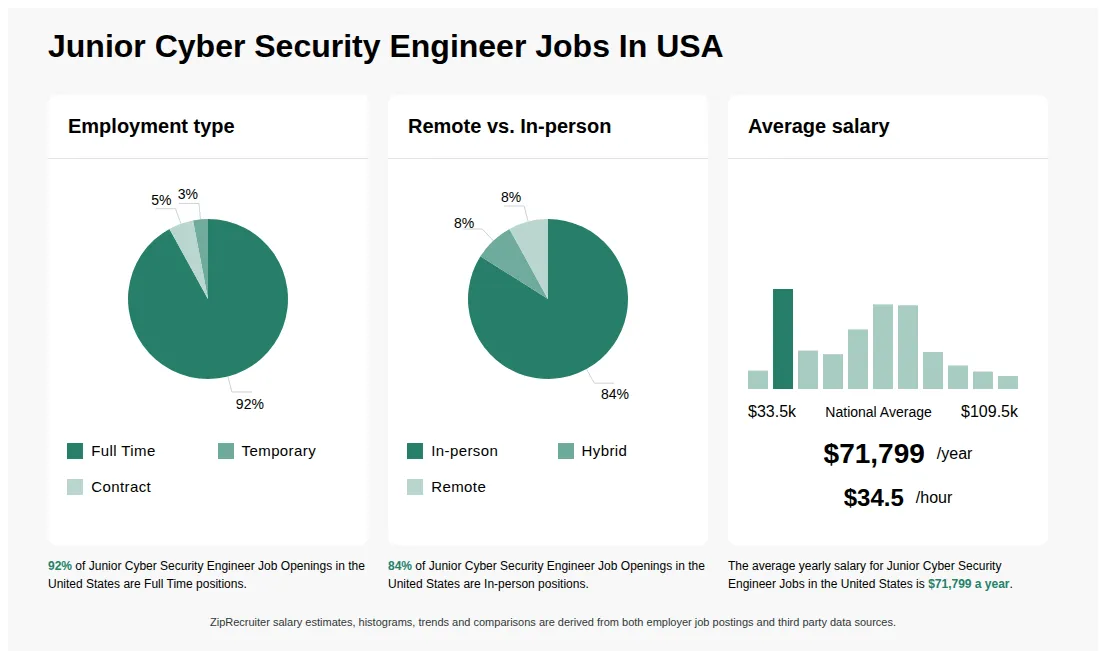
Junior Cyber Security Engineer information
See salary details
$33.5K - $40.4K
3% of jobs
$40.4K - $47.3K
20% of jobs
$48.8K is the 25th percentile. Wages below this are outliers.
$47.3K - $54.2K
7% of jobs
$54.2K - $61.1K
6% of jobs
$61.1K - $68K
12% of jobs
The median wage is $68.5K / yr.
$68K - $75K
17% of jobs
$78.6K is the 75th percentile. Wages above this are outliers.
$75K - $81.9K
17% of jobs
$81.9K - $88.8K
7% of jobs
$88.8K - $95.7K
4% of jobs
$95.7K - $102.6K
3% of jobs
$102.6K - $109.5K
2% of jobs
$33.5K
$71.8K
$109.5K
How much do junior cyber security engineer jobs pay per year?
As of Sep 14, 2026, the average yearly pay for junior cyber security engineer in the United States is $71,799.00, according to ZipRecruiter salary data. Most workers in this role earn between $48,500.00 and $80,000.00 per year, depending on experience, location, and employer.
What is a junior cyber security engineer?
A Junior Cyber Security Engineer is an entry-level professional responsible for assisting in identifying, analyzing, and mitigating security threats within an organization’s IT infrastructure. They work under the guidance of senior security engineers to monitor networks, respond to security incidents, and implement security measures. Their tasks may include vulnerability assessments, security audits, and ensuring compliance with security policies. They often use cybersecurity tools to detect and prevent breaches while continuously learning about evolving threats. This role provides hands-on experience and serves as a foundation for advancing in the cybersecurity field.
What types of projects or tasks are typically assigned to a junior cyber security engineer?
As a Junior Cyber Security Engineer, you can expect to assist with monitoring network activity, analyzing security alerts, and helping to identify and remediate vulnerabilities. Many entry-level professionals spend time conducting routine security audits, updating and maintaining security tools, and assisting with the development of internal security policies. You may also work closely with senior engineers to learn about incident response and threat analysis. This hands-on experience helps you build foundational skills and gain exposure to various aspects of cybersecurity, providing a strong pathway for professional growth.
What are the key skills and qualifications needed to thrive in the junior cyber security engineer position, and why are they important?
To thrive as a Junior Cyber Security Engineer, you need a solid understanding of networking, information security principles, and risk assessment, often acquired through a degree in computer science or a related field. Familiarity with security tools such as firewalls, intrusion detection systems (IDS), and holding certifications like CompTIA Security+ or CEH is highly valued. Strong problem-solving abilities, attention to detail, and effective communication skills help you excel in collaborative environments. These competencies are crucial to identify vulnerabilities, implement security measures, and work efficiently within a security team.
More about Junior Cyber Security Engineer jobs
What cities are hiring for Junior Cyber Security Engineer jobs?
Cities with the most Junior Cyber Security Engineer job openings:
What are the most commonly searched types of Cyber Security Engineer jobs?
The most popular types of Cyber Security Engineer jobs are:
What states have the most Junior Cyber Security Engineer jobs?
States with the most job openings for Junior Cyber Security Engineer jobs include:
What are popular job titles related to Junior Cyber Security Engineer jobs?
For Junior Cyber Security Engineer jobs, the most frequently searched job titles are:

Junior Cybersecurity Engineer
Annapolis Junction, MD • On-site
TekSynap
• IT Services • 201 - 500 employees201 - 500 employees
Full-time
Re-posted 25 days ago
TekSynap rating

8.1
Based on 5 frontline employees who took The Breakroom Quiz
Job description
Job Summary:
TekSynap is a fast-growing high-tech company that understands both the pace of technology today and the need to have a comprehensive well planned information management environment. The Junior Cybersecurity Engineer oversees security plans and details security policies, developing and implementing security measures to protect information and network infrastructure.
Responsibilities:
• Develop, execute and track the performance of security measures to protect information and network infrastructure and computer systems.
• Design computer security strategy and engineer comprehensive cybersecurity architecture.
• Identify, define and document system security requirements and recommend solutions to management.
• Configure, troubleshoot and maintain security infrastructure software and hardware.
• Install software that monitors systems and networks for security breaches and intrusions.
• Monitor systems for irregular behavior and set up preventive measures.
• Plan, develop, implement and update company’s information security strategy.
• Implement and design security counter-measures to respond in the event of a security breach.
• Coordinate security rules and internal access authorization with IT Operations leadership and management.
• Configure and maintain user access and accounts.
• Ensure compliance with security policies and procedures as well as industry-specific regulations.
• Evaluate and recommend security and equipment updates as necessary.
• Prepare and maintain technical documentation.
• Conduct periodic risk management audits to ensure company security is updated and as effective as possible.
• May design, lead and conduct security policy training and education.
• Research latest security threats and methods to counteract security risks.
Qualifications:
Required:
• Active TS/SCI + CI Poly clearance
• HS, 8-10 years of relevant experience; BS, 2-4 years; MS 0-2 years
• One or more of the following DoD 8570/8140 certifications: ComTIA Security+, CompTIA CySA+, SSCP (ISC²), GIAC Security Essentials (GSEC)
Company:
TekSynap is a well planned information management environment that offers to meet the business needs of Local Government customers. Founded in 2008, the company is headquartered in Reston, USA, with a team of 1001-5000 employees. The company is currently Late Stage.
TekSynap is a fast-growing high-tech company that understands both the pace of technology today and the need to have a comprehensive well planned information management environment. The Junior Cybersecurity Engineer oversees security plans and details security policies, developing and implementing security measures to protect information and network infrastructure.
Responsibilities:
• Develop, execute and track the performance of security measures to protect information and network infrastructure and computer systems.
• Design computer security strategy and engineer comprehensive cybersecurity architecture.
• Identify, define and document system security requirements and recommend solutions to management.
• Configure, troubleshoot and maintain security infrastructure software and hardware.
• Install software that monitors systems and networks for security breaches and intrusions.
• Monitor systems for irregular behavior and set up preventive measures.
• Plan, develop, implement and update company’s information security strategy.
• Implement and design security counter-measures to respond in the event of a security breach.
• Coordinate security rules and internal access authorization with IT Operations leadership and management.
• Configure and maintain user access and accounts.
• Ensure compliance with security policies and procedures as well as industry-specific regulations.
• Evaluate and recommend security and equipment updates as necessary.
• Prepare and maintain technical documentation.
• Conduct periodic risk management audits to ensure company security is updated and as effective as possible.
• May design, lead and conduct security policy training and education.
• Research latest security threats and methods to counteract security risks.
Qualifications:
Required:
• Active TS/SCI + CI Poly clearance
• HS, 8-10 years of relevant experience; BS, 2-4 years; MS 0-2 years
• One or more of the following DoD 8570/8140 certifications: ComTIA Security+, CompTIA CySA+, SSCP (ISC²), GIAC Security Essentials (GSEC)
Company:
TekSynap is a well planned information management environment that offers to meet the business needs of Local Government customers. Founded in 2008, the company is headquartered in Reston, USA, with a team of 1001-5000 employees. The company is currently Late Stage.

About TekSynap
Sourced by ZipRecruiter
Industry
It services
Company size
201 - 500 Employees
Headquarters location
Reston, VA, US