Co-Simulation Engineer III
$104K - $130K/yr
DLB Associates is a premier engineering and consulting firm specializing in innovative, mission ... Co-Simulation Engineer III Position Location: Remote - work virtually from most locations in the ...
$104K - $130K/yr
DLB Associates is a premier engineering and consulting firm specializing in innovative, mission ... Co-Simulation Engineer III Position Location: Remote - work virtually from most locations in the ...
$104K - $130K/yr
DLB Associates is a premier engineering and consulting firm specializing in innovative, mission ... Co-Simulation Engineer III Position Location: Remote - work virtually from most locations in the ...
Annapolis Junction, MD · On-site
$185K - $200K/yr
Tensley Consulting is seeking a Modeling, Simulation, and Technical Analyst (MSTA) - Level 3 to support the distributed TechSIGINT mission. The selected candidate will apply analytic methods ...
Quick apply
Annapolis Junction, MD · On-site
$185K - $200K/yr
Tensley Consulting is seeking a Modeling, Simulation, and Technical Analyst (MSTA) - Level 3 to support the distributed TechSIGINT mission. The selected candidate will apply analytic methods ...
Our industry-leading experts in engineering and consulting are committed to driving positive change ... Analyze simulation results to identify optimal configurations aligned with customer objectives.
Our industry-leading experts in engineering and consulting are committed to driving positive change ... Analyze simulation results to identify optimal configurations aligned with customer objectives.
Customer support, training, consulting, problem investigation and debugging * Engage with domestic and international business partners to successfully develop software and simulation solutions used ...
Customer support, training, consulting, problem investigation and debugging * Engage with domestic and international business partners to successfully develop software and simulation solutions used ...
Customer support, training, consulting, problem investigation and debugging * Engage with domestic and international business partners to successfully develop software and simulation solutions used ...
Customer support, training, consulting, problem investigation and debugging * Engage with domestic and international business partners to successfully develop software and simulation solutions used ...
Customer support, training, consulting, problem investigation and debugging * Engage with domestic and international business partners to successfully develop software and simulation solutions used ...
Customer support, training, consulting, problem investigation and debugging * Engage with domestic and international business partners to successfully develop software and simulation solutions used ...
Customer support, training, consulting, problem investigation and debugging * Engage with domestic and international business partners to successfully develop software and simulation solutions used ...
Customer support, training, consulting, problem investigation and debugging * Engage with domestic and international business partners to successfully develop software and simulation solutions used ...
Customer support, training, consulting, problem investigation and debugging * Engage with domestic and international business partners to successfully develop software and simulation solutions used ...
Customer support, training, consulting, problem investigation and debugging * Engage with domestic and international business partners to successfully develop software and simulation solutions used ...
Customer support, training, consulting, problem investigation and debugging * Engage with domestic and international business partners to successfully develop software and simulation solutions used ...
Customer support, training, consulting, problem investigation and debugging * Engage with domestic and international business partners to successfully develop software and simulation solutions used ...
Customer support, training, consulting, problem investigation and debugging * Engage with domestic and international business partners to successfully develop software and simulation solutions used ...
Customer support, training, consulting, problem investigation and debugging * Engage with domestic and international business partners to successfully develop software and simulation solutions used ...
Customer support, training, consulting, problem investigation and debugging * Engage with domestic and international business partners to successfully develop software and simulation solutions used ...
Customer support, training, consulting, problem investigation and debugging * Engage with domestic and international business partners to successfully develop software and simulation solutions used ...
... consultants and support. To ensure mission success we focus on putting our customers first while ... The Visualization & Simulation Software Engineer will build interactive 3D applications and ...
... consultants and support. To ensure mission success we focus on putting our customers first while ... The Visualization & Simulation Software Engineer will build interactive 3D applications and ...
Customer support, training, consulting, problem investigation and debugging * Engage with domestic and international business partners to successfully develop software and simulation solutions used ...
Customer support, training, consulting, problem investigation and debugging * Engage with domestic and international business partners to successfully develop software and simulation solutions used ...
Customer support, training, consulting, problem investigation and debugging * Engage with domestic and international business partners to successfully develop software and simulation solutions used ...
Customer support, training, consulting, problem investigation and debugging * Engage with domestic and international business partners to successfully develop software and simulation solutions used ...
Customer support, training, consulting, problem investigation and debugging * Engage with domestic and international business partners to successfully develop software and simulation solutions used ...
Customer support, training, consulting, problem investigation and debugging * Engage with domestic and international business partners to successfully develop software and simulation solutions used ...
Customer support, training, consulting, problem investigation and debugging * Engage with domestic and international business partners to successfully develop software and simulation solutions used ...
Customer support, training, consulting, problem investigation and debugging * Engage with domestic and international business partners to successfully develop software and simulation solutions used ...
... The Consultant- Standardized Patients (SP) are needed to serve in the role of a patient undergoing a physical examination by a student in the health care professions. The SP will simulate the ...
... The Consultant- Standardized Patients (SP) are needed to serve in the role of a patient undergoing a physical examination by a student in the health care professions. The SP will simulate the ...
Dearborn, MI · On-site
This role is responsible for leading development of discrete-event simulation models and driving ... As a global leader in architecture, engineering, and consulting, we partner with clients to deliver ...
Dearborn, MI · On-site
This role is responsible for leading development of discrete-event simulation models and driving ... As a global leader in architecture, engineering, and consulting, we partner with clients to deliver ...
This role is responsible for leading development of discrete-event simulation models and driving ... As a global leader in architecture, engineering, and consulting, we partner with clients to deliver ...
This role is responsible for leading development of discrete-event simulation models and driving ... As a global leader in architecture, engineering, and consulting, we partner with clients to deliver ...
In between meetings, he/she will present virtually to new clients our RTDS-based simulation capabilities and consulting offerings. Finally, the Senior Expert will review the progress of several RTDS ...
New
In between meetings, he/she will present virtually to new clients our RTDS-based simulation capabilities and consulting offerings. Finally, the Senior Expert will review the progress of several RTDS ...
New
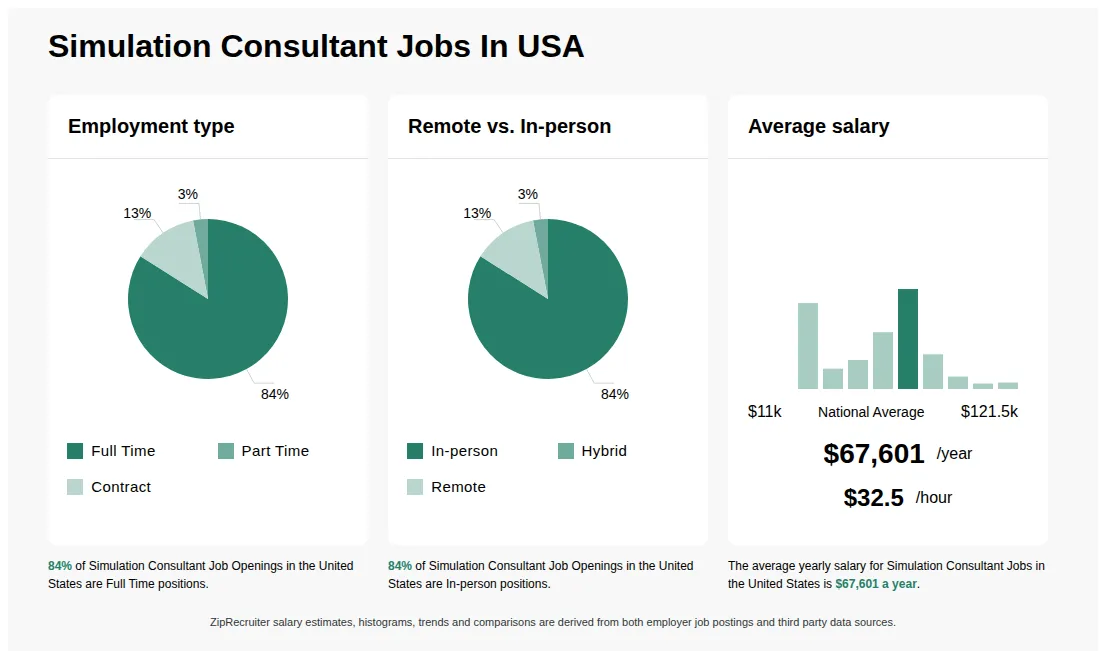
$11K - $21K
0% of jobs
$21K - $31.1K
0% of jobs
$41K is the 25th percentile. Wages below this are outliers.
$31.1K - $41.1K
25% of jobs
$41.1K - $51.2K
5% of jobs
$51.2K - $61.2K
8% of jobs
The median wage is $67.8K / yr.
$61.2K - $71.3K
17% of jobs
$77.8K is the 75th percentile. Wages above this are outliers.
$71.3K - $81.3K
29% of jobs
$81.3K - $91.4K
9% of jobs
$91.4K - $101.4K
3% of jobs
$101.4K - $111.5K
1% of jobs
$111.5K - $121.5K
1% of jobs
$11K
$67.6K
$121.5K
To thrive as a Simulation Consultant, you need a strong background in engineering, mathematics, or computer science, combined with expertise in modeling and simulation methodologies. Proficiency with simulation software (such as AnyLogic, Simul8, or Arena), computing languages (like Python or MATLAB), and relevant certifications (like Certified Modeling & Simulation Professional) is highly valuable. Exceptional problem-solving, communication, and project management skills help you effectively translate client needs into simulation solutions and work collaboratively within multidisciplinary teams. These skills are essential for delivering high-impact, accurate simulations that drive informed decision-making and client satisfaction.
Simulation Consultants often work on diverse projects such as optimizing manufacturing processes, analyzing supply chain logistics, improving healthcare systems, or modeling complex engineering scenarios. Their work involves collaborating closely with clients to understand specific challenges, developing tailored simulation models, and interpreting data-driven insights to recommend actionable improvements. The impact of their work is significant, as it helps organizations test solutions in a risk-free environment and make evidence-based decisions. Simulation Consultants frequently present their findings to stakeholders and may also help train in-house staff to use or interpret simulation tools. This role offers variety and the opportunity to make a tangible difference across multiple industries.
A Simulation Consultant uses modeling and simulation techniques to analyze complex systems, optimize processes, and support decision-making. They work across various industries, including manufacturing, healthcare, and engineering, to create virtual models that test different scenarios without real-world risks. Their role involves data analysis, software expertise, and collaboration with stakeholders to improve efficiency and reduce costs.

$104K - $130K/yr
Full-time
Medical, Dental, Vision, Life, Retirement, PTO
Posted 8 days ago

Sourced by ZipRecruiter
Engineering professional services
51 - 200 Employees
Neptune City, NJ, US
1980


