Remote after 30 days or proficient. Must live in Anchorage Municipality. Qualifications: SCF ... Six (6) years of medical or behavioral coding experience. * Two (2) years of clerical experience ...
Remote after 30 days or proficient. Must live in Anchorage Municipality. Qualifications: SCF ... Six (6) years of medical or behavioral coding experience. * Two (2) years of clerical experience ...

Outpatient Coding Technician - Hospital Rev Cycle - Remote Work Schedule
Anchorage, AK · On-site +1
$21.10 - $25.80/hr
Medical Insurance provided through the Federal Employee Health Benefits Program as a Tribal ... Productivity Data & Reporting: o Calculate and communicate coder productivity data to HIM coding ...
Outpatient Coding Technician - Hospital Rev Cycle - Remote Work Schedule
Anchorage, AK · On-site +1
$21.10 - $25.80/hr
Medical Insurance provided through the Federal Employee Health Benefits Program as a Tribal ... Productivity Data & Reporting: o Calculate and communicate coder productivity data to HIM coding ...
Remote Journeyman Plumber - Prudhoe Bay
Prudhoe Bay, AK · Remote
$114K/yr
Cuts, threads, bends, and installs or repairs a wide variety of pipes (includes medical gas systems ... plumbing codes. * Must be licensed to work as a Journeyman Plumber in the State of Alaska. * A ...
Remote Journeyman Plumber - Prudhoe Bay
Prudhoe Bay, AK · Remote
$114K/yr
Cuts, threads, bends, and installs or repairs a wide variety of pipes (includes medical gas systems ... plumbing codes. * Must be licensed to work as a Journeyman Plumber in the State of Alaska. * A ...
Remote Journeyman Plumber - Prudhoe Bay
Prudhoe Bay, AK · On-site +1
$114K/yr
Cuts, threads, bends, and installs or repairs a wide variety of pipes (includes medical gas systems ... plumbing codes. * Must be licensed to work as a Journeyman Plumber in the State of Alaska. * A ...
Remote Journeyman Plumber - Prudhoe Bay
Prudhoe Bay, AK · On-site +1
$114K/yr
Cuts, threads, bends, and installs or repairs a wide variety of pipes (includes medical gas systems ... plumbing codes. * Must be licensed to work as a Journeyman Plumber in the State of Alaska. * A ...
Remote Journeyman Plumber - Prudhoe Bay
Prudhoe Bay, AK · Remote
$114K/yr
Cuts, threads, bends, and installs or repairs a wide variety of pipes (includes medical gas systems ... plumbing codes. * Must be licensed to work as a Journeyman Plumber in the State of Alaska. * A ...
Remote Journeyman Plumber - Prudhoe Bay
Prudhoe Bay, AK · Remote
$114K/yr
Cuts, threads, bends, and installs or repairs a wide variety of pipes (includes medical gas systems ... plumbing codes. * Must be licensed to work as a Journeyman Plumber in the State of Alaska. * A ...
Remote Journeyman Plumber - Prudhoe Bay
Prudhoe Bay, AK · On-site +1
$114K/yr
Cuts, threads, bends, and installs or repairs a wide variety of pipes (includes medical gas systems ... plumbing codes. * Must be licensed to work as a Journeyman Plumber in the State of Alaska. * A ...
Remote Journeyman Plumber - Prudhoe Bay
Prudhoe Bay, AK · On-site +1
$114K/yr
Cuts, threads, bends, and installs or repairs a wide variety of pipes (includes medical gas systems ... plumbing codes. * Must be licensed to work as a Journeyman Plumber in the State of Alaska. * A ...

Medical Billing Specialist
Anchorage, AK · Remote
$50 - $80/hr
Remote micro1 is engaging Medical Writers / Clinical Document Authors to participate in a customer's project focused on developing advanced AI-assisted writing tools for clinical documentation. In ...
Medical Billing Specialist
Anchorage, AK · Remote
$50 - $80/hr
Remote micro1 is engaging Medical Writers / Clinical Document Authors to participate in a customer's project focused on developing advanced AI-assisted writing tools for clinical documentation. In ...

Machine Learning Engineer New Grad 2024-2025 -Remote
Anchorage, AK · Remote
$51.76 - $77.74/hr
Our engineers focus on creating polished products and writing high quality code by designing APIs ... Quora offers a wide range of benefits including medical/dental/vision coverage, equity refreshers ...
Machine Learning Engineer New Grad 2024-2025 -Remote
Anchorage, AK · Remote
$51.76 - $77.74/hr
Our engineers focus on creating polished products and writing high quality code by designing APIs ... Quora offers a wide range of benefits including medical/dental/vision coverage, equity refreshers ...
Machine Learning Engineer New Grad 2024-2025 -Remote
Fairbanks, AK · Remote
$51.76 - $77.74/hr
Our engineers focus on creating polished products and writing high quality code by designing APIs ... Quora offers a wide range of benefits including medical/dental/vision coverage, equity refreshers ...
Machine Learning Engineer New Grad 2024-2025 -Remote
Fairbanks, AK · Remote
$51.76 - $77.74/hr
Our engineers focus on creating polished products and writing high quality code by designing APIs ... Quora offers a wide range of benefits including medical/dental/vision coverage, equity refreshers ...
Machine Learning Engineer New Grad 2024-2025 -Remote
Juneau, AK · Remote
$51.76 - $77.74/hr
Our engineers focus on creating polished products and writing high quality code by designing APIs ... Quora offers a wide range of benefits including medical/dental/vision coverage, equity refreshers ...
Machine Learning Engineer New Grad 2024-2025 -Remote
Juneau, AK · Remote
$51.76 - $77.74/hr
Our engineers focus on creating polished products and writing high quality code by designing APIs ... Quora offers a wide range of benefits including medical/dental/vision coverage, equity refreshers ...
iOS Engineer -Remote
Fairbanks, AK · Remote
$61.63 - $88.47/hr
Own the entire software development process from timeline estimation to coding, testing and release ... Quora offers a wide range of benefits including medical/dental/vision coverage, equity refreshers ...
iOS Engineer -Remote
Fairbanks, AK · Remote
$61.63 - $88.47/hr
Own the entire software development process from timeline estimation to coding, testing and release ... Quora offers a wide range of benefits including medical/dental/vision coverage, equity refreshers ...

Project Engineer
Palmer, AK · On-site +1
... code: 17-3022 FLSA Classification: Exempt Department/Location: Palmer Office / Remote Projects ... Once eligible, Health Insurance (medical, dental, vision) 401k, life insurance, long-term ...
Project Engineer
Palmer, AK · On-site +1
... code: 17-3022 FLSA Classification: Exempt Department/Location: Palmer Office / Remote Projects ... Once eligible, Health Insurance (medical, dental, vision) 401k, life insurance, long-term ...
iOS Engineer -Remote
Anchorage, AK · Remote
$61.63 - $88.47/hr
Own the entire software development process from timeline estimation to coding, testing and release ... Quora offers a wide range of benefits including medical/dental/vision coverage, equity refreshers ...
iOS Engineer -Remote
Anchorage, AK · Remote
$61.63 - $88.47/hr
Own the entire software development process from timeline estimation to coding, testing and release ... Quora offers a wide range of benefits including medical/dental/vision coverage, equity refreshers ...
iOS Engineer -Remote
Juneau, AK · Remote
$61.63 - $88.47/hr
Own the entire software development process from timeline estimation to coding, testing and release ... Quora offers a wide range of benefits including medical/dental/vision coverage, equity refreshers ...
iOS Engineer -Remote
Juneau, AK · Remote
$61.63 - $88.47/hr
Own the entire software development process from timeline estimation to coding, testing and release ... Quora offers a wide range of benefits including medical/dental/vision coverage, equity refreshers ...
Medical Claims Specialist II - DOE - $1,000.00 Sig-on Bonus(Non-remote)
Anchorage, AK · On-site +1
$18.50 - $24.50/hr
Medical Insurance provided through the Federal Employee Health Benefits Program as a Tribal ... MINIMUM EDUCATION QUALIFICATION A billing or coding certification and/or Associate's degree in ...
Medical Claims Specialist II - DOE - $1,000.00 Sig-on Bonus(Non-remote)
Anchorage, AK · On-site +1
$18.50 - $24.50/hr
Medical Insurance provided through the Federal Employee Health Benefits Program as a Tribal ... MINIMUM EDUCATION QUALIFICATION A billing or coding certification and/or Associate's degree in ...

Construction Project Manager - Strong Benefits + High-Impact Projects
Anchorage, AK · On-site +1
$110K - $130K/hr
Access to employer-sponsored medical insurance and 100% employer-paid dental and vision coverage ... Work is split between office-based project management and active construction sites in remote and ...
Construction Project Manager - Strong Benefits + High-Impact Projects
Anchorage, AK · On-site +1
$110K - $130K/hr
Access to employer-sponsored medical insurance and 100% employer-paid dental and vision coverage ... Work is split between office-based project management and active construction sites in remote and ...
Construction Project Manager - Strong Benefits + High-Impact Projects
Fairbanks, AK · On-site +1
$110K - $130K/yr
Access to employer-sponsored medical insurance and 100% employer-paid dental and vision coverage ... Work is split between office-based project management and active construction sites in remote and ...
Quick apply
Construction Project Manager - Strong Benefits + High-Impact Projects
Fairbanks, AK · On-site +1
$110K - $130K/yr
Access to employer-sponsored medical insurance and 100% employer-paid dental and vision coverage ... Work is split between office-based project management and active construction sites in remote and ...
Description This is a remote position, based out of the corporate office in Anchorage, AK. Please ... medical insurance, PTO, dental, vision, and a matching 401(k) retirement plan, as well as clear ...
Description This is a remote position, based out of the corporate office in Anchorage, AK. Please ... medical insurance, PTO, dental, vision, and a matching 401(k) retirement plan, as well as clear ...
Construction Project Manager - Strong Benefits + High-Impact Projects
Anchorage, AK · On-site +1
$110K - $130K/yr
Access to employer-sponsored medical insurance and 100% employer-paid dental and vision coverage ... Work is split between office-based project management and active construction sites in remote and ...
Quick apply
Construction Project Manager - Strong Benefits + High-Impact Projects
Anchorage, AK · On-site +1
$110K - $130K/yr
Access to employer-sponsored medical insurance and 100% employer-paid dental and vision coverage ... Work is split between office-based project management and active construction sites in remote and ...

This is a remote position, based out of the corporate office in Anchorage, AK. Please note that ... Ensure adherence to federal, state, and local construction codes and environmental regulations.
This is a remote position, based out of the corporate office in Anchorage, AK. Please note that ... Ensure adherence to federal, state, and local construction codes and environmental regulations.
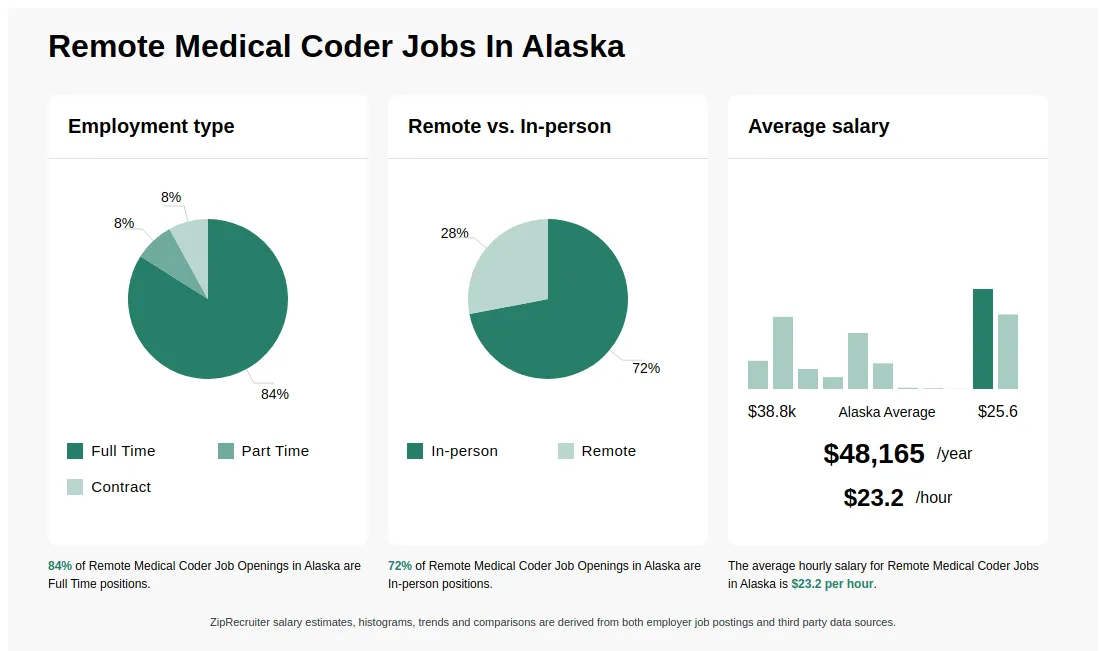
Remote Medical Coder information
See Alaska salary details
$18.64 - $19.27
7% of jobs
$19.88 is the 25th percentile. Wages below this are outliers.
$19.27 - $19.91
19% of jobs
$19.91 - $20.55
5% of jobs
$20.55 - $21.18
3% of jobs
$21.18 - $21.82
14% of jobs
The median wage is $21.98 / hr.
$21.82 - $22.45
6% of jobs
$22.45 - $23.09
0% of jobs
$23.09 - $23.72
0% of jobs
$23.72 - $24.36
0% of jobs
$24.86 is the 75th percentile. Wages above this are outliers.
$24.36 - $24.99
26% of jobs
$24.99 - $25.63
20% of jobs
$18
$23
$25
How much do remote medical coder jobs pay per hour?
As of Sep 8, 2026, the average hourly pay for remote medical coder in Alaska is $23.16, according to ZipRecruiter salary data. Most workers in this role earn between $19.42 and $24.62 per hour, depending on experience, location, and employer.
What is a remote medical coder?
A remote medical coder is a healthcare professional who reviews clinical documents and assigns standardized codes for diagnoses, procedures, and medical services, all while working from a remote location such as their home. These codes are essential for billing, insurance claims, and maintaining patient records. Remote medical coders typically use electronic health records (EHR) and must have a strong understanding of medical terminology, coding systems like ICD-10 and CPT, and relevant regulations. Working remotely offers flexibility but still requires attention to detail, confidentiality, and adherence to industry standards.
What does a remote medical coder do?
Remote medical coders are medical coders who work from home or locations outside of healthcare facilities. They process patient information, such as diagnosis, services rendered, and equipment used to conduct tests, in order to translate it into medical codes consisting of numbers and letters. Billing and coding specialists manage this information so that patients or their insurance companies can be billed appropriately. Remote medical coders may be self-employed or work for large coding firms that contract with hospitals or healthcare facilities.
What are the key skills and qualifications needed to thrive as a remote medical coder, and why are they important?
To thrive as a Remote Medical Coder, you need a solid understanding of medical terminology, anatomy, and coding systems such as ICD-10 and CPT, usually supported by a coding certification (e.g., CPC, CCS). Familiarity with electronic health records (EHRs) and coding software like 3M or Epic is essential for accurate and efficient work. Attention to detail, time management, and strong written communication skills help remote coders excel in independent, deadline-driven environments. These abilities ensure accurate billing, compliance with regulations, and minimal claim denials, which are critical for healthcare organizations' operational and financial success.
How do remote medical coders typically communicate and collaborate with healthcare providers and team members?
Remote Medical Coders often collaborate with healthcare providers, billing teams, and other coders through secure digital platforms, email, and scheduled video conferences. Clear communication is essential to clarify documentation, resolve coding discrepancies, and ensure accurate billing. Many employers use specialized health information systems and project management tools to streamline workflow and maintain HIPAA compliance. Frequent virtual meetings and messaging help foster teamwork and keep everyone aligned, even when working from different locations.
What is the difference between Remote Medical Coder vs Remote Medical Biller?
| Aspect | Remote Medical Coder | Remote Medical Biller |
|---|---|---|
| Certifications | Certified Professional Coder (CPC), CCS | Certified Medical Reimbursement Specialist (CMRS), CPC |
| Work Environment | Analyzing medical records, coding diagnoses and procedures | Submitting claims, following up on payments |
| Industry Usage | Healthcare providers, hospitals, clinics | Insurance companies, billing services, healthcare providers |
Remote Medical Coders and Remote Medical Billers often work together but focus on different tasks. Coders assign codes based on medical records, while Billers handle claims submission and payment follow-up. Both roles require similar certifications and are essential in healthcare revenue cycle management.
How to get a remote job as a remote medical coder?
To secure a remote medical coder position, obtain relevant certifications such as CPC or CCS, gain experience with coding software and electronic health records, and build a strong resume highlighting your coding skills. Job seekers should search for openings on healthcare job boards and company websites, and demonstrate attention to detail and knowledge of medical terminology during the application process.
Is remote medical coding worth it?
Remote medical coding is a viable career option that offers flexibility and the ability to work from home. It requires certification, attention to detail, and proficiency with coding software, making it suitable for those seeking a flexible schedule and independent work environment.
More about Remote Medical Coder jobs
What are the most commonly searched types of Medical Coder jobs in Alaska?
The most popular types of Medical Coder jobs in Alaska are:
What are popular job titles related to Remote Medical Coder jobs in Alaska?
For Remote Medical Coder jobs in Alaska, the most frequently searched job titles are:
What job categories do people searching Remote Medical Coder jobs in Alaska look for?
The top searched job categories for Remote Medical Coder jobs in Alaska are:
What cities in Alaska are hiring for Remote Medical Coder jobs?
Cities in Alaska with the most Remote Medical Coder job openings:
What are popular job titles related to Remote Medical Coder jobs in AK?
For Remote Medical Coder jobs in AK, the most frequently searched job titles are:

Full-time
Posted 4 days ago
Southcentral Foundation rating

7.4
Based on 33 frontline employees who took The Breakroom Quiz
263rd of 898 rated healthcare providers
Job description
Coding Analyst
Hiring Range: $30.14 to $40.18
The Southcentral Foundation (SCF) Coding Analyst is responsible for reviewing and assigning accurate medical and behavioral codes for diagnoses, procedures, and services performed by physicians and other qualified healthcare providers in the office setting. The Coding Analyst is an expert in coding across a wide range of services, including evaluation and management, surgery, radiology, pathology, behavioral, and medical procedures. The Coding Analyst demonstrates expertise in medical coding guidelines and regulations including compliance and reimbursement. The Coding Analyst has expertise in CPT, HCPCs, and ICD-10 as well as knowledge of anatomy, physiology, and medical terminology necessary to correctly code provider diagnosis and services. The Coding Analyst is responsible for training and/or mentoring Coding Specialist staff. In addition, the Coding Analyst demonstrates expertise in denials management, identifying root causes and proposing solutions.
Remote after 30 days or proficient. Must live in Anchorage Municipality.
Qualifications:
SCF programs are established for the purpose of serving a primary population comprised of Alaska Natives who are affiliated with the Cook Inlet Region, Inc. (CIRI) and Alaska Natives and American Indians within SCF’s geographical service area. All employees should have a thorough understanding of the cultures and the needs of the CIRI members and of the general culture and needs of Alaska Natives and American Indians. Such knowledge is critical in order to ensure the achievement of the mission and vision of SCF, “Working together with the Native community to provide the best services with Native staff who value the family and family wellness as the heart of the Native community”:
- Associate’s Degree in Accounting, Health Care Financial Management or related field; OR equivalent combination of training, education and related experience.
- CPC (Certified Professional Coding) Certification through AAPC or CCS or CCS-P (Certified Coding Specialist, Certified Coding Specialist-Professional) or RHIT (Registered Health Information Technician) or RHIA (Registered Health Information Administrator) certification through AHIMA required.
- Six (6) years of medical or behavioral coding experience.
- Two (2) years of clerical experience working in a health care organization or in a position that requires understanding and application of basic accounting principles or equivalent.
- Two (2) years’ experience training/mentoring others in coding CPT, E&M, ICD-10, and HCPCS
Employee Health Requirements:
Compliance with our Employee Health procedure is a condition of SCF employment. You are required to agree that you will comply with all job-related employee health screening and immunizations prior to your first day of employment. Jobs designated as a Health Care Personnel (HCP) position, requires that you have documentation that you have completed the following immunizations prior to your first day of employment: MMR (Measles, Mumps and Rubella, Varicella (Chicken Pox), Hepatitis B, Influenza, and T-dap (Tetanus - Diphtheria - Pertussis), COVID19 vaccination required.
As an additional condition of employment, the successful applicant must be able to comply with the applicable standards of SCF’s Background Check Policy, including the requirements imposed by the Alaska Barrier Crimes/Conditions and Background Checks regulations, the Indian Child Protection and Family Violence Prevention Act, the Crime Control Act of 1990, and the mandatory and permissive exclusion provisions of the Social Security Act.
Alaska Native/American Indian Preference in Employment
Pursuant to the Indian Self-Determination and Education Assistance Act, as amended, SCF pursues a policy of Alaska Native/American Indian preference in hiring, contracting, and training.
What Southcentral Foundation employees say
Pay
Benefits
Hours and flexibility
Workplace
Get the full story on Breakroom

About Southcentral Foundation
Sourced by ZipRecruiter
Industry
Health care and social assistance
Company size
1,001 - 5,000 Employees
Headquarters location
Anchorage, AK, US
Year founded
1982