Closer - REI
Boise, ID · Remote
$90K - $300K/yr (+ commission)
High Ticket Closer | Real Estate Investing Education About Curvion Blue At Curvion Blue, we help ... Remote Compensation Range: $90K - $300K
Quick apply
Boise, ID · Remote
$90K - $300K/yr (+ commission)
High Ticket Closer | Real Estate Investing Education About Curvion Blue At Curvion Blue, we help ... Remote Compensation Range: $90K - $300K
Quick apply
Boise, ID · Remote
$90K - $300K/yr (+ commission)
High Ticket Closer | Real Estate Investing Education About Curvion Blue At Curvion Blue, we help ... Remote Compensation Range: $90K - $300K
San Francisco, CA · Remote
$90K - $300K/yr (+ commission)
High Ticket Closer | Real Estate Investing Education About Curvion Blue At Curvion Blue, we help ... Remote Compensation Range: $90K - $300K
Quick apply
San Francisco, CA · Remote
$90K - $300K/yr (+ commission)
High Ticket Closer | Real Estate Investing Education About Curvion Blue At Curvion Blue, we help ... Remote Compensation Range: $90K - $300K
Sacramento, CA · Remote
$90K - $300K/yr (+ commission)
High Ticket Closer | Real Estate Investing Education About Curvion Blue At Curvion Blue, we help ... Remote Compensation Range: $90K - $300K
Quick apply
Sacramento, CA · Remote
$90K - $300K/yr (+ commission)
High Ticket Closer | Real Estate Investing Education About Curvion Blue At Curvion Blue, we help ... Remote Compensation Range: $90K - $300K
Oklahoma City, OK · Remote
$90K - $300K/yr (+ commission)
High Ticket Closer | Real Estate Investing Education About Curvion Blue At Curvion Blue, we help ... Remote Compensation Range: $90K - $300K
Quick apply
Oklahoma City, OK · Remote
$90K - $300K/yr (+ commission)
High Ticket Closer | Real Estate Investing Education About Curvion Blue At Curvion Blue, we help ... Remote Compensation Range: $90K - $300K
Austin, TX · Remote
$90K - $300K/yr (+ commission)
High Ticket Closer | Real Estate Investing Education About Curvion Blue At Curvion Blue, we help ... Remote Compensation Range: $90K - $300K
Quick apply
Austin, TX · Remote
$90K - $300K/yr (+ commission)
High Ticket Closer | Real Estate Investing Education About Curvion Blue At Curvion Blue, we help ... Remote Compensation Range: $90K - $300K
Tampa, FL · Remote
$90K - $300K/yr (+ commission)
High Ticket Closer | Real Estate Investing Education About Curvion Blue At Curvion Blue, we help ... Remote Compensation Range: $90K - $300K
Quick apply
Tampa, FL · Remote
$90K - $300K/yr (+ commission)
High Ticket Closer | Real Estate Investing Education About Curvion Blue At Curvion Blue, we help ... Remote Compensation Range: $90K - $300K
Miami, FL · Remote
$90K - $300K/yr (+ commission)
High Ticket Closer | Real Estate Investing Education About Curvion Blue At Curvion Blue, we help ... Remote Compensation Range: $90K - $300K
Quick apply
Miami, FL · Remote
$90K - $300K/yr (+ commission)
High Ticket Closer | Real Estate Investing Education About Curvion Blue At Curvion Blue, we help ... Remote Compensation Range: $90K - $300K
Indianapolis, IN · Remote
$90K - $300K/yr (+ commission)
High Ticket Closer | Real Estate Investing Education About Curvion Blue At Curvion Blue, we help ... Remote Compensation Range: $90K - $300K
Quick apply
Indianapolis, IN · Remote
$90K - $300K/yr (+ commission)
High Ticket Closer | Real Estate Investing Education About Curvion Blue At Curvion Blue, we help ... Remote Compensation Range: $90K - $300K
Columbus, OH · Remote
$90K - $300K/yr (+ commission)
High Ticket Closer | Real Estate Investing Education About Curvion Blue At Curvion Blue, we help ... Remote Compensation Range: $90K - $300K
Quick apply
Columbus, OH · Remote
$90K - $300K/yr (+ commission)
High Ticket Closer | Real Estate Investing Education About Curvion Blue At Curvion Blue, we help ... Remote Compensation Range: $90K - $300K
Charlotte, NC · Remote
$90K - $300K/yr (+ commission)
High Ticket Closer | Real Estate Investing Education About Curvion Blue At Curvion Blue, we help ... Remote Compensation Range: $90K - $300K
Quick apply
Charlotte, NC · Remote
$90K - $300K/yr (+ commission)
High Ticket Closer | Real Estate Investing Education About Curvion Blue At Curvion Blue, we help ... Remote Compensation Range: $90K - $300K
Los Angeles, CA · Remote
$90K - $300K/yr (+ commission)
High Ticket Closer | Real Estate Investing Education About Curvion Blue At Curvion Blue, we help ... Remote Compensation Range: $90K - $300K
Quick apply
Los Angeles, CA · Remote
$90K - $300K/yr (+ commission)
High Ticket Closer | Real Estate Investing Education About Curvion Blue At Curvion Blue, we help ... Remote Compensation Range: $90K - $300K
Fort Worth, TX · Remote
$90K - $300K/yr (+ commission)
High Ticket Closer | Real Estate Investing Education About Curvion Blue At Curvion Blue, we help ... Remote Compensation Range: $90K - $300K
Quick apply
Fort Worth, TX · Remote
$90K - $300K/yr (+ commission)
High Ticket Closer | Real Estate Investing Education About Curvion Blue At Curvion Blue, we help ... Remote Compensation Range: $90K - $300K
El Paso, TX · Remote
$90K - $300K/yr (+ commission)
High Ticket Closer | Real Estate Investing Education About Curvion Blue At Curvion Blue, we help ... Remote Compensation Range: $90K - $300K
Quick apply
El Paso, TX · Remote
$90K - $300K/yr (+ commission)
High Ticket Closer | Real Estate Investing Education About Curvion Blue At Curvion Blue, we help ... Remote Compensation Range: $90K - $300K
Atlanta, GA · Remote
$90K - $300K/yr (+ commission)
High Ticket Closer | Real Estate Investing Education About Curvion Blue At Curvion Blue, we help ... Remote Compensation Range: $90K - $300K
Quick apply
Atlanta, GA · Remote
$90K - $300K/yr (+ commission)
High Ticket Closer | Real Estate Investing Education About Curvion Blue At Curvion Blue, we help ... Remote Compensation Range: $90K - $300K
$90K - $300K/yr (+ commission)
High Ticket Closer | Real Estate Investing Education About Curvion Blue At Curvion Blue, we help ... Remote Compensation Range: $90K - $300K
Quick apply
$90K - $300K/yr (+ commission)
High Ticket Closer | Real Estate Investing Education About Curvion Blue At Curvion Blue, we help ... Remote Compensation Range: $90K - $300K
Little Rock, AR · Remote
$90K - $300K/yr (+ commission)
High Ticket Closer | Real Estate Investing Education About Curvion Blue At Curvion Blue, we help ... Remote Compensation Range: $90K - $300K
Quick apply
Little Rock, AR · Remote
$90K - $300K/yr (+ commission)
High Ticket Closer | Real Estate Investing Education About Curvion Blue At Curvion Blue, we help ... Remote Compensation Range: $90K - $300K
New York, NY · Remote
$90K - $300K/yr (+ commission)
High Ticket Closer | Real Estate Investing Education About Curvion Blue At Curvion Blue, we help ... Remote Compensation Range: $90K - $300K
Quick apply
New York, NY · Remote
$90K - $300K/yr (+ commission)
High Ticket Closer | Real Estate Investing Education About Curvion Blue At Curvion Blue, we help ... Remote Compensation Range: $90K - $300K
Nashville, TN · Remote
$90K - $300K/yr (+ commission)
High Ticket Closer | Real Estate Investing Education About Curvion Blue At Curvion Blue, we help ... Remote Compensation Range: $90K - $300K
Quick apply
Nashville, TN · Remote
$90K - $300K/yr (+ commission)
High Ticket Closer | Real Estate Investing Education About Curvion Blue At Curvion Blue, we help ... Remote Compensation Range: $90K - $300K
San Jose, CA · Remote
$90K - $300K/yr (+ commission)
High Ticket Closer | Real Estate Investing Education About Curvion Blue At Curvion Blue, we help ... Remote Compensation Range: $90K - $300K
Quick apply
San Jose, CA · Remote
$90K - $300K/yr (+ commission)
High Ticket Closer | Real Estate Investing Education About Curvion Blue At Curvion Blue, we help ... Remote Compensation Range: $90K - $300K
San Antonio, TX · Remote
$90K - $300K/yr (+ commission)
High Ticket Closer | Real Estate Investing Education About Curvion Blue At Curvion Blue, we help ... Remote Compensation Range: $90K - $300K
Quick apply
San Antonio, TX · Remote
$90K - $300K/yr (+ commission)
High Ticket Closer | Real Estate Investing Education About Curvion Blue At Curvion Blue, we help ... Remote Compensation Range: $90K - $300K
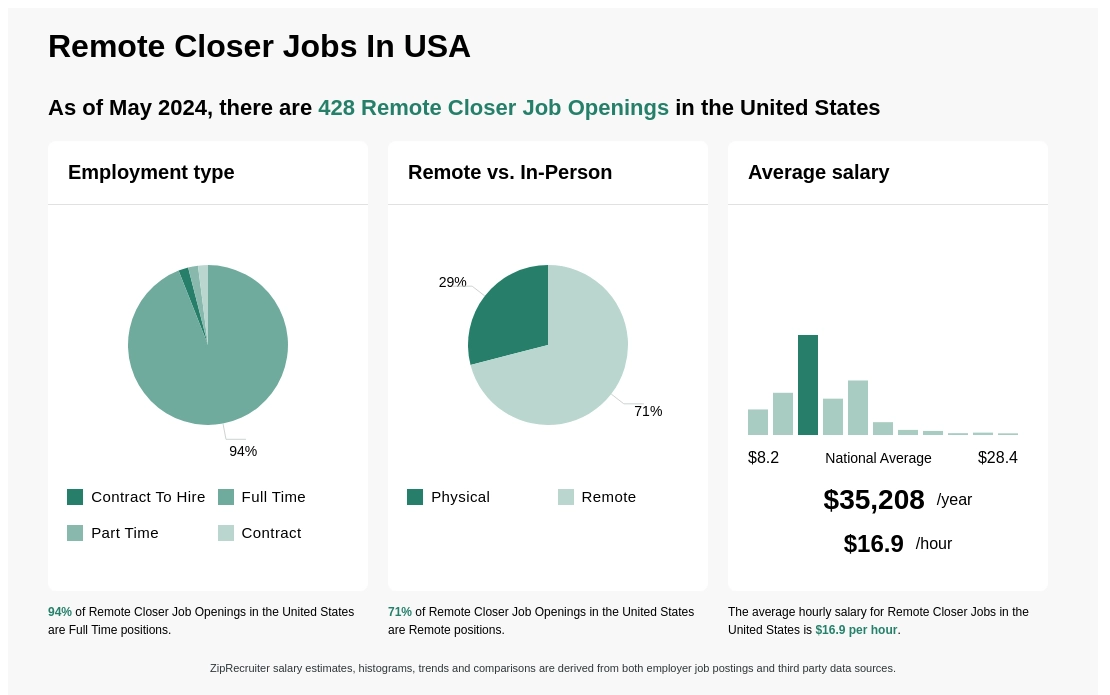
$8.17 - $10.01
9% of jobs
$10.01 - $11.84
15% of jobs
$11.91 is the 25th percentile. Wages below this are outliers.
$11.84 - $13.68
37% of jobs
$13.68 - $15.52
13% of jobs
$15.68 is the 75th percentile. Wages above this are outliers.
$15.52 - $17.35
20% of jobs
$17.35 - $19.19
4% of jobs
$19.19 - $21.02
1% of jobs
$21.02 - $22.86
1% of jobs
$22.86 - $24.69
0% of jobs
$24.69 - $26.53
0% of jobs
$26.53 - $28.37
0% of jobs
$8
$16
$28
A remote closer is a sales representative who is responsible for getting clients to commit to the sale. They typically contact the customer after another salesperson has established a relationship with the client. As a remote closer, you usually do not meet with clients in person; you perform your job duties at home or from another location outside of the office with internet connectivity. Your responsibilities include identifying the issues that are preventing the sale, discussing the advantages of the product or service you are selling, using proven techniques to influence the customer towards accepting the offer, and negotiating a final contract or agreement. Strong negotiation skills are required to succeed in this career.
| Aspect | Remote Closer | Remote Sales Representative |
|---|---|---|
| Primary Role | Focuses on closing sales deals | Generates leads and nurtures prospects |
| Skills Needed | Strong negotiation, persuasion, closing techniques | Lead generation, communication, relationship building |
| Work Environment | Typically works on finalizing deals with warm leads | Engages in outreach and prospecting |
| Common Certifications | Sales certifications, negotiation courses | Sales training, CRM proficiency |
While both roles are vital in sales, a Remote Closer specializes in sealing deals, whereas a Remote Sales Representative focuses on generating and nurturing leads. Understanding these differences helps employers and job seekers align expectations and skills for each position.
Cities with the most Remote Closer job openings:
The most popular types of Closer jobs are:
States with the most job openings for Remote Closer jobs include:
The top searched job categories for Remote Closer jobs are:
$90K - $300K/yr (+ commission)
Full-time
Re-posted 17 days ago
At Curvion Blue, we help some of the fastest-growing education, coaching, and consulting brands scale through world-class sales talent.
We partner with a portfolio of leading real estate investing education companies that help aspiring and experienced investors build wealth, generate cash flow, and create financial freedom through real estate.
Our mission is simple:
Deploy the right seller into the right revenue ecosystem.
We're currently hiring High Ticket Closers to support our growing Real Estate Investing Education Division.
Position OverviewThis is not a traditional sales role.
You'll speak with motivated individuals seeking to build wealth through real estate investing. Some are exploring their first investment property, while others are looking to scale existing portfolios, increase cash flow, or create greater financial freedom for themselves and their families.
Your role is to uncover a prospect's goals, current challenges, financial aspirations, and long-term vision while helping them determine whether one of our partner programs is the right fit.
Success in this role requires strong discovery skills, emotional intelligence, and the ability to create certainty around a prospect's future potential.
The ideal candidate understands how to sell transformation, not transactions.
You SHOULD Apply IfYou have experience selling high-ticket coaching, consulting, education, or business opportunity offers
You consistently performed as a top producer in previous sales roles
You excel at uncovering emotional buying motivations
You are skilled at building trust quickly
You thrive in consultative sales conversations
You enjoy helping people pursue ambitious financial goals
You are highly coachable and performance-driven
You rely heavily on scripts
You consider yourself primarily an order taker
You struggle building emotional connection with prospects
You prefer highly transactional sales environments
You avoid conversations around finances, goals, or personal responsibility
You need prospects to be fully convinced before getting on the call
Conducting world-class discovery conversations
Helping prospects gain clarity around their financial goals
Building trust and certainty throughout the sales process
Consistently converting qualified appointments into enrolled clients
Delivering an exceptional prospect experience
Achieving and exceeding revenue goals
Candidates from the following environments often excel in this role:
Real estate investing education
Wealth-building programs
Financial education
Business opportunity offers
Entrepreneurship coaching
Online education companies
Remote closing organizations
High-ticket coaching environments
Unlike traditional recruiting firms, Curvion Blue specializes in aligning elite sales talent with the environments where they are most likely to succeed.
We evaluate sales professionals based on sales psychology alignment, discovery sophistication, communication style, and buyer compatibility, not simply revenue claims.
As part of our Real Estate Investing Education Division, you'll have the opportunity to work with some of the most respected brands in the industry while receiving ongoing support, training, and growth opportunities.
If you're passionate about helping people create wealth, build financial freedom, and pursue meaningful life goals through real estate investing, we'd love to meet you.
Pay: $90,000.00 - $360,000.00 per year
This position is an Independent Contractor Role - 1099
Flexible Schedule
Work Location: Remote
Compensation Range: $90K - $300K