The SME will support research, analysis, and development of finished intelligence products addressing nation-state threats to national security, the private sector, and critical infrastructure. This ...
Quick apply
The SME will support research, analysis, and development of finished intelligence products addressing nation-state threats to national security, the private sector, and critical infrastructure. This ...
Quick apply
The SME will support research, analysis, and development of finished intelligence products addressing nation-state threats to national security, the private sector, and critical infrastructure. This ...
The SME will support research, analysis, and development of finished intelligence products addressing nation-state threats to national security, the private sector, and critical infrastructure. This ...
The SME will support research, analysis, and development of finished intelligence products addressing nation-state threats to national security, the private sector, and critical infrastructure. This ...
The SME will support research, analysis, and development of finished intelligence products addressing nation-state threats to national security, the private sector, and critical infrastructure. This ...
The SME will support research, analysis, and development of finished intelligence products addressing nation-state threats to national security, the private sector, and critical infrastructure. This ...
... intelligence capabilities, to the largest defense and health federal organizations. Through ... We are privately held, are repeatedly recognized as a top place to work, and have been on the Inc ...
... intelligence capabilities, to the largest defense and health federal organizations. Through ... We are privately held, are repeatedly recognized as a top place to work, and have been on the Inc ...
As a Intelligence Operations Specialist (Strategic Debriefer), you will serve as an overt Human ... The experience may have been gained in either the public, private sector or volunteer service.. One ...
As a Intelligence Operations Specialist (Strategic Debriefer), you will serve as an overt Human ... The experience may have been gained in either the public, private sector or volunteer service.. One ...
Dark Web & Deep Web Intelligence Collection ... Monitor and analyze dark web marketplaces, carding forums, private Telegram channels, Discord ...
Dark Web & Deep Web Intelligence Collection ... Monitor and analyze dark web marketplaces, carding forums, private Telegram channels, Discord ...
... private or public sector. Specialized experience must demonstrate the following: * Planning ... Developing and integrating foreign liaison strategy considerations into overall HQMC Intelligence ...
... private or public sector. Specialized experience must demonstrate the following: * Planning ... Developing and integrating foreign liaison strategy considerations into overall HQMC Intelligence ...
... intelligence capabilities, to the largest defense and health federal organizations. Through ... We are privately held, are repeatedly recognized as a top place to work, and have been on the Inc ...
... intelligence capabilities, to the largest defense and health federal organizations. Through ... We are privately held, are repeatedly recognized as a top place to work, and have been on the Inc ...
... intelligence capabilities, to the largest defense and health federal organizations. Through ... We are privately held, are repeatedly recognized as a top place to work, and have been on the Inc ...
Quick apply
... intelligence capabilities, to the largest defense and health federal organizations. Through ... We are privately held, are repeatedly recognized as a top place to work, and have been on the Inc ...
Mclean, VA · On-site
Successful candidates will demonstrate a solid understanding of intelligence production in the private sector, proficiency with global intelligence processes and platforms, and strong research ...
Mclean, VA · On-site
Successful candidates will demonstrate a solid understanding of intelligence production in the private sector, proficiency with global intelligence processes and platforms, and strong research ...
Successful candidates will demonstrate a solid understanding of intelligence production in the private sector, proficiency with global intelligence processes and platforms, and strong research ...
Successful candidates will demonstrate a solid understanding of intelligence production in the private sector, proficiency with global intelligence processes and platforms, and strong research ...
S. Army Intelligence and Security Command, 706th Military Intelligence Group, Office of the ... Creditable experience may include previous military experience, experience gained in the private ...
S. Army Intelligence and Security Command, 706th Military Intelligence Group, Office of the ... Creditable experience may include previous military experience, experience gained in the private ...
Successful candidates will demonstrate a solid understanding of intelligence production in the private sector, proficiency with global intelligence processes and platforms, and strong research ...
Successful candidates will demonstrate a solid understanding of intelligence production in the private sector, proficiency with global intelligence processes and platforms, and strong research ...
Covina, CA · Remote
$80K/yr
This is a mission-critical seat with high visibility in a rapidly growing (Inc#4043 Fastest Growing Companies of 2023) private intelligence firm which reports directly to the Vice President of Sales.
Quick apply
Covina, CA · Remote
$80K/yr
This is a mission-critical seat with high visibility in a rapidly growing (Inc#4043 Fastest Growing Companies of 2023) private intelligence firm which reports directly to the Vice President of Sales.
Mclean, VA · On-site
Successful candidates will demonstrate a solid understanding of intelligence production in the private sector, proficiency with global intelligence processes and platforms, and strong research ...
Mclean, VA · On-site
Successful candidates will demonstrate a solid understanding of intelligence production in the private sector, proficiency with global intelligence processes and platforms, and strong research ...
S. Army Intelligence and Security Command, 706th Military Intelligence Group, Office of the ... Creditable experience may include previous military experience, experience gained in the private ...
S. Army Intelligence and Security Command, 706th Military Intelligence Group, Office of the ... Creditable experience may include previous military experience, experience gained in the private ...
Washington, DC · On-site
$106K - $134K/yr
This experience may be a combination of private sector, civil service, or military experience. * Experience in intelligence programs or projects. * Experience in some of the following areas: All ...
Washington, DC · On-site
$106K - $134K/yr
This experience may be a combination of private sector, civil service, or military experience. * Experience in intelligence programs or projects. * Experience in some of the following areas: All ...
Successful candidates will demonstrate a solid understanding of intelligence production in the private sector, proficiency with global intelligence processes and platforms, and strong research ...
Successful candidates will demonstrate a solid understanding of intelligence production in the private sector, proficiency with global intelligence processes and platforms, and strong research ...
Fairfax, VA · On-site
$72K - $80K/yr
Three (3) years of general experience in analysis with federal, state, or local government agency, law enforcement agency, or private industry. * One year of experience writing Intelligence reports ...
Fairfax, VA · On-site
$72K - $80K/yr
Three (3) years of general experience in analysis with federal, state, or local government agency, law enforcement agency, or private industry. * One year of experience writing Intelligence reports ...
S. Army Intelligence and Security Command, Assistant Chief of Staff, G-3, Army Geospatial ... Creditable experience may include previous military experience, experience gained in the private ...
S. Army Intelligence and Security Command, Assistant Chief of Staff, G-3, Army Geospatial ... Creditable experience may include previous military experience, experience gained in the private ...
$11K - $22.1K
0% of jobs
$22.1K - $33.2K
0% of jobs
$33.2K - $44.3K
0% of jobs
$44.3K - $55.4K
0% of jobs
$55.4K - $66.5K
0% of jobs
$73.9K is the 25th percentile. Wages below this are outliers.
$66.5K - $77.5K
37% of jobs
$77.5K - $88.6K
0% of jobs
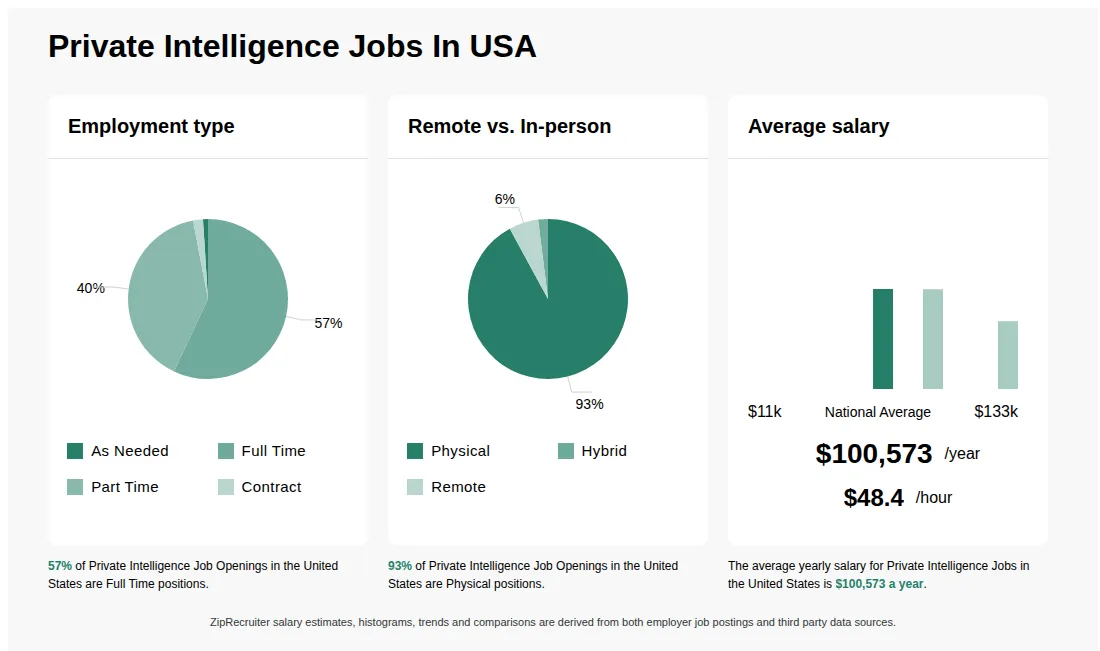
The median wage is $92.4K / yr.
$88.6K - $99.7K
37% of jobs
$99.7K - $110.8K
0% of jobs
$110.8K - $121.9K
0% of jobs
$122K is the 75th percentile. Wages above this are outliers.
$121.9K - $133K
25% of jobs
$11K
$100.6K
$133K
Private intelligence jobs include background check specialists and intelligence analysts. Your responsibilities as a background check specialist include verifying references, education, and employment, processing outbound and inbound telephone calls, and performing professional and personal reference interviews. As an intelligence analyst, your duties are to investigate information, perform threat analysis and data security tasks, detect issues, determine the validity of information, and assess the quality of information. In this job, you also develop intelligence assessments. The purpose of both positions is to ensure the integrity and safety of an agency or company. These jobs are available in both the government and private sectors.
| Aspect | Private Intelligence | Corporate Security Analyst |
|---|---|---|
| Required Credentials | Security clearances, intelligence certifications, background in law enforcement or military | Security certifications (CSP, CPP), risk management, background in security or law enforcement |
| Work Environment | Private firms, government agencies, consulting firms | Corporations, large organizations, government agencies |
| Employer & Industry Usage | Used for intelligence gathering, threat assessment, and risk mitigation | Focuses on physical security, incident response, and policy enforcement |
Private Intelligence and Corporate Security Analysts both require security-related credentials and often work within security-focused environments. However, Private Intelligence typically involves intelligence gathering and threat analysis for private clients or agencies, while Corporate Security Analysts focus on protecting company assets, physical security, and internal risk management. Both roles are vital for organizational safety but differ in scope and daily responsibilities.

Full-time
Re-posted 15 days ago
SGI is seeking a Subject Matter Expert (SME) to provide senior-level expertise supporting all-source intelligence analysis, production, and dissemination. The SME will support research, analysis, and development of finished intelligence products addressing nation-state threats to national security, the private sector, and critical infrastructure. This role provides analytic leadership to ensure intelligence products meet established analytic tradecraft standards and supports senior decision makers through high-quality intelligence assessments, briefings, and strategic analytic guidance.
*Contingent on contract award*
ResponsibilitiesSGI Global provides equal employment opportunities (EEO) to all employees and applicants for employment without regard to race, color, religion, gender, sexual orientation, gender identity or expression, national origin, age, disability, genetic information, marital status, amnesty, or status as a covered veteran in accordance with applicable federal, state and local laws.

Sourced by ZipRecruiter
Police protection
501 - 1,000 Employees
Alexandria, VA, US
2008






