Risk Intelligence Analyst - Night Shift Prosegur's Global Risk Services (GRS) operates Global ... Prior experience leveraging private sector intelligence tools (or similar government platforms ...
Quick apply
Risk Intelligence Analyst - Night Shift Prosegur's Global Risk Services (GRS) operates Global ... Prior experience leveraging private sector intelligence tools (or similar government platforms ...
Quick apply
Risk Intelligence Analyst - Night Shift Prosegur's Global Risk Services (GRS) operates Global ... Prior experience leveraging private sector intelligence tools (or similar government platforms ...
The Senior Intelligence Analyst is a mission-critical leadership role within the Threat Management ... and private sector intelligence organizations * Project Management and maintain intelligence ...
The Senior Intelligence Analyst is a mission-critical leadership role within the Threat Management ... and private sector intelligence organizations * Project Management and maintain intelligence ...
Las Vegas, NV · On-site
$83K - $100K/yr
The Senior Intelligence Analyst is a mission-critical leadership role within the Threat Management ... and private sector intelligence organizations * Project Management and maintain intelligence ...
Las Vegas, NV · On-site
$83K - $100K/yr
The Senior Intelligence Analyst is a mission-critical leadership role within the Threat Management ... and private sector intelligence organizations * Project Management and maintain intelligence ...
... or private-sector intelligence firm. * Experience utilizing artificial intelligence (AI) and ... Strong analytical and critical thinking skills with the ability to identify patterns, trends, and ...
... or private-sector intelligence firm. * Experience utilizing artificial intelligence (AI) and ... Strong analytical and critical thinking skills with the ability to identify patterns, trends, and ...
... or private-sector intelligence firm. * Experience utilizing artificial intelligence (AI) and ... Strong analytical and critical thinking skills with the ability to identify patterns, trends, and ...
... or private-sector intelligence firm. * Experience utilizing artificial intelligence (AI) and ... Strong analytical and critical thinking skills with the ability to identify patterns, trends, and ...
Phoenix, AZ · On-site
$70K - $79K/yr
Backed by proprietary AI-enabled SaaS technologies, advanced Global Operations Centers, an extensive global footprint, and the largest team of private-sector intelligence analysts in the world, we ...
Phoenix, AZ · On-site
$70K - $79K/yr
Backed by proprietary AI-enabled SaaS technologies, advanced Global Operations Centers, an extensive global footprint, and the largest team of private-sector intelligence analysts in the world, we ...
Lowell, MA · On-site
$65K - $70K/yr
This high-performing team of Risk Intelligence Analysts is responsible for monitoring threats to ... Prior experience leveraging private sector intelligence tools (or similar government platforms ...
Lowell, MA · On-site
$65K - $70K/yr
This high-performing team of Risk Intelligence Analysts is responsible for monitoring threats to ... Prior experience leveraging private sector intelligence tools (or similar government platforms ...
Atlanta, GA · On-site
Backed by proprietary AI-enabled SaaS technologies, advanced Global Operations Centers, an extensive global footprint, and the largest team of private-sector intelligence analysts in the world, we ...
Atlanta, GA · On-site
Backed by proprietary AI-enabled SaaS technologies, advanced Global Operations Centers, an extensive global footprint, and the largest team of private-sector intelligence analysts in the world, we ...
Annapolis, MD · On-site
$75K - $77K/yr
Backed by proprietary AI-enabled SaaS technologies, advanced Global Operations Centers, an extensive global footprint, and the largest team of private-sector intelligence analysts in the world, we ...
Annapolis, MD · On-site
$75K - $77K/yr
Backed by proprietary AI-enabled SaaS technologies, advanced Global Operations Centers, an extensive global footprint, and the largest team of private-sector intelligence analysts in the world, we ...
San Antonio, TX · On-site
$77K/yr
... private sector setting. * A college degree or real-world experience in intelligence analysis, executive protection, investigations, or threat assessment Hiring Process Requirements: * 12-Day ...
San Antonio, TX · On-site
$77K/yr
... private sector setting. * A college degree or real-world experience in intelligence analysis, executive protection, investigations, or threat assessment Hiring Process Requirements: * 12-Day ...
San Antonio, TX · On-site
$77K/yr
... private sector setting. * A college degree or real-world experience in intelligence analysis, executive protection, investigations, or threat assessment Hiring Process Requirements: * 12-Day ...
San Antonio, TX · On-site
$77K/yr
... private sector setting. * A college degree or real-world experience in intelligence analysis, executive protection, investigations, or threat assessment Hiring Process Requirements: * 12-Day ...
... private sector setting. * A college degree or real-world experience in intelligence analysis, executive protection, investigations, or threat assessment Hiring Process Requirements: * 12-Day ...
... private sector setting. * A college degree or real-world experience in intelligence analysis, executive protection, investigations, or threat assessment Hiring Process Requirements: * 12-Day ...
San Antonio, TX · On-site
$77K/yr
... private sector setting. * A college degree or real-world experience in intelligence analysis, executive protection, investigations, or threat assessment Hiring Process Requirements: * 12-Day ...
San Antonio, TX · On-site
$77K/yr
... private sector setting. * A college degree or real-world experience in intelligence analysis, executive protection, investigations, or threat assessment Hiring Process Requirements: * 12-Day ...
Backed by proprietary AI-enabled SaaS technologies, advanced Global Operations Centers, an extensive global footprint, and the largest team of private-sector intelligence analysts in the world, we ...
Backed by proprietary AI-enabled SaaS technologies, advanced Global Operations Centers, an extensive global footprint, and the largest team of private-sector intelligence analysts in the world, we ...
Backed by proprietary AI-enabled SaaS technologies, advanced Global Operations Centers, an extensive global footprint, and the largest team of private-sector intelligence analysts in the world, we ...
Backed by proprietary AI-enabled SaaS technologies, advanced Global Operations Centers, an extensive global footprint, and the largest team of private-sector intelligence analysts in the world, we ...
$75K - $80K/yr
OPEN-SOURCE INTELLIGENCE ANALYST WHO ARE WE?: The Jewish Federation of Cincinnati (JFC), the ... The IA is expected to maintain solid professional relationships with public and private sector ...
$75K - $80K/yr
OPEN-SOURCE INTELLIGENCE ANALYST WHO ARE WE?: The Jewish Federation of Cincinnati (JFC), the ... The IA is expected to maintain solid professional relationships with public and private sector ...
Cincinnati, OH · On-site
$75K - $80K/yr
OPEN-SOURCE INTELLIGENCE ANALYST WHO ARE WE?: The Jewish Federation of Cincinnati (JFC), the ... The IA is expected to maintain solid professional relationships with public and private sector ...
Cincinnati, OH · On-site
$75K - $80K/yr
OPEN-SOURCE INTELLIGENCE ANALYST WHO ARE WE?: The Jewish Federation of Cincinnati (JFC), the ... The IA is expected to maintain solid professional relationships with public and private sector ...
... private sector setting. • A college degree or real-world experience in intelligence analysis, executive protection, investigations, or threat assessment • 12-Day Introductory Training Academy in ...
... private sector setting. • A college degree or real-world experience in intelligence analysis, executive protection, investigations, or threat assessment • 12-Day Introductory Training Academy in ...
... across Intelligence, Analytics, Engineering, Mission Support, and Communications disciplines ... As a leader in our space, we partner with firms in the private sector, academic institutions, and ...
Quick apply
... across Intelligence, Analytics, Engineering, Mission Support, and Communications disciplines ... As a leader in our space, we partner with firms in the private sector, academic institutions, and ...
... across Intelligence, Analytics, Engineering, Mission Support, and Communications disciplines ... As a leader in our space, we partner with firms in the private sector, academic institutions, and ...
... across Intelligence, Analytics, Engineering, Mission Support, and Communications disciplines ... As a leader in our space, we partner with firms in the private sector, academic institutions, and ...
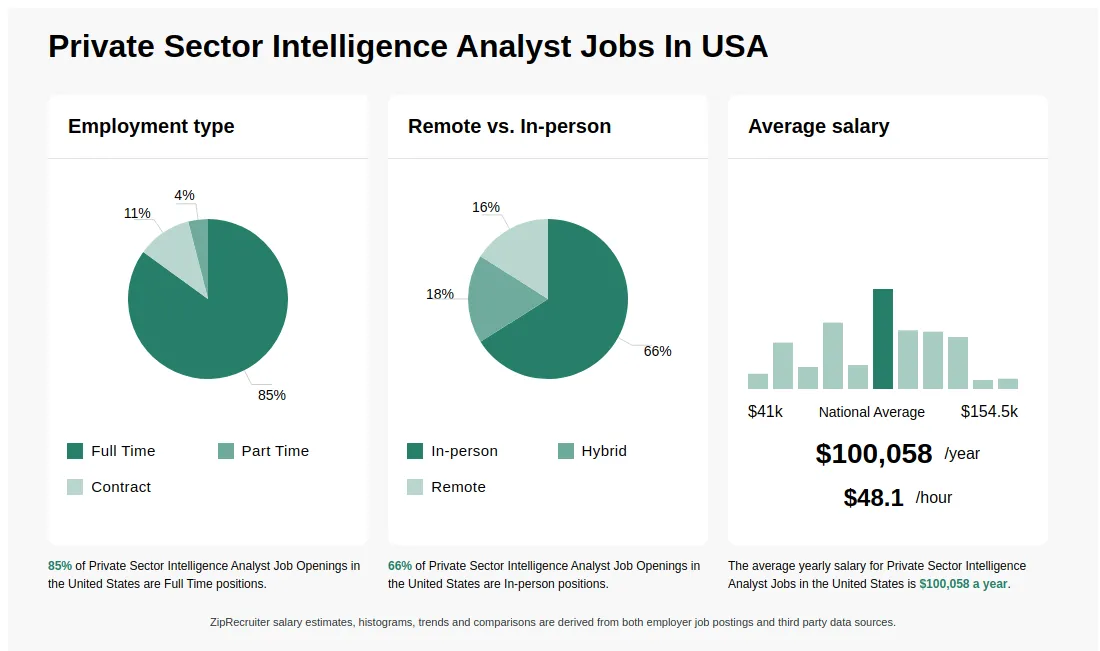
$41K - $51.3K
3% of jobs
$51.3K - $61.6K
11% of jobs
$61.6K - $72K
4% of jobs
$76.9K is the 25th percentile. Wages below this are outliers.
$72K - $82.3K
15% of jobs
$82.3K - $92.6K
5% of jobs
The median wage is $98.2K / yr.
$92.6K - $102.9K
22% of jobs
$102.9K - $113.2K
13% of jobs
$115.2K is the 75th percentile. Wages above this are outliers.
$113.2K - $123.5K
13% of jobs
$123.5K - $133.9K
12% of jobs
$133.9K - $144.2K
1% of jobs
$144.2K - $154.5K
2% of jobs
$41K
$100.1K
$154.5K
A Private Sector Intelligence Analyst gathers, analyzes, and interprets data to help businesses identify risks, threats, and opportunities. They monitor competitive activity, cybersecurity threats, supply chain risks, and geopolitical developments to support strategic decision-making. These analysts work in industries like finance, technology, and consulting, using open-source intelligence (OSINT), proprietary data, and threat intelligence. Their goal is to provide actionable insights that protect assets, enhance security, and maintain business continuity.
A typical day for a Private Sector Intelligence Analyst involves gathering and interpreting data from multiple sources to assess potential threats or business risks facing the organization. You may spend time preparing detailed intelligence reports, briefing executives or security teams, and monitoring ongoing events that could impact company operations. Collaboration with IT, risk management, and executive leadership is common, as is adapting to urgent requests or new data developments. This dynamic environment means you'll often balance proactive research with rapid response to emerging issues, making adaptability and effective communication key aspects of the role.
To thrive as a Private Sector Intelligence Analyst, you need strong analytical skills, a background in data analysis or security studies, and a relevant bachelor's degree, such as in international relations, political science, or criminal justice. Familiarity with threat intelligence platforms, data visualization tools, open-source intelligence (OSINT) systems, and industry certifications like CISSP or CompTIA Security+ are commonly expected. Excellent written and verbal communication, attention to detail, and the ability to work collaboratively under pressure help you stand out in this role. These skills are essential for accurately identifying risks, generating actionable reports, and supporting decision-makers in the fast-paced private sector environment.
Cities with the most Private Sector Intelligence Analyst job openings:
The most popular types of Private Sector Intelligence Analyst jobs are:
States with the most job openings for Private Sector Intelligence Analyst jobs include:
The top searched job categories for Private Sector Intelligence Analyst jobs are:

Other
This job post has expired today. Applications are no longer accepted.
5.8
Based on 64 frontline employees who took The Breakroom Quiz
70th of 118 rated security
Prosegur’s Global Risk Services (GRS) operates Global Security Operations Center (GSOC) services for our clients as a dedicated, managed service. This position is part of a dedicated, embedded team supporting an multinational client in the medical technology sector. This high-performing team of Risk Intelligence Analysts is responsible for monitoring threats to travelers, intaking and assessing intelligence alerts, providing support for the crisis management program, and conducting protective intelligence monitoring to assist the Executive Protection (EP) team on a 24x7x365 basis. This intelligence-focused GSOC works closely with the client’s Global Security staff to provide custom intelligence products to support the client’s needs.
The Risk Intelligence Analyst is a critical role within the GSOC. This analyst provides focused intelligence and threat monitoring to deter, protect, and respond to threats and risks to the client’s personnel and facilities.
Shift: 7PM - 7AM
Role Responsibilities
The main responsibilities of the Risk Intelligence Analyst include:
Minimum Qualifications and Requirements
#PRO123
At Prosegur, we make our world safer by taking care of people and businesses while remaining at the forefront of innovation. Every day, we work to secure what our clients value most, from their families to their assets, from their reputation to their networks, and from their money to their cloud. As the 3rd largest security services provider, our 175k+ team members in 36 countries combine and adapt global best practices to match the unique nature of each market we serve and partner with Electronic Security, Global Risk Services, CyberSecurity, and Remote Services (iSOC) divisions to create meaningful ‘Hybrid Security' solutions for Prospects.

Sourced by ZipRecruiter
Investigation and physical security services
10,000+ Employees
Herndon, VA, US


