1

Population Health Management Jobs (NOW HIRING)

As a Population Health Lead, you will serve as a primary driver of the Healthy Planet ecosystem ... Manage technical initiatives surrounding innovative payment models, including surgical bundles and ...

As a Population Health Lead, you will serve as a primary driver of the Healthy Planet ecosystem ... Manage technical initiatives surrounding innovative payment models, including surgical bundles and ...

As a Population Health Lead, you will serve as a primary driver of the Healthy Planet ecosystem ... Manage technical initiatives surrounding innovative payment models, including surgical bundles and ...

Population Health Pharmacist

Plano, TX · On-site

$55.75 - $67/hr

Develop, implement, and evaluate population health initiatives centered around medication management, adherence, and optimizing therapeutic outcomes. Utilize health data analytics to identify trends ...

Population Health Pharmacist

Plano, TX · Remote

$59.50 - $71.75/hr

Develop, implement, and evaluate population health initiatives centered around medication management, adherence, and optimizing therapeutic outcomes. Utilize health data analytics to identify trends ...

Population Health Pharmacist

Plano, TX · On-site

$55.75 - $67/hr

ROLE AND RESPONSIBILITIES: • Develop, implement, and evaluate population health initiatives centered around medication management, adherence, and optimizing therapeutic outcomes. • Utilize health ...

next page

Showing results 1-20

Population Health Management information

See salary details

$25K

$87.8K

$173.5K

How much do population health management jobs pay per year?

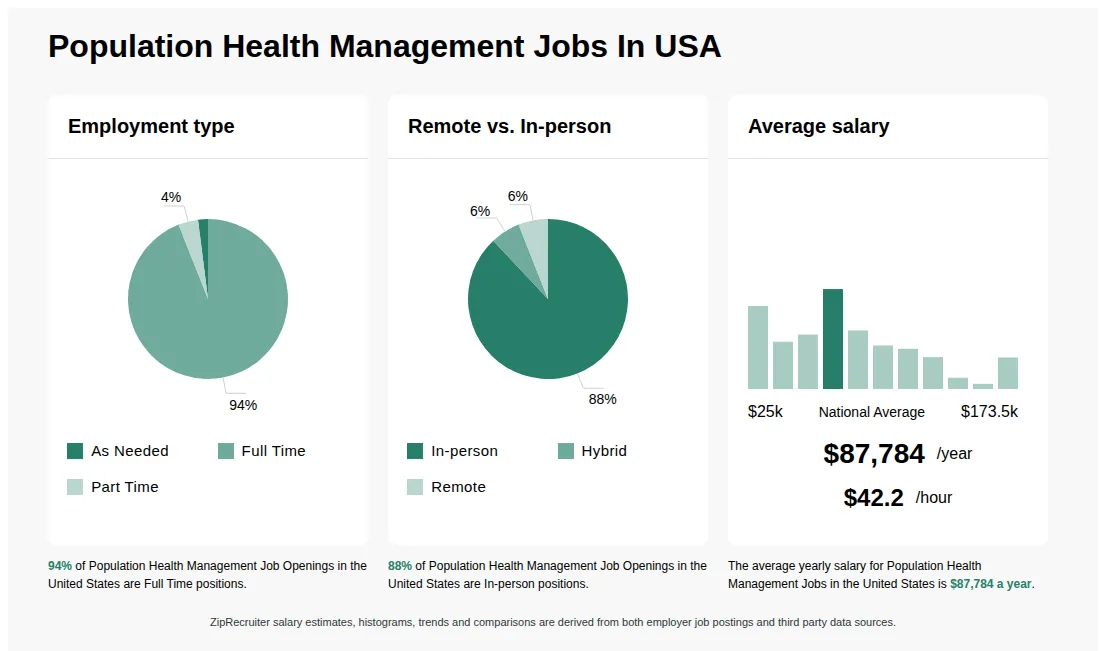
As of Jun 12, 2026, the average yearly pay for population health management in the United States is $87,784.00, according to ZipRecruiter salary data. Most workers in this role earn between $53,000.00 and $111,000.00 per year, depending on experience, location, and employer.

What are the key skills and qualifications needed to thrive in Population Health Management, and why are they important?

To thrive in Population Health Management, you need expertise in public health principles, data analysis, care coordination, and a relevant degree in public health, healthcare administration, or a related field. Familiarity with population health analytics platforms, electronic health records (EHRs), and certifications such as Certified Population Health Management Professional (CPHMP) are often required. Strong communication, problem-solving, and leadership skills are essential for collaborating across healthcare teams and engaging diverse patient populations. These skills ensure effective program implementation, improved patient outcomes, and efficient management of community health initiatives.

How to become a population health manager?

To become a population health manager, individuals typically need a bachelor's degree in public health, healthcare administration, or a related field, with many roles preferring a master's degree such as an MPH or MHA. Relevant experience in healthcare, data analysis, or care coordination is important, along with skills in project management and familiarity with health information systems. Certification programs like Certified in Population Health Management (CPHM) can enhance qualifications.

Is population health a good career?

Population health management is a growing field focused on improving health outcomes for communities through data analysis, care coordination, and policy development. It offers opportunities in healthcare organizations, public health agencies, and consulting firms, often requiring skills in data management and understanding of healthcare systems. The career can be stable and impactful, with increasing demand for professionals trained in health analytics and program implementation.

What are some common challenges faced in a Population Health Management role, and how are they typically addressed?

Professionals in Population Health Management often encounter challenges such as integrating data from multiple sources, ensuring patient engagement, and addressing health disparities across diverse populations. These challenges are typically addressed by leveraging advanced health IT systems, collaborating closely with interdisciplinary teams including clinicians, data analysts, and community partners, and implementing targeted outreach and education programs. Continuous learning and adaptation are key, as the field evolves rapidly with new technologies and regulatory requirements.

What does a population health manager do?

A population health manager oversees strategies to improve health outcomes for specific groups by analyzing data, coordinating care, and implementing health programs. They often work with healthcare providers, use health information systems, and require knowledge of public health principles and data analysis tools.

What is the highest paying job in healthcare management?

In healthcare management, executive roles such as Chief Executive Officer (CEO), Chief Operating Officer (COO), or Chief Financial Officer (CFO) typically have the highest salaries, often exceeding six figures annually. These positions require extensive experience, leadership skills, and often advanced degrees like an MBA or healthcare administration certification.

How to Get a Job in Population Health Management

Your qualifications to get a job in population health management depend on the position. Population health management analysts and managers typically have a minimum of a bachelor’s degree in health care administration, public health, or a related field, but managers may additionally need a formal education in business management or equivalent professional experience. Both positions require exceptional data analysis skills and the ability to problem-solve, communicate effectively with writing and speaking, and understand health care issues, trends, and programs that affect the populations with which you work. You can find population health management jobs with medical groups, hospitals, and government health departments.

What is the difference between Population Health Management vs Care Coordinator?

AspectPopulation Health ManagementCare Coordinator
CredentialsOften requires a degree in public health, nursing, or related fields; certifications like CHES or CPHTypically requires nursing, social work, or health education background; certifications vary
Work EnvironmentHealthcare organizations, public health agencies, insurance companiesHospitals, clinics, community health settings
Employer & Industry UsageUsed in population-based health strategies, policy planningFocuses on individual patient care coordination

Population Health Management involves analyzing and improving health outcomes across populations, often at a systemic level. Care Coordinators focus on managing individual patient care plans. While both roles aim to improve health, Population Health Management emphasizes data-driven strategies for groups, whereas Care Coordinators work directly with patients to ensure they receive appropriate care.

What is population health management?

Population health management is a strategy used in healthcare to improve the health outcomes of a specific group or population by analyzing data and implementing targeted interventions. It involves coordinating care, identifying health trends, and addressing social determinants of health to prevent disease and reduce healthcare costs. Healthcare providers, insurers, and organizations use population health management to deliver personalized care, improve quality, and ensure better patient engagement.
What cities are hiring for Population Health Management jobs? Cities with the most Population Health Management job openings:
What are the most commonly searched types of Population Health Management jobs? The most popular types of Population Health Management jobs are:
What states have the most Population Health Management jobs? States with the most job openings for Population Health Management jobs include:
Infographic showing various Population Health Management job openings in the United States as of June 2026, with employment types broken down into 8% As Needed, 23% Full Time, 65% Part Time, 2% Temporary, 1% Contract, and 1% Nights. Highlights an 96% Physical, 1% Hybrid, and 3% Remote job distribution, with an average salary of $87,784 per year, or $42.2 per hour.
Director of Population Health

Director of Population Health

Essen Medical Associates

Bronx, NY • On-site

$145K - $175K/yr

Full-time

Posted 5 days ago


Job description

Overview
Essen Health Care is the largest privately held, multispecialty medical group in New York, providing high-quality, compassionate care to some of the state's most vulnerable and underserved residents.
Founded in 1999, we've grown from a single primary care office into a network of 50+ locations offering urgent care, primary care and specialty services, from women's health to endocrinology and psychiatry. We also provide nursing home support, care management, and in-home care through our Essen House Calls program. Guided by a Population Health model, our team of 500+ providers deliver care in-person, at home, or via telehealth, ensuring patients get the support they need when and where they need it.
We're looking for talented, motivated individuals to join our growing team. Whether you're a medical provider, administrator, or operations professional, there's a career here for you. Join us in making a real difference in the health of our community.
Job Summary
The Director of Population Health will provide strategic direction, leadership, and oversight of all population health initiatives within a large Integrated Delivery System (IDS). The incumbent will be responsible for the planning, development, and implementation of comprehensive population health, value-based care, and performance improvement programs. This includes oversight of HEDIS measures, care management, risk stratification, and utilization management to enhance care quality, promote cost savings, and improve patient outcomes.
Responsibilities
1. Population Health Strategy & Program Development
Develop and implement a system-wide strategy for population health management aligned with the organization's mission, vision, and values.
Lead the design and execution of innovative care delivery and value-based initiatives to support improved health outcomes and cost efficiency.
Collaborate with senior leadership to set short- and long-term goals and performance metrics for population health, ensuring alignment with organizational strategy.
2. HEDIS Oversight and Quality Reporting
Oversee the development, implementation, and monitoring of HEDIS-related processes to ensure the highest level of quality and compliance with regulatory requirements.
Ensure accurate and timely data collection, reporting, and analysis for HEDIS, CMS Stars, and other quality measures.
Identify performance gaps and drive improvement initiatives to enhance HEDIS performance across the organization.
3. Care Management and Coordination
Provide leadership and direction for care management teams, including nurses, social workers, and care coordinators, to ensure effective care coordination for high-risk, high-cost patient populations.
Implement risk stratification models and evidence-based care pathways to optimize patient outcomes and resource utilization.
Ensure coordinated transitions of care, reduce readmissions, and improve patient engagement through strong interdepartmental collaboration.
4. Utilization Management
Oversee utilization management activities, ensuring adherence to clinical guidelines and best practices to optimize care delivery and reduce unnecessary costs.
Collaborate with providers, payers, and care teams to design and implement strategies to reduce avoidable hospital admissions, readmissions, and Emergency Department (ED) visits.
Drive the utilization review process, establishing benchmarks and key performance indicators to monitor performance and identify improvement opportunities.
5. Data Analytics and Technology Integration
Work closely with IT and Data Analytics teams to leverage population health management software and analytic tools for monitoring, trending, and forecasting clinical and financial outcomes.
Utilize data-driven insights to identify population health trends, develop targeted interventions, and measure program effectiveness.
Champion the use of electronic health records (EHR) to streamline care coordination, clinical documentation, and performance reporting.
6. Collaboration and Stakeholder Engagement
Develop strong partnerships with physicians, clinical leaders, external healthcare organizations, community-based organizations, and payers to foster a culture of collaboration for population health initiatives.
Serve as a subject matter expert for population health and value-based care, providing education, training, and guidance to internal stakeholders.
Represent the organization in community forums, professional associations, and conferences to promote best practices in population health.
7. Regulatory Compliance and Accreditation
Maintain current knowledge of federal, state, and local regulations and accreditation standards related to population health, quality, and value-based care.
Ensure the organization's compliance with regulatory requirements and accreditation standards (e.g., NCQA, CMS) related to population health and quality programs.
Lead audits, accreditation processes, and quality improvement initiatives to meet and exceed compliance obligations.
8. Financial and Operational Management
Develop and manage the budget for population health initiatives, ensuring cost-effectiveness and alignment with strategic priorities.
Monitor financial performance and ROI for population health programs, implementing course corrections as needed.
Identify and secure grants, partnerships, and other funding opportunities to support and expand population health efforts.
9. Leadership and Team Development
Recruit, mentor, and retain high-performing population health and care management teams, fostering a culture of innovation and continuous learning.
Provide leadership, coaching, and professional development opportunities to direct reports and cross-functional team members.
Establish performance expectations and conduct regular performance evaluations, ensuring accountability and alignment with organizational goals.
Qualifications
1. Education and Certification
Master's degree in public health, Health Administration, Nursing, Business Administration, or a related field required.
Clinical background (RN, MD/DO, or similar) preferred but not required.
Certification in Population Health Management, Case Management, or Healthcare Quality (e.g., CPHQ, CCM) is highly desirable.
2.Experience:
Minimum of 7-10 years of progressive leadership experience in population health, care management, or quality improvement within a large integrated delivery system or health plan.
Demonstrated success in implementing and overseeing HEDIS, CMS Star Ratings, or other quality improvement programs.
Proven track record of leveraging data analytics to drive strategic decisions, reduce costs, and improve clinical outcomes.
Experience in leading interdisciplinary teams and managing complex, system-wide initiatives.
3. Knowledge and Skills:
In-depth knowledge of population health principles, healthcare delivery models, and value-based care arrangements (e.g., ACOs, bundled payments, capitation).
Familiarity with healthcare regulations, accrediting body standards (e.g., NCQA), and best practices in quality management and performance improvement.
Exceptional analytical and problem-solving skills, with the ability to interpret complex data and implement evidence-based strategies.
Strong leadership, communication, and interpersonal skills to inspire teamwork, influence stakeholders, and drive organizational change.
Proficiency in Microsoft Office Suite, EHR systems, and population health management software.
Working Conditions and Physical Requirements
Primarily an office-based role with occasional travel to hospitals, outpatient clinics, and community sites within the IDS.
Must be able to operate standard office equipment (computer, phone, copier, etc.).
Some evening or weekend work may be required to meet program deadlines or address urgent issues.
Application Process:
Interested candidates should submit a resume/CV via
Salary: $145,000-$175,000
Equal Opportunity Employer
Essen Health care is proud to be an equal opportunity employer, and we seek candidates who desire to work in and serve an ethnically diverse population.