2

Part Time Contract Jobs (NOW HIRING)

Lawton, Oklahoma Position Type: Part-Time | Contract Duration: 6 Months Schedule: 2 days per week (Monday-Tuesday) Start Date: As soon as credentialed An opportunity is available for an Optometrist ...

Showing results 21-40

Part Time Contract information

See salary details

$17

$26

$49

How much do part time contract jobs pay per hour?

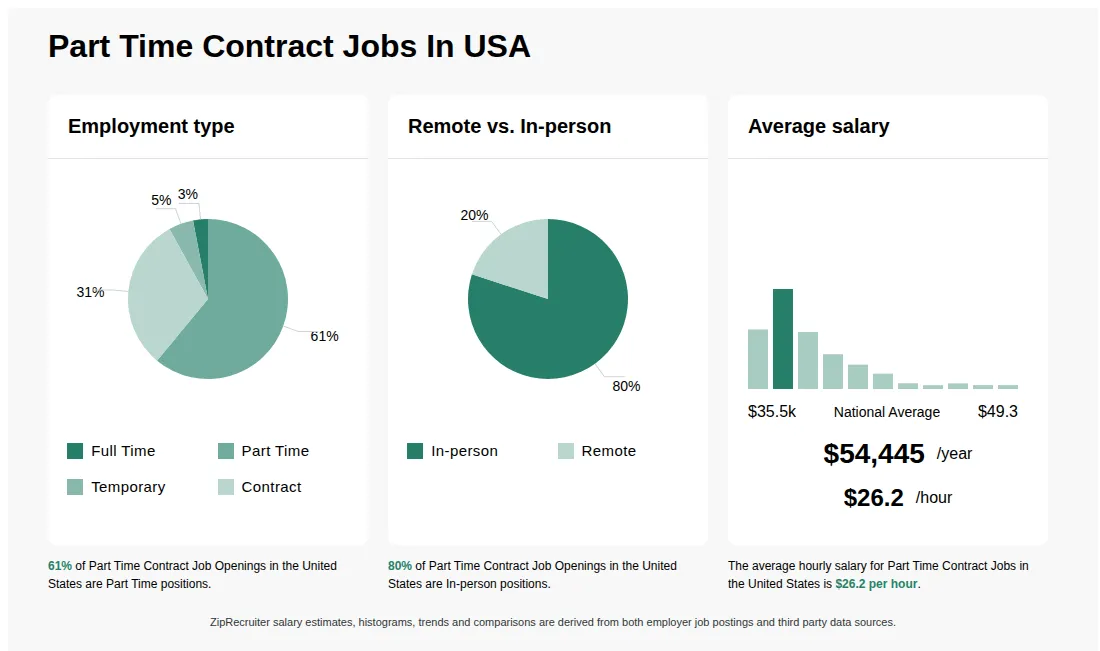
As of Sep 12, 2026, the average hourly pay for part time contract in the United States is $26.18, according to ZipRecruiter salary data. Most workers in this role earn between $20.19 and $28.61 per hour, depending on experience, location, and employer.

What is a part-time contract?

Part-time contract jobs are positions where individuals work fewer hours than full-time employees and are hired for a specific duration or project based on a contractual agreement. These roles often offer flexibility in scheduling and may not include benefits such as health insurance or paid time off. Workers in part-time contract roles are typically considered independent contractors rather than regular employees, which affects tax obligations and workplace protections. This type of employment is common in industries like education, consulting, freelance writing, and IT.

How do part-time contract roles typically integrate with full-time teams and company workflows?

Part-time contract roles often collaborate closely with full-time team members to complete specific projects or tasks. Communication is key, as contractors may work limited hours and need to stay aligned with the team's priorities and deadlines. Companies usually provide access to internal systems, regular check-ins, and clear project briefs to ensure part-time contractors remain connected and productive. Flexibility and proactive communication help contractors manage expectations and contribute effectively despite not being on-site or available full-time.

What are the qualifications to get a part-time contract job?

The minimum qualifications for a part-time contract job vary with the position. To become an assistant athletic coach, you need a bachelor’s degree in sports science, kinesiology, or sports medicine. Employers typically a CPR certification as well. A freelance accountant should have at least a bachelor’s degree in finance, accounting, or a similar field. Advancing your skills with a CMA or CPA license can also be beneficial. Knowledge of accounting software like QuickBooks is beneficial when you are applying for jobs. A college instructor should have at least a master’s degree in the field they are teaching. However, some employers prefer applicants with a doctorate.

What are the key skills and qualifications needed to thrive as a part-time contract worker, and why are they important?

To thrive as a Part-Time Contract Worker, you generally need relevant experience in your field, adaptability, and the ability to work independently, usually supported by a high school diploma or higher education as required by the specific role. Familiarity with project management software, time-tracking tools, and cloud-based collaboration platforms is often necessary. Strong communication, time management, and self-motivation help you excel in meeting deadlines and client expectations. These skills and qualities are crucial because they ensure high productivity, reliability, and satisfaction in flexible, often remote, working arrangements.

What is the difference between Part Time Contract vs Part Time Permanent?

AspectPart Time ContractPart Time Permanent
DurationFixed-term, project-based or temporaryOngoing, indefinite employment
Job SecurityLess secure, contract ends after termMore secure, ongoing employment
BenefitsLimited or no benefitsTypically includes benefits like health insurance
Work HoursPart-time, flexible hoursPart-time, consistent hours
Employer UsageUsed for specific projects or seasonal workUsed for long-term staffing needs

In summary, Part Time Contract roles are temporary with fixed durations and fewer benefits, ideal for project-based work. Part Time Permanent positions offer ongoing employment with more stability and benefits, suitable for long-term staffing needs.

What cities are hiring for Part Time Contract jobs?

Cities with the most Part Time Contract job openings:

What are the most commonly searched types of Part Time jobs?

The most popular types of Part Time jobs are:

What states have the most Part Time Contract jobs?

States with the most job openings for Part Time Contract jobs include:

Infographic showing various Part Time Contract job openings in the United States as of September 2026, with employment types broken down into 100% Part Time. Highlights an 85% In-person, and 15% Remote job distribution, with an average salary of $54,445 per year, or $26.2 per hour.

Respiratory Therapist-Part Time-Contract

Logan, OH • On-site

Hocking Valley Community Hospital
Health Care and Social Assistance • 201 - 500 employees

$60/hr

Part-time, Contractor, Other

Re-posted 20 days ago


Job description

Description:

Administers respiratory care and life support to patients with cardiopulmonary system deficiencies and abnormalities. Trains and acts as a resource for respiratory department technicians.

  • This is a part time, contract position
  • This is a Night shift position 7pm to 7am
  • This position is up to 48 hours per pay period


ORGANIZATIONAL EXPECTATIONS

  • Provides a positive and professional representation of the organization.
  • Promotes culture of safety for patients and employees through proper identification, reporting, documentation, and prevention.
  • Maintains hospital standards for a clean and quiet patient environment to maintain a positive patient care experience.
  • Maintains competency and knowledge of current standards of practice, trends, and developments in related scope of job role or practice.
  • Adheres to infection-control policies and protocols, medication administration and storage procedures, and controlled substance regulations.
  • Participates in ongoing quality improvement activities.
  • Maintains compliance with organization’s policies, as well as established practices, protocols, and procedures of the position, department, and applicable professional standards.
  • Complies with organizational and regulatory policies for handling confidential patient information.
  • Demonstrates excellent customer service through his/her attitude and actions, consistent with the standards contained in the Vision, Mission, and Values of the organization.
  • Adheres to professional standards, hospital policies and procedures, federal, state, and local requirements, and DNV standards and/or standards from other accrediting bodies.


ESSENTIAL FUNCTIONS

  • Assesses patients and recommends respiratory therapy treatments.
  • Plans, prepares, and administers respiratory therapy treatments including aerosol, chest physical therapy, incentive spirometry, and sputum inductions, in accordance with established policies and procedures.
  • Performs diagnostic pulmonary and cardiac tests.
  • Records patient treatment, response, and progress.
  • Inspects, tests, maintains, and operates respiratory therapy equipment.
  • Responds to "code blue" calls and assists by maintaining the patient's airway and performing CPR.
  • Reads prescription, measures arterial blood gases, and reviews patient information to assess patient condition and determine requirements for treatment such as type and duration of therapy, and medication and dosages.
  • Determines most suitable method of administering inhalants, precautions to be observed, and modifications which may be needed that will be compatible with physician's orders.
  • Sets up and operates devices such as mechanical ventilators, therapeutic gas administration apparatus, environmental control systems, and aerosol generators.
  • Operates equipment to ensure specified parameters of treatment such as volume, gas, concentration, humidity, and temperature, and to administer medicinal gases and aerosol drugs to patients.
  • Monitors patient's physiological responses to therapy such as vital signs, arterial blood gases, and blood chemistry changes.
  • Performs bronchopulmonary drainage and assists patient in performing breathing exercises.
  • Performs pulmonary function tests to be used by physician in diagnosis of case.
  • Observes equipment function and adjusts equipment to obtain optimum results to therapy.
  • Consults with physician in event of adverse reactions.
  • Maintains patient's chart that contains pertinent identification and therapy information.
  • Inspects and tests respiratory therapy equipment to ensure equipment is functioning safely and efficiently.
  • Orders repairs when needed.
  • Demonstrates respiratory care procedures to trainees and other health care personnel.
  • Able to perform tasks without supervision after competence has been verified by the director of the area, and only under the medical direction of a licensed provider.


Requirements:


 JOB REQUIREMENTS

  • Graduate of a Respiratory Therapy school accredited by the Committee for Allied Health Education and Accreditation of the American Medical Association.
  • Associates degree or equivalent from a two-year college or technical school. Licensed through the Ohio Respiratory Care Board.
  • One year healthcare experience preferred.
  • CPR - approved by th e American Heart Association.
  • ACLS - approved by the American Heart Association.
  • PALS – approved by the American Heart Association.


FUNCTIONAL DEMANDS

Working Conditions and Physical Environment

  • Works in a patient care setting where there is potential exposure to blood, body fluids, infectious materials; and electrical, fire, chemical, physical contact and equipment hazards.
  • Fast-paced setting with rapid patient turnover.
  • High patient traffic.
  • Close-quartered and shared work space.
  • Sufficient mobility to negotiate physical plant.
  • Strength and endurance sufficient enough to perform physically for long periods of time without sitting (four to eight hours). May include: walking; lifting 25 – 50lbs with or without assistance; bending; twisting; standing; sitting; reaching; stair-climbing and descending.
  • Physical dexterity and psychomotor skills to respond adequately and appropriately to routine and emergency patient care needs in an ambulatory setting.
  • Visual and auditory capabilities sufficient to read information and respond to patient care needs.
  • Ability to work in a computerized environment that includes prolonged sitting and use of keyboard, mouse, and monitor.
  • Cognitive ability to accurately observe, analyze, and interpret general and technical data both verbal and written to accurately communicate this information.