1

Optical Engineer Jobs in Georgia (NOW HIRING)

Senior Hardware Engineer

Atlanta, GA

$106K - $141K/yr

Job Summary The Senior Hardware Engineer will be a member of a team responsible for designing Coherent Pluggable Optical Transceiver modules for metro, core and data center applications. Senior ...

Be Seen First

Optical Technician

Fayetteville, GA · On-site

$11 - $15/hr

An Optometric Technician is able to handle a wide range of duties while using optical equipment to perform the initial testing needed to prepare a patient for an exam with the optometrist. Essential ...

Be Seen First

Senior Field Service Engineer

Atlanta, GA · On-site

$80K - $100K/yr

We are highly recognized as a quality developer and supplier of state-of-the-art laser-based systems for precision optics alignment, assembly, and inspection. The successful candidate will work with ...

Be Seen First

Optical Technician

Fayetteville, GA · On-site

$11 - $15/hr

An Optometric Technician is able to handle a wide range of duties while using optical equipment to perform the initial testing needed to prepare a patient for an exam with the optometrist. Essential ...

Sr. Software Engineer (Firmware)

Atlanta, GA · On-site

$114K - $151K/yr

You will collaborate closely with optical, hardware, and test engineers to deliver high-quality, production-grade firmware for next-generation optical networking systems. Key Responsibilities

Optical Technician / Optician

Smyrna, GA · On-site

$16.75 - $21.75/hr

SUMMARY An Optical Technician will achieve a world class Total Patient Experience that maximizes retail sales while also supporting the patients' medical needs. This team member is trained to ...

Sr. Software Engineer (Firmware)

Atlanta, GA · Hybrid

$114K - $151K/yr

You will collaborate closely with optical, hardware, and test engineers to deliver high-quality, production-grade firmware for next-generation optical networking systems. Key Responsibilities

Optical Technician / Optician

Snellville, GA · On-site

$14.75 - $19.25/hr

SUMMARY An Optical Technician will achieve a world class Total Patient Experience that maximizes retail sales while also supporting the patients' medical needs. This team member is trained to ...

Optical Technician / Optician

Lilburn, GA · On-site

$15.75 - $20.50/hr

SUMMARY An Optical Technician will achieve a world class Total Patient Experience that maximizes retail sales while also supporting the patients' medical needs. This team member is trained to ...

Optical Technician / Optician

Smyrna, GA

$16.75 - $21.75/hr

SUMMARY An Optical Technician will achieve a world class Total Patient Experience that maximizes retail sales while also supporting the patients' medical needs. This team member is trained to ...

next page

Showing results 1-20

Optical Engineer information

See Georgia salary details

$70.1K

$121.3K

$142.3K

How much do optical engineer jobs pay per year?

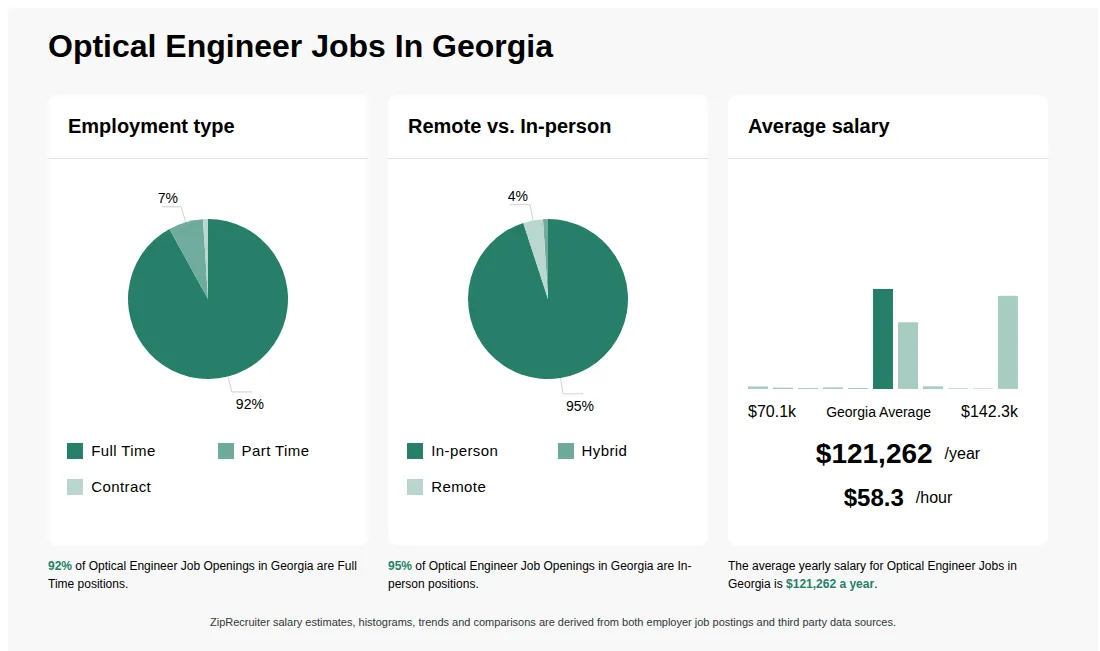
As of Jun 17, 2026, the average yearly pay for optical engineer in Georgia is $121,262.00, according to ZipRecruiter salary data. Most workers in this role earn between $108,900.00 and $141,000.00 per year, depending on experience, location, and employer.

What is the difference between Optical Engineer vs Optical Technician?

AspectOptical EngineerOptical Technician
Required CredentialsBachelor's or higher in optical engineering, physics, or related fieldAssociate's degree or technical certification in optics or related field
Work EnvironmentDesign, development, and testing of optical systems in labs or R&D settingsAssembly, alignment, and maintenance of optical equipment in manufacturing or labs
Employer & Industry UsageResearch institutions, tech companies, aerospace, defenseManufacturers, optical labs, production facilities

Optical Engineers focus on designing and developing optical systems, requiring higher education and involved in R&D. Optical Technicians handle the assembly, alignment, and maintenance of optical devices, often with technical certifications. Both roles are essential in the optics industry but differ in responsibilities and qualifications.

What is an optical engineer?

An optical engineer designs, develops, and tests systems and devices that utilize light, such as lenses, lasers, and imaging systems. They often work with optical materials, use simulation software, and require knowledge of physics and engineering principles to improve optical performance and functionality.

What Does an Optical Engineer Do?

An optical engineer oversees the scientific application of optics and light in an industrial, research, or manufacturing setting. As an optical engineering professional, your responsibilities include the design of instruments and products that rely on optics, from space telescopes to DVD players. You also may work in research and development to create new technologies and applications for optical science. Your specific duties and the level of education you need varies depending on the field in which you work

What are the key skills and qualifications needed to thrive as an Optical Engineer, and why are they important?

To thrive as an Optical Engineer, you need a solid background in physics, optics, and mathematics, typically supported by a degree in optical engineering or a related field. Familiarity with optical design software (such as Zemax or Code V), CAD tools, and laboratory equipment is commonly required, along with relevant certifications like SPIE or OSA membership. Strong analytical thinking, problem-solving abilities, and effective teamwork are crucial soft skills for success in this field. These skills and qualifications are vital for designing precise optical systems, solving complex technical challenges, and collaborating on innovative projects.

What are some typical challenges Optical Engineers face when working on new product development?

Optical Engineers involved in new product development often encounter challenges such as balancing optical performance with manufacturability and cost constraints. They must collaborate closely with mechanical and electrical engineers to ensure system integration meets all technical requirements. Additionally, they need to troubleshoot issues that arise during prototyping, such as unexpected aberrations or alignment difficulties, and iterate designs rapidly to meet project timelines. Effective communication and creative problem-solving are essential in overcoming these hurdles.

What engineer makes $500,000 a year?

Highly experienced optical engineers working in specialized industries such as aerospace, defense, or advanced research can earn salaries approaching or exceeding $500,000 annually, especially with senior roles, management responsibilities, or significant expertise in optical systems and laser technologies. Such compensation often includes bonuses, stock options, or other incentives.

What does an optical engineer do?

An optical engineer designs and develops devices and systems that use the properties of light, such as lenses, lasers, microscopes, and fiber optics. They use principles of physics and engineering to solve problems related to the generation, transmission, and detection of light. Optical engineers work in a variety of industries, including telecommunications, aerospace, healthcare, and manufacturing. Their work often involves research, testing, and improving optical components and systems to enhance performance and efficiency.

Are optical engineers in high demand?

Optical engineers are in high demand due to their expertise in designing and developing optical systems for industries such as telecommunications, healthcare, and defense. The field requires strong knowledge of optics, photonics, and related tools, and job growth is driven by advancements in technology and increasing reliance on optical components.

What do optical engineers work on?

Optical engineers design, develop, and test optical systems and components such as lenses, lasers, and imaging devices. They work on projects related to telecommunications, medical instruments, imaging systems, and laser technology, often using tools like CAD software and requiring knowledge of physics and optics principles.
What are the most commonly searched types of Optical Engineer jobs in Georgia? The most popular types of Optical Engineer jobs in Georgia are:
What are popular job titles related to Optical Engineer jobs in Georgia? For Optical Engineer jobs in Georgia, the most frequently searched job titles are:
What cities in Georgia are hiring for Optical Engineer jobs? Cities in Georgia with the most Optical Engineer job openings:
What are popular job titles related to Optical Engineer jobs in GA? For Optical Engineer jobs in GA, the most frequently searched job titles are:
Infographic showing various Optical Engineer job openings in Georgia as of June 2026, with employment types broken down into 99% Full Time, and 1% Part Time. Highlights an 87% Physical, 5% Hybrid, and 8% Remote job distribution, with an average salary of $121,262 per year, or $58.3 per hour.
Senior Hardware Engineer

Senior Hardware Engineer

Adtran

Atlanta, GA

$106K - $141K/yr

Full-time

Posted 2 days ago


Job description

Welcome!

Our Growth is Creating Great Opportunities!
Our team is expanding, and we want to hire the most talented people we can. Continued success depends on it! Once you've had a chance to explore our current open positions, apply to the ones you feel suit you best and keep track of both your progress in the selection process, and new postings that might interest you!
Thanks for your interest in working on our team!

Job Summary

The Senior Hardware Engineer will be a member of a team responsible for designing Coherent Pluggable Optical Transceiver modules for metro, core and data center applications. Senior Engineer will have a proven competency in the areas of electronic design, Microcontrollers and Signal Integrity management.

Duties and Responsibilities
  • Develop block diagrams and schematics from initial concept phase
  • Specify, design, test, integrate and release new products to production
  • Create Hardware Unit Design specification and test plans
  • Work cross functionally within all R&D disciplines in order to meet design objectives
  • Provide engineering support for designs in production and transfer of products to contract manufacturers
  • Provide guidance to CAD designers during PCB design
  • Work closely with layout engineers
  • Work closely with the FPGA/FW/Test engineering team during integration phase of the product
  • Utilize Ansys "HFFS" 3D solver for circuit design and high speed simulations
  • Complete the full product design life cycle on a portion of the system involving multiple components
  • Work independently on the assigned design activities with minimal supervision
  • Understand the product architecture, design, processes, tools, etc. required to perform their assigned design activities
QualificationsBasic Qualifications
  • BS or MS in Electrical Engineering or Physics
  • Operates at the equivalent of an engineer with 5 plus years' relevant experience (high-speed board design)
  • High proficiency using schematic design tools (e.g. Xpedition) and EM simulation tools (HFSS/ADS) is a must
  • Experience in Coherent Pluggable XCVR design a big plus.
  • Proficiency with Microsoft Office suite
  • Experience with high-speed RF measurements and characterization equipment
  • Strong fundamentals in EM and RF such as impedance matching, S-parameters
  • Experience with Spectrum Analyzer, Network Analyzer, Logic, Analyzer, Function Generator, and BER test sets
  • Experience in fiber optics test and measurements
Preferred Qualifications
  • Master's Degree in Electrical Engineering
  • Mentor Graphics DxDesigner (schematics), Hyperlynx (SI, PI), SW proficiency is a plus
  • Experience with coherent optical systems is a plus.
  • Knowledgeable on optical component reliability and telecom performance standards such as Telcordia, IEC, and ITU is highly desirable
  • Proven competency in the areas of signal integrity management utilizing Ansys HFSS is highly desirable
  • Working experience of optical transceivers is a bonus
  • Programming skills in LabView, Python, or Matlab for test purposes is a bonus
Success Criteria
  • Able to drive design teams, component vendors and manufacturing partners
  • Able to generate high quality design documents (High level design and Unit Test)
  • Good communication skills, both written and verbal
  • Self-motivated and able to perform with minimal supervision
  • Has knowledge of commonly-used concepts, practices, and procedures within a particular field
  • Relies on instructions and pre-established guidelines to perform the functions of the job