1

Image Processing Engineer Jobs (NOW HIRING)

Bachelor's degree in Electrical Engineering, Computer Engineering, Computer Science, Physics, or a ... Optimize image quality across the hardware and software stack, ensuring hardware capabilities are ...

Sr. Image Processing Engineer

Newton Center, MA · Remote

$107K - $146K/yr

The Senior Image Processing Engineer works at a high level with the entire life cycle of data classification algorithms and image processing, specifically for medical imaging, including analyzing ...

The Video Signal Processing and Algorithms (VSP&A) team is seeking to hire a Senior Image Processing Engineer to solve problems and implement solutions related to infrared image and video quality and ...

next page

Showing results 1-20

Image Processing Engineer information

See salary details

$5

$62

$89

How much do image processing engineer jobs pay per hour?

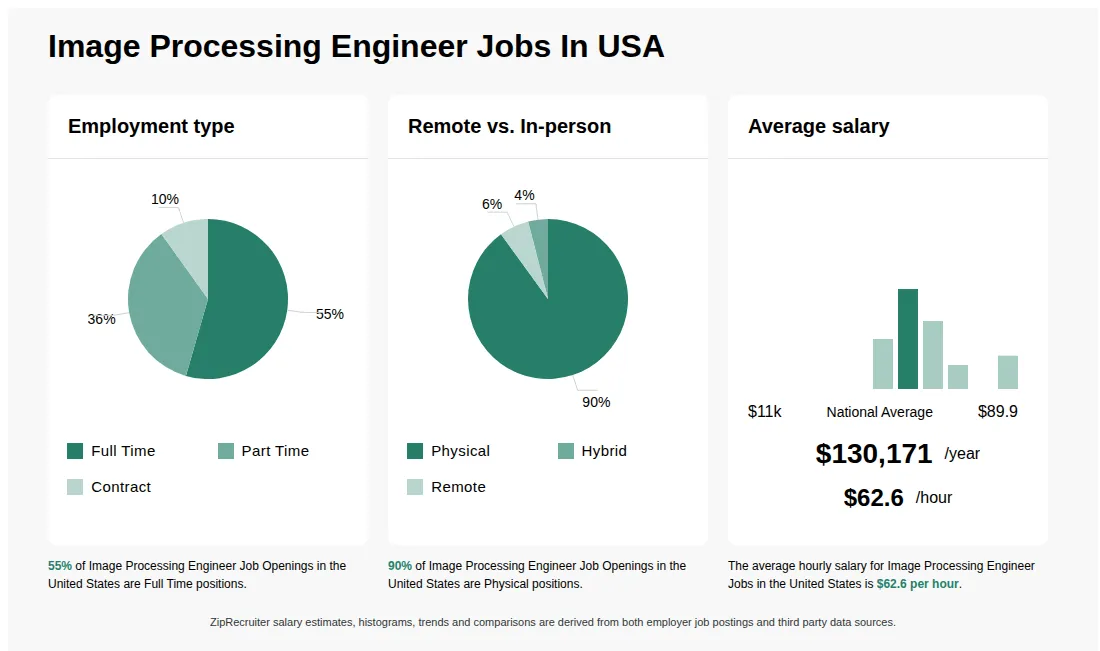
As of Jun 25, 2026, the average hourly pay for image processing engineer in the United States is $62.58, according to ZipRecruiter salary data. Most workers in this role earn between $51.92 and $66.83 per hour, depending on experience, location, and employer.

What does an Image Processing Engineer do?

An Image Processing Engineer designs, develops, and implements algorithms and systems to analyze, enhance, and manipulate digital images. They work on tasks such as image filtering, feature extraction, pattern recognition, and computer vision applications. Their work is used in a variety of fields including medical imaging, robotics, surveillance, and multimedia. They often use programming languages like Python or C++ and tools like OpenCV or MATLAB to solve complex image-related problems.

What is the difference between Image Processing Engineer vs Computer Vision Engineer?

AspectImage Processing EngineerComputer Vision Engineer
Required CredentialsBachelor's or Master's in Electrical Engineering, Computer Science, or related fields; knowledge of image processing algorithmsBachelor's or Master's in Computer Science, Electrical Engineering, or related fields; expertise in computer vision techniques
Work EnvironmentResearch labs, tech companies, imaging hardware firmsTech companies, autonomous vehicles, robotics, AI firms
Industry UsageFocus on image enhancement, filtering, and analysisFocus on object detection, scene understanding, and AI integration

While both roles involve working with visual data, Image Processing Engineers primarily focus on improving and analyzing images through algorithms, whereas Computer Vision Engineers develop systems that interpret and understand visual information for applications like autonomous vehicles and AI. The roles often overlap but differ in their core objectives and application areas.

What Does an Image Processing Engineer Do?

An image processing engineer assists with the entire life cycle of data classification algorithms and image processing for a company. Your responsibilities in this career are to analyze data, write reports, develop methods for feature extraction and classification, research basic to advanced image processing algorithms, give presentations, and create visual interpretations of data. Your duties also include working on target detection and tracking, video georeferencing, implementing an image processing system, enhancing new software, and enabling immersive augmented and virtual reality experiences. You also develop algorithms for real 3D images and accurate wireless tracking.

What are some common challenges Image Processing Engineers face when working on cross-functional teams?

Image Processing Engineers often collaborate with data scientists, software developers, and hardware engineers, which can present challenges in aligning technical requirements and timelines. One frequent hurdle is ensuring that image processing algorithms integrate seamlessly with broader system architectures, especially when resources or real-time performance constraints are involved. Clear communication and adaptability are key, as team members may have differing levels of understanding of image processing concepts. Building strong collaborative relationships and regularly sharing progress can help overcome these challenges and ensure project success.

What are the key skills and qualifications needed to thrive as an Image Processing Engineer, and why are they important?

To thrive as an Image Processing Engineer, you need a strong background in mathematics, computer vision, and programming (often with a degree in computer science, electrical engineering, or a related field). Familiarity with tools and libraries such as OpenCV, MATLAB, Python, and machine learning frameworks is typically expected, along with experience in image analysis algorithms. Strong problem-solving, analytical thinking, and effective communication skills help you collaborate with multidisciplinary teams and interpret complex results. These skills are crucial for developing robust image processing solutions that meet technical requirements and drive innovation in fields like healthcare, automotive, and security.
What cities are hiring for Image Processing Engineer jobs? Cities with the most Image Processing Engineer job openings:
What are the most commonly searched types of Image Processing Engineer jobs? The most popular types of Image Processing Engineer jobs are:
What states have the most Image Processing Engineer jobs? States with the most job openings for Image Processing Engineer jobs include:
What are popular job titles related to Image Processing Engineer jobs? For Image Processing Engineer jobs, the most frequently searched job titles are:
Infographic showing various Image Processing Engineer job openings in the United States as of June 2026, with employment types broken down into 97% Full Time, 1% Part Time, and 2% Contract. Highlights an 97% Physical, and 3% Remote job distribution, with an average salary of $130,171 per year, or $62.6 per hour.

Image Processing Engineer

Google

Mountain View, CA • On-site

Full-time

Posted 27 days ago


Google rating

8.8

Company rating: 8.8 out of 10

Based on 94 frontline employees who took The Breakroom Quiz

33rd of 191 rated software companies


Job description

Minimum qualifications:
  • Bachelor's degree in Electrical Engineering, Computer Engineering, Computer Science, Physics, or a specialized field (e.g., optics, sensors, audio, or DSP), or equivalent practical experience.
  • 2 years of experience working in an image quality, computer vision, or related technical environment.
  • Experience with Python and C for algorithm development and implementation.

Preferred qualifications:
  • Master's degree or PhD in Electrical Engineering, Computer Engineering, Physics, or a related field (e.g., optics, sensors, audio, or DSP).
  • Experience with emerging technologies and new technical domains.
  • Ability to solve multi-layered technical problems on their own with a high degree of motivation.
  • Excellent written and verbal communication skills, with a demonstrated ability to translate technical concepts into clear, actionable insights for cross-functional partners.

About the job
The Platforms and Devices team encompasses Google's various computing software platforms across environments (desktop, mobile, applications), as well as our first party devices and services that combine the best of Google AI, software, and hardware. Teams across this area research, design, and develop new technologies to make our user's interaction with computing faster and more seamless, building innovative experiences for our users around the world.
Individual pay is determined by factors including job-related skills, experience, and relevant education or training.
US: $132000 - $190000 (USD) 15% bonus target equity benefits
Learn more about benefits at Google .
Responsibilities
  • Optimize image quality across the hardware and software stack, ensuring hardware capabilities are leveraged through software tuning.
  • Fine-tune 3A algorithms to ensure performance across lighting and environmental conditions.
  • Build software tools, utilizing machine learning (ML) automation to streamline image quality (IQ) tuning, testing, benchmarking, and calibration workflows.

Information collected and processed as part of your Google Careers profile, and any job applications you choose to submit is subject to Google's Applicant and Candidate Privacy Policy .
Google is proud to be an equal opportunity and affirmative action employer. We are committed to building a workforce that is representative of the users we serve, creating a culture of belonging, and providing an equal employment opportunity regardless of race, creed, color, religion, gender, sexual orientation, gender identity/expression, national origin, disability, age, genetic information, veteran status, marital status, pregnancy or related condition (including breastfeeding), expecting or parents-to-be, criminal histories consistent with legal requirements, or any other basis protected by law. See also Google's EEO Policy , Know your rights: workplace discrimination is illegal , Belonging at Google , and How we hire .
If you have a need that requires accommodation, please let us know by completing our Accommodations for Applicants form .
Google is a global company and, in order to facilitate efficient collaboration and communication globally, English proficiency is a requirement for all roles unless stated otherwise in the job posting.
To all recruitment agencies: Google does not accept agency resumes. Please do not forward resumes to our jobs alias, Google employees, or any other organization location. Google is not responsible for any fees related to unsolicited resumes.
Equity is granted exclusively and discretionarily by Alphabet Inc. on the basis of an agreement concluded between you and Alphabet Inc. Alphabet Inc. is your sole contractual partner with respect to equity grants. GSU grants are not guaranteed, are discretionary, are subject to approval by the Alphabet Inc. board of directors or its delegate, the terms of the relevant Alphabet Inc. stock plan, and your grant agreement. They have no impact on statutory payments. Current or past grants do not confer an acquired right.

What Google employees say

Pay

Benefits

Hours and flexibility

Workplace

Get the full story on Breakroom