We are seeking a highly skilled Image Processing Subject Matter Expert (SME) to support the ... Collaborate with FPGA engineers to transition computational imaging algorithms into hardware ...
We are seeking a highly skilled Image Processing Subject Matter Expert (SME) to support the ... Collaborate with FPGA engineers to transition computational imaging algorithms into hardware ...

We are seeking an experienced Image Processing (IP) Engineer who will join a highly skilled team of systems engineering technologists and algorithm developers supporting various contracts and IRADs ...
We are seeking an experienced Image Processing (IP) Engineer who will join a highly skilled team of systems engineering technologists and algorithm developers supporting various contracts and IRADs ...
We are seeking an experienced Image Processing (IP) Engineer who will join a highly skilled team of systems engineering technologists and algorithm developers supporting various contracts and IRADs ...
We are seeking an experienced Image Processing (IP) Engineer who will join a highly skilled team of systems engineering technologists and algorithm developers supporting various contracts and IRADs ...
We are seeking an experienced Image Processing (IP) Engineer who will join a highly skilled team of systems engineering technologists and algorithm developers supporting various contracts and IRADs ...
We are seeking an experienced Image Processing (IP) Engineer who will join a highly skilled team of systems engineering technologists and algorithm developers supporting various contracts and IRADs ...

Image Processing Measurements Engineer Location: Painted Post, NY Duration: 12 Months Only W2 candidates are eligible for this position. Third-party or C2C candidates will not be considered ...
Quick apply
Image Processing Measurements Engineer Location: Painted Post, NY Duration: 12 Months Only W2 candidates are eligible for this position. Third-party or C2C candidates will not be considered ...
We are seeking an experienced Image Processing (IP) Engineer who will join a highly skilled team of systems engineering technologists and algorithm developers supporting various contracts and IRADs ...
We are seeking an experienced Image Processing (IP) Engineer who will join a highly skilled team of systems engineering technologists and algorithm developers supporting various contracts and IRADs ...

In this role, the selected candidate will join a staff of signal/image processing engineers, systems engineers, and software engineers that supports the development of signal and image processing ...
In this role, the selected candidate will join a staff of signal/image processing engineers, systems engineers, and software engineers that supports the development of signal and image processing ...
In this role, the selected candidate will join a staff of signal/image processing engineers, systems engineers, and software engineers that supports the development of signal and image processing ...
In this role, the selected candidate will join a staff of signal/image processing engineers, systems engineers, and software engineers that supports the development of signal and image processing ...

Sr. Algorithm Engineer (Image Processing)
Ann Arbor, MI · Hybrid
$105K - $180K/yr
There is never a dull moment with us. /Preferred Qualifications Join KLA in Michigan as an Image Processing Algorithm Engineer! Are you passionate about innovating and crafting new algorithms thatgo ...
Sr. Algorithm Engineer (Image Processing)
Ann Arbor, MI · Hybrid
$105K - $180K/yr
There is never a dull moment with us. /Preferred Qualifications Join KLA in Michigan as an Image Processing Algorithm Engineer! Are you passionate about innovating and crafting new algorithms thatgo ...
Sr. Algorithm Engineer (Image Processing)
Ann Arbor, MI · Hybrid
$105K - $180K/yr
There is never a dull moment with us. /Preferred Qualifications Join KLA in Michigan as an Image Processing Algorithm Engineer! Are you passionate about innovating and crafting new algorithms thatgo ...
Sr. Algorithm Engineer (Image Processing)
Ann Arbor, MI · Hybrid
$105K - $180K/yr
There is never a dull moment with us. /Preferred Qualifications Join KLA in Michigan as an Image Processing Algorithm Engineer! Are you passionate about innovating and crafting new algorithms thatgo ...
Sr. Algorithm Engineer (Image Processing)
Ann Arbor, MI · On-site
$105K - $180K/yr
There is never a dull moment with us. /Preferred Qualifications Join KLA in Michigan as an Image Processing Algorithm Engineer! Are you passionate about innovating and crafting new algorithms that go ...
Sr. Algorithm Engineer (Image Processing)
Ann Arbor, MI · On-site
$105K - $180K/yr
There is never a dull moment with us. /Preferred Qualifications Join KLA in Michigan as an Image Processing Algorithm Engineer! Are you passionate about innovating and crafting new algorithms that go ...

Sr. Algorithm Engineer (Image Processing)
Ann Arbor, MI · Hybrid
$105K - $180K/yr
There is never a dull moment with us. /Preferred Qualifications Join KLA in Michigan as an Image Processing Algorithm Engineer! Are you passionate about innovating and crafting new algorithms thatgo ...
Sr. Algorithm Engineer (Image Processing)
Ann Arbor, MI · Hybrid
$105K - $180K/yr
There is never a dull moment with us. /Preferred Qualifications Join KLA in Michigan as an Image Processing Algorithm Engineer! Are you passionate about innovating and crafting new algorithms thatgo ...
InterImage currently has a need for an Image Processing SME Experience Required: • Experience ... Electrical Engineering, Physics, Computer Science, Computer Engineering or Mathematics.
InterImage currently has a need for an Image Processing SME Experience Required: • Experience ... Electrical Engineering, Physics, Computer Science, Computer Engineering or Mathematics.

SAR Signal and Image Processing Engineer
Chantilly, VA · On-site
$129K - $193K/yr
We are looking for experienced SAR Signal & Image Processing Engineers to grow our department of highly skilled technical specialists. Join us today to become part of a culture and legacy of ...
SAR Signal and Image Processing Engineer
Chantilly, VA · On-site
$129K - $193K/yr
We are looking for experienced SAR Signal & Image Processing Engineers to grow our department of highly skilled technical specialists. Join us today to become part of a culture and legacy of ...
SAR Signal and Image Processing Engineer
Chantilly, VA · On-site
$129K - $193K/yr
We are looking for experienced SAR Signal & Image Processing Engineers to grow our department of highly skilled technical specialists. Join us today to become part of a culture and legacy of ...
SAR Signal and Image Processing Engineer
Chantilly, VA · On-site
$129K - $193K/yr
We are looking for experienced SAR Signal & Image Processing Engineers to grow our department of highly skilled technical specialists. Join us today to become part of a culture and legacy of ...
We are seeking a highly skilled Image Processing Subject Matter Expert (SME) to support the ... Collaborate with FPGA engineers to transition computational imaging algorithms into hardware ...
We are seeking a highly skilled Image Processing Subject Matter Expert (SME) to support the ... Collaborate with FPGA engineers to transition computational imaging algorithms into hardware ...
Senior SAR Signal and Image Processing Engineer
Chantilly, VA · On-site
$166K - $249K/yr
We are looking for experienced SAR Signal & Image Processing Engineers to grow our department of highly skilled technical specialists. Join us today to become part of a culture and legacy of ...
Senior SAR Signal and Image Processing Engineer
Chantilly, VA · On-site
$166K - $249K/yr
We are looking for experienced SAR Signal & Image Processing Engineers to grow our department of highly skilled technical specialists. Join us today to become part of a culture and legacy of ...
InterImage currently has a need for an Image Processing SME Experience Required: Experience ... The individual will likely hold a Masters Degree or even a PhD in Electrical Engineering, Physics ...
InterImage currently has a need for an Image Processing SME Experience Required: Experience ... The individual will likely hold a Masters Degree or even a PhD in Electrical Engineering, Physics ...
Senior SAR Signal and Image Processing Engineer
Chantilly, VA · On-site
$166K - $249K/yr
We are looking for experienced SAR Signal & Image Processing Engineers to grow our department of highly skilled technical specialists. Join us today to become part of a culture and legacy of ...
Senior SAR Signal and Image Processing Engineer
Chantilly, VA · On-site
$166K - $249K/yr
We are looking for experienced SAR Signal & Image Processing Engineers to grow our department of highly skilled technical specialists. Join us today to become part of a culture and legacy of ...

... tone, image, and/or video processing algorithms and prototyping them in Matlab/Python/C/C++ Preferred Qualifications MS/PhD in Electrical Engineering or Computer Science or Color Science and 20 ...
... tone, image, and/or video processing algorithms and prototyping them in Matlab/Python/C/C++ Preferred Qualifications MS/PhD in Electrical Engineering or Computer Science or Color Science and 20 ...
Image Processing Engineer information
See salary details
$5.29 - $12.98
0% of jobs
$12.98 - $20.67
0% of jobs
$20.67 - $28.37
0% of jobs
$28.37 - $36.06
0% of jobs
$36.06 - $43.75
0% of jobs
$43.75 - $51.44
18% of jobs
$52.83 is the 25th percentile. Wages below this are outliers.
$51.44 - $59.13
37% of jobs
$65.38 is the 75th percentile. Wages above this are outliers.
$59.13 - $66.83
24% of jobs
$66.83 - $74.52
8% of jobs
$74.52 - $82.21
0% of jobs
$82.21 - $89.90
12% of jobs
$5
$62
$89
How much do image processing engineer jobs pay per hour?
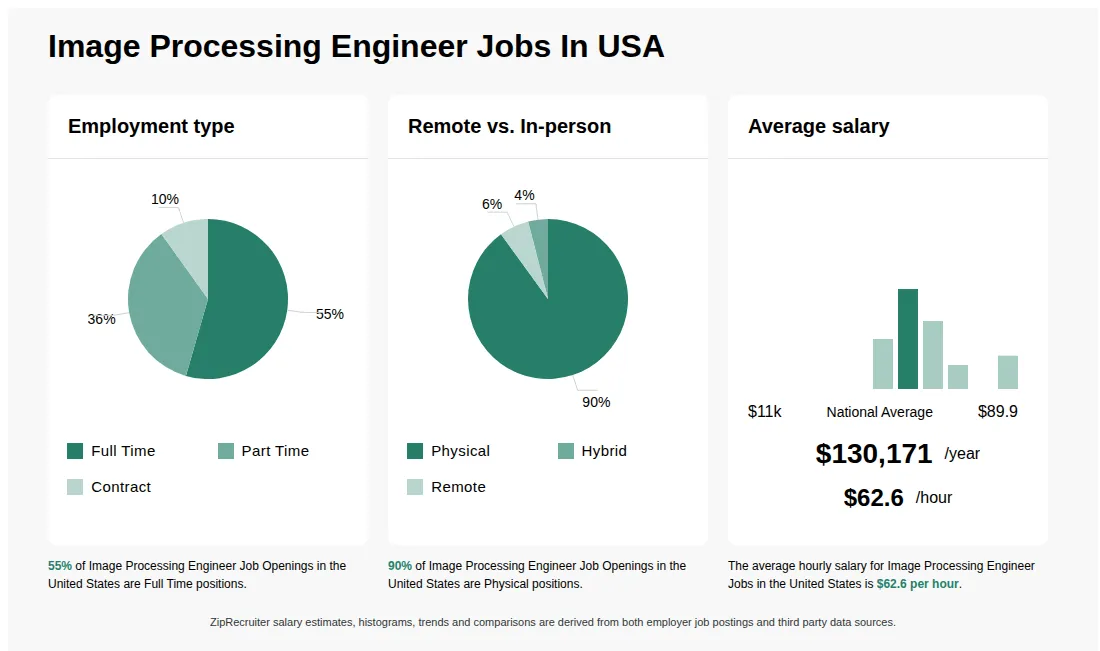
As of Jul 15, 2026, the average hourly pay for image processing engineer in the United States is $62.58, according to ZipRecruiter salary data. Most workers in this role earn between $51.92 and $66.83 per hour, depending on experience, location, and employer.
What does an Image Processing Engineer do?
An Image Processing Engineer designs, develops, and implements algorithms and systems to analyze, enhance, and manipulate digital images. They work on tasks such as image filtering, feature extraction, pattern recognition, and computer vision applications. Their work is used in a variety of fields including medical imaging, robotics, surveillance, and multimedia. They often use programming languages like Python or C++ and tools like OpenCV or MATLAB to solve complex image-related problems.
What is the difference between Image Processing Engineer vs Computer Vision Engineer?
| Aspect | Image Processing Engineer | Computer Vision Engineer |
|---|---|---|
| Required Credentials | Bachelor's or Master's in Electrical Engineering, Computer Science, or related fields; knowledge of image processing algorithms | Bachelor's or Master's in Computer Science, Electrical Engineering, or related fields; expertise in computer vision techniques |
| Work Environment | Research labs, tech companies, imaging hardware firms | Tech companies, autonomous vehicles, robotics, AI firms |
| Industry Usage | Focus on image enhancement, filtering, and analysis | Focus on object detection, scene understanding, and AI integration |
While both roles involve working with visual data, Image Processing Engineers primarily focus on improving and analyzing images through algorithms, whereas Computer Vision Engineers develop systems that interpret and understand visual information for applications like autonomous vehicles and AI. The roles often overlap but differ in their core objectives and application areas.
What Does an Image Processing Engineer Do?
An image processing engineer assists with the entire life cycle of data classification algorithms and image processing for a company. Your responsibilities in this career are to analyze data, write reports, develop methods for feature extraction and classification, research basic to advanced image processing algorithms, give presentations, and create visual interpretations of data. Your duties also include working on target detection and tracking, video georeferencing, implementing an image processing system, enhancing new software, and enabling immersive augmented and virtual reality experiences. You also develop algorithms for real 3D images and accurate wireless tracking.
What are some common challenges Image Processing Engineers face when working on cross-functional teams?
Image Processing Engineers often collaborate with data scientists, software developers, and hardware engineers, which can present challenges in aligning technical requirements and timelines. One frequent hurdle is ensuring that image processing algorithms integrate seamlessly with broader system architectures, especially when resources or real-time performance constraints are involved. Clear communication and adaptability are key, as team members may have differing levels of understanding of image processing concepts. Building strong collaborative relationships and regularly sharing progress can help overcome these challenges and ensure project success.
What are the key skills and qualifications needed to thrive as an Image Processing Engineer, and why are they important?
To thrive as an Image Processing Engineer, you need a strong background in mathematics, computer vision, and programming (often with a degree in computer science, electrical engineering, or a related field). Familiarity with tools and libraries such as OpenCV, MATLAB, Python, and machine learning frameworks is typically expected, along with experience in image analysis algorithms. Strong problem-solving, analytical thinking, and effective communication skills help you collaborate with multidisciplinary teams and interpret complex results. These skills are crucial for developing robust image processing solutions that meet technical requirements and drive innovation in fields like healthcare, automotive, and security.
More about Image Processing Engineer jobs
What cities are hiring for Image Processing Engineer jobs? Cities with the most Image Processing Engineer job openings:
What are the most commonly searched types of Image Processing Engineer jobs? The most popular types of Image Processing Engineer jobs are:
What states have the most Image Processing Engineer jobs? States with the most job openings for Image Processing Engineer jobs include:
What job categories do people searching Image Processing Engineer jobs look for? The top searched job categories for Image Processing Engineer jobs are:
What are popular job titles related to Image Processing Engineer jobs? For Image Processing Engineer jobs, the most frequently searched job titles are:

Full-time
Medical, Dental, Vision, Life, Retirement, PTO
Posted 2 days ago
Job description
We are seeking a highly skilled Image Processing Subject Matter Expert (SME) to support the development of advanced imaging and signal processing solutions within a cutting-edge FPGA engineering environment. The ideal candidate will possess deep expertise in scientific and computational imaging, image correction algorithms, machine vision, and automated image analysis. This role will work closely with FPGA, software, hardware, and algorithm development teams to design and optimize image processing pipelines for high-performance, mission-critical applications.
The successful candidate will contribute to the development of advanced imaging solutions involving microscopy, scientific sensors, electro-optical systems, and other high-resolution imaging platforms. This position offers the opportunity to solve complex imaging challenges while supporting innovative technologies for government, research, and commercial applications.
Responsibilities- Analyze and develop image correction algorithms to compensate for optical aberrations, lensing defects, sensor non-linearity, geometric distortions, illumination inconsistencies, and other imaging artifacts.
- Design, evaluate, and optimize advanced image processing pipelines for scientific and high-resolution imaging systems.
- Develop algorithms for object detection, feature extraction, segmentation, classification, and pattern recognition within large image datasets.
- Create and optimize image stitching, registration, and mosaic generation techniques for microscopy and scientific imaging applications.
- Implement image preprocessing methods including noise reduction, deconvolution, contrast enhancement, normalization, filtering, and edge detection.
- Collaborate with FPGA engineers to transition computational imaging algorithms into hardware-accelerated implementations.
- Evaluate algorithm performance, accuracy, throughput, and resource utilization for real-time and near-real-time processing applications.
- Develop and validate machine learning and computer vision models for automated image analysis workflows.
- Support integration, testing, verification, and validation of imaging systems and processing pipelines.
- Work with multidisciplinary teams including FPGA developers, software engineers, optical engineers, data scientists, and system architects.
- Document technical designs, algorithm performance analyses, validation results, and implementation approaches.
- Provide technical leadership and subject matter expertise on imaging science, computational photography, and machine vision technologies.
Requirements
Required Qualifications- Bachelor's degree in Electrical Engineering, Computer Engineering, Computer Science, Applied Mathematics, Physics, Imaging Science, or a related technical discipline.
- 8+ years of experience developing advanced image processing, computer vision, or computational imaging solutions.
- Strong understanding of image formation, optics, sensor technologies, and imaging system performance characteristics.
- Demonstrated experience correcting scientific image data affected by aberrations, lens distortion, optical anomalies, non-uniform illumination, and sensor artifacts.
- Expertise in object detection, feature extraction, image segmentation, and pattern recognition algorithms.
- Experience developing image registration, alignment, and stitching solutions for large-scale image mosaics.
- Strong knowledge of image preprocessing techniques and enhancement methodologies.
- Experience handling large, high-resolution image datasets while optimizing performance and computational efficiency.
- Proficiency in Python, C++, MATLAB, or similar algorithm development environments.
- Ability to communicate complex technical concepts effectively across engineering disciplines.
- Experience supporting FPGA-based image processing architectures and hardware acceleration initiatives.
- Knowledge of GPU computing, parallel processing, and high-performance computing techniques.
- Experience developing machine learning models for image classification, detection, segmentation, and anomaly detection.
- Familiarity with hyperspectral, multispectral, electro-optical, infrared, or scientific imaging systems.
- Experience working with microscopy imagery, laboratory imaging systems, or advanced scientific instrumentation.
- Knowledge of computer vision model deployment for real-time processing environments.
- Experience supporting government agencies, research laboratories, federally funded research organizations, or commercial entities focused on imagery exploitation and analysis.
- Familiarity with imaging standards, calibration methodologies, and quantitative image quality assessment.
- Experience utilizing image processing libraries such as OpenCV, SciPy, NumPy, scikit-image, TensorFlow, PyTorch, or equivalent frameworks.
Education:
- The individual will likely hold a Masters Degree or even a PhD in Electrical Engineering, Physics, Computer Science, Computer Engineering or Mathematics.
Requirements:
- TS/SCI Full Scope Poly required
Benefits
- 401K: up to 3% discretionary profit sharing contribution + 100% match on the 1st 7% of pay
- PTO: 20 days per year
- Healthcare, dental, vision, Free for a single participant
- $50,000 Life insurance provided, additional voluntary life insurance available
InterImage is an Equal Opportunity Employer. All qualified applicants will receive consideration for employment without regard to race, color, religion, sex, sexual orientation, gender identity, national origin, age, disability or veteran status, or any other applicable state or federal protected class. InterImage provides affirmative action in employment for qualified Individuals with a Disability and Protected Veterans in compliance with Section 503 of the Rehabilitation Act and the Vietnam Era Veterans' Readjustment Assistance Act.

About InterImage
Sourced by ZipRecruiter
Company size
51 - 200 Employees
Headquarters location
Arlington, VA, US
Year founded
1996