Description As a Display Image Processing Algorithms Architect, you are responsible for the design ... engineering and software teams to map algorithms into well-defined architectures that may be ...
Description As a Display Image Processing Algorithms Architect, you are responsible for the design ... engineering and software teams to map algorithms into well-defined architectures that may be ...
Description As a Display Image Processing Algorithms Architect, you are responsible for the design ... engineering and software teams to map algorithms into well-defined architectures that may be ...
Description As a Display Image Processing Algorithms Architect, you are responsible for the design ... engineering and software teams to map algorithms into well-defined architectures that may be ...

Image Processing / Sensor Engineer
Laurel, MD · On-site
$245K/yr
As a sensor and signal processing engineer... * Your primary responsibility will be to derive requirements, perform trade studies, and analyze the performance of advanced sensor systems. * You will ...
Image Processing / Sensor Engineer
Laurel, MD · On-site
$245K/yr
As a sensor and signal processing engineer... * Your primary responsibility will be to derive requirements, perform trade studies, and analyze the performance of advanced sensor systems. * You will ...
Description As a Display Image Processing Algorithms Engineer, you are responsible for the design of algorithms and architectures for the display sub-system of Apple's application processor chip ...
Description As a Display Image Processing Algorithms Engineer, you are responsible for the design of algorithms and architectures for the display sub-system of Apple's application processor chip ...

Image Processing Subject Matter Expert in Annapolis Junction, MD Security Clearance Required:TS/SCI ... A masters degree or PhD in Electrical Engineering, Physics, Computer Science, Computer Engineering ...
Quick apply
Image Processing Subject Matter Expert in Annapolis Junction, MD Security Clearance Required:TS/SCI ... A masters degree or PhD in Electrical Engineering, Physics, Computer Science, Computer Engineering ...

Image Analysis Engineer
Seattle, WA · On-site
$160K - $250K/yr
This is a crucial role in our design and development process. As the Image Analysis Engineer, your responsibilities are: • Lead image analysis from probe bring-up to final optimization • Lead ...
Quick apply
Image Analysis Engineer
Seattle, WA · On-site
$160K - $250K/yr
This is a crucial role in our design and development process. As the Image Analysis Engineer, your responsibilities are: • Lead image analysis from probe bring-up to final optimization • Lead ...

Image Processing SME with Security Clearance
Hanover, MD · On-site
$170K - $220K/yr
We are seeking an experienced Image Processing SME to advance image analysis capabilities for high ... Engineering, Physics, Computer Science, Computer Engineering, Mathematics, or related field The ...
Image Processing SME with Security Clearance
Hanover, MD · On-site
$170K - $220K/yr
We are seeking an experienced Image Processing SME to advance image analysis capabilities for high ... Engineering, Physics, Computer Science, Computer Engineering, Mathematics, or related field The ...
Image Analysis Engineer
Seattle, WA · On-site
$160K - $250K/yr
This is a crucial role in our design and development process. As the Image Analysis Engineer, your responsibilities are: • Lead image analysis from probe bring-up to final optimization • Lead ...
Image Analysis Engineer
Seattle, WA · On-site
$160K - $250K/yr
This is a crucial role in our design and development process. As the Image Analysis Engineer, your responsibilities are: • Lead image analysis from probe bring-up to final optimization • Lead ...
Image Analysis Engineer
Seattle, WA · On-site
$160K - $250K/yr
This is a crucial role in our design and development process. As the Image Analysis Engineer, your responsibilities are: Lead image analysis from probe bring-up to final optimization Lead ultrasound ...
Image Analysis Engineer
Seattle, WA · On-site
$160K - $250K/yr
This is a crucial role in our design and development process. As the Image Analysis Engineer, your responsibilities are: Lead image analysis from probe bring-up to final optimization Lead ultrasound ...
Image Processing Subject Matter Expert
Fort George G Meade, MD · On-site
$165K - $230K/yr
Image Processing Subject Matter Expert in Annapolis Junction, MD Security Clearance Required: TS ... A master's degree or PhD in Electrical Engineering, Physics, Computer Science, Computer Engineering ...
Image Processing Subject Matter Expert
Fort George G Meade, MD · On-site
$165K - $230K/yr
Image Processing Subject Matter Expert in Annapolis Junction, MD Security Clearance Required: TS ... A master's degree or PhD in Electrical Engineering, Physics, Computer Science, Computer Engineering ...
Define and refine requirements for image processing and image-based analytics, including ... Collaborate with software engineers to integrate algorithms and AI models into user-friendly ...
Define and refine requirements for image processing and image-based analytics, including ... Collaborate with software engineers to integrate algorithms and AI models into user-friendly ...
Image Processing Subject Matter Expert
$165K - $230K/yr
Image Processing Subject Matter Expert in Annapolis Junction, MD Security Clearance Required:TS/SCI ... A master's degree or PhD in Electrical Engineering, Physics, Computer Science, Computer Engineering ...
Image Processing Subject Matter Expert
$165K - $230K/yr
Image Processing Subject Matter Expert in Annapolis Junction, MD Security Clearance Required:TS/SCI ... A master's degree or PhD in Electrical Engineering, Physics, Computer Science, Computer Engineering ...

This role is execution-focused and suited for engineers with strong foundations in computer vision, image processing, and machine learning who want to apply their skills to real-world, mission-driven ...
This role is execution-focused and suited for engineers with strong foundations in computer vision, image processing, and machine learning who want to apply their skills to real-world, mission-driven ...

As a Signal Processing Engineer, you will: • Design, develop, and verify complex DSP blocks (mixers, re-samplers, channelizers, DUC/DDC, etc.) on embedded processors, ASICs, FPGAs, and Versal ...
As a Signal Processing Engineer, you will: • Design, develop, and verify complex DSP blocks (mixers, re-samplers, channelizers, DUC/DDC, etc.) on embedded processors, ASICs, FPGAs, and Versal ...

Image Processing SME (2025-0073)
Annapolis, MD · On-site
$220K - $230K/yr
We are currently recruiting for an Image Processing SME with a TS/SCI w/ poly to work in support of ... The individual will likely hold a master's degree or even a PhD in Electrical Engineering, Physics ...
Image Processing SME (2025-0073)
Annapolis, MD · On-site
$220K - $230K/yr
We are currently recruiting for an Image Processing SME with a TS/SCI w/ poly to work in support of ... The individual will likely hold a master's degree or even a PhD in Electrical Engineering, Physics ...
We are currently recruiting for an Image Processing SME with a TS/SCI w/ poly to work in support of ... The individual will likely hold a master's degree or even a PhD in Electrical Engineering, Physics ...
Quick apply
We are currently recruiting for an Image Processing SME with a TS/SCI w/ poly to work in support of ... The individual will likely hold a master's degree or even a PhD in Electrical Engineering, Physics ...

Image & Computer Vision AI Engineer
Reston, VA · On-site
$140K - $170K/yr
This role is execution-focused and suited for engineers with strong foundations in computer vision, image processing, and machine learning who want to apply their skills to real-world, mission-driven ...
Quick apply
Image & Computer Vision AI Engineer
Reston, VA · On-site
$140K - $170K/yr
This role is execution-focused and suited for engineers with strong foundations in computer vision, image processing, and machine learning who want to apply their skills to real-world, mission-driven ...
This role is execution-focused and suited for engineers with strong foundations in computer vision, image processing, and machine learning who want to apply their skills to real-world, mission-driven ...
This role is execution-focused and suited for engineers with strong foundations in computer vision, image processing, and machine learning who want to apply their skills to real-world, mission-driven ...
We are looking for a Signal Processing Engineer who has a background in Signal Processing algorithm development. Key activities you will accomplish in this role: As a Signal Processing Engineer, you ...
We are looking for a Signal Processing Engineer who has a background in Signal Processing algorithm development. Key activities you will accomplish in this role: As a Signal Processing Engineer, you ...
We are looking for a Signal Processing Engineer who has a background in Signal Processing algorithm development. Key activities you will accomplish in this role: As a Signal Processing Engineer, you ...
We are looking for a Signal Processing Engineer who has a background in Signal Processing algorithm development. Key activities you will accomplish in this role: As a Signal Processing Engineer, you ...
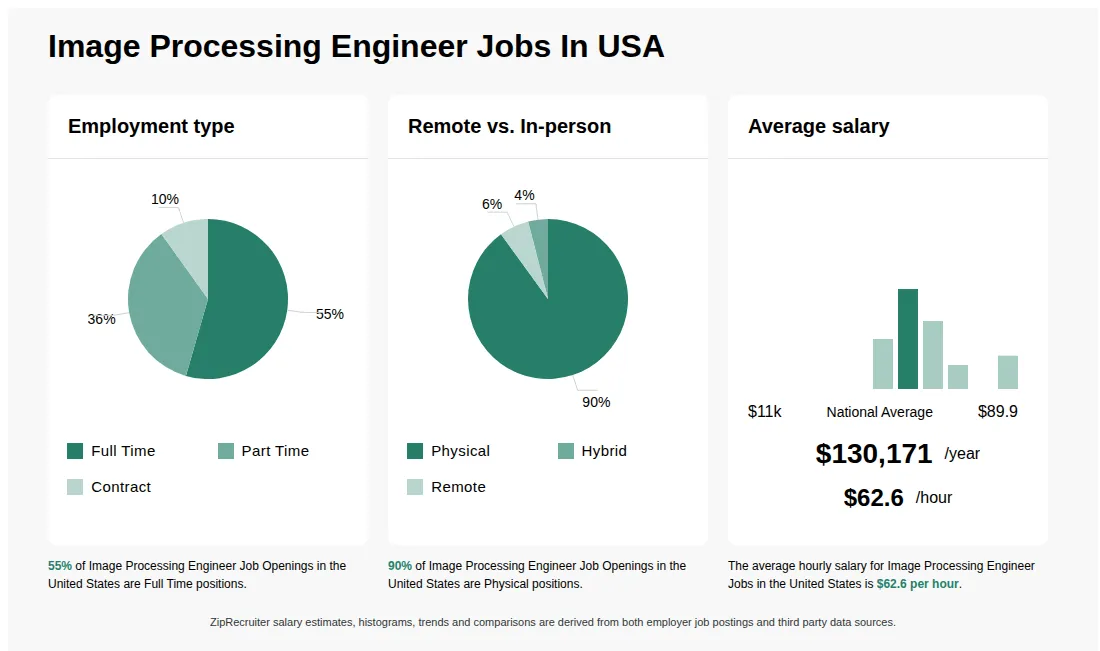
Image Processing Engineer information
See salary details
$5.29 - $12.98
0% of jobs
$12.98 - $20.67
0% of jobs
$20.67 - $28.37
0% of jobs
$28.37 - $36.06
0% of jobs
$36.06 - $43.75
0% of jobs
$43.75 - $51.44
18% of jobs
$52.83 is the 25th percentile. Wages below this are outliers.
$51.44 - $59.13
37% of jobs
$65.38 is the 75th percentile. Wages above this are outliers.
$59.13 - $66.83
24% of jobs
$66.83 - $74.52
8% of jobs
$74.52 - $82.21
0% of jobs
$82.21 - $89.90
12% of jobs
$5
$62
$89
How much do image processing engineer jobs pay per hour?
As of Jul 15, 2026, the average hourly pay for image processing engineer in the United States is $62.58, according to ZipRecruiter salary data. Most workers in this role earn between $51.92 and $66.83 per hour, depending on experience, location, and employer.
What does an Image Processing Engineer do?
An Image Processing Engineer designs, develops, and implements algorithms and systems to analyze, enhance, and manipulate digital images. They work on tasks such as image filtering, feature extraction, pattern recognition, and computer vision applications. Their work is used in a variety of fields including medical imaging, robotics, surveillance, and multimedia. They often use programming languages like Python or C++ and tools like OpenCV or MATLAB to solve complex image-related problems.
What is the difference between Image Processing Engineer vs Computer Vision Engineer?
| Aspect | Image Processing Engineer | Computer Vision Engineer |
|---|---|---|
| Required Credentials | Bachelor's or Master's in Electrical Engineering, Computer Science, or related fields; knowledge of image processing algorithms | Bachelor's or Master's in Computer Science, Electrical Engineering, or related fields; expertise in computer vision techniques |
| Work Environment | Research labs, tech companies, imaging hardware firms | Tech companies, autonomous vehicles, robotics, AI firms |
| Industry Usage | Focus on image enhancement, filtering, and analysis | Focus on object detection, scene understanding, and AI integration |
While both roles involve working with visual data, Image Processing Engineers primarily focus on improving and analyzing images through algorithms, whereas Computer Vision Engineers develop systems that interpret and understand visual information for applications like autonomous vehicles and AI. The roles often overlap but differ in their core objectives and application areas.
What Does an Image Processing Engineer Do?
An image processing engineer assists with the entire life cycle of data classification algorithms and image processing for a company. Your responsibilities in this career are to analyze data, write reports, develop methods for feature extraction and classification, research basic to advanced image processing algorithms, give presentations, and create visual interpretations of data. Your duties also include working on target detection and tracking, video georeferencing, implementing an image processing system, enhancing new software, and enabling immersive augmented and virtual reality experiences. You also develop algorithms for real 3D images and accurate wireless tracking.
What are some common challenges Image Processing Engineers face when working on cross-functional teams?
Image Processing Engineers often collaborate with data scientists, software developers, and hardware engineers, which can present challenges in aligning technical requirements and timelines. One frequent hurdle is ensuring that image processing algorithms integrate seamlessly with broader system architectures, especially when resources or real-time performance constraints are involved. Clear communication and adaptability are key, as team members may have differing levels of understanding of image processing concepts. Building strong collaborative relationships and regularly sharing progress can help overcome these challenges and ensure project success.
What are the key skills and qualifications needed to thrive as an Image Processing Engineer, and why are they important?
To thrive as an Image Processing Engineer, you need a strong background in mathematics, computer vision, and programming (often with a degree in computer science, electrical engineering, or a related field). Familiarity with tools and libraries such as OpenCV, MATLAB, Python, and machine learning frameworks is typically expected, along with experience in image analysis algorithms. Strong problem-solving, analytical thinking, and effective communication skills help you collaborate with multidisciplinary teams and interpret complex results. These skills are crucial for developing robust image processing solutions that meet technical requirements and drive innovation in fields like healthcare, automotive, and security.
More about Image Processing Engineer jobs
What cities are hiring for Image Processing Engineer jobs? Cities with the most Image Processing Engineer job openings:
What are the most commonly searched types of Image Processing Engineer jobs? The most popular types of Image Processing Engineer jobs are:
What states have the most Image Processing Engineer jobs? States with the most job openings for Image Processing Engineer jobs include:
What job categories do people searching Image Processing Engineer jobs look for? The top searched job categories for Image Processing Engineer jobs are:
What are popular job titles related to Image Processing Engineer jobs? For Image Processing Engineer jobs, the most frequently searched job titles are:

$205K - $308K/yr
Full-time
Medical, Dental, Retirement
Re-posted yesterday
Apple rating

8.1
Based on 670 frontline employees who took The Breakroom Quiz
5th of 30 rated technology retailers
Job description
Do you love working on state-of-the-art technologies? Are you forward-thinking and love solving technological and architectural challenges? At Apple, our Platform Architecture team features a collaborative and hands-on environment that cultivates engineering perfection, creativity, and innovation! In this highly visible role, you will work with display and SoC architects, SoC design and verification teams, display technology and software teams to support the development of SoC display architectures across various Apple products! Join this team and you’ll collaborate with engineers across Apple to develop algorithms and architectures that help build the seamless experiences we are known for worldwide! In this role, you will be developing state-of-the-art algorithms for color and tone management, image and video processing and will be collaborating with architecture, design and software to enable features and algorithms on various Apple products.
Description
As a Display Image Processing Algorithms Architect, you are responsible for the design of algorithms and architectures related to color and tone management, image and video processing for Apple products.","responsibilities":"Develop and evaluate best-in-class image, video, color/tone and display processing algorithms in Matlab/Python/C/C++
Develop methodologies for as well as perform subjective and objective quality evaluations
Develop tools that may be useful for image and video quality assessment
Work with chip architecture, silicon design/verification, display engineering and software teams to map algorithms into well-defined architectures that may be implemented in software and/or hardware
Evaluate tradeoffs for image quality, power, performance, area and compute
Generate architecture test vectors for hardware/software validation
Preferred Qualifications
MS/PhD in Electrical Engineering or Computer Science or Color Science and 20+ years of relevant experience
Ability to be a good problem solver, willingness to learn new concepts and develop skills in hardware architecture and modeling
Ability to abstract various image and video processing problems mathematically and develop new algorithms that are competitive with the state-of-the-art
Ability to take features and algorithms from concept to shipping products with solid understanding of implications to hardware and software
Deep knowledge of digital signal processing and its applications to image, video, and display processing
Deep knowledge of color theory, tone management and processing as well as visual perception
Effective interpersonal skills and ability to work across groups
Strong written and verbal communication skills
Minimum Qualifications
Bachelor’s degree
Experience with color, tone, image, and/or video processing algorithms and prototyping them in Matlab/Python/C/C++
Pay & Benefits
At Apple, base pay is one part of our total compensation package and is determined within a range. This provides the opportunity to progress as you grow and develop within a role. The base pay range for this role is between $205,400 and $308,500, and your base pay will depend on your skills, qualifications, experience, and location.
Apple employees also have the opportunity to become an Apple shareholder through participation in Apple's discretionary employee stock programs. Apple employees are eligible for discretionary restricted stock unit awards, and can purchase Apple stock at a discount if voluntarily participating in Apple's Employee Stock Purchase Plan. You'll also receive benefits including: Comprehensive medical and dental coverage, retirement benefits, a range of discounted products and free services, and for formal education related to advancing your career at Apple, reimbursement for certain educational expenses - including tuition. Additionally, this role might be eligible for discretionary bonuses or commission payments as well as relocation. Learn more about Apple Benefits
Note: Apple benefit, compensation and employee stock programs are subject to eligibility requirements and other terms of the applicable plan or program.
Description
As a Display Image Processing Algorithms Architect, you are responsible for the design of algorithms and architectures related to color and tone management, image and video processing for Apple products.","responsibilities":"Develop and evaluate best-in-class image, video, color/tone and display processing algorithms in Matlab/Python/C/C++
Develop methodologies for as well as perform subjective and objective quality evaluations
Develop tools that may be useful for image and video quality assessment
Work with chip architecture, silicon design/verification, display engineering and software teams to map algorithms into well-defined architectures that may be implemented in software and/or hardware
Evaluate tradeoffs for image quality, power, performance, area and compute
Generate architecture test vectors for hardware/software validation
Preferred Qualifications
MS/PhD in Electrical Engineering or Computer Science or Color Science and 20+ years of relevant experience
Ability to be a good problem solver, willingness to learn new concepts and develop skills in hardware architecture and modeling
Ability to abstract various image and video processing problems mathematically and develop new algorithms that are competitive with the state-of-the-art
Ability to take features and algorithms from concept to shipping products with solid understanding of implications to hardware and software
Deep knowledge of digital signal processing and its applications to image, video, and display processing
Deep knowledge of color theory, tone management and processing as well as visual perception
Effective interpersonal skills and ability to work across groups
Strong written and verbal communication skills
Minimum Qualifications
Bachelor’s degree
Experience with color, tone, image, and/or video processing algorithms and prototyping them in Matlab/Python/C/C++
Pay & Benefits
At Apple, base pay is one part of our total compensation package and is determined within a range. This provides the opportunity to progress as you grow and develop within a role. The base pay range for this role is between $205,400 and $308,500, and your base pay will depend on your skills, qualifications, experience, and location.
Apple employees also have the opportunity to become an Apple shareholder through participation in Apple's discretionary employee stock programs. Apple employees are eligible for discretionary restricted stock unit awards, and can purchase Apple stock at a discount if voluntarily participating in Apple's Employee Stock Purchase Plan. You'll also receive benefits including: Comprehensive medical and dental coverage, retirement benefits, a range of discounted products and free services, and for formal education related to advancing your career at Apple, reimbursement for certain educational expenses - including tuition. Additionally, this role might be eligible for discretionary bonuses or commission payments as well as relocation. Learn more about Apple Benefits
Note: Apple benefit, compensation and employee stock programs are subject to eligibility requirements and other terms of the applicable plan or program.

About Apple
Sourced by ZipRecruiter
Imagine what you could do here! At Apple, new ideas have a way of becoming extraordinary products, services, and customer experiences very quickly. Bring passion and dedication to your job and there's no telling what you could accomplish. Dynamic, intelligent people and inspiring, innovative technologies are the norm here. The people who work here have reinvented entire industries with all Apple Hardware products. The same real passion for innovation that goes into our products also applies to our practices strengthening our dedication to leave the world better than we found it.
Industry
Computer and electronic product manufacturing
Company size
10,000+ Employees
Headquarters location
Cupertino, CA, US
Year founded
1976