1

Insurance Arbitration Jobs (NOW HIRING)

... arbitration and/or dispute resolution is important. In the absence of No Surprises Act experience, preference will be given to arbitrators with AAA training and healthcare/insurance review experience.

Showing results 21-40

Insurance Arbitration information

See salary details

$25K

$65K

$121.5K

How much do insurance arbitration jobs pay per year?

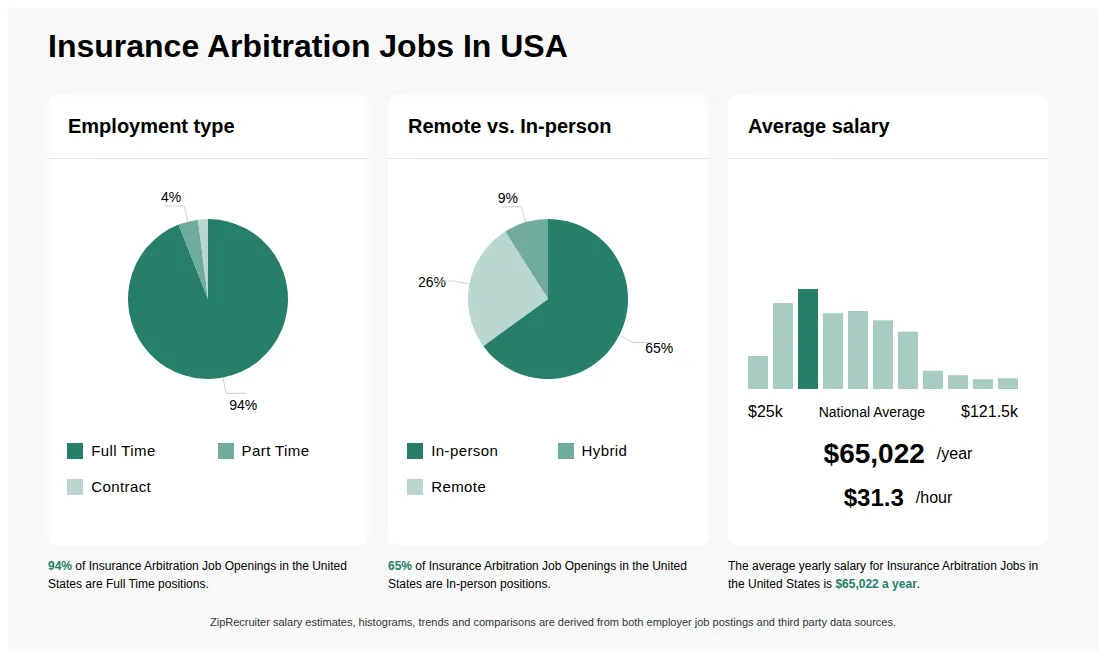
As of Sep 7, 2026, the average yearly pay for insurance arbitration in the United States is $65,022.00, according to ZipRecruiter salary data. Most workers in this role earn between $44,500.00 and $77,000.00 per year, depending on experience, location, and employer.

What is insurance arbitration?

An Insurance Arbitration job involves resolving disputes between insurance companies and policyholders, or between two insurers, outside of court. Professionals in this role act as neutral third parties, reviewing evidence, policy terms, and legal arguments to make a binding or non-binding decision. They work to ensure fair outcomes while helping both parties avoid costly and lengthy litigation. Strong knowledge of insurance policies, legal procedures, and negotiation tactics is essential for success in this field.

What are the key skills and qualifications needed to thrive in insurance arbitration?

To thrive in Insurance Arbitration, you need a thorough understanding of insurance policies, legal frameworks, and negotiation processes, typically backed by a background in law, insurance, or dispute resolution. Familiarity with case management software, arbitration platforms, and relevant certifications such as arbitration or mediation credentials is beneficial. Excellent communication, impartiality, and analytical thinking are crucial soft skills for success in this position. These qualities enable fair and efficient resolution of disputes, maintaining trust among all parties and upholding industry standards.

What are the most common challenges faced in an insurance arbitration role?

One of the most frequent challenges in Insurance Arbitration is managing complex cases where policy interpretations may vary and stakeholders have conflicting interests. Navigating these situations requires impartial judgment, thorough research, and clear documentation to ensure fairness and compliance with legal standards. Insurance arbitrators often handle multiple cases simultaneously, requiring strong organizational skills and the ability to prioritize effectively. Successfully resolving disputes not only streamlines claims processes but also fosters better relationships between insurers and policyholders.

How to become an insurance arbitrator?

To become an insurance arbitrator, individuals typically need a background in law, insurance, or dispute resolution, along with experience in insurance claims or legal practice. Certification from professional organizations such as the American Arbitration Association can enhance credibility, and strong analytical and negotiation skills are essential for success in this role.

What does an insurance arbitrator do?

An insurance arbitrator evaluates disputes between insurance companies and policyholders, often reviewing claims, policies, and evidence to make binding or non-binding decisions. They facilitate resolution by analyzing the facts, applying relevant laws or policies, and issuing an impartial ruling, often working in a legal or insurance setting. Certification or specialized knowledge in insurance law and dispute resolution is typically required.
More about Insurance Arbitration jobs

What cities are hiring for Insurance Arbitration jobs?

Cities with the most Insurance Arbitration job openings:

What states have the most Insurance Arbitration jobs?

States with the most job openings for Insurance Arbitration jobs include:

Infographic showing various Insurance Arbitration job openings in the United States as of August 2026, with employment types broken down into 1% As Needed, 72% Full Time, 22% Part Time, and 5% Contract. Highlights an 91% Physical, 1% Hybrid, and 8% Remote job distribution, with an average salary of $65,022 per year, or $31.3 per hour.

NSA & State Arbitration Pathway Compliance Specialist

OrthoMed Anesthesia

Addison, TX • On-site

$80 - $100/hr

Other

Posted 6 days ago


Key responsibilities

  • Build and run the NSA compliance program, including policies, SOPs, controls, training, auditing, and escalation procedures.

  • Maintain a state‑by‑state jurisdiction matrix to determine applicable laws and rules for federal and state dispute pathways.

  • Own federal IDR execution processes, including eligibility review, documentation, notice initiation, and post‑decision follow‑up.


Job description

Location: Addison, TX 75001.

The No Surprises Act and State Arbitration Pathway Compliance Officer will lead the organization’s end‑to‑end compliance and operations for federal surprise billing protections and state surprise billing/arbitration pathways. This role ensures the organization correctly determines whether claims fall under the federal NSA pathway or state law (often differing for fully insured vs. self‑insured plans), and that required notices, documentation, and filing deadlines are met—supporting dispute strategy without creating regulatory exposure.

This role is especially important for multi‑state physician organizations with meaningful out‑of‑network exposure, where jurisdiction determination, timeline management, and complete dispute documentation materially affect both compliance risk and financial outcomes.

Why This Role Matters

The No Surprises Act restricts surprise billing for certain emergency and non‑emergency services and limits patients to in‑network cost sharing for protected services. It also creates operational requirements for:

  • Federal IDR (Independent Dispute Resolution)
  • Good faith estimates (GFEs) for uninsured/self‑pay patients
  • Patient‑provider dispute resolution (PPDR) readiness
  • Disclosures, notice and consent workflows (where permitted)
  • Strict documentation and timing obligations

Because some claims may be governed by state processes (especially fully insured claims), the organization needs a dedicated owner for both federal and state pathways.

Scope
  • Federal surprise billing compliance and disclosures
  • Federal IDR operations (including open negotiation)
  • Uninsured/self‑pay GFE compliance and PPDR readiness
  • State surprise billing laws and state arbitration/dispute pathways (multi‑state)
Core Responsibilities (Key Outcomes)
  • Build and run the NSA compliance program: policies, SOPs, controls, training, auditing, and escalation for surprise billing compliance across patient access, scheduling, coding, billing, managed care, and collections.
  • Maintain a state‑by‑state jurisdiction matrix: when federal IDR applies vs. when state arbitration/payment rules control, including bifurcated rules for fully insured vs. self‑funded plans.
  • Prevent missed deadlines: implement workflows to identify eligible claims quickly after payer processing and manage negotiation/arbitration election windows.
  • Own federal IDR execution: eligibility review, batching logic, open negotiation documentation, notice of initiation, offer package preparation, supporting documentation, fee tracking, and post‑decision payment follow‑up.
  • Coordinate state dispute/arbitration pathways: state‑specific filing rules, deadlines, templates, documentation standards, and escalation procedures.
  • Improve quality and defensibility: partner with contracting, legal, RCM, and analytics to identify underpayments, confirm eligibility, reduce ineligible filings, and strengthen supporting documentation.
  • Audit and QA: controls for patient notices, EOB‑related workflows, cost‑sharing calculations, NSA‑sensitive billing edits, and dispute‑file completeness.
  • Stay current and operationalize change: monitor litigation, rulemaking, and agency guidance; translate updates into SOPs and training.
  • Train stakeholders: patient access, clinicians, schedulers, coders, billers, collectors, managed care, and legal/compliance teams.
  • Report performance and risk: volumes, open negotiations, arbitration yields, ineligible dispute rates, cycle times, fees, reversals, and material compliance incidents.
Qualifications

Required

  • Bachelor’s degree
  • 3+ years in healthcare billing, compliance, managed care, payer disputes, legal operations, or provider reimbursement strategy
  • Strong working knowledge of physician billing, remittance/EOB interpretation, underpayment identification, and dispute documentation

Strongly Preferred

  • Direct No Surprises Act operational experience, including federal IDR submissions, open negotiation strategy, eligibility review, and out‑of‑network reimbursement issues
  • Experience maintaining a multi‑state legal applicability framework and working with counsel/advisors on jurisdiction/pathway decisions
Preferred Certifications (optional)
  • CHC, CPCO, CPC, CPMA, CRCP, or similar (helpful but secondary to NSA/IDR operational expertise)
Success Profile

A strong candidate combines regulatory judgment with hands‑on operational execution, builds scalable workflows, meets strict deadlines, and aligns legal, RCM, and operations around a compliant, defensible, and financially sound dispute strategy across multiple states.

#J-18808-Ljbffr