1

Fraud Investigator Jobs (NOW HIRING)

Section 1: Position Summary As a key member of the Ascensus Risk Management team, the Fraud Investigator will provide meaningful contributions to the detection and prevention of fraud and financial ...

Section 1: Position Summary As a key member of the Ascensus Risk Management team, the Fraud Investigator will provide meaningful contributions to the detection and prevention of fraud and financial ...

Fraud Investigator

Newton, MA · On-site

$75/hr

Section 1: Position Summary As a key member of the Ascensus Risk Management team, the Fraud Investigator will provide meaningful contributions to the detection and prevention of fraud and financial ...

Section 1: Position Summary As a key member of the Ascensus Risk Management team, the Fraud Investigator will provide meaningful contributions to the detection and prevention of fraud and financial ...

Works closely with Deposit and Retail Operations on loss prevention, fraud and security investigations to investigate and deter fraud against the Bank. This role requires the ability to conduct in ...

Section 1: Position Summary As a key member of the Ascensus Risk Management team, the Fraud Investigator will provide meaningful contributions to the detection and prevention of fraud and financial ...

next page

Showing results 1-20

Fraud Investigator information

See salary details

$15

$30

$53

How much do fraud investigator jobs pay per hour?

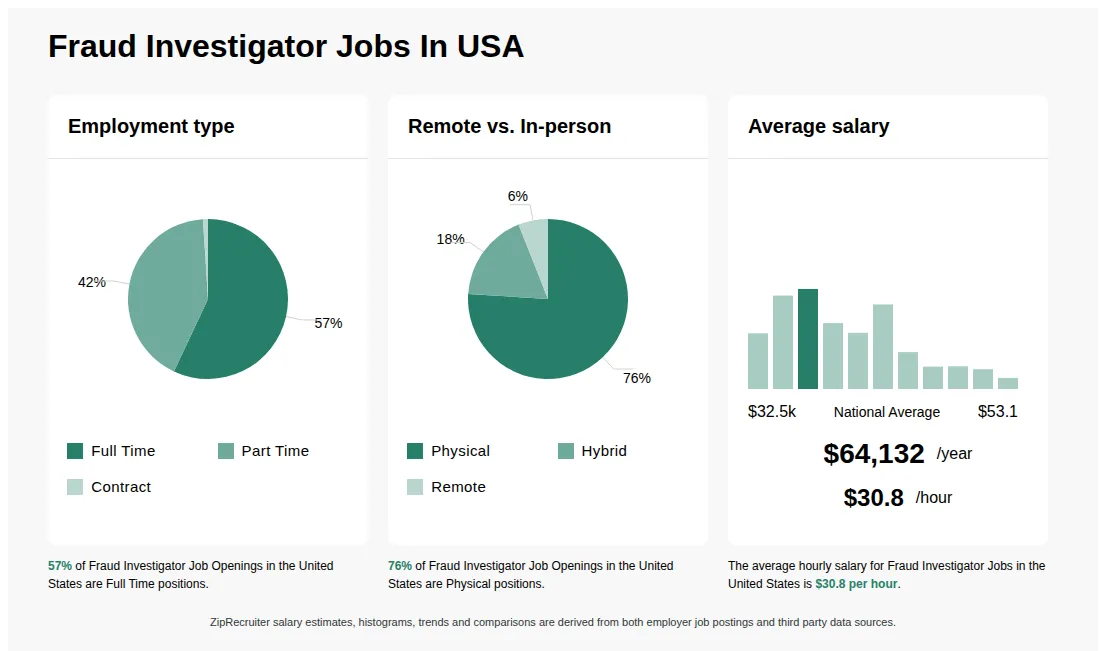
As of Jun 9, 2026, the average hourly pay for fraud investigator in the United States is $30.83, according to ZipRecruiter salary data. Most workers in this role earn between $22.12 and $35.34 per hour, depending on experience, location, and employer.

What does a Fraud Investigator do?

A Fraud Investigator is responsible for detecting, investigating, and preventing fraudulent activities within an organization or on behalf of clients. They gather and analyze evidence, interview witnesses and suspects, and compile detailed reports of their findings. Fraud Investigators often work closely with law enforcement agencies, legal teams, and other professionals to resolve cases. Their goal is to minimize financial losses and protect the integrity of their organization or clients.

What are the key skills and qualifications needed to thrive as a Fraud Investigator, and why are they important?

To thrive as a Fraud Investigator, you need strong analytical thinking, attention to detail, and a background in criminal justice, finance, or a related field. Familiarity with fraud detection software, data analysis tools, and knowledge of relevant laws and regulations is typically required, and certifications like CFE (Certified Fraud Examiner) are highly valued. Excellent communication, problem-solving skills, and discretion help build trust and effectively handle sensitive investigations. These skills and qualities are crucial for accurately identifying fraudulent activity, protecting organizational assets, and ensuring legal compliance.

What Does a Fraud Investigator Do?

Fraud investigators, or fraud examiners, look into cases of suspected fraud. They can work for a variety of organizations including law enforcement, criminal justice, government agencies, private investigation firms, financial institutions, and insurance companies. The type of investigations varies depending on the field. Job duties may include collecting evidence, researching transactions, interviewing victims and witnesses, and writing reports on investigations. To succeed in a career as a fraud investigator, you need excellent spoken and written communication skills.


What are some common challenges faced by Fraud Investigators and how can they be addressed?

Fraud Investigators often encounter challenges such as rapidly evolving fraud tactics, managing large volumes of complex data, and balancing thorough investigations with strict deadlines. Staying current with new fraud schemes requires ongoing training and collaboration with colleagues. Utilizing advanced analytical tools and maintaining open communication with legal, compliance, and law enforcement teams can help address these challenges and ensure effective investigations.

What is the difference between Fraud Investigator vs Insurance Claims Adjuster?

AspectFraud InvestigatorInsurance Claims Adjuster
Required CredentialsTypically a bachelor's degree; certifications like CFE (Certified Fraud Examiner) are commonBachelor's degree often required; licensing or certifications vary by state
Work EnvironmentInvestigations often in offices, sometimes in the field or onlineOffice-based, inspecting claims, interviewing claimants and witnesses
Employer & IndustryFinancial institutions, government agencies, corporationsInsurance companies, adjusting claims for policyholders
Common Search & ComparisonFraud Investigator vs Insurance Claims Adjuster

While both roles involve assessing financial information, Fraud Investigators focus on detecting and preventing fraud across various sectors, often requiring investigative skills and certifications. Insurance Claims Adjusters primarily evaluate insurance claims to determine coverage and settlement, usually within the insurance industry. Understanding these differences helps job seekers find the right career path based on their skills and interests.

What cities are hiring for Fraud Investigator jobs? Cities with the most Fraud Investigator job openings:
What are the most commonly searched types of Fraud Investigator jobs? The most popular types of Fraud Investigator jobs are:
Who are the top companies hiring for Fraud Investigator jobs? The top employers for Fraud Investigator jobs are:
What states have the most Fraud Investigator jobs? States with the most job openings for Fraud Investigator jobs include:
What are popular job titles related to Fraud Investigator jobs? For Fraud Investigator jobs, the most frequently searched job titles are:
Infographic showing various Fraud Investigator job openings in the United States as of May 2026, with employment types broken down into 64% Full Time, 34% Part Time, and 2% Contract. Highlights an 92% Physical, 2% Hybrid, and 6% Remote job distribution, with an average salary of $64,132 per year, or $30.8 per hour.

$25/hr

Full-time

Posted 4 days ago


Job description

Description
GENERAL SUMMARY:
This position is primarily responsible for providing support to the Corporate Fraud Department. It will work closely with Operations Center, Information Security and the BSA Department. 
The Fraud Investigator will review reports, help identify and prevent potential fraud or financial crimes in the bank(s) electronic banking operations. Will help identify and timely investigate significant occurrences of fraud involving the Pinnacle Banks’ employees or customers. Will take lead role in significant cases as assigned. Will be responsible for prompt reporting and follow up on assigned cases. Will be responsible for training focus of Fraud Department and will serve as a training resource to all bank charters.  
 
RESPONSIBILITIES AND DUTIES:
  1. Promptly reviews all assigned fraud related reports and supporting materials for each charter so as to detect and identify possible illegal or fraudulent activity involving customer accounts, employee conduct, and other business transactions that may adversely affect the bank(s). 
  2. Investigates and takes appropriate action as directed such as updating and maintaining the fraud case log, researching account history, working with branch personnel to place holds or closing accounts when potentially fraudulent activity is detected. This may involve contacting and working with law enforcement and/or other governmental units, requesting additional information from employees, customers, or designated bank charter contacts, or working with Operations Center personnel. Will work with Fiserv Risk Office on regular basis and provide direction as needed. 
  3. Reviews reports and provides analysis and recommendations bank Officers. 
  4. Obtains knowledge of the Bank Protection Act, Bank Secrecy Act, FCRA, and Bank Bribery Act. Must review update materials to stay current on bank fraud regulations, and issues involving bank fraud. Attends trainings as needed. Participates in local and state security and fraud trade organizations. 
  5. Maintains records of investigations performed and SIRs received and participates in SAR Committee. Will file SARs in absence of Fraud & Assistant Fraud Officers. 
  6. Helps Fraud Officer administer Identity Theft program designed to educate customers and employees of the implications of identity theft. Aids in design of customer communications designed to reduce potential of such theft.
  7. Develops and administers training program for Fraud Department designed to communicate training and fraud related developments to all employees.
  8. Perform all other duties as assigned.
  9. Regular and reliable attendance.
 
KNOWLEDGE, SKILLS, AND ABILITIES:
  • Knowledge of bank operations and bank fraud landscape a plus.
  • Skill in excellent verbal and written communication.
  • Skill and desire to problem solve.
  • Skills in Computer proficiency and general word processing.
  • Ability to maintain strict confidentiality at the highest level. 
  • Ability to organize and handle multiple tasks at same time.

EDUCATION AND EXPERIENCE:
  • College degree with some emphasis on business, criminal justice, law, or human relations preferred. 
  • Minimum 2 years’ experience in banking environment preferred. 
 
PHYSICAL REQUIREMENTS:
                                                                                  
Seeing: 75-100%
Able to read computer screens                                                                                                 
 
Hearing: 75-100%
Able to communicate with                                                                                                         
 
Standing/Walking: 25-49%                                                                      
 
Climbing/Stooping/Kneeling: 0-24%                             
            
Lifting/Pulling/Pushing: 0-24%                                       
 
Fingering/Grasping/Feeling: 75-100%                                                                                            Typing on computer
 
PHYSICAL DIMENSIONS
Light Work: Exerting up to 20 pounds of force occasionally, and/or a negotiable amount of force frequently or constantly to lift, carry, push, pull, or otherwise move objects.  Job involves sitting most of the time.
 
NOTE: The statements herein are intended to describe the general nature and level, or work being performed by employees assigned to this classification.  They are not intended to be construed as an exhaustive list of all responsibilities, duties, and skills, required of personnel so classified.         

More Details
One position Monday through Friday 8-5. One position Monday through Friday 9-6. Office is in Gretna, Nebraska.