Exercise Physiologist
Palo Alto, CA · On-site
Exercise physiology is the study of the human body's metabolic response to short- and long-term physical activity for the purposes of increased athletic performance, wellness, and rehabilitation. An ...
Palo Alto, CA · On-site
Exercise physiology is the study of the human body's metabolic response to short- and long-term physical activity for the purposes of increased athletic performance, wellness, and rehabilitation. An ...
Palo Alto, CA · On-site
Exercise physiology is the study of the human body's metabolic response to short- and long-term physical activity for the purposes of increased athletic performance, wellness, and rehabilitation. An ...
Stanford, CA · On-site
Exercise physiology is the study of the human body's metabolic response to short- and long-term physical activity for the purposes of increased athletic performance, wellness, and rehabilitation. An ...
Stanford, CA · On-site
Exercise physiology is the study of the human body's metabolic response to short- and long-term physical activity for the purposes of increased athletic performance, wellness, and rehabilitation. An ...
Chicago, IL · On-site
$30 - $36/hr
The Exercise Physiologist will also be responsible for evaluating, educating, and referring inpatients to outpatient programs when the cardiopulmonary rehabilitation nurse is unavailable. In addition ...
Chicago, IL · On-site
$30 - $36/hr
The Exercise Physiologist will also be responsible for evaluating, educating, and referring inpatients to outpatient programs when the cardiopulmonary rehabilitation nurse is unavailable. In addition ...
Chicago, IL · On-site
The Exercise Physiologist will also be responsible for evaluating, educating, and referring inpatients to outpatient programs when the cardiopulmonary rehabilitation nurse is unavailable. In addition ...
Chicago, IL · On-site
The Exercise Physiologist will also be responsible for evaluating, educating, and referring inpatients to outpatient programs when the cardiopulmonary rehabilitation nurse is unavailable. In addition ...
Dallas, TX · On-site
$26 - $37/hr
Exercise Physiologist Job Summary The Exercise physiologist will evaluate patients vitals, conducting pulmonary function testing, flexibility, body composition, muscular strength/endurance, conduct ...
Dallas, TX · On-site
$26 - $37/hr
Exercise Physiologist Job Summary The Exercise physiologist will evaluate patients vitals, conducting pulmonary function testing, flexibility, body composition, muscular strength/endurance, conduct ...
Auburn, NY · On-site
$30 - $33/hr
The Exercise Physiologist focuses primarily on implementing and supervising the physical exercise program and coordinating the Cardiac Rehabilitation Program. Will be responsible for maintaining the ...
Auburn, NY · On-site
$30 - $33/hr
The Exercise Physiologist focuses primarily on implementing and supervising the physical exercise program and coordinating the Cardiac Rehabilitation Program. Will be responsible for maintaining the ...
Elizabeth, NJ · On-site
$30.54 - $40.89/hr
Job Title: Exercise Physiologist Location: WILLIAMSON STREET Department Name: Cardiac Rehabilitation Req #: 0000253585 Status: Hourly Shift: Evening Pay Range: $30.54 - $40.89 per hour Pay ...
Elizabeth, NJ · On-site
$30.54 - $40.89/hr
Job Title: Exercise Physiologist Location: WILLIAMSON STREET Department Name: Cardiac Rehabilitation Req #: 0000253585 Status: Hourly Shift: Evening Pay Range: $30.54 - $40.89 per hour Pay ...
Austin, TX · On-site
Exercise Physiologist Are you passionate about the patient experience? At HCA Healthcare, we are committed to caring for patients with purpose and integrity. We care like family! Jump-start your ...
Austin, TX · On-site
Exercise Physiologist Are you passionate about the patient experience? At HCA Healthcare, we are committed to caring for patients with purpose and integrity. We care like family! Jump-start your ...
Evaluates the physiological aspects of activity and determines an individual exercise prescription in order to facilitate achievement of optimal physical and mental reconditioning. Evaluates clients ...
Evaluates the physiological aspects of activity and determines an individual exercise prescription in order to facilitate achievement of optimal physical and mental reconditioning. Evaluates clients ...
Stanford, CA · On-site
Exercise physiology is the study of the human body's metabolic response to short- and long-term physical activity for the purposes of increased athletic performance, wellness, and rehabilitation. An ...
Stanford, CA · On-site
Exercise physiology is the study of the human body's metabolic response to short- and long-term physical activity for the purposes of increased athletic performance, wellness, and rehabilitation. An ...
Palo Alto, CA · On-site
Exercise physiology is the study of the human body's metabolic response to short- and long-term physical activity for the purposes of increased athletic performance, wellness, and rehabilitation. An ...
Palo Alto, CA · On-site
Exercise physiology is the study of the human body's metabolic response to short- and long-term physical activity for the purposes of increased athletic performance, wellness, and rehabilitation. An ...
$30 - $36/hr
The Exercise Physiologist will also be responsible for evaluating, educating, and referring inpatients to outpatient programs when the cardiopulmonary rehabilitation nurse is unavailable. In addition ...
$30 - $36/hr
The Exercise Physiologist will also be responsible for evaluating, educating, and referring inpatients to outpatient programs when the cardiopulmonary rehabilitation nurse is unavailable. In addition ...
Elizabeth, NJ · On-site
$30.54 - $40.89/hr
Job Title: Exercise Physiologist Location: WILLIAMSON STREET Department Name: Cardiac Rehabilitation Req #: 0000253585 Status: Hourly Shift: Evening Pay Range: $30.54 - $40.89 per hour Pay ...
Elizabeth, NJ · On-site
$30.54 - $40.89/hr
Job Title: Exercise Physiologist Location: WILLIAMSON STREET Department Name: Cardiac Rehabilitation Req #: 0000253585 Status: Hourly Shift: Evening Pay Range: $30.54 - $40.89 per hour Pay ...
Anniston, AL · On-site
Evaluates the physiological aspects of activity and determines an individual exercise prescription in order to facilitate achievement of optimal physical and mental reconditioning. Evaluates clients ...
Anniston, AL · On-site
Evaluates the physiological aspects of activity and determines an individual exercise prescription in order to facilitate achievement of optimal physical and mental reconditioning. Evaluates clients ...
Austin, TX · On-site
Exercise Physiologist Are you passionate about the patient experience? At HCA Healthcare, we are committed to caring for patients with purpose and integrity. We care like family! Jump-start your ...
Austin, TX · On-site
Exercise Physiologist Are you passionate about the patient experience? At HCA Healthcare, we are committed to caring for patients with purpose and integrity. We care like family! Jump-start your ...
Flemington, NJ · On-site
Position Summary Provides quality patient care to the patient through the application of exercise physiology, adaptive exercise therapy and disease management tools using evidence based practice ...
Flemington, NJ · On-site
Position Summary Provides quality patient care to the patient through the application of exercise physiology, adaptive exercise therapy and disease management tools using evidence based practice ...
Elizabeth, NJ · On-site
$30.54 - $40.89/hr
Job Title: Exercise Physiologist Location: WILLIAMSON STREET Department Name: Cardiac Rehabilitation Req #: 0000253585 Status: Hourly Shift: Evening Pay Range: $30.54 - $40.89 per hour Pay ...
Elizabeth, NJ · On-site
$30.54 - $40.89/hr
Job Title: Exercise Physiologist Location: WILLIAMSON STREET Department Name: Cardiac Rehabilitation Req #: 0000253585 Status: Hourly Shift: Evening Pay Range: $30.54 - $40.89 per hour Pay ...
Flemington, NJ · On-site
$20 - $25/hr
Position Summary Provides quality patient care to the patient through the application of exercise physiology, adaptive exercise therapy and disease management tools using evidence based practice ...
Flemington, NJ · On-site
$20 - $25/hr
Position Summary Provides quality patient care to the patient through the application of exercise physiology, adaptive exercise therapy and disease management tools using evidence based practice ...
Fredonia, KS · On-site
The Exercise Physiologist analyzes a patient's medical history, conducts fitness and stress tests, measures vital signs, and develops individualized exercise prescriptions to improve the patient ...
Fredonia, KS · On-site
The Exercise Physiologist analyzes a patient's medical history, conducts fitness and stress tests, measures vital signs, and develops individualized exercise prescriptions to improve the patient ...
Elizabeth, NJ · On-site
$30.54 - $40.89/hr
Job Title: Exercise Physiologist Location: WILLIAMSON STREET Department Name: Cardiac Rehabilitation Req #: 0000253585 Status: Hourly Shift: Evening Pay Range: $30.54 - $40.89 per hour Pay ...
Elizabeth, NJ · On-site
$30.54 - $40.89/hr
Job Title: Exercise Physiologist Location: WILLIAMSON STREET Department Name: Cardiac Rehabilitation Req #: 0000253585 Status: Hourly Shift: Evening Pay Range: $30.54 - $40.89 per hour Pay ...
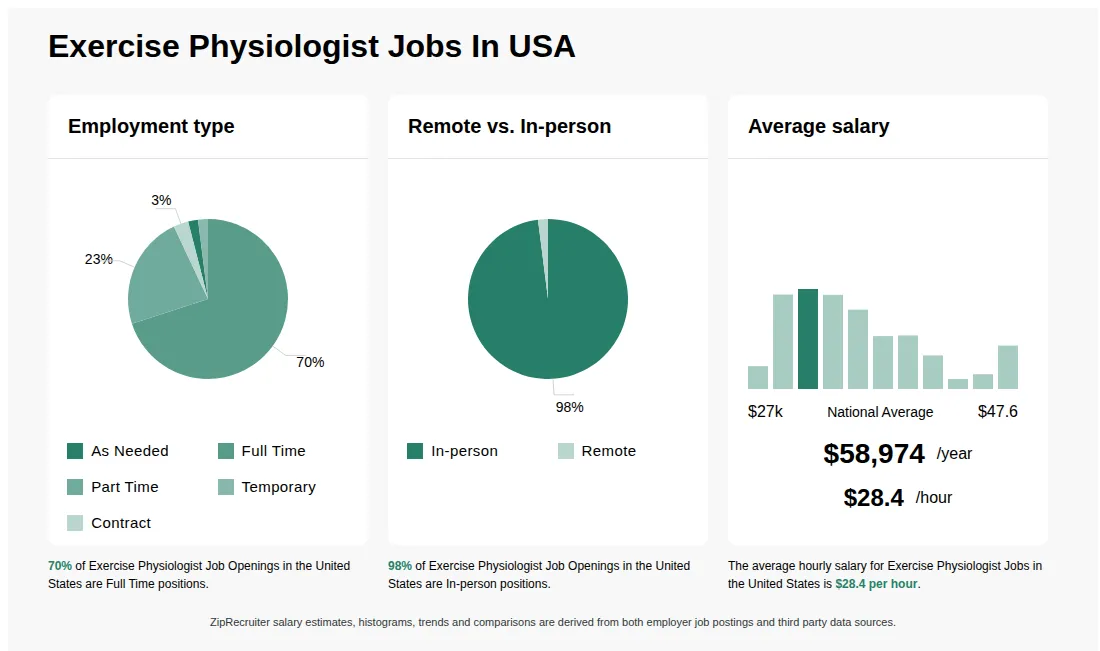
$12.98 - $16.13
3% of jobs
$16.13 - $19.27
16% of jobs
$20.31 is the 25th percentile. Wages below this are outliers.
$19.27 - $22.42
17% of jobs
The median wage is $25.04 / hr.
$22.42 - $25.57
16% of jobs
$25.57 - $28.72
14% of jobs
$31.76 is the 75th percentile. Wages above this are outliers.
$28.72 - $31.86
9% of jobs
$31.86 - $35.01
9% of jobs
$35.01 - $38.16
5% of jobs
$38.16 - $41.30
1% of jobs
$41.30 - $44.45
2% of jobs
$44.45 - $47.60
8% of jobs
$12
$28
$47
Exercise Physiologists are health professionals who assist their patients in improving their lifestyles and maintaining good health. They may work with patients who have heart disease, diabetes, or pulmonary disease to regain their strength and health. Sometimes they also work with amateur and professional athletes, providing training and tips to optimize their performance and prevent injury. Exercise Physiologists evaluate their patient’s health using stress tests and other examinations to assess cardiovascular function and metabolism. After reviewing the results, they design fitness plans to achieve their patient’s goals.
| Aspect | Exercise Physiologist | Physical Therapist |
|---|---|---|
| Credentials | Bachelor's or Master's in Exercise Science, certification (e.g., ACSM) | Doctor of Physical Therapy (DPT), state licensure |
| Work Environment | Fitness centers, rehab clinics, hospitals | Hospitals, outpatient clinics, rehab centers |
| Employer & Industry | Healthcare, sports, wellness industries | Healthcare, rehabilitation services |
Exercise Physiologists focus on improving physical fitness and managing chronic diseases through exercise programs, often working in wellness and rehab settings. Physical Therapists diagnose and treat injuries, providing hands-on therapy and rehabilitation. While both roles promote health and recovery, their credentials, scope, and work environments differ significantly.
Cities with the most Exercise Physiologist job openings:
The most popular types of Exercise Physiologist jobs are:
The top employers for Exercise Physiologist jobs are:
States with the most job openings for Exercise Physiologist jobs include:
For Exercise Physiologist jobs, the most frequently searched job titles are:
Palo Alto, CA • On-site
Other
Posted 16 days ago
** JOB SUMMARY**
This paragraph summarizes the general nature, level and purpose of the job.
According to the American Society of Exercise Physiologists (ASEP), exercise physiology includes the study, assessment and improvement of human biomechanical movement. Exercise physiology is the study of the human body's metabolic response to short- and long-term physical activity for the purposes of increased athletic performance, wellness, and rehabilitation. An exercise physiologist designs and carefully monitors exercise programs that increase patients' endurance and speed their recovery after a heart attack or heart procedure. Exercise physiologists need a degree and professional certification. The Exercise Physiologist is a staff member of the ECHO Department at Lucile Packard Children's Hospital.
Under the direct supervision of the Medical Director of the Exercise Physiology lab and the Director of the OP Heart center, the Exercise Physiologist performs appropriate exercise testing for all ages in the Pediatric Heart Center Cardio Pulmonary Lab for children and young adults. This includes both metabolic and non-metabolic testing as well as exercise echoes and cardiac rehabilitation.
** ESSENTIAL FUNCTIONS**
The essential functions listed are typical examples of work performed by positions in this job classification. They are not designed to contain or be interpreted as a comprehensive inventory of all duties, tasks, and responsibilities. Employees may also perform other duties as assigned.
Employees must abide by all Joint Commission Requirements including but not limited to sensitivity to cultural diversity, patient care, patient rights and ethical treatment, safety and security of physical environments, emergency management, teamwork, respect for others, participation in ongoing education and training, communication and adherence to safety and quality programs, sustaining compliance with National Patient Safety Goals, and licensure and health screenings.
Must perform all duties and responsibilities in accordance with the hospital's policies and procedures, including its Service Standards and its Code of Conduct.
Employee must perform all duties and responsibilities in accordance with the PCARES Standards of the Hospital. PCARES is the foundation of Lucile Packard Children's Hospital patient experience and represents the framework for patient and family centered care.
*Supervises and performs exercise testing (including metabolic, non-metabolic, and exercise echoes) on all patients.
*Supervises and trains medical assistants on 6 minute walk testing and report completion.
*Appropriate and timely documentation of exercise testing reports. Including timely presentation to the reading Cardiologist for final read.
*Supervise and participate in Cardiac Rehabilitation program including patient teaching and direction.
*Assists in setting up procedures, policies and protocols or guidelines for the exercise lab.
*Participates in checking and documenting calibration of equipment function. Participates in research projects and provides testing to research patients as needed.
*Performs all other related duties as assigned.
Qualifications:
Qualifications
** MINIMUM QUALIFICATIONS**
Any combination of education and experience that would likely provide the required knowledge, skills and abilities as well as possession of any required licenses or certifications is qualifying.
Education: Bachelor Degree in exercise physiology, Kinesiology or equivalent. Masters Degree in Exercise Physiology, Kinesiology or equivalent preferred.
Experience: One year of experience in exercise physiology. One year of experience in pediatric exercise physiology, cardiac rehabilitation preferred.
License/Certification: American College of Sports Medicine (ACSM) Certification preferred.
** KNOWLEDGE**
These are the observable and measurable attributes and skills required to perform successfully the essential functions of the job and are generally demonstrated through qualifying experience, education or licensure/certification.
*Broad knowledge of exercise protocols and procedures with a willingness to learn echocardiography.
*Preferred: Proven knowledge base and exercise leadership qualities and ability to relate effectively with medical. Paramedical, and parent/patient individuals.
** PHYSICAL REQUIREMENTS**
The Physical Requirements and Working Conditions in which the job is typically performed are available from the Occupational Health Department. Reasonable accommodations will be made to enable individuals with disabilities to perform the essential functions of the job.
Additional Information
Pay Range
Compensation is based on the level and requirements of the role.
Salary within our ranges may also be determined by your education, experience, knowledge, skills, location, and abilities, as required by the role, as well as internal equity and alignment with market data.
Typically, new team members join at the minimum to mid salary range.
Minimum to Midpoint Range (Hourly): $73.13 to $82.95
Stanford Medicine Children's Health (SMCH) strongly values diversity and is committed to equal opportunity and non-discrimination in all of its policies and practices, including the area of employment. Accordingly, SMCH does not discriminate against any person on the basis of race, color, sex, sexual orientation or gender identity, religion, age, national or ethnic origin, political beliefs, marital status, medical condition, genetic information, veteran status, or disability, or the perception of any of the above. People of all genders, members of all racial and ethnic groups, people with disabilities, and veterans are encouraged to apply. Qualified applicants with criminal convictions will be considered after an individualized assessment of the conviction and the job requirements, and where applicable, in compliance with the San Francisco Fair Chance Ordinance.