We are seeking an Artificial Intelligence Engineer I to join our team Summary: This position is responsible for contributing to the design, delivery, and support of production-grade artificial ...
We are seeking an Artificial Intelligence Engineer I to join our team Summary: This position is responsible for contributing to the design, delivery, and support of production-grade artificial ...
We are seeking an Artificial Intelligence Engineer I to join our team Summary: This position is responsible for contributing to the design, delivery, and support of production-grade artificial ...
We are seeking an Artificial Intelligence Engineer I to join our team Summary: This position is responsible for contributing to the design, delivery, and support of production-grade artificial ...
About the Role We are looking for an AI Engineer to join our growing AI team and help build ... The Healthcare Intelligence Cloud equips every stakeholder in the patient journey to turn ...
About the Role We are looking for an AI Engineer to join our growing AI team and help build ... The Healthcare Intelligence Cloud equips every stakeholder in the patient journey to turn ...

The Role: We're looking for an experienced artificial intelligence engineer to join the revolution, using deep learning, neuro-linguistic programming (NLP), LLM, computer vision, robotic process ...
The Role: We're looking for an experienced artificial intelligence engineer to join the revolution, using deep learning, neuro-linguistic programming (NLP), LLM, computer vision, robotic process ...

Staff Research Scientist - Artificial Intelligence Engineer Position Highlights: * Research, develop, test and deploy artificial intelligence, machine learning and computer vision software. * Process ...
Staff Research Scientist - Artificial Intelligence Engineer Position Highlights: * Research, develop, test and deploy artificial intelligence, machine learning and computer vision software. * Process ...


Artificial Intelligence Engineer
Pittsburgh, PA · On-site
$111K - $133K/yr
Conducts data analysis, preprocessing, training, testing, validating and feature engineering to extract valuable insights from large datasets, improving model performance and accuracy. * Stays ...
Artificial Intelligence Engineer
Pittsburgh, PA · On-site
$111K - $133K/yr
Conducts data analysis, preprocessing, training, testing, validating and feature engineering to extract valuable insights from large datasets, improving model performance and accuracy. * Stays ...
Staff Research Scientist - Artificial Intelligence Engineer Position Highlights: * Research, develop, test and deploy artificial intelligence, machine learning and computer vision software. * Process ...
Staff Research Scientist - Artificial Intelligence Engineer Position Highlights: * Research, develop, test and deploy artificial intelligence, machine learning and computer vision software. * Process ...
Artificial Intelligence Engineer
Pittsburgh, PA · On-site
$109K - $132K/yr
Conducts data analysis, preprocessing, training, testing, validating and feature engineering to extract valuable insights from large datasets, improving model performance and accuracy. * Stays ...
Artificial Intelligence Engineer
Pittsburgh, PA · On-site
$109K - $132K/yr
Conducts data analysis, preprocessing, training, testing, validating and feature engineering to extract valuable insights from large datasets, improving model performance and accuracy. * Stays ...
Artificial Intelligence Engineer
Pittsburgh, PA · Hybrid
$111K - $133K/yr
Conducts data analysis, preprocessing, training, testing, validating and feature engineering to extract valuable insights from large datasets, improving model performance and accuracy. * Stays ...
Artificial Intelligence Engineer
Pittsburgh, PA · Hybrid
$111K - $133K/yr
Conducts data analysis, preprocessing, training, testing, validating and feature engineering to extract valuable insights from large datasets, improving model performance and accuracy. * Stays ...

Artificial Intelligence Engineer with Security Clearance
San Antonio, TX · On-site
$99K - $225K/yr
R0246377 Artificial Intelligence Engineer The Opportunity: As an experienced engineer, you know that machine learning is critical to understanding and processing massive datasets. Your ability to ...
Artificial Intelligence Engineer with Security Clearance
San Antonio, TX · On-site
$99K - $225K/yr
R0246377 Artificial Intelligence Engineer The Opportunity: As an experienced engineer, you know that machine learning is critical to understanding and processing massive datasets. Your ability to ...
Senior Artificial Intelligence Engineer
San Francisco, CA · On-site
$123K - $169K/yr
About the Role We are looking for a Senior AI Engineer to join our growing AI team and help build ... The Healthcare Intelligence Cloud equips every stakeholder in the patient journey to turn ...
Senior Artificial Intelligence Engineer
San Francisco, CA · On-site
$123K - $169K/yr
About the Role We are looking for a Senior AI Engineer to join our growing AI team and help build ... The Healthcare Intelligence Cloud equips every stakeholder in the patient journey to turn ...
About the Role We are looking for a Principal AI Engineer to join our growing AI team and help ... The Healthcare Intelligence Cloud equips every stakeholder in the patient journey to turn ...
About the Role We are looking for a Principal AI Engineer to join our growing AI team and help ... The Healthcare Intelligence Cloud equips every stakeholder in the patient journey to turn ...
Artificial Intelligence (AI) Engineer III (2316)
Melbourne, FL · Hybrid
$55 - $62/hr
Title: Artificial Intelligence (AI) Engineer III (2316) Location: Melbourne, Florida Openings: 1 Work Model: Hybrid, 2 - 3 days in office Job Type: Contract Duration: 1 Year Rate: $61/hour (W2 ...
Artificial Intelligence (AI) Engineer III (2316)
Melbourne, FL · Hybrid
$55 - $62/hr
Title: Artificial Intelligence (AI) Engineer III (2316) Location: Melbourne, Florida Openings: 1 Work Model: Hybrid, 2 - 3 days in office Job Type: Contract Duration: 1 Year Rate: $61/hour (W2 ...
Artificial Intelligence Engineer with Security Clearance
San Antonio, TX · On-site
$77K - $176K/yr
R0246367 Artificial Intelligence Engineer The Opportunity: As an experience d engineer, you know that machine learning (ML) is critical to understanding and processing massive datasets. Your ability ...
Artificial Intelligence Engineer with Security Clearance
San Antonio, TX · On-site
$77K - $176K/yr
R0246367 Artificial Intelligence Engineer The Opportunity: As an experience d engineer, you know that machine learning (ML) is critical to understanding and processing massive datasets. Your ability ...

... engineering Artificial Intelligence environment and contributes to Artificial Intelligence Design Practice(s). Qualifications : Required : • Bachelor's degree and typically 3 or more years ...
... engineering Artificial Intelligence environment and contributes to Artificial Intelligence Design Practice(s). Qualifications : Required : • Bachelor's degree and typically 3 or more years ...

Artificial Intelligence Location Bethesda, MD Job Code 2568 # of Openings 1
Artificial Intelligence Location Bethesda, MD Job Code 2568 # of Openings 1

Artificial Intelligence Engineer Primary Work location: 5805 N Lamar Blvd, Austin, TX 78752 Agency: Texas Department of Public Safety Solicitation Reference Number: 40526R0024893 Category:
Quick apply
Artificial Intelligence Engineer Primary Work location: 5805 N Lamar Blvd, Austin, TX 78752 Agency: Texas Department of Public Safety Solicitation Reference Number: 40526R0024893 Category:

Artificial Intelligence
Los Angeles, CA · On-site
Direct client JOB 2: AI ML Developer with Data Science experience Location: Woodland Hills. CA ... Artificial Intelligence & Machine Learning (AI/ML) Systems Analyst to bridge the gap between ...
Artificial Intelligence
Los Angeles, CA · On-site
Direct client JOB 2: AI ML Developer with Data Science experience Location: Woodland Hills. CA ... Artificial Intelligence & Machine Learning (AI/ML) Systems Analyst to bridge the gap between ...

... engineering, computer sciences, criminal justice, cybersecurity, marketing, health sciences ... Indiana Tech invites applications for a full-time faculty member in Artificial Intelligence (AI) to ...
... engineering, computer sciences, criminal justice, cybersecurity, marketing, health sciences ... Indiana Tech invites applications for a full-time faculty member in Artificial Intelligence (AI) to ...
Entry Level Artificial Intelligence Engineer information
See salary details
$30K - $38K
2% of jobs
$38K - $46K
10% of jobs
$51.3K is the 25th percentile. Wages below this are outliers.
$46K - $54K
20% of jobs
$54K - $62K
13% of jobs
The median wage is $64K / yr.
$62K - $70K
21% of jobs
$75.2K is the 75th percentile. Wages above this are outliers.
$70K - $78K
14% of jobs
$78K - $86K
7% of jobs
$86K - $94K
5% of jobs
$94K - $102K
3% of jobs
$102K - $110K
2% of jobs
$110K - $118K
2% of jobs
$30K
$69.4K
$118K
How much do entry level artificial intelligence engineer jobs pay per year?
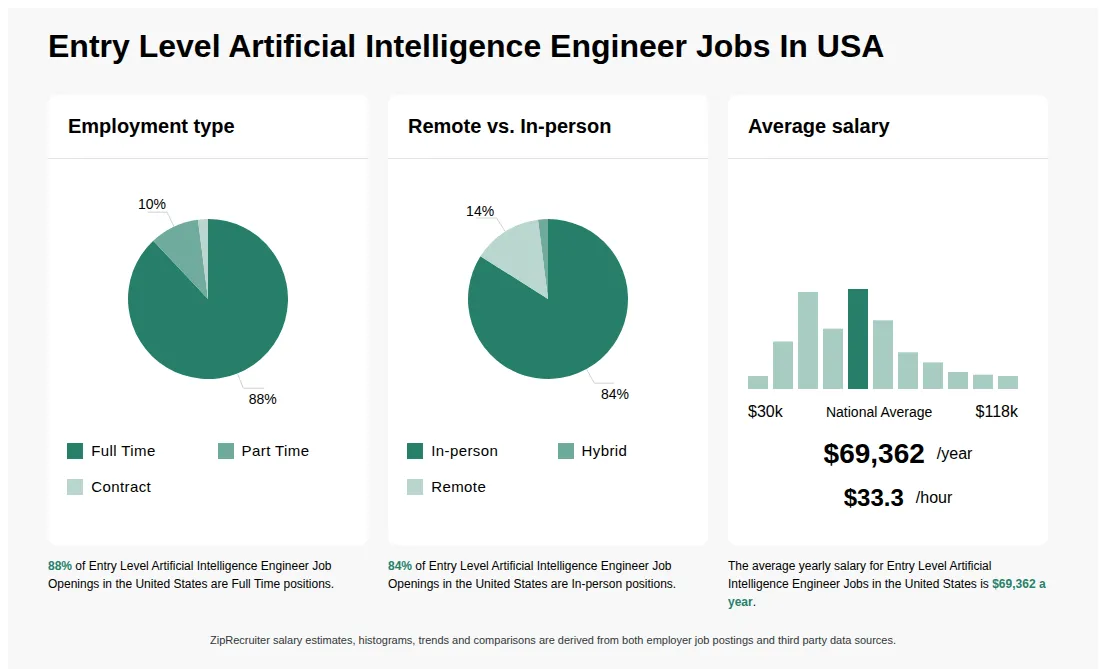
As of Sep 2, 2026, the average yearly pay for entry level artificial intelligence engineer in the United States is $69,362.00, according to ZipRecruiter salary data. Most workers in this role earn between $51,500.00 and $78,500.00 per year, depending on experience, location, and employer.
What is an entry level artificial intelligence engineer?
An Entry Level Artificial Intelligence Engineer is responsible for developing AI models, writing algorithms, and working with data to build intelligent systems. They typically assist in training machine learning models, optimizing performance, and integrating AI solutions into applications. This role requires knowledge of programming languages like Python, machine learning frameworks, and data processing techniques. Entry-level AI engineers often collaborate with data scientists and software engineers to improve AI functionalities. Employers usually look for candidates with a degree in computer science, engineering, or a related field, along with hands-on experience in AI projects.
What kind of projects or tasks does an entry level artificial intelligence engineer typically work on?
Entry Level Artificial Intelligence Engineers often assist with data collection and preprocessing, implement and test machine learning models, and support research or production teams in developing AI solutions. You may help analyze large datasets, tune model parameters, write scripts for automation, and contribute to code reviews or documentation. Collaboration is common, as you’ll often work closely with data scientists, senior AI engineers, and product managers to advance ongoing projects. These experiences provide a strong foundation for developing your technical skills and understanding how AI solutions are built and deployed in real business environments.
What are the key skills and qualifications needed to thrive as an entry level artificial intelligence engineer?
To thrive as an Entry Level Artificial Intelligence Engineer, you need a solid background in programming (especially Python), mathematics (linear algebra, statistics), and foundational machine learning concepts, often demonstrated through a relevant degree or project experience. Familiarity with key AI frameworks such as TensorFlow or PyTorch, version control systems like Git, and optionally certifications like Google’s TensorFlow Developer Certificate are valuable assets. Strong problem-solving skills, curiosity, and the ability to collaborate and communicate clearly within teams will help you stand out. These competencies are crucial for contributing effectively to real-world AI projects, learning on the job, and advancing in this rapidly evolving field.
More about Entry Level Artificial Intelligence Engineer jobs
What cities are hiring for Entry Level Artificial Intelligence Engineer jobs?
Cities with the most Entry Level Artificial Intelligence Engineer job openings:
What are the most commonly searched types of Artificial Intelligence Engineer jobs?
The most popular types of Artificial Intelligence Engineer jobs are:
What states have the most Entry Level Artificial Intelligence Engineer jobs?
States with the most job openings for Entry Level Artificial Intelligence Engineer jobs include:
What job categories do people searching Entry Level Artificial Intelligence Engineer jobs look for?
The top searched job categories for Entry Level Artificial Intelligence Engineer jobs are:

Full-time
Medical, Dental, Vision, PTO
Posted 19 days ago
Insperity rating

7.4
Based on 35 frontline employees who took The Breakroom Quiz
223rd of 500 rated business services
Job description
Insperity provides the most comprehensive suite of scalable HR solutions available in the marketplace with an optimal blend of premium HR service and technology. With more than 90 locations throughout the U.S., Insperity is currently making a difference for thousands of businesses and communities nationwide.
Behind our success is the unshakeable belief in the value of our people. We value diversity, inclusivity and a sense of belonging. We celebrate work and life events, and we partner with our clients and communities to make great things happen.
We've earned recognition time and again as a top place to work-named among the best by respected organizations like Glassdoor and U.S. News & World Report. We're also proud to be recognized for one of the country's Top 50 Midsize Early Talent Programs through RippleMatch's Campus Forward Awards. There's never been a better time to be part of Insperity, and our best work is still ahead. Learn more at Insperity.com.
Why Insperity?
Flexibility: Over 80% of Insperity's jobs have flexibility. We want your time to have balance, whether it's spent with coworkers, clients, family or your community.
Career Growth: Insperity provides many ways to grow with the company. We offer continuous learning programs, mentorship opportunities and ongoing training.
Well-Being: Our total rewards package includes generous paid time off, top-tier medical, dental and vision benefits, health & wellness support, paid volunteer hours and much more. We take care of our people so that you can do your best work.
We are seeking an Artificial Intelligence Engineer I to join our team
Summary:
This position is responsible for contributing to the design, delivery, and support of production-grade artificial intelligence systems under close guidance. This role applies foundational software engineering, data management, and generative AI skills to implement well-defined components of AI-powered applications and automated workflows. The Artificial Intelligence Engineer I focuses on building strong SQL and data management capabilities, learning enterprise AI standards, and developing proficiency in production software practices.
Responsibilities:
Implements well-defined components of AI solutions, including LLM-based application features and supporting services, under guidance.
Develops and maintains Python-based scripts, APIs, and services that support AI workflows and integrations.
Writes, optimizes, and validates SQL queries and data transformations used by AI systems; supports data quality checks and basic troubleshooting.
Assists with retrieval-augmented generation (RAG) components such as document ingestion, indexing, retrieval configuration, and prompt assembly.
Supports creation of evaluation datasets and execution of basic evaluation procedures to measure model outputs and system quality.
Follows established testing, documentation, security, and deployment practices to ensure production readiness for assigned work.
Identifies data issues, model failure modes, or operational risks and escalates concerns appropriately.
Qualifications:
Bachelor's degree in Computer Science, Software Engineering, Data Science, or a related technical field, or equivalent demonstrated practical experience.
Zero to two (0-2) years or equivalent demonstrated experience in software engineering, data engineering, analytics engineering, or AI-related development.
Proficiency in SQL and foundational data management skills, including data validation, data quality awareness, and working with structured datasets (core requirement).
Proficiency in Python for application development, scripting, and basic API integration.
Introductory experience with generative AI application development, including prompt-based workflows and model-assisted features.
Familiarity with Git and modern development practices (branching, code review, and issue tracking).
Exposure to LLM tooling such as LangChain, LangGraph, LlamaIndex, Semantic Kernel, or similar is beneficial but not required.
Ability to communicate clearly, ask good questions, and incorporate feedback through iterative development.
This job specification should not be construed to imply that these requirements are the exclusive standards of the position. Incumbent will follow any other instructions, and perform any other related duties, as may be required by the supervisor.
At Insperity, we celebrate the diversity of our employees and our leadership. Insperity is an equal opportunity employer, and all qualified applicants will receive consideration for employment without regard to race, color, religion, sex, national origin, disability status, protected veteran status or any other characteristic protected by law.
What Insperity employees say
Pay
Benefits
Hours and flexibility
Workplace
Get the full story on Breakroom

About Insperity
Sourced by ZipRecruiter
Take care of your people Insperity has a long history of improving the success equation of small and midsize businesses across the country – because when businesses succeed, communities prosper. And in today’s changing business environment, it’s our privilege to take care of an organization’s most valuable asset: its people.
Industry
Software development
Company size
1,001 - 5,000 Employees
Headquarters location
Houston, TX, US