1

Engineering Jobs in Ohio (NOW HIRING)

Founded in 1960, Mackin is a multi-disciplinary engineering and consulting firm providing innovative solutions for public and private sector clients across Pennsylvania, Ohio, Maryland, and West ...

Founded in 1960, Mackin is a multi-disciplinary engineering and consulting firm providing innovative solutions for public and private sector clients across Pennsylvania, Ohio, Maryland, and West ...

Engineering Supervisor

Dublin, OH ยท On-site

$85K - $100K/yr

Engineering Manager Job Summary: The Engineering Supervisor provides day-to-day leadership, technical guidance, issue resolution, and development support to engineering team members working on ...

Roadway Engineer

Columbus, OH ยท On-site

$80K - $110K/yr

Moody Engineering is seeking an experienced, growth-minded Roadway Project Manager/Engineer for our fast-growing roadway team in Columbus, Ohio. Working at Moody Engineering provides a unique working ...

Civil Engineer Designer

Cleveland, OH ยท On-site

$90K - $140K/yr

Moody Engineering is expanding! We're seeking experienced, growth-minded Site Civil Engineers to join our dynamic Roadway and Site Development team in Cleveland, Ohio. At Moody, you'll work on a ...

Roadway Engineer

Columbus, OH ยท On-site +1

$401K/yr

Working at Moody Engineering provides a unique working environment due to our highly diverse project portfolio and personnel. We are a growing firm looking for well-rounded professionals to join our ...

Engineering Intern

Youngstown, OH ยท On-site

$15.75 - $20.50/hr

Position Overview We are seeking a detail-oriented and motivated Engineering Intern to support our Engineering team with technical documentation, process improvement, and product-related initiatives.

next page

Showing results 1-20

Engineering information

See Ohio salary details

$44.2K

$139.6K

$165.4K

How much do engineering jobs pay per year?

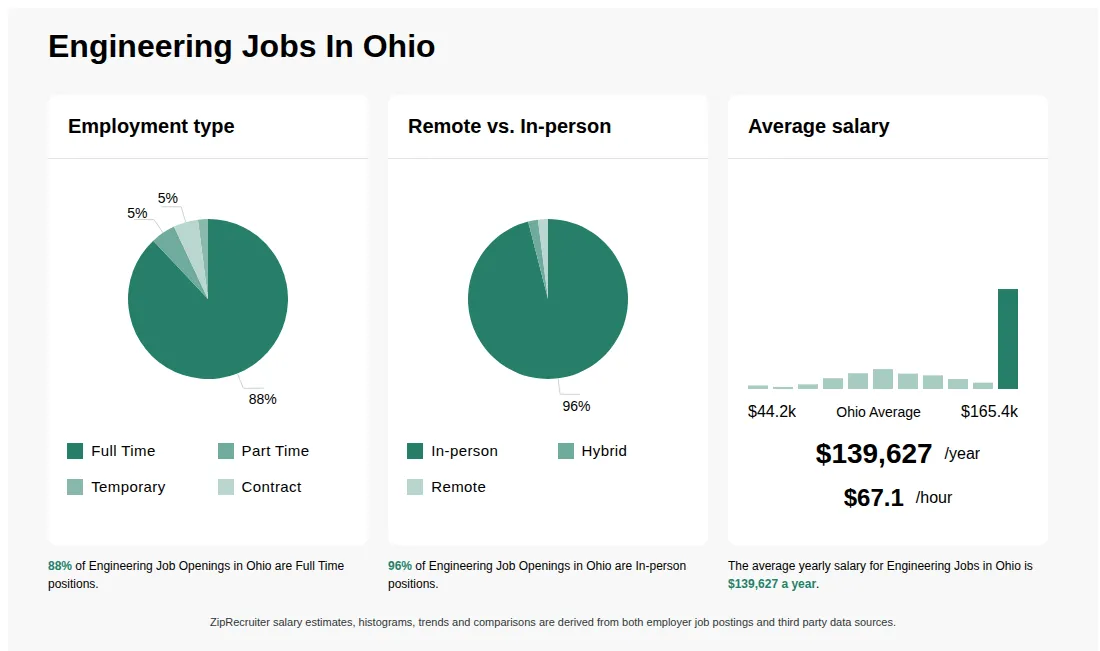
As of Jun 14, 2026, the average yearly pay for engineering in Ohio is $139,627.00, according to ZipRecruiter salary data. Most workers in this role earn between $110,800.00 and $164,500.00 per year, depending on experience, location, and employer.

What are the key skills and qualifications needed to thrive as an Engineer, and why are they important?

To thrive as an Engineer, you need strong analytical abilities, problem-solving skills, and a relevant engineering degree or certification. Familiarity with CAD software, project management tools, and industry-specific technical systems is typically required. Excellent teamwork, communication, and adaptability help engineers collaborate and navigate complex projects effectively. These skills and qualities are vital for delivering innovative, efficient solutions and ensuring project success in dynamic technical environments.

What are careers in engineering?

Careers in engineering involve designing, developing, and maintaining systems, structures, or products across various fields such as civil, mechanical, electrical, and software engineering. These roles typically require strong problem-solving skills, technical knowledge, and often a bachelor's degree in engineering or related disciplines. Engineers work in diverse environments including offices, laboratories, and construction sites, and may pursue certifications like Professional Engineer (PE) licensure.

What Are Engineering Jobs?

Engineering jobs encompass a range of positions in a variety of technical fields, including mechanical, chemical, electrical, aeronautic, and civil engineering. Some engineering jobs are in research and design, while others focus on the construction and manufacturing industry. In this career, you need a mix of design, project management, and research skills. You can work in numerous industries, including construction, manufacturing, agriculture, medical, aviation, and natural resource extraction. Some jobs are based primarily in an office or lab setting, while others require you to travel to field sites to make surveys and assessments.

What are some common challenges engineers face when working on multidisciplinary teams?

Engineers often collaborate with professionals from diverse backgrounds, such as designers, project managers, and business analysts. One common challenge is ensuring clear communication, as each discipline may use different terminology or prioritize different aspects of a project. Additionally, aligning objectives and managing conflicting expectations can require strong interpersonal and problem-solving skills. Successfully navigating these challenges helps engineers contribute to more innovative and efficient solutions while building valuable teamwork experience.

What jobs can I do in engineering?

Engineering offers a wide range of jobs including civil, mechanical, electrical, software, chemical, and aerospace engineering. These roles typically involve designing, developing, testing, and maintaining systems or products, often requiring technical skills, problem-solving abilities, and relevant certifications or degrees. Engineers work in various industries such as construction, technology, manufacturing, and energy, often in office, laboratory, or field environments.

What is engineering?

Engineering is the application of scientific and mathematical principles to design, build, and maintain structures, machines, devices, systems, and processes. Engineers use creativity, technical knowledge, and problem-solving skills to develop solutions that meet societal needs in areas such as infrastructure, technology, manufacturing, and the environment. There are many branches of engineering, including civil, mechanical, electrical, chemical, and software engineering, each focusing on different aspects of technology and innovation.

What engineer makes $500,000 a year?

Highly experienced engineers in specialized fields such as petroleum engineering, software engineering, or aerospace engineering can earn $500,000 or more annually, often through a combination of base salary, bonuses, and stock options. These roles typically require advanced skills, extensive experience, and often involve leadership or executive responsibilities.

What is the difference between Engineering vs Mechanical Engineering?

AspectEngineeringMechanical Engineering
Required CredentialsBachelor's degree in engineering or related fieldBachelor's degree in mechanical engineering or similar
Work EnvironmentVaries widely across disciplines, including offices, labs, and manufacturingDesign, analysis, and manufacturing environments, often involving machinery and systems
Industry UsageBroadly used across multiple industries such as civil, electrical, and mechanical sectorsPrimarily in manufacturing, automotive, aerospace, and energy sectors

Engineering is a broad field encompassing various disciplines, including mechanical engineering. Mechanical engineering focuses specifically on designing and analyzing mechanical systems and machinery. While all mechanical engineers are engineers, not all engineers are mechanical engineers. The two roles often overlap but differ in specialization and application areas.

What are 10 engineering jobs?

Engineering encompasses a wide range of roles including civil engineer, mechanical engineer, electrical engineer, software engineer, chemical engineer, aerospace engineer, industrial engineer, environmental engineer, biomedical engineer, and petroleum engineer. These jobs typically require technical skills, relevant degrees, and sometimes professional certifications. They involve designing, developing, testing, and maintaining systems or products across various industries.
What are the most commonly searched types of Engineering jobs in Ohio? The most popular types of Engineering jobs in Ohio are:
What cities in Ohio are hiring for Engineering jobs? Cities in Ohio with the most Engineering job openings:
Infographic showing various Engineering job openings in Ohio as of June 2026, with employment types broken down into 91% Full Time, and 9% Contract. Highlights an 98% In-person, and 2% Hybrid job distribution, with an average salary of $139,627 per year, or $67.1 per hour.
ENGINEERING

ENGINEERING

US Department of the Air Force

Wright-patterson Air Force Base, OH โ€ข On-site

$55K/yr

Other

Posted 19 days ago


Job description

The PALACE Acquire Program offers you a permanent position upon completion of your formal training plan. As a Palace Acquire Intern you will experience both personal and professional growth while dealing effectively and ethically with change, complexity, and problem solving. The program offers a 3-year formal training plan with yearly salary increases. Promotions and salary increases are based upon your successful performance and supervisory approval.Qualifications:BASIC REQUIREMENTS for GS-7 and GS-9:
Degree: Professional engineering. To be acceptable, the curriculum must: (1) be in a school of engineering with at least one curriculum accredited by the Accreditation Board for Engineering and Technology (ABET) as a professional engineering curriculum; or (2) include differential and integral calculus and courses (more advanced than first-year physics and chemistry) in five of the following seven areas of engineering science or physics: (a) statics, dynamics; (b) strength of materials (stress-strain relationships); (c) fluid mechanics, hydraulics; (d) thermodynamics;(e) electrical fields and circuits; (f) nature and properties of materials (relating particle and aggregate structure to properties; and (g) any other comparable area of fundamental engineering science or physics, such as optics, heat transfer, soil mechanics, or electronics.
You may qualify if you meet one of the following:
1. GS-7: You must have completed a 4 year course of study leading to a bachelor's from an accredited institution AND must have documented Superior Academic Achievement (SAA) or one of the following:
a) Class Standing - upper third of the graduating class based on completed courses in the college, university, or major subdivision;
b) Grade Point Average - 2.95 or higher out of a possible 4.0 as recorded on your official transcript or as computed based on 4 years of education or as computed based on courses completed during the final 2 years of curriculum; OR 3.45 or higher out of a possible 4.0 based on the average of the required courses completed in your major field or the required courses in your major field completed during the final 2 years of your curriculum. If more than 10 percent of total undergraduate credit hours are non-graded, i.e. pass/fail, CLEP, CCAF, DANTES, military credit, etc, you cannot qualify based on GPA;
c) Election to membership in a national scholastic honor society (note: freshman honor society cannot be used to meet the requirements of this position). (If qualifying based on class standing or honor society membership, provide appropriate documentation). OR 2. You have one full year (18 semester hours or the equivalent) of graduate level study, or possess a master's or higher degree, e.g., LL.B., J.D., LL.M., Ph.D., in a field that provided the knowledge, skills, and abilities to do the work of this position. Such fields include business administration, industrial management, industrial engineering, industrial psychology, public administration, political science, or government.(Submit copy of transcripts).
2. GS-9: You must have completed 2 years of progressively higher-level graduate education leading to a master's degree or equivalent graduate degree:
a) Grade Point Average - 2.95 or higher out of a possible 4.0 as recorded on your official transcript or as computed based on 4 years of education or as computed based on courses completed during the final 2 years of curriculum; OR 3.45 or higher out of a possible 4.0 based on the average of the required courses completed in your major field or the required courses in your major field completed during the final 2 years of your curriculum. If more than 10 percent of total undergraduate credit hours are non-graded, i.e. pass/fail, CLEP, CCAF, DANTES, military credit, etc. you cannot qualify based on GPA.
KNOWLEDGE, SKILLS AND ABILITIES (KSAs): Your qualifications will be evaluated on the basis of your level of knowledge, skills, abilities and/or competencies in the following areas:
GS series 0801/0806/0830/0840/0850/0854/0855/0861/0893/0896
  1. Performs general engineering tasks of limited scope and difficulty which are screened by a higher-grade engineer. Some knowledge of work processes, and the capability to apply standard general engineering practices, required to directly apply varied rules, procedures and precedents to the assignments.
  2. Performs engineering work of limited scope and complexity in support of projects assigned to higher grade engineers. Plans work procedures and selects standard practices and data to be applied to work projects and identified problems. Uses accepted engineering work processes to search for information to bear on a problem and recognizes situations which may require referral to others.
  3. Uses engineering manuals, standard publications and technical material to obtain information pertinent data to be used by higher level engineers, contractors and /or customers.
  4. Keeps abreast of emerging technologies and professional developments to maintain current in the field and for application to work assignments. Uses computers/computer software such as analysis tools and project tracking programs to solve engineering problems and facilitate work.
GS series 0858
  1. Professional knowledge of biomedical engineering concept, theories, and principles and standard engineering practices, methods, and techniques to perform difficult, but well-precedented assignments which are normally minor phases of a larger project.
  2. Knowledge of automated technology and practices used to prepare engineering designs/drawings.
  3. Skill in analyzing problems, identifying significant factors, gathering and interpreting pertinent data, and applying established rules and procedures in order to recommend solutions.
  4. Skill in gathering and interpreting pertinent data, preparing recommendations, and making calculations by applying standard formulas; preparing graphs, curves, or tables; and recording factual data or information from studies.
  5. Ability to communicate clearly, concisely, and with technical accuracy, both orally and in writing, as well as work in a professional manner with peers and management.
  6. Ability to learn and apply analytical investigate techniques to accomplish work in the subject-matter field.

PART-TIME OR UNPAID EXPERIENCE: Credit will be given for appropriate unpaid and or part-time work. You must clearly identify the duties and responsibilities in each position held and the total number of hours per week.
VOLUNTEER WORK EXPERIENCE: Refers to paid and unpaid experience, including volunteer work done through National Service Programs (i.e., Peace Corps, AmeriCorps) and other organizations (e.g., professional; philanthropic; religious; spiritual; community; student and social). Volunteer work helps build critical competencies, knowledge and skills that can provide valuable training and experience that translates directly to paid employment. You will receive credit for all qualifying experience, including volunteer experience.Education:This position has an education requirement. You MUST provide transcripts to support your educational claims. Education must be accredited by an accrediting institution recognized by the U.S. Department of Education. http://www2.ed.gov/admins/finaid/accred/index.html
Please submit copies of all Transcripts to include Transferred hours - Official copies are not required at time of application. If selected, you will be required to provide official copies of all Transcripts. ***NOTE***Degree Audits are not accepted.
If you qualify based on undergraduate education and you have not graduated prior to applying to this position. You may be offered a position contingent upon your final grade point average or class ranking.
IF USING EDUCATION TO QUALIFY: You MUST provide transcripts to support your educational claims. Education must be accredited by an accrediting institution recognized by the U.S. Department of Education.
FOREIGN EDUCATION: Education completed in foreign colleges or universities may be used to meet the requirements. You must show proof the education credentials have been deemed to be at least equivalent to that gained in conventional U.S. education program. It is your responsibility to provide such evidence when applying.Employment Type: OTHER