Represents the emergency management program in collaborations with external partners and stakeholders (EMS/Local PD) to ensure alignment and partnership with private and public emergency management ...
Represents the emergency management program in collaborations with external partners and stakeholders (EMS/Local PD) to ensure alignment and partnership with private and public emergency management ...
Emergency Management Coordinator
Hastings, MN · On-site
$82K - $128K/yr
OFFICE OF RISK AND EMERGENCY MANAGEMENT - 2290001 Opening Date: 09/03/2026 Closing Date: 9/24/2026 4:30 PM Central General Description POSTING TYPE: Open competitive DEPARTMENT: Risk Management HOURS ...
Emergency Management Coordinator
Hastings, MN · On-site
$82K - $128K/yr
OFFICE OF RISK AND EMERGENCY MANAGEMENT - 2290001 Opening Date: 09/03/2026 Closing Date: 9/24/2026 4:30 PM Central General Description POSTING TYPE: Open competitive DEPARTMENT: Risk Management HOURS ...

Emergency Management Support
Dayton, OH · On-site
The Emergency Management Member will support planning, coordination, and execution of activities that enhance organizational readiness, response, and recovery from all-hazards incidents. This role ...
Emergency Management Support
Dayton, OH · On-site
The Emergency Management Member will support planning, coordination, and execution of activities that enhance organizational readiness, response, and recovery from all-hazards incidents. This role ...
Emergency Management Coordinator
Hastings, MN · On-site
$82K - $128K/yr
This position fulfills the appointed role of Emergency Management Deputy Director as defined by MN Statute 12.25, subd. 2 The position requires periodic work outside of core business hours (Monday ...
Emergency Management Coordinator
Hastings, MN · On-site
$82K - $128K/yr
This position fulfills the appointed role of Emergency Management Deputy Director as defined by MN Statute 12.25, subd. 2 The position requires periodic work outside of core business hours (Monday ...
Emergency Management Support
Dayton, OH · On-site
The Emergency Management Member will support planning, coordination, and execution of activities that enhance organizational readiness, response, and recovery from all-hazards incidents. This role ...
Emergency Management Support
Dayton, OH · On-site
The Emergency Management Member will support planning, coordination, and execution of activities that enhance organizational readiness, response, and recovery from all-hazards incidents. This role ...
Manager, Emergency Management
Templeton, CA · On-site
$108K - $163K/yr
Represents the emergency management program in collaborations with external partners and stakeholders (EMS/Local PD) to ensure alignment and partnership with private and public emergency management ...
Manager, Emergency Management
Templeton, CA · On-site
$108K - $163K/yr
Represents the emergency management program in collaborations with external partners and stakeholders (EMS/Local PD) to ensure alignment and partnership with private and public emergency management ...

Emergency Management Administrator
$75K - $120K/yr
Essential Job Functions Organize and direct the County's Emergency Management and Homeland Security programs and activities related to the four phases of emergency management: mitigation ...
Emergency Management Administrator
$75K - $120K/yr
Essential Job Functions Organize and direct the County's Emergency Management and Homeland Security programs and activities related to the four phases of emergency management: mitigation ...
Emergency Management Lead
Idaho Falls, ID · On-site
About the role The Emergency Management Lead establishes and maintains Aalo's emergency management program for CTR, Aalo-0, Aalo-X, and associated Idaho Falls activities. The Lead ensures credible ...
Emergency Management Lead
Idaho Falls, ID · On-site
About the role The Emergency Management Lead establishes and maintains Aalo's emergency management program for CTR, Aalo-0, Aalo-X, and associated Idaho Falls activities. The Lead ensures credible ...
The Supervisory Emergency Management Specialist (Recovery), IC-0089-14, leads the Appeals Team for Region 9, working with the Regional Administrator on legal and program reviews of all Region 9 ...
The Supervisory Emergency Management Specialist (Recovery), IC-0089-14, leads the Appeals Team for Region 9, working with the Regional Administrator on legal and program reviews of all Region 9 ...

Emergency Management Specialist
Washington, DC · On-site +1
$121K - $187K/yr
The incumbent serves as an Emergency Management Specialist and expert on all matters pertaining to continuity of operations program (COOP), continuity of government (COG), pandemic preparedness, and ...
Emergency Management Specialist
Washington, DC · On-site +1
$121K - $187K/yr
The incumbent serves as an Emergency Management Specialist and expert on all matters pertaining to continuity of operations program (COOP), continuity of government (COG), pandemic preparedness, and ...

Emergency Management Analyst
Columbus, OH · On-site
$33.32/hr
- Emergency Management Analyst (260006PD) Emergency Management Analyst ( 260006PD ) Organization Public Safety Agency Contact Name and Information : Alison Granger / argranger@dps.ohio.gov Unposting ...
New
Emergency Management Analyst
Columbus, OH · On-site
$33.32/hr
- Emergency Management Analyst (260006PD) Emergency Management Analyst ( 260006PD ) Organization Public Safety Agency Contact Name and Information : Alison Granger / argranger@dps.ohio.gov Unposting ...
New
Emergency Management Specialist Decatur Independent School District Central Office - Decatur, Texas Open in Google Maps This job is also posted in Decatur Independent School District Job Details Job ...
Emergency Management Specialist Decatur Independent School District Central Office - Decatur, Texas Open in Google Maps This job is also posted in Decatur Independent School District Job Details Job ...

The Director, Emergency Management will be responsible for the coordination and implementation of emergency preparedness standards to facilitate a safe environment for patients, staff, and visitors ...
The Director, Emergency Management will be responsible for the coordination and implementation of emergency preparedness standards to facilitate a safe environment for patients, staff, and visitors ...

Emergency Management Specialist
Huntington, WV · On-site +1
$106K - $138K/yr
Serves as Chief of the Emergency Management Program, directing the activities of Emergency Management and response Corps employees involved in emergency operations. Emergencies include a wide variety ...
Emergency Management Specialist
Huntington, WV · On-site +1
$106K - $138K/yr
Serves as Chief of the Emergency Management Program, directing the activities of Emergency Management and response Corps employees involved in emergency operations. Emergencies include a wide variety ...

Manager Emergency Management
Towson, MD · On-site
The Emergency Management Manager reports to the Public Safety Director for SJMC. Primary Responsibilities Leadership Responsible for the implementation and functionality of the facility's Emergency ...
Manager Emergency Management
Towson, MD · On-site
The Emergency Management Manager reports to the Public Safety Director for SJMC. Primary Responsibilities Leadership Responsible for the implementation and functionality of the facility's Emergency ...

Primary function of the job is to coordinate emergency management, disaster preparedness, and recovery assistance for the County and serves as the official Emergency Management Coordinator for the ...
Primary function of the job is to coordinate emergency management, disaster preparedness, and recovery assistance for the County and serves as the official Emergency Management Coordinator for the ...
Manager Emergency Management
Towson, MD · On-site
The Emergency Management Manager reports to the Public Safety Director for SJMC. Primary Responsibilities Leadership • Responsible for the implementation and functionality of the facility ...
Manager Emergency Management
Towson, MD · On-site
The Emergency Management Manager reports to the Public Safety Director for SJMC. Primary Responsibilities Leadership • Responsible for the implementation and functionality of the facility ...

Emergency Management Specialist
Des Moines, IA · On-site
$90K - $117K/yr
Specialized experience includes: applying the policies governing emergency management programs and operations; assisting with the execution of a comprehensive emergency management program; responding ...
Emergency Management Specialist
Des Moines, IA · On-site
$90K - $117K/yr
Specialized experience includes: applying the policies governing emergency management programs and operations; assisting with the execution of a comprehensive emergency management program; responding ...
Emergency Management Program Coordinator
Goldendale, WA · On-site
$51K - $67K/yr
Basic Job Purpose/Function Emergency Management Program Coordinator-Public Works-Goldendale, WA-Part-time- 30/hr. week-Non-Exempt- Grade 38, Steps 1-3, $24.72-26.20, DOQ. First Review: 09/11/2026 ...
Emergency Management Program Coordinator
Goldendale, WA · On-site
$51K - $67K/yr
Basic Job Purpose/Function Emergency Management Program Coordinator-Public Works-Goldendale, WA-Part-time- 30/hr. week-Non-Exempt- Grade 38, Steps 1-3, $24.72-26.20, DOQ. First Review: 09/11/2026 ...
Emergency Management Specialist - Comprehensive Emergency Management Plans Reviewer
Fort Lauderdale, FL · On-site
$60K - $97K/yr
Emergency Operations Center, 201 NW 84th Ave., Plantation, FL Job Type: Full-Time Job Number: 1414712 Department: Emerg Mgmt Operations Opening Date: 09/10/2026 Closing Date: 9/15/2026 5:00 PM ...
Emergency Management Specialist - Comprehensive Emergency Management Plans Reviewer
Fort Lauderdale, FL · On-site
$60K - $97K/yr
Emergency Operations Center, 201 NW 84th Ave., Plantation, FL Job Type: Full-Time Job Number: 1414712 Department: Emerg Mgmt Operations Opening Date: 09/10/2026 Closing Date: 9/15/2026 5:00 PM ...
Emergency Management information
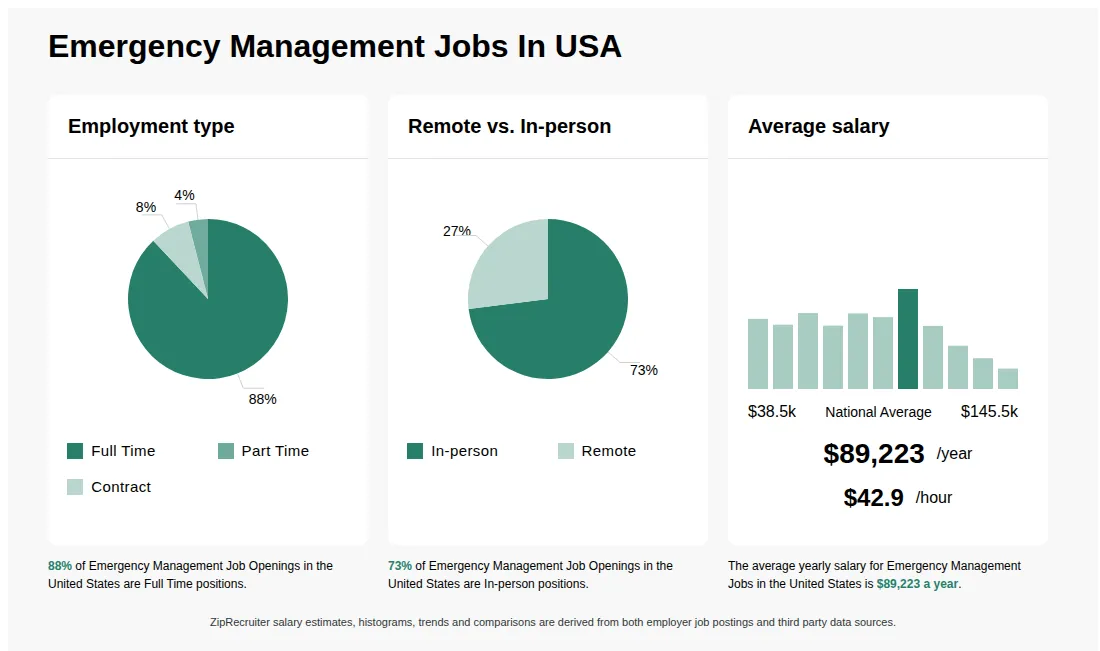
See salary details
$38.5K - $48.2K
11% of jobs
$48.2K - $58K
9% of jobs
$62.2K is the 25th percentile. Wages below this are outliers.
$58K - $67.7K
12% of jobs
$67.7K - $77.4K
9% of jobs
The median wage is $84.9K / yr.
$77.4K - $87.1K
12% of jobs
$87.1K - $96.9K
11% of jobs
$104.7K is the 75th percentile. Wages above this are outliers.
$96.9K - $106.6K
15% of jobs
$106.6K - $116.3K
9% of jobs
$116.3K - $126K
6% of jobs
$126K - $135.8K
4% of jobs
$135.8K - $145.5K
2% of jobs
$38.5K
$89.2K
$145.5K
How much do emergency management jobs pay per year?
As of Sep 15, 2026, the average yearly pay for emergency management in the United States is $89,223.00, according to ZipRecruiter salary data. Most workers in this role earn between $62,500.00 and $109,000.00 per year, depending on experience, location, and employer.
What does an emergency management professional do?
An Emergency Management job focuses on preparing for, responding to, and recovering from emergencies and disasters. Professionals in this field develop response plans, coordinate with agencies, and ensure public safety during crises such as natural disasters, health emergencies, or security threats. They work for government agencies, non-profits, or private organizations to minimize risks and improve disaster resilience. Strong communication, planning, and problem-solving skills are essential in this role.
What are the key skills and qualifications needed for emergency management?
To thrive in Emergency Management, you need expertise in disaster response planning, risk assessment, and incident command, typically supported by a relevant bachelor’s degree and certifications such as Certified Emergency Manager (CEM). Familiarity with emergency management software like WebEOC, GIS mapping tools, and federal response frameworks such as FEMA’s NIMS/ICS is often required. Strong communication, leadership, and decision-making skills help professionals coordinate effectively under pressure. These skills ensure effective crisis response, collaboration with agencies, and public safety during emergencies.
What are common challenges faced by emergency management professionals, and how do they manage them?
Emergency management professionals often face challenges such as rapidly evolving situations, coordinating with multiple agencies, and limited resources during emergencies. They manage these challenges by maintaining detailed preparedness plans, participating in regular training and drills, and using clear communication protocols with stakeholders. Staying adaptable and calm under pressure is essential, as is leveraging technology for real-time information and resource management. Working collaboratively within diverse teams is also key to ensuring a coordinated and effective response.
Are emergency managers in demand?
Emergency managers are in demand due to increasing frequency of natural disasters, climate change impacts, and the need for disaster preparedness and response planning. The role often requires certifications such as the Certified Emergency Manager (CEM) and skills in crisis communication, risk assessment, and coordination with government agencies. Employment prospects are generally strong across various regions, especially in government, healthcare, and private sectors.
What can you do with emergency management?
Emergency management professionals coordinate and implement plans to prepare for, respond to, and recover from disasters and emergencies. They conduct risk assessments, develop response strategies, and collaborate with agencies to ensure community safety. Certifications like the Certified Emergency Manager (CEM) can enhance career opportunities in this field.
What is a career in emergency management?
A career in emergency management involves coordinating and implementing plans to prepare for, respond to, and recover from disasters and emergencies. Professionals in this field often work with government agencies, first responders, and communities, utilizing skills in risk assessment, communication, and crisis response. Certifications such as the Certified Emergency Manager (CEM) can enhance job prospects, and the work environment may include irregular hours during emergencies.
More about Emergency Management jobs
What cities are hiring for Emergency Management jobs?
Cities with the most Emergency Management job openings:
What are the most commonly searched types of Emergency Management jobs?
The most popular types of Emergency Management jobs are:
What states have the most Emergency Management jobs?
States with the most job openings for Emergency Management jobs include:
What job categories do people searching Emergency Management jobs look for?
The top searched job categories for Emergency Management jobs are:

Manager, Emergency Management
Templeton, CA • On-site
Adventist Health
• Non-Profits • 10K+ employees10,000+ employees
Full-time
Posted 4 days ago
Adventist Health rating

7.7
Based on 247 frontline employees who took The Breakroom Quiz
Job description
Located in Templeton amongst the oak trees, Adventist Health Twin Cities has been serving northern San Luis Obispo County since 1977. Comprised of a 122-bed acute care facility, our team provides exceptional care in emergency medicine, orthopedics, obstetrics, digestive disorders, wound care, and various medical, surgical and outpatient services. Locals enjoy weekly farmers markets in downtown Templeton, farm-to-fork dining, beautiful landscapes for hiking and biking, and beach days just fifteen minutes away at Cambria and Morro Bay.
Job Summary:
Assumes site(s) specific responsibility for all aspects of the emergency management program including being the driving force of the emergency management program success. Partners with senior leadership team and leading key strategic initiatives and coordinates with account executives. Represents the emergency management program in collaborations with external partners and stakeholders (EMS/Local PD) to ensure alignment and partnership with private and public emergency management organizations.
Job Requirements:
Education and Work Experience:
- Bachelor's Degree or equivalent combination of education/related experience: Required
- Master's Degree: Preferred
- Five years' related experience: Preferred
- One year's leadership experience: Preferred
Licenses/Certifications:
- Valid Driver's License (DL) and must be at least 21 yrs of age or older: Required
- Completion of FEMA Incident Command Systems ICS-100, 200, 700 and 800: Required within 30 days of hire
- Completion of FEMA Incident Command Systems ICS-300 and 400: Preferred
Essential Functions:
- Attends emergency preparedness meetings with local, regional, state, and federal level agencies, and incorporates outcomes, decisions, and recommendations to site quality and safety leadership and hospital executives. Attends and actively participates in hospital meetings that may include but not limited to infection control/safety/quality/emergency preparedness. Demonstrates competence in hospital emergency management concepts within a complex and fast paced environment.
- Leads a multi-disciplinary approach to the integration of emergency planning standards into routine processes and activities at a site level. Oversees the Emergency Management committee to assure the effective oversight and monitoring and reporting of EM standards. Ensures alignment and compliance with TJC, CMS, FEMA, OSHA, NFPA emergency management requirements. Engages in proactive problem resolution and strategies for emergency management program management to include incorporating best practices and alignment with system emergency management initiatives.
- Provides guidance and mentoring as the emergency management subject matter expert (SME) engaging with all departments (on and off site), clinical staff, and partners, and engages leadership in establishing a culture of preparedness. Designs, develops, and implements hospital training and exercises, to include drills/exercises, in partnership with leadership, physicians, and healthcare workers associated with TJC, CMS, OSHA, NFPA, and other applicable regulations relating to emergency management program requirements.
- Leads the development and annual maintenance of the facility's written disaster plans and procedures to ensure effective multi-hazard disaster response. Maintains all disaster equipment and supplies in a clean, secure location and ensures that all disaster resources are easily accessible and available for rapid deployment. Supports the development and maintenance of hospital decontamination program to ensure compliance with State and Federal regulations. Engages with offsite departments to include, but not limited to, clinics, dental, home health, and hospital at home programs and develops department specific emergency plans and includes departments in training/education, drills/exercise annually.
- Supports a safe work environment for staff by ensuring adherence to all safety/infection control policies and procedures/practices to include but not limited to the wearing of appropriate protective clothing and gear and the proper handling of contaminated equipment and tools. Identifies performance improvement opportunities using internal and external auditing to include rounding, tracers, and other appropriate methodologies. Participates in incident investigation to identify causal factors to determine how incidents might be prevented in the future. Recommends remedial and corrective action.
- Performs other job-related duties as assigned.
Organizational Requirements:
Adventist Health is committed to the safety and wellbeing of our associates and patients. Therefore, we require that all associates receive all required vaccinations as a condition of employment and annually thereafter, where applicable. Medical and religious exemptions may apply.
Adventist Health participates in E-Verify. Visit https://adventisthealth.org/careers/everify/ for more information about E-Verify. By choosing to apply, you acknowledge that you have accessed and read the E-Verify Participation and Right to Work notices and understand the contents therein.
What Adventist Health employees say
Pay
Benefits
Hours and flexibility
Workplace
Get the full story on Breakroom

About Adventist Health
Sourced by ZipRecruiter
Industry
Non-profits and health care and social assistance
Company size
10,000+ Employees
Headquarters location
Roseville, CA, US