1

Emergency Management Jobs (NOW HIRING)

next page

Showing results 1-20

Emergency Management information

See salary details

$38.5K

$89.2K

$145.5K

How much do emergency management jobs pay per year?

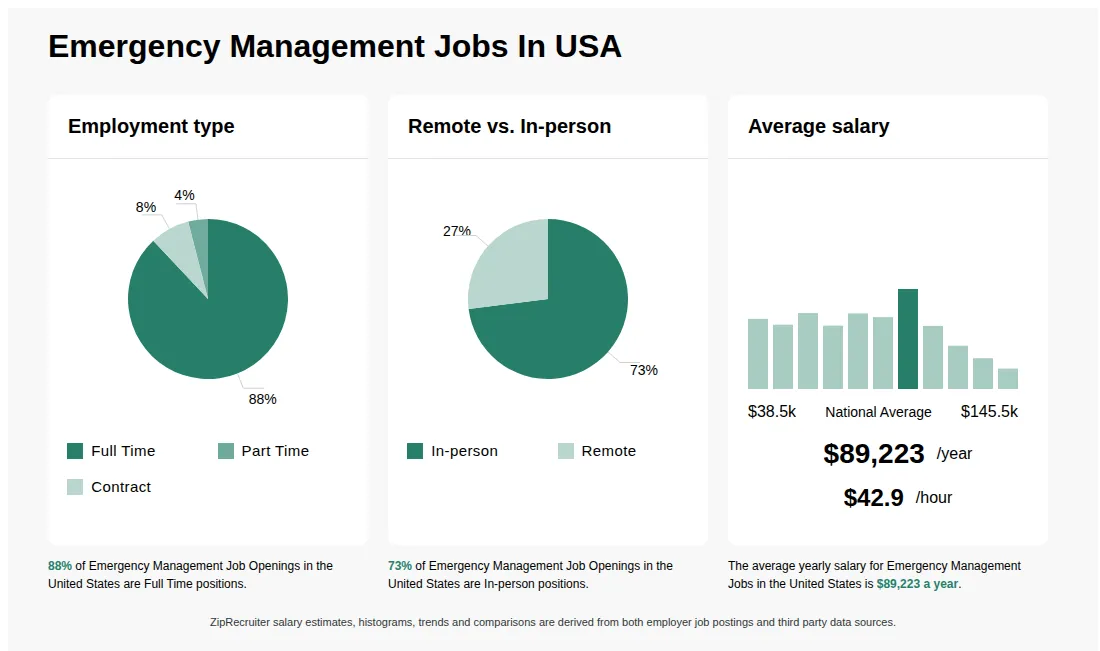
As of Jun 5, 2026, the average yearly pay for emergency management in the United States is $89,223.00, according to ZipRecruiter salary data. Most workers in this role earn between $62,500.00 and $109,000.00 per year, depending on experience, location, and employer.

What does an Emergency Management job involve?

An Emergency Management job focuses on preparing for, responding to, and recovering from emergencies and disasters. Professionals in this field develop response plans, coordinate with agencies, and ensure public safety during crises such as natural disasters, health emergencies, or security threats. They work for government agencies, non-profits, or private organizations to minimize risks and improve disaster resilience. Strong communication, planning, and problem-solving skills are essential in this role.

What are some common challenges faced by emergency management professionals, and how do they manage them?

Emergency management professionals often face challenges such as rapidly evolving situations, coordinating with multiple agencies, and limited resources during emergencies. They manage these challenges by maintaining detailed preparedness plans, participating in regular training and drills, and using clear communication protocols with stakeholders. Staying adaptable and calm under pressure is essential, as is leveraging technology for real-time information and resource management. Working collaboratively within diverse teams is also key to ensuring a coordinated and effective response.

What are the key skills and qualifications needed to thrive in the Emergency Management position, and why are they important?

To thrive in Emergency Management, you need expertise in disaster response planning, risk assessment, and incident command, typically supported by a relevant bachelor’s degree and certifications such as Certified Emergency Manager (CEM). Familiarity with emergency management software like WebEOC, GIS mapping tools, and federal response frameworks such as FEMA’s NIMS/ICS is often required. Strong communication, leadership, and decision-making skills help professionals coordinate effectively under pressure. These skills ensure effective crisis response, collaboration with agencies, and public safety during emergencies.

What cities are hiring for Emergency Management jobs? Cities with the most Emergency Management job openings:
What are the most commonly searched types of Emergency Management jobs? The most popular types of Emergency Management jobs are:
What states have the most Emergency Management jobs? States with the most job openings for Emergency Management jobs include:
Infographic showing various Emergency Management job openings in the United States as of May 2026, with employment types broken down into 84% Full Time, 15% Part Time, and 1% Contract. Highlights an 92% Physical, 2% Hybrid, and 6% Remote job distribution, with an average salary of $89,223 per year, or $42.9 per hour.
Emergency Management Coordinator - Emergency Management

Emergency Management Coordinator - Emergency Management

CoxHealth

Lake Spring, MO

Other

Posted 4 days ago


CoxHealth rating

6.6

Company rating: 6.6 out of 10

Based on 227 frontline employees who took The Breakroom Quiz

559th of 865 rated healthcare providers


Job description

Description

:The “Coordinator” position within the Emergency Management department is a critical component to the success and progress of the department as a whole and to the Programs they each oversee. The coordinator assumes primary responsibility for the development, implementation, and maintenance of the Program(s) in each of their respective fields of expertise. The Programs that exist within the BCEM department require continuous sharing of information; therefore, each of the coordinators must communicate and collaborate amongst each other to fully understand the role each other plays within the department.
The Emergency Management Coordinator has primary responsibility for the:
▪ CoxHealth Emergency Management Program (covering the Springfield and CHG campuses)
1. Mitigation
2. Preparedness
3. Response
4. Recovery (shared duties with the Business Continuity Coordinator)
The Emergency Management Coordinator also has a secondary/shared responsibility for the:
▪ CoxHealth Patient Decontamination (HazMat) Program (shared duties with the Training & Exercise Coordinator)
This role involves coordinating disaster response efforts, conducting risk assessments, developing emergency plans, and providing input on training and drills. The coordinator will collaborate with local, state, and federal agencies, as well as internal departments, to ensure compliance with emergency management regulations and best practices.

Education:
▪ Required:
• Candidates with 3+ years in Fire, Law Enforcement and/or military training experience
OR
• Bachelor’s degree in Emergency and Disaster Management, Homeland Security, or related field
Experience:
▪ Preferred: 3+ years' health care and/or Emergency Management experience
Skills:
▪ Intermediate knowledge of accreditation and regulatory processes
▪ Performance Improvement and/or project management experience with the ability to work on multiple concurrent projects with various deadlines simultaneously
▪ Strong Microsoft Office skills – PowerPoint, Word, and Excel
▪ Excellent communication skills in both written and verbal formats to include public speaking
▪ Proven skills facilitating interactive planning meetings (virtual and in-person) according to an agenda, managing time, and including multiple department leaders
▪ Advanced drill and exercise development skills and background to include evaluating all types of HSEEP level exercises
▪ Previous work with adult learners, including training development and facilitation
▪ Emergency Operations Plan Development
▪ Demonstrated experience in developing discussion-based and operations-based exercises of varying sizes and complexity
▪ Training curriculum development
Licensure/Certification/Registration:
▪ Preferred:
• Certification in Homeland Security Exercise and Evaluation Program (HSEEP)
• Master Exercise Practitioner (MEP) or Certified Emergency Manager (CEM) certification
• Incident Command System (ICS) or HICS 100, 200, 700, and 800 certification
• Incident Command System (ICS) 120.a Introduction to Exercises
• Incident Command System (ICS) 300 and 400
• Additional ICS related courses of interest: 130, 201, 230.d, 454, and 2001
• Any other Emergency Management related certification


What CoxHealth employees say

Pay

Benefits

Hours and flexibility

Workplace

Get the full story on Breakroom