1

Economic Development Director Jobs in Texas (NOW HIRING)

next page

Showing results 1-20

Economic Development Director information

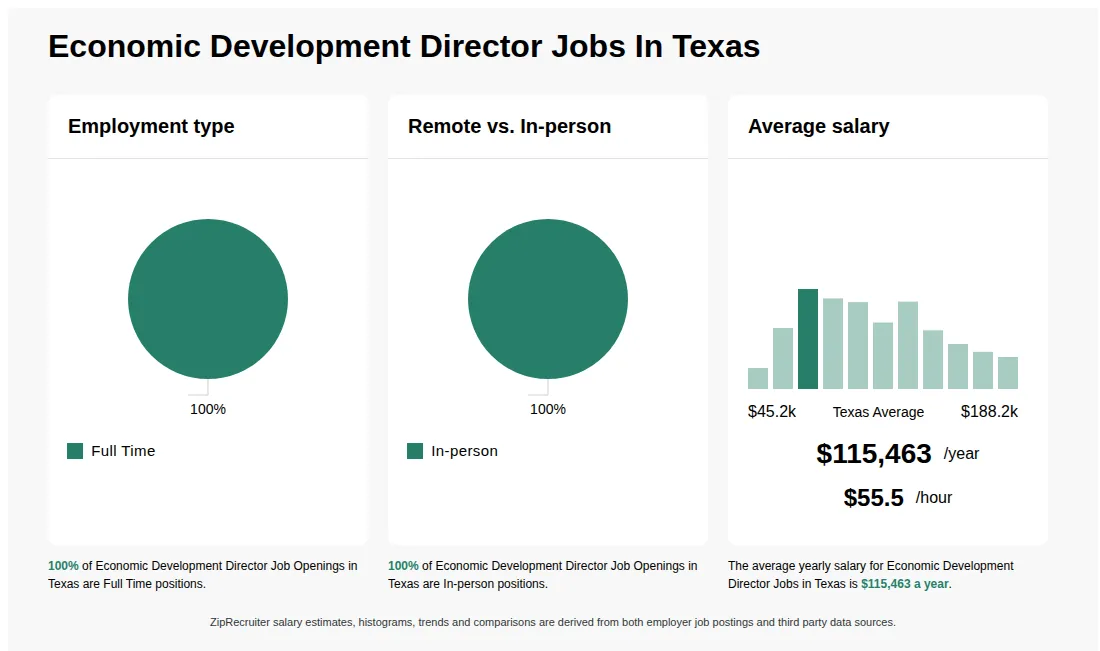
See Texas salary details

$45.2K

$115.5K

$188.2K

How much do economic development director jobs pay per year?

As of Jul 27, 2026, the average yearly pay for economic development director in Texas is $115,463.00, according to ZipRecruiter salary data. Most workers in this role earn between $83,400.00 and $143,000.00 per year, depending on experience, location, and employer.

What is the difference between Economic Development Director vs Economic Development Specialist?

AspectEconomic Development DirectorEconomic Development Specialist
CredentialsBachelor's or Master's in Economics, Business, or Public Administration; experience in economic planningSimilar credentials, often with less managerial experience
Work EnvironmentLeadership role in government agencies or economic development organizationsSupport role, assisting with projects and research
Employer & IndustryMunicipalities, regional agencies, economic development firmsLocal government departments, economic development offices
Search & Comparison IntentUnderstanding leadership roles in economic developmentLearning about supporting roles in economic growth projects

The main difference between an Economic Development Director and an Economic Development Specialist lies in their level of responsibility and leadership. The Director oversees strategic planning and manages teams, while the Specialist focuses on supporting projects and research. Both roles require similar educational backgrounds and work within government or economic organizations, but the Director holds a higher managerial position.

What are the key skills and qualifications needed to thrive as an Economic Development Director, and why are they important?

To thrive as an Economic Development Director, you need expertise in economic analysis, project management, and public policy, typically supported by a degree in economics, public administration, or a related field. Familiarity with economic modeling software, GIS tools, and grant management systems is often required, along with certifications such as Certified Economic Developer (CEcD). Strong leadership, strategic communication, and relationship-building abilities help foster collaboration among public, private, and community stakeholders. These skills are crucial for identifying growth opportunities, securing funding, and driving sustainable economic progress in a community or region.

What are the main challenges Economic Development Directors face when balancing community needs and business interests?

Economic Development Directors often need to align the interests of local businesses, government stakeholders, and community members, which can be challenging due to differing priorities. For example, attracting new businesses might conflict with preserving community character or addressing affordable housing. Success in this role frequently involves transparent communication, creative problem-solving, and building consensus through public engagement and strategic partnerships. Navigating these complexities requires adaptability and a strong understanding of both economic trends and local needs.

What does an Economic Development Director do?

An Economic Development Director is responsible for creating and implementing strategies to promote economic growth within a community or region. They work to attract new businesses, support existing ones, and encourage job creation by collaborating with local government officials, business leaders, and community organizations. Their duties often include managing economic incentive programs, overseeing redevelopment projects, and conducting market research to identify opportunities for development. Ultimately, their goal is to improve the local economy and enhance the quality of life for residents.

What Is an Economic Development Director?

An economic development director is a city government employee who helps spur the city economy. Your two biggest responsibilities are to persuade new businesses to move into your town and to encourage existing businesses to expand. You attend fundraising events for civic and business groups and interact with donors to make connections with potentially valuable economic partners. Your duties include developing strategic programs for economic and financial growth, analyzing market trends, writing city tax policy proposals, and advising the city manager and the city council.

What are the most commonly searched types of Economic Development jobs in Texas? The most popular types of Economic Development jobs in Texas are:
What are popular job titles related to Economic Development Director jobs in Texas? For Economic Development Director jobs in Texas, the most frequently searched job titles are:
What cities in Texas are hiring for Economic Development Director jobs? Cities in Texas with the most Economic Development Director job openings:
Infographic showing various Economic Development Director job openings in Texas as of July 2026, with employment types broken down into 1% As Needed, 82% Full Time, 15% Part Time, and 2% Contract. Highlights an 92% Physical, 2% Hybrid, and 6% Remote job distribution, with an average salary of $115,463 per year, or $55.5 per hour.
Economic Development Director

Economic Development Director

City of Victoria

Victoria, TX

$110K - $134K/yr

Full-time

Posted 26 days ago


City Of Victoria (Texas) rating

6.8

Company rating: 6.8 out of 10

Based on 5 frontline employees who took The Breakroom Quiz

667th of 832 rated public administrative organizations


Job description

JOB SUMMARY Under general direction, leads the implementation of the City of Victoria's Economic Development Strategic Plan by coordinating partnerships, driving business recruitment and retention efforts, and supporting strategic growth initiatives. This position serves as a primary liaison with developers, business leaders, regional partners, and governmental agencies to promote a pro-business environment and attract new investment. The role manages the Victoria Sales Tax Development Corporation (Type B) and departmental budgets, ensuring alignment with City Council goals, while advancing redevelopment initiatives, overseeing incentive programs, and supporting funding opportunities.

Provides data-driven analysis, reports, and recommendations to leadership and plays a key role in shaping economic growth and long-term community success. PRINCIPAL DUTIES AND RESPONSIBILITIES Essential functions, as defined under the Americans with Disabilities Act, may include any of the following representative duties, knowledge, and skills. This list is ILLUSTRATIVE ONLY and is not a comprehensive listing of all functions and duties performed by incumbents of this class.

Employees are required to be in attendance and prepared to begin work at their assigned work location on the specified days and hours. Factors such as regular attendance at the job are not routinely listed in job descriptions but are an essential function. Essential duties and responsibilities may include, but are not limited to, the following: Spearheads the implementation of the Economic Development Strategic Plan for the City of Victoria.

Oversees the departmental budget and financial activities related to economic development initiatives and partner organizations, while contributing to the preparation of the City's annual budget. Coordinates economic development efforts between, but not limited to, including the City, Victoria Port Authority, Victoria Regional Airport, Victoria County, A&M-Victoria, Victoria College, Workforce Solutions Golden Crescent, Victoria Sales Tax Development Corporation (VSTDC), and the Victoria Economic Development Corporation (VEDC). Provides leadership in developing short- and long-term economic and community development plans, including conducting research, preparing studies, reports, and recommendations, and proactively collaborating with the City's Planning Department on initiatives related to future land use.

Prepares and maintains data related to demographics, utilities, taxes, transportation, community services, financing tools, and incentives to respond to requests for information for economic development purposes and comprehensive reports as required. Provides professional economic development guidance; assists with application and permitting processes; and serves as an advocate for the City's economic development priorities, ordinances, and goals. Extends this advocacy through coordination with external partners, including the County and Council of Governments (e.g., CEDS), ensuring the City of Victoria maintains a strong and active presence in regional initiatives

Works closely with the Victoria Chamber of Commerce, A&M-Victoria Small Business Development Center, VEDC and various other Boards and Commissions to identify areas of concern to effectively foster a "pro-business" environment for the City of Victoria. Works to attract prospective commercial and retail developments to the area with the use of a well-defined marketing strategy. Establishes relationships with existing and new developers to identify growth opportunities in the area.

Promotes business retention and expansion ("BRE") by building strong relationships with local employers and/or business owners. Maintains detailed and accurate documentation of all interactions with local employers and business owners as part of the City's Business Retention and Expansion (BRE) program. Oversee real estate and redevelopment initiatives, including City-owned properties and negotiation of development agreements.

Identifies and pursues funding opportunities from public and private sources for economic development and community growth. Serve as primary point of contact, in coordination with the Victoria Economic Development Corporation (VEDC), for the Governor's Office of Economic Development & Tourism, commercial developers, site selectors, brokers and entrepreneurs. Serves as a liaison with various local, State, and Federal agencies; coordinates projects with agencies as necessary and appropriate.

Provides information and makes presentations to supervisors, boards, commissions, civic groups, businesses, individuals, and the public related to economic development issues, programs, services, and plans. Manages market incentive programs such as tax abatements, grants, and public-private partnerships. Establishes relationships with foreign direct investment stakeholders such as international counterparts and the U.S

Commercial Service. Attends City Council, Victoria Sales Tax Corporation, Downtown TIRZ, Housing Finance Corporation, and Public Facility Corporation meetings and work sessions, as needed to support the economic development needs of the City. Attends and participates in industry-related professional associations, conventions, conferences, and trade shows including continuing education opportunities.

Performs related duties as required or assigned. PHYSICAL AND ENVIRONMENTAL CONDITIONS Work is performed in a standard office environment with frequent meetings and site visits. Attendance at evening meetings, community events and occasional travel is required.

REQUIRED QUALIFICATIONS Education: Bachelor's degree in Economic Development, Business Administration, Public Administration, Urban Planning or related field AND seven (7) years of progressively responsible experience in community or economic development; OR an equivalent combination of education, training, and experience. Knowledge of: Applicable local, state, and federal laws, codes, regulations, and ordinances General office operations and administrative functions Records management and retention requirements Supervisory principles Budget development and administration Data analysis and reporting principles Economic development program planning and administration Grant and contract management Municipal planning and development processes Skill in: Strong knowledge of economic development tools, incentives, and financing mechanisms. Understanding of real estate development underwriting preferred.

Ability to interpret plans, codes, and ordinances. Excellent communication, negotiation, and relationship-building skills. Ability to manage budgets, organize priorities, and meet deadlines.

Effective leadership and supervision of staff. Proficiency in data entry, recordkeeping, and maintaining accurate files. Ability to prepare clear, concise reports and present to varied audiences.

Ability to interact tactfully and professionally with staff, agencies, and the public. Proficiency in Microsoft Office and familiarity with GIS, AI, CRM systems or economic development software. Required Contacts: Employee has direct contact with citizens and all levels of employees when answering inquiries.

License and Certification Requirements: Must possess a valid State driver's license that meets the city guideline. CEcD, EDFP, or EDP certification or completion of recognized economic development program (e.g. PCED, IEDC, GrowAmerica, or TEDC), is preferred.


What City Of Victoria (Texas) employees say

Pay

Hours and flexibility

Workplace

Get the full story on Breakroom