1

Disaster Response Jobs (NOW HIRING)

next page

Showing results 1-20

Disaster Response information

See salary details

$12

$20

$28

How much do disaster response jobs pay per hour?

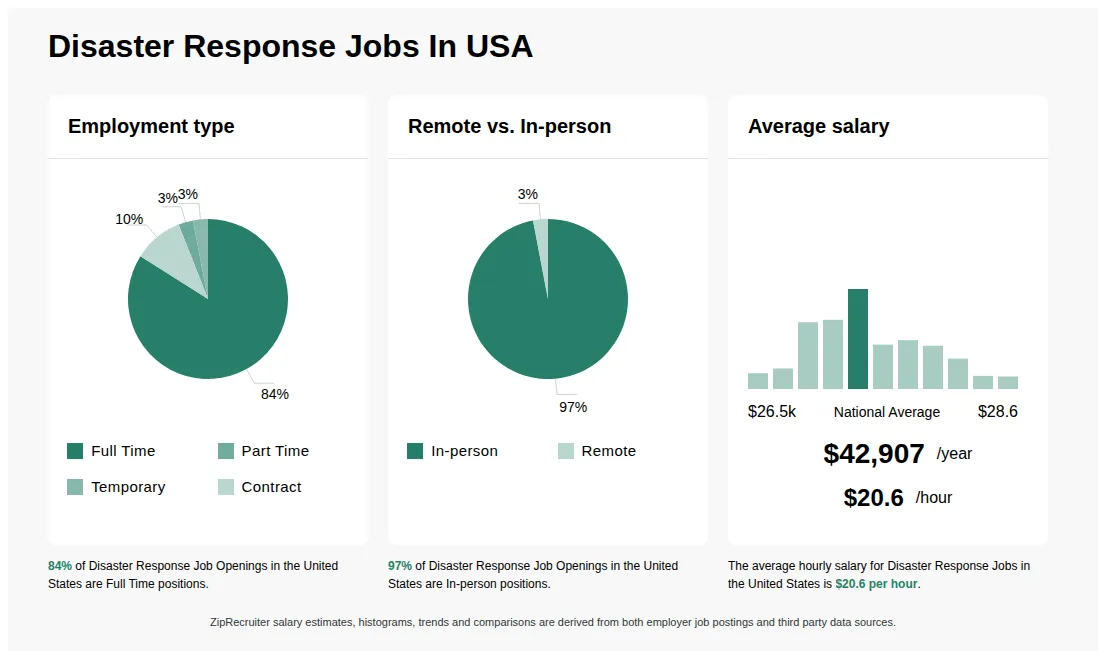
As of Sep 2, 2026, the average hourly pay for disaster response in the United States is $20.63, according to ZipRecruiter salary data. Most workers in this role earn between $17.31 and $22.84 per hour, depending on experience, location, and employer.

What is disaster response?

Disaster response refers to the coordinated efforts and actions taken immediately following a disaster to save lives, reduce health impacts, ensure public safety, and meet the basic needs of affected communities. This phase includes activities such as search and rescue, providing emergency shelter, distributing food and water, and offering medical care. Disaster response is carried out by a range of organizations, including government agencies, humanitarian groups, and emergency services. The goal is to stabilize the situation quickly and lay the groundwork for recovery.

What are disaster response jobs?

Disaster response jobs focus on providing emergency relief after a natural or human-made disaster. In this role, you may be asked to take action shortly after a disaster occurs, help with planning and preparation before disasters strike, and help with management during a crisis. The jobs themselves take a variety of forms, from working on the ground to rescue people and pass out supplies to managing communications or raising public awareness about threats. State and federal governments provide many disaster response jobs, but many non-profit and humanitarian organizations also respond to disasters. These roles are not the same as firefighters or police. While both help with disasters, disaster response jobs focus on events like earthquakes, major wildfires, or outbreaks of disease.

What are the key skills and qualifications needed to thrive in disaster response, and why are they important?

To thrive in Disaster Response, you need a solid background in emergency management, risk assessment, and crisis intervention, often supported by relevant degrees or certifications such as FEMA training or Certified Emergency Manager (CEM) credentials. Familiarity with incident command systems, GIS mapping tools, and emergency communication platforms is typically required. Strong problem-solving, adaptability, and teamwork skills help responders manage high-pressure situations and coordinate effectively with diverse agencies. These abilities are crucial for ensuring rapid, organized, and effective responses to emergencies, minimizing harm and aiding affected communities.

What are some common challenges faced by professionals in disaster response, and how can they be managed?

Disaster response professionals often face unpredictable and rapidly changing situations, which can include logistical hurdles, communication breakdowns, and emotional stress. Managing these challenges requires strong adaptability, clear protocols, and effective teamwork. Regular training, mental health support, and reliable communication systems are essential to maintaining resilience and performance in high-pressure environments. Building strong relationships with local agencies and community members also helps streamline coordination and resource allocation during emergencies.

What is the difference between Disaster Response vs Emergency Medical Technician?

AspectDisaster ResponseEmergency Medical Technician
Required CredentialsDisaster response training, certifications in emergency management, first aid, and sometimes specialized coursesEMT certification, CPR, first aid
Work EnvironmentField operations during disasters, including natural and man-made events, often in challenging conditionsPre-hospital emergency care, ambulances, hospitals
Employer & IndustryGovernment agencies, NGOs, emergency management firmsAmbulance services, hospitals, clinics

Disaster Response involves coordinating and providing aid during large-scale emergencies, often requiring specialized training and working in challenging environments. Emergency Medical Technicians focus on providing immediate medical care in emergency settings, primarily within healthcare and ambulance services. While both roles respond to emergencies, Disaster Response covers broader disaster management activities, whereas EMTs specialize in medical treatment.

Do disaster response workers get paid?

Disaster response workers are typically paid for their work, especially if they are employed by government agencies, non-profit organizations, or private companies. Compensation varies based on the role, experience, and organization, and may include hourly wages, salaries, or stipends. Many disaster response roles also require specialized training and certifications.

What cities are hiring for Disaster Response jobs?

Cities with the most Disaster Response job openings:

What are the most commonly searched types of Disaster Response jobs?

The most popular types of Disaster Response jobs are:

What states have the most Disaster Response jobs?

States with the most job openings for Disaster Response jobs include:

Infographic showing various Disaster Response job openings in the United States as of August 2026, with employment types broken down into 1% As Needed, 83% Full Time, 13% Part Time, 2% Contract, and 1% Nights. Highlights an 91% Physical, 2% Hybrid, and 7% Remote job distribution, with an average salary of $42,907 per year, or $20.6 per hour.

Disaster Response Technician - West

WellSpan Health

Waynesboro, PA • On-site

$17.25 - $22.75/hr

Part-time

Re-posted 19 days ago


WellSpan Health rating

7.6

Company rating: 7.6 out of 10

Based on 307 frontline employees who took The Breakroom Quiz

192nd of 898 rated healthcare providers


Job description

Schedule

PRN

General Summary

Provides support to the response and recovery efforts of the Hospital Emergency Management Department and Disaster Response Team (DRT) which includes mitigation and training support to the Director, Manager, Team Leader and Coordinators of Emergency Management and the emergency management program. Responds during an emergency situation as required; serves as an active member of the department's DRT and supports the DRT for any local disaster or relief operation. Supports the functions of the DRT in a state of positive preparedness, readiness and response capabilities through didactic and practical training exercises as well as team meetings, details and drills and exercises.

WellSpan Health's vision is to reimagine healthcare through the delivery of comprehensive, equitable health and wellness solutions throughout our continuum of care. As an integrated delivery system focused on leading in value-based care, we encompass more than 2,300 employed providers, 250 locations, nine award-winning hospitals, home care and a behavioral health organization serving central Pennsylvania and northern Maryland. Our high-performing Medicare Accountable Care Organization (ACO) is the region's largest and one of the best in the nation. With a team 23,000 strong, WellSpan experts provide a range of services, from wellness and employer services solutions to advanced care for complex medical and behavioral conditions. Our clinically integrated network of 3,000 aligned physicians and advanced practice providers is dedicated to providing the highest quality and safety, inspiring our patients and communities to be their healthiest.

Qualifications
Minimum Education:

  • High School Diploma or GED Required

Work Experience:

  • 1 year Experience in Emergency management, emergency or disaster response, emergency medical response, decontamination response, or firefighting. Required
  • Experience in HazMat. Preferred

Licenses:

  • Certified Emergency Medical Technician Upon Hire Preferred or
  • Certified Paramedic Upon Hire Preferred

Knowledge, Skills, and Abilities:

  • Use of PPE (APR-SCBA).

Essential Functions:

  • Responds to decontamination alerts (hospital, mutual aid, community or regional responses) and disaster alerts (surge capacity, triage, and evacuation).
  • Assists with stores and maintenance of decon room, truck and trailer which includes contents of each.
  • Attends monthly DRT meetings, DRT training; Participates in drills and exercises as scheduled.
  • Assists with disaster preparedness and response initiatives as scheduled.

Common Expectations:

  • Maintains certification and competency: HazMat Operations (Receiver & Responder) and Incident Command course (Hospital Incident Command System and NIMS components); use of Personal Protective Equipment, use of all decon deployable and static equipment/facilities.
  • Is able to safely deploy and operate all decontamination equipment, personal protective equipment and stand down all equipment to a state of readiness; work effectively under pressure in a disaster environment; work in a team situation during stressful situations.
  • Provides outstanding service to all customers; fosters teamwork; and practices fiscal responsibility through improvement and innovation.

What WellSpan Health employees say

Pay

Benefits

Hours and flexibility

Workplace

Get the full story on Breakroom