1

Director Business Process Improvement Jobs (NOW HIRING)

You will be responsible of helping to drive the strategic evolution of business processes across ... Promote a culture of continuous improvement through individual improvement programs and consistent ...

The Flex Director, Business Process is a key member of the Associate Experience + Business Process ... growth and improvement. The team manages process transformation projects and stewards the ...

next page

Showing results 1-20

Director Business Process Improvement information

See salary details

$45.5K

$102.9K

$150K

How much do director business process improvement jobs pay per year?

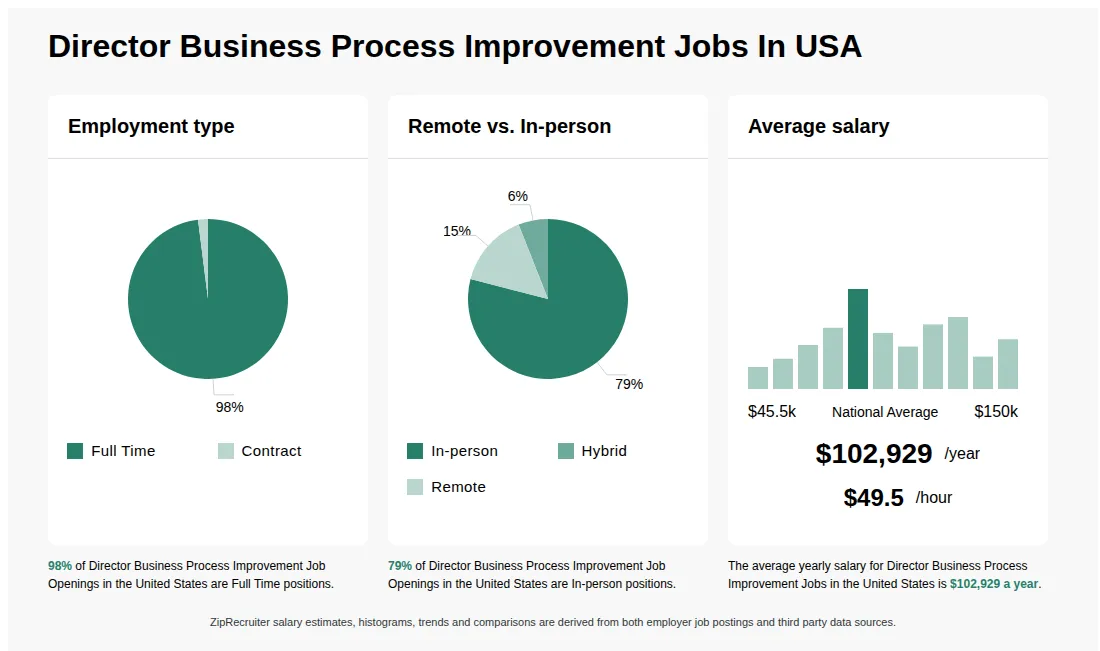
As of Jul 4, 2026, the average yearly pay for director business process improvement in the United States is $102,929.00, according to ZipRecruiter salary data. Most workers in this role earn between $82,000.00 and $121,500.00 per year, depending on experience, location, and employer.

What are the key skills and qualifications needed to thrive as a Director of Business Process Improvement, and why are they important?

To thrive as a Director of Business Process Improvement, you need expertise in process analysis, project management, and change management, often backed by a bachelor’s or master’s degree in business or a related field. Familiarity with Lean, Six Sigma, BPM software, and process mapping tools, as well as relevant certifications (like Lean Six Sigma Black Belt), is typically required. Strong leadership, communication, and stakeholder engagement skills help drive cross-functional initiatives and foster a culture of continuous improvement. These skills and qualities are vital for identifying inefficiencies, implementing sustainable solutions, and delivering measurable business results.

How does a Director of Business Process Improvement typically collaborate with other departments to drive organizational change?

A Director of Business Process Improvement works closely with leaders and teams across various departments, such as operations, finance, IT, and HR, to identify inefficiencies and develop strategies for enhancement. Collaboration often involves facilitating cross-functional workshops, leading process mapping sessions, and gathering input from stakeholders to ensure proposed changes align with business objectives. This role also requires clear communication and change management skills to gain buy-in and support implementation. By working collaboratively, the Director ensures that process improvements are practical, sustainable, and positively impact the organization as a whole.

What does a Director of Business Process Improvement do?

A Director of Business Process Improvement leads efforts to analyze, design, and implement changes that enhance an organization's efficiency and effectiveness. This role involves assessing current business processes, identifying areas for improvement, and working with teams to streamline operations, reduce costs, and improve quality. Directors in this position often use methodologies like Lean or Six Sigma to guide process changes, measure results, and ensure continuous improvement across the company. They collaborate with various departments to align process improvements with business goals and drive lasting change.

What is the difference between Director Business Process Improvement vs Business Process Analyst?

AspectDirector Business Process ImprovementBusiness Process Analyst
CredentialsBachelor's/Master's in Business, Management, or related fields; certifications like Lean, Six SigmaBachelor's in Business, Management, or related fields; certifications like Lean, Six Sigma
Work EnvironmentLeadership roles in strategic planning, cross-departmental projectsAnalyzing processes, data collection, process mapping
Employer & Industry UsageUsed in large corporations, consulting firms, manufacturing, healthcareCommon in various industries for process analysis and improvement
Search & Comparison IntentUnderstanding leadership roles in process improvementDetailing process analysis functions and skills

The main difference is that the Director Business Process Improvement oversees strategic process initiatives and leads teams, while the Business Process Analyst focuses on analyzing and mapping existing processes. The director has broader responsibilities, often managing multiple projects and teams, whereas the analyst provides detailed insights to support process enhancements.

More about Director Business Process Improvement jobs
What cities are hiring for Director Business Process Improvement jobs? Cities with the most Director Business Process Improvement job openings:
What are the most commonly searched types of Business Process Improvement jobs? The most popular types of Business Process Improvement jobs are:
What states have the most Director Business Process Improvement jobs? States with the most job openings for Director Business Process Improvement jobs include:
Infographic showing various Director Business Process Improvement job openings in the United States as of June 2026, with employment types broken down into 82% Full Time, 15% Part Time, and 3% Contract. Highlights an 92% Physical, 2% Hybrid, and 6% Remote job distribution, with an average salary of $102,929 per year, or $49.5 per hour.
Director - Business Process Improvement

Full-time

Posted 21 days ago


Job description

Overview
The Director - Business Process Improvement for Revenue Cycle Management (RCM) is responsible for process evaluation and standardization, establishing performance metrics, identifying productivity enhancements, developing and maintaining process documentation, and driving overall continuous improvement. This role partners closely with operational leaders, IT, analytics, compliance, and executive stakeholders to identify opportunities to improve efficiency, reduce manual work, enhance accuracy, strengthen controls, and improve financial outcomes.
The Director - Business Process Improvement serves as both a strategic leader and operational architect-driving enterprise process improvement initiatives while ensuring efforts align with organizational goals, regulatory requirements, and the realities of healthcare operations. This role oversees operational workflows that align with strategic growth goals, project prioritization, vendor collaboration and procurement, planning, change management, and long-term optimization efforts across end-to-end revenue cycle functions.
Job Highlights
ESSENTIAL DUTIES AND RESPONSIBILITIES: (The ideal candidate must be able to complete all physical requirements of the job with or without a reasonable accommodation)
Strategic Leadership
Translates executive vision into an actionable, measurable roadmap for operational excellence across multiple departments.
Identifies high-impact automation and process improvement opportunities across the revenue cycle, including patient access, coding, billing, claims management, payment posting, denials, collections, and reporting.
Builds multi-year roadmaps focused on scalability, operational efficiency, and measurable ROI.
Establishes governance frameworks for intake, prioritization, implementation, and monitoring.
Serves as a strategic advisor to executive leadership regarding process transformation opportunities and operational modernization.
Process Optimization and Operational Excellence
Leads end-to-end process analysis to identify inefficiencies, bottlenecks, rework, and operational risk areas.
Standardizes workflows and operational practices to support scalable automation solutions.
Drives Lean, Six Sigma, or continuous improvement methodologies across RCM operations.
Partners with operational leaders to redesign workflows that improve productivity, quality, turnaround time, and employee experience.
Develops and monitors KPIs related to automation performance, operational efficiency, financial outcomes, and adoption.
Design and Implementation
Defines complex problem statements, develops success metrics, and presents outcomes to senior leadership.
Maps out end to end current and future state workflows to identify bottlenecks, waste, and friction points.
Develops and maintains process documentation, including process maps, standard operating procedures, and performance metrics.
Collaborates with IT, data, analytics, and vendors to ensure successful solution design, testing, implementation, and support.
Optimizes reporting, dashboards, and updates to show status, risks, and impact.
Stakeholder Partnership and Change Management
Builds strong partnerships across operations, finance, compliance, IT, analytics, and executive leadership.
Translates operational challenges into scalable solutions and actionable business requirements.
Leads organizational change management efforts related to process transformation and adoption.
Communicates project progress, risks, outcomes, and ROI to senior leadership and key stakeholders.
Drives a culture of innovation, operational excellence, and continuous improvement leveraging data to inform decisions and prioritize initiatives.
Coordinates, educates, and integrates data management to support leaders.
Qualifications
KNOWLEDGE/SKILLS/ABILITIES (KSAs):
Required
  • Bachelor's degree in business, healthcare administration, information systems, finance, operations, or a related field.
  • 7+ years of experience in healthcare revenue cycle operations, process improvement, automation, or operational transformation.
  • 7+ years of leadership experience managing projects, programs, teams, or enterprise initiatives.
  • Strong knowledge of healthcare revenue cycle functions, workflows, payer processes, and regulatory considerations.
  • Demonstrated ability to lead cross-functional initiatives and influence senior stakeholders.
  • Strong analytical, operational, and strategic problem-solving skills.
  • Excellent communication, presentation, and executive-facing skills.

Preferred
  • Master's degree (MBA, MHA, or related field).
  • Experience with Epic, Cerner, Athenahealth, Meditech, or other healthcare systems.
  • Lean Six Sigma, PMP, or related certifications.
  • Experience leading AI-enabled workflow transformation initiatives.
  • Familiarity with healthcare compliance requirements including HIPAA and CMS regulations.
  • Experience implementing automation technologies and process improvement initiatives within complex healthcare environments.

*The physical demands described here are representative of those that may need to be met by an employee to successfully perform the essential functions of this job. Reasonable accommodations may be made to enable individuals with disabilities to perform the essential functions.
  • Occasional Standing
  • Occasional Walking
  • Frequent Sitting
  • Frequent hand, finger movement
  • Use office equipment (in office or remote)
  • Communicate verbally and in writing