1

Data Analytics Graduate Jobs (NOW HIRING)

Data Analytics Manager

Renton, WA · On-site

$125K - $188K/yr

Graduate degree is a plus. * 7+ years of relevant work experience, including at least 2 years of experience leading a team. * Experience using R, python, or similar tools to conduct data analysis.

The Lecturer will teach courses for the Carr School of Accountancy at both the graduate and undergraduate levels in topics related to data analytics. Courses may be taught online, hybrid ...

The candidate should have 7+ years of industry experience in data science and analytics. Graduate degrees in a technical field such as Statistics, Computer Science, Data Science, Bioinformatics ...

As a Graduate Service Data Analyst here at Honeywell, you will take ownership of the foundational ... In this role, you will impact the quality and effectiveness of Honeywell's service data analytics ...

New

As a Graduate Service Data Analyst here at Honeywell, you will take ownership of the foundational ... In this role, you will impact the quality and effectiveness of Honeywell's service data analytics ...

New

The candidate should have 5+ years of industry experience in data science and analytics. Graduate degrees in a technical field such as Statistics, Computer Science, Data Science, Bioinformatics ...

Showing results 21-40

Data Analytics Graduate information

See salary details

$24

$54

$94

How much do data analytics graduate jobs pay per hour?

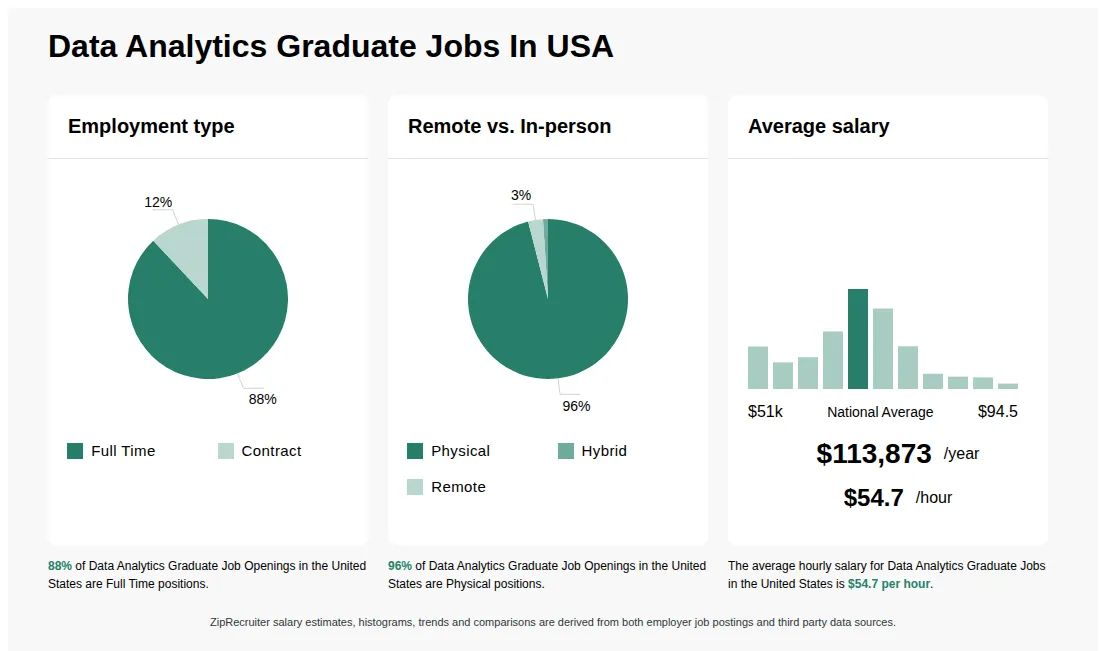
As of Jul 24, 2026, the average hourly pay for data analytics graduate in the United States is $54.75, according to ZipRecruiter salary data. Most workers in this role earn between $43.99 and $62.02 per hour, depending on experience, location, and employer.

What are the key skills and qualifications needed to thrive in the Data Analytics Graduate position, and why are they important?

To thrive as a Data Analytics Graduate, you need a solid understanding of statistics, data modeling, and analytical techniques, usually supported by a relevant degree in mathematics, statistics, computer science, or a related field. Familiarity with tools like SQL, Excel, Python or R, and visualization platforms such as Tableau or Power BI is highly valued, and certifications in these can provide an added advantage. Strong problem-solving abilities, attention to detail, and effective communication skills help you distill complex data sets into actionable insights and present findings to diverse stakeholders. These skills are essential for delivering data-driven solutions that support business decisions and foster organizational growth.

What are typical career paths or growth opportunities for a Data Analytics Graduate?

As a Data Analytics Graduate, you often start by supporting more senior analysts with data preparation, exploratory analysis, and report generation. Over time, you can advance to positions such as Data Analyst, Business Intelligence Analyst, or Data Scientist, depending on your interests and ongoing skill development. Many organizations encourage further training and offer mentorship to help you specialize in areas like machine learning, data engineering, or domain-focused analytics. With experience and demonstrated impact, leadership roles such as Analytics Manager or Team Lead become attainable, providing broader responsibilities and strategic input into organizational decision-making.

What is a Data Analytics Graduate job?

A Data Analytics Graduate job is an entry-level role designed for recent graduates with a background in data science, statistics, or related fields. It typically involves collecting, cleaning, analyzing, and visualizing data to help organizations make data-driven decisions. Graduates in this role may work with tools like SQL, Python, Excel, and data visualization software to interpret trends and patterns. They often collaborate with different departments to provide insights that optimize business processes. This role serves as a foundation for more advanced positions in data analytics or data science.

More about Data Analytics Graduate jobs
What cities are hiring for Data Analytics Graduate jobs? Cities with the most Data Analytics Graduate job openings:
What are the most commonly searched types of Data Analytics Graduate jobs? The most popular types of Data Analytics Graduate jobs are:
What states have the most Data Analytics Graduate jobs? States with the most job openings for Data Analytics Graduate jobs include:
Infographic showing various Data Analytics Graduate job openings in the United States as of July 2026, with employment types broken down into 95% Full Time, 3% Part Time, and 2% Contract. Highlights an 80% Physical, 6% Hybrid, and 14% Remote job distribution, with an average salary of $113,873 per year, or $54.7 per hour.

Predictive Analytics Fellow, Workforce Intelligence

AlphaHire

Remote

Contractor

Posted 29 days ago


Job description

About AlphaHire Workforce Intelligence Lab (WIL)
The AlphaHire Workforce Intelligence Lab (WIL) is an applied workforce research initiative focused on construction labor markets, workforce planning systems, compensation intelligence, labor scarcity analysis, and operational workforce visibility.
WIL develops workforce intelligence frameworks and regional labor market analysis designed to support operational decision-making across the construction industry.
The lab synthesizes publicly available labor data, compensation trends, contractor growth indicators, workforce demand signals, and construction activity into workforce intelligence systems for construction firms and industry operators.
Learn more:
AlphaHire Workforce Intelligence Lab (WIL)
About the role
We are seeking Predictive Analytics Fellows interested in workforce forecasting support systems, labor market analytics, operational workforce modeling, and workforce intelligence initiatives focused on the construction industry.
This fellowship is designed for graduate students, PhD candidates, analysts, data scientists, operations researchers, and analytically oriented professionals interested in workforce systems, labor market visibility, workforce planning, compensation analysis, and operational forecasting support.
Predictive Analytics Fellows will contribute to workforce intelligence initiatives focused on:
  • workforce trend modeling
  • labor market analytics
  • compensation trend analysis
  • workforce forecasting support
  • labor scarcity indicators
  • workforce intelligence methodologies
  • operational workforce visibility
  • workforce planning systems
  • workforce signal interpretation
  • dashboard validation
  • regional workforce intelligence reporting

This is a flexible, remote, project-based fellowship structured around approximately 3-5 hours per week.
Requirements
  • Support workforce intelligence and workforce forecasting initiatives
  • Assist with workforce analytics and labor market trend analysis
  • Contribute to workforce intelligence reports and publications
  • Participate in workforce intelligence framework and forecasting support development
  • Research publicly available labor market and workforce datasets
  • Support operational workforce visibility and workforce planning initiatives
  • Assist with dashboard validation and workforce signal analysis
  • Contribute to workforce intelligence methodology documentation
  • Support workforce forecasting support systems focused on operational construction decision-making

Preferred backgrounds
We are particularly interested in candidates with backgrounds in:
  • predictive analytics
  • workforce analytics
  • operations research
  • econometrics
  • statistics
  • industrial engineering
  • labor economics
  • forecasting systems
  • data science
  • business analytics
  • operational analytics
  • quantitative modeling
  • applied economics
  • mathematics
  • data analytics

Graduate students, PhD candidates, early-career researchers, analysts, and analytically oriented professionals are encouraged to apply.
Benefits
Fellowship structure
  • Flexible remote participation
  • Approximately 3-5 hours per week
  • Project-based collaboration
  • Ongoing contribution opportunities based on interest and availability

Additional information
This is an applied workforce analytics fellowship focused on operational workforce visibility and workforce planning support for the construction industry.
The fellowship is intended for individuals interested in:
  • workforce forecasting support systems
  • workforce analytics
  • labor market analysis
  • operational workforce systems
  • workforce intelligence methodologies
  • compensation intelligence
  • labor scarcity interpretation
  • workforce planning frameworks
  • construction workforce intelligence

rather than speculative forecasting or purely theoretical modeling.
The fellowship emphasizes:
  • explainable methodologies
  • operational usefulness
  • workforce visibility
  • practical workforce planning support
  • labor market interpretation

NOT:
  • black-box prediction systems
  • exaggerated AI claims
  • speculative forecasting
  • unsupported predictive precision

Benefits
What fellows receive
Predictive Analytics Fellows will have opportunities to:
  • contribute to workforce intelligence reports and publications
  • participate in applied workforce analytics initiatives
  • gain exposure to workforce planning systems and labor market analysis
  • contribute to workforce intelligence methodologies and forecasting support systems
  • build portfolio-quality workforce intelligence and analytics projects
  • collaborate on workforce intelligence dashboards and workforce visibility systems
  • participate in workforce intelligence discussions with researchers, analysts, and industry operators

As WIL expands, fellows may also have opportunities to participate in:
  • expanded research collaborations
  • advisory initiatives
  • future grant-supported projects
  • workforce intelligence publications and presentations
  • workforce forecasting and workforce planning initiatives