Digital Forensics Analyst
Indianapolis, IN · On-site +1
Job Title: Digital Forensics Analyst Working Pattern: Fulltime - hybrid Working location ... PhD in Cybersecurity, Computer Science, Information Technology, Mathematics OR; * In lieu of a ...
Indianapolis, IN · On-site +1
Job Title: Digital Forensics Analyst Working Pattern: Fulltime - hybrid Working location ... PhD in Cybersecurity, Computer Science, Information Technology, Mathematics OR; * In lieu of a ...
Indianapolis, IN · On-site +1
Job Title: Digital Forensics Analyst Working Pattern: Fulltime - hybrid Working location ... PhD in Cybersecurity, Computer Science, Information Technology, Mathematics OR; * In lieu of a ...
Biloxi, MS · On-site
$80 - $100/hr
Versed in computer security investigative processes. * Understanding of electronic investigation, forensic tools, and methodologies, including log correlation and analysis and forensically handling ...
Biloxi, MS · On-site
$80 - $100/hr
Versed in computer security investigative processes. * Understanding of electronic investigation, forensic tools, and methodologies, including log correlation and analysis and forensically handling ...
Indianapolis, IN · On-site +1
Job Title: Digital Forensics Analyst Working Pattern: Fulltime - hybrid Working location ... Computer Forensics Specialist
New
Indianapolis, IN · On-site +1
Job Title: Digital Forensics Analyst Working Pattern: Fulltime - hybrid Working location ... Computer Forensics Specialist
New
Alexandria, VA · On-site
$150 - $200/hr
The Role The analyst conducts digital forensic examinations across Windows, Linux, and macOS environments, performs disk duplication and mobile device acquisition, and carries out malware analysis.
Alexandria, VA · On-site
$150 - $200/hr
The Role The analyst conducts digital forensic examinations across Windows, Linux, and macOS environments, performs disk duplication and mobile device acquisition, and carries out malware analysis.
Host Forensics Analyst * Arlington, VA * Information Technology Our Partner serves as a prime ... Active TS/SCI Clearance * Must be able to obtain DHS Suitability * BS Computer Science ...
Host Forensics Analyst * Arlington, VA * Information Technology Our Partner serves as a prime ... Active TS/SCI Clearance * Must be able to obtain DHS Suitability * BS Computer Science ...
S. Computer Science, Information Technology, or a related field * Three (3) years of experience in digital forensics. * Expertise in disk, memory and registry analysis using industry standard tools ...
S. Computer Science, Information Technology, or a related field * Three (3) years of experience in digital forensics. * Expertise in disk, memory and registry analysis using industry standard tools ...
$150 - $200/hr
The Role The analyst conducts digital forensic examinations across Windows, Linux, and macOS environments, performs disk duplication and mobile device acquisition, and carries out malware analysis.
$150 - $200/hr
The Role The analyst conducts digital forensic examinations across Windows, Linux, and macOS environments, performs disk duplication and mobile device acquisition, and carries out malware analysis.
S. Computer Science, Information Technology, or a related field * Three (3) years of experience in digital forensics. * Expertise in disk, memory and registry analysis using industry standard tools ...
Quick apply
S. Computer Science, Information Technology, or a related field * Three (3) years of experience in digital forensics. * Expertise in disk, memory and registry analysis using industry standard tools ...
Arlington, VA · On-site
$86K - $198K/yr
R0245581 Biometrics and Forensics Analyst The Opportunity: Support the government in the development, implementation, and annual update of a five-year Science and Technology ( S & T ) strategic plan ...
Arlington, VA · On-site
$86K - $198K/yr
R0245581 Biometrics and Forensics Analyst The Opportunity: Support the government in the development, implementation, and annual update of a five-year Science and Technology ( S & T ) strategic plan ...
Fort George G Meade, MD · On-site
$90K - $150K/yr
GCFA GIAC Certified Forensics Analyst * GCIH GIAC Certified Incident Handler * SCYBER Cisco Cybersecurity Specialty Certification * CNDSP Computer Network Defense Service Provider * CSSP-IR DoD ...
Fort George G Meade, MD · On-site
$90K - $150K/yr
GCFA GIAC Certified Forensics Analyst * GCIH GIAC Certified Incident Handler * SCYBER Cisco Cybersecurity Specialty Certification * CNDSP Computer Network Defense Service Provider * CSSP-IR DoD ...
Relevant experience must be in the design/development of computer or information systems, programming, computer/network security, vulnerability analysis, penetration testing, computer forensics, and ...
Relevant experience must be in the design/development of computer or information systems, programming, computer/network security, vulnerability analysis, penetration testing, computer forensics, and ...
Fort George G Meade, MD · On-site
$90K - $150K/yr
GCFA GIAC Certified Forensics Analyst * GCIH GIAC Certified Incident Handler * SCYBER Cisco Cybersecurity Specialty Certification * CNDSP Computer Network Defense Service Provider * CSSP-IR DoD ...
Fort George G Meade, MD · On-site
$90K - $150K/yr
GCFA GIAC Certified Forensics Analyst * GCIH GIAC Certified Incident Handler * SCYBER Cisco Cybersecurity Specialty Certification * CNDSP Computer Network Defense Service Provider * CSSP-IR DoD ...
We are looking for a Forensic Analyst to join a growing team in Annapolis Junction, MD ... Computer Forensics, Cyber Security, Software Engineering, Information Assurance, or Computer ...
We are looking for a Forensic Analyst to join a growing team in Annapolis Junction, MD ... Computer Forensics, Cyber Security, Software Engineering, Information Assurance, or Computer ...
Chantilly, VA · On-site
$200 - $250/hr
Conduct computer forensics and security vulnerability analysis using commercial-off-the-shelf (COTS) and/or customer-provided tools; * Evaluate cloud services, web applications, and COTS software and ...
Chantilly, VA · On-site
$200 - $250/hr
Conduct computer forensics and security vulnerability analysis using commercial-off-the-shelf (COTS) and/or customer-provided tools; * Evaluate cloud services, web applications, and COTS software and ...
Fort George G Meade, MD · On-site
$90K - $150K/yr
GCFA GIAC Certified Forensics Analyst * GCIH GIAC Certified Incident Handler * SCYBER Cisco Cybersecurity Specialty Certification * CNDSP Computer Network Defense Service Provider * CSSP-IR DoD ...
Fort George G Meade, MD · On-site
$90K - $150K/yr
GCFA GIAC Certified Forensics Analyst * GCIH GIAC Certified Incident Handler * SCYBER Cisco Cybersecurity Specialty Certification * CNDSP Computer Network Defense Service Provider * CSSP-IR DoD ...
Relevant experience must be in the design/development of computer or information systems, programming, computer/network security, vulnerability analysis, penetration testing, computer forensics, and ...
Relevant experience must be in the design/development of computer or information systems, programming, computer/network security, vulnerability analysis, penetration testing, computer forensics, and ...
Relevant experience must be in the design/development of computer or information systems, programming, computer/network security, vulnerability analysis, penetration testing, computer forensics, and ...
Relevant experience must be in the design/development of computer or information systems, programming, computer/network security, vulnerability analysis, penetration testing, computer forensics, and ...
Bachelor's degree in Digital Forensics or Computer Science + six (6) years of digital forensic ... Working experience conducting intelligence analysis and writing finished intelligence reporting ...
Bachelor's degree in Digital Forensics or Computer Science + six (6) years of digital forensic ... Working experience conducting intelligence analysis and writing finished intelligence reporting ...
Bachelor's degree in Digital Forensics or Computer Science + six (6) years of digital forensic ... Working experience conducting intelligence analysis and writing finished intelligence reporting ...
Quick apply
Bachelor's degree in Digital Forensics or Computer Science + six (6) years of digital forensic ... Working experience conducting intelligence analysis and writing finished intelligence reporting ...
Host Forensics Analyst IV * Arlington, VA * Information Technology Our Partner, as a prime ... Must be able to obtain DHS Suitability * BS Computer Science, Cybersecurity, Computer Engineering ...
Host Forensics Analyst IV * Arlington, VA * Information Technology Our Partner, as a prime ... Must be able to obtain DHS Suitability * BS Computer Science, Cybersecurity, Computer Engineering ...
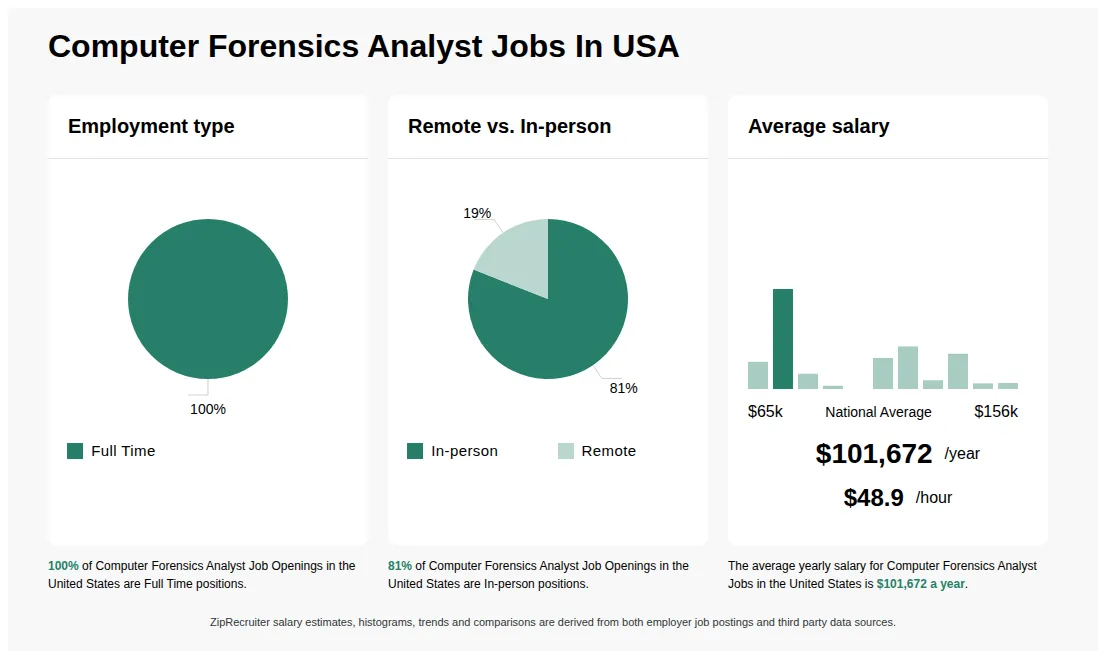
$65K - $73.3K
9% of jobs
$76.7K is the 25th percentile. Wages below this are outliers.
$73.3K - $81.5K
38% of jobs
The median wage is $86.5K / yr.
$81.5K - $89.8K
5% of jobs
$89.8K - $98.1K
1% of jobs
$98.1K - $106.4K
0% of jobs
$106.4K - $114.6K
11% of jobs
$120.2K is the 75th percentile. Wages above this are outliers.
$114.6K - $122.9K
16% of jobs
$122.9K - $131.2K
3% of jobs
$131.2K - $139.5K
13% of jobs
$139.5K - $147.7K
2% of jobs
$147.7K - $156K
2% of jobs
$65K
$101.7K
$156K
As a computer forensics analyst, your duties focus on investigating electronic data and digital devices for law enforcement purposes. Your responsibilities include obtaining, accessing, and analyzing data from hard drives, emails, smartphones, and tablets. In this career, you may investigate cyber crimes (which take place on the internet) or gather digital evidence for other types of criminal investigations. In addition to collecting information, you retrieve data that someone destroyed, deleted, or obscured to hide evidence of a crime. Computer forensic analysts work for law enforcement agencies, private contractors, lawyers, or corporations. Some computer experts work on a freelance basis.
| Aspect | Computer Forensics Analyst | Digital Forensics Specialist |
|---|---|---|
| Certifications | EnCE, GCFA | EnCE, GCFA |
| Work Environment | Law enforcement, corporate security, consulting firms | Law enforcement, government agencies, private sector |
| Industry Usage | Commonly used in investigations and legal cases | Used in incident response and cybersecurity investigations |
Both roles involve analyzing digital evidence, often requiring similar certifications like EnCE and GCFA. The main difference lies in their focus: Computer Forensics Analysts typically work on legal cases and investigations, while Digital Forensics Specialists often focus on incident response and cybersecurity threats. Both roles are vital in digital security and forensics fields, with overlapping skills and work environments.
Cities with the most Computer Forensics Analyst job openings:
The most popular types of Computer Forensics Analyst jobs are:
The top employers for Computer Forensics Analyst jobs are:
States with the most job openings for Computer Forensics Analyst jobs include:
For Computer Forensics Analyst jobs, the most frequently searched job titles are:

Indianapolis, IN • On-site, Remote
Full-time
Medical, Dental, Vision, Life, Retirement, PTO
Posted 4 days ago
9.0
Based on 14 frontline employees who took The Breakroom Quiz
29th of 499 rated machine equipment manufacturers
Job Title: Digital Forensics Analyst
Working Pattern: Fulltime - hybrid
Working location: Indianapolis, IN
Relocation assistance will be provided if applicable
Why Rolls-Royce?
At Rolls-Royce we are proud to be a business that has truly helped to shape the modern world and are committed to always being a force for progress; powering, protecting and connecting people everywhere.
By joining Rolls-Royce, you'll have the opportunity to create world-class power and propulsion solutions, pushing your problem-solving and ingenuity, to deliver real impact that puts safety first.
You'll be given responsibility and the opportunity to grow in our high-performance culture. This is Infinite Potential. And it's your chance to really shine and contribute to one of the world's most recognized brands and a beacon for engineering excellence.
Position Summary:
We are seeking a highly motivated DFIR Specialist to join our Purple Team. This role bridges offensive and defensive security operations by combining incident response, threat hunting, digital forensics, adversary emulation, and detection engineering.
The ideal candidate enjoys investigating real-world attacks, understanding adversary behavior, improving detection capabilities, and working collaboratively with red and blue teams to strengthen security posture.
What you will be doing:
Incident ResponseBasic Qualifications:
Preferred Qualifications:
Certifications:
Our vision is to ensure that the quality and dynamism that shaped our history continues into our future. It's a bold pursuit, and we never stop striving to go further, faster, and better. We lead progress, creating the technologies that move us forward. If you're driven to grow, to learn, and to make a lasting difference, this is where you belong.
Rolls-Royce is an Equal Opportunity Employer. All qualified applicants will receive consideration for employment without regard to any protected characteristics. We are committed to providing a respectful and non-discriminatory workplace where individuality is valued and everyone can thrive.
Infinite Potential
#CLOLI
#CLOPROF
Pay ranges for remote employees are based on the state where the employee resides and may vary from the posted range.
Location:
Benefits
Rolls-Royce provides a comprehensive and competitive Total Rewards package that includes base pay and a discretionary bonus plan. Eligible employees may have the opportunity to enroll in other benefits, including health, dental, vision, disability, life and accidental death & dismemberment insurance; a flexible spending account; a health savings account; a 401(k) retirement savings plan with a company match; Employee Assistance Program; Paid Time Off; certain paid holidays; paid parental and family care leave; tuition reimbursement; and a long-term incentive plan. The options available to an employee may vary depending on eligibility factors such as date of hire, employment type, and the applicability of collective bargaining agreements.
Get the full story on Breakroom

Sourced by ZipRecruiter
Aerospace product and parts manufacturing and engine, turbine, and power transmission equipment manufacturing
10,000+ Employees
London, ENG, GB