Title: RPA Business Analyst (UiPath) Location: Remote USA Experience: 5 8 Years Job Summary We are looking for an experienced RPA Business Analyst with strong UiPath experience to work with business ...
Title: RPA Business Analyst (UiPath) Location: Remote USA Experience: 5 8 Years Job Summary We are looking for an experienced RPA Business Analyst with strong UiPath experience to work with business ...
Financial Management Analyst- Robotics Process Automation (RPA) Developer
Falls Church, VA · On-site
$110 - $170/hr
The Financial Management Analyst- RPA Developer is responsible for the full lifecycle of RPA and ... Develop detailed business requirements, documents, and technical design specifications. * Evaluate ...
Financial Management Analyst- Robotics Process Automation (RPA) Developer
Falls Church, VA · On-site
$110 - $170/hr
The Financial Management Analyst- RPA Developer is responsible for the full lifecycle of RPA and ... Develop detailed business requirements, documents, and technical design specifications. * Evaluate ...

The Business Analyst (RPA & BOT Solutions) must understand TTI business processes, system interactions, data flows, and automation opportunities across assigned business areas. The Business Analyst ...
The Business Analyst (RPA & BOT Solutions) must understand TTI business processes, system interactions, data flows, and automation opportunities across assigned business areas. The Business Analyst ...
The Financial Management Analyst- RPA Developer is responsible for the full lifecycle of RPA and ... Develop detailed business requirements, documents, and technical design specifications. Evaluate ...
The Financial Management Analyst- RPA Developer is responsible for the full lifecycle of RPA and ... Develop detailed business requirements, documents, and technical design specifications. Evaluate ...
The Business Analyst (RPA & BOT Solutions) must understand TTI business processes, system interactions, data flows, and automation opportunities across assigned business areas. The Business Analyst ...
The Business Analyst (RPA & BOT Solutions) must understand TTI business processes, system interactions, data flows, and automation opportunities across assigned business areas. The Business Analyst ...
The Financial Management Analyst- RPA Developer is responsible for the full lifecycle of RPA and ... Develop detailed business requirements, documents, and technical design specifications. • ...
The Financial Management Analyst- RPA Developer is responsible for the full lifecycle of RPA and ... Develop detailed business requirements, documents, and technical design specifications. • ...
Financial Management Analyst- Robotics Process Automation (RPA) with Security Clearance
Falls Church, VA · On-site
The Financial Management Analyst- RPA Developer is responsible for the full lifecycle of RPA and ... Develop detailed business requirements, documents, and technical design specifications. • ...
Financial Management Analyst- Robotics Process Automation (RPA) with Security Clearance
Falls Church, VA · On-site
The Financial Management Analyst- RPA Developer is responsible for the full lifecycle of RPA and ... Develop detailed business requirements, documents, and technical design specifications. • ...
RPA Developer
Falls Church, VA · On-site
$90 - $140/hr
Financial Management Analyst- Robotics Process Automation (RPA) Developer Location: Falls Church ... Develop detailed business requirements, documents, and technical design specifications. * Evaluate ...
New
RPA Developer
Falls Church, VA · On-site
$90 - $140/hr
Financial Management Analyst- Robotics Process Automation (RPA) Developer Location: Falls Church ... Develop detailed business requirements, documents, and technical design specifications. * Evaluate ...
New

Automation Engineer (RPA)
Charlotte, NC · On-site
The RPA Engineer will be responsible for analyzing business processes, gathering requirements, translating them into technical specifications, and working closely with the RPA development team to ...
Automation Engineer (RPA)
Charlotte, NC · On-site
The RPA Engineer will be responsible for analyzing business processes, gathering requirements, translating them into technical specifications, and working closely with the RPA development team to ...
Automation Engineer (RPA)
Charlotte, NC · On-site
The RPA Engineer will be responsible for analyzing business processes, gathering requirements, translating them into technical specifications, and working closely with the RPA development team to ...
Automation Engineer (RPA)
Charlotte, NC · On-site
The RPA Engineer will be responsible for analyzing business processes, gathering requirements, translating them into technical specifications, and working closely with the RPA development team to ...
Sr. RPA Business Analyst
Irving, TX · On-site
$88K - $114K/yr
Role: Sr. RPA Business Analyst Location: Irving, TX - Fulltime Position Roles & Responsibilities * 5+ years of hands-on experience as a business analyst * Proficient in Agile methodology and ...
Sr. RPA Business Analyst
Irving, TX · On-site
$88K - $114K/yr
Role: Sr. RPA Business Analyst Location: Irving, TX - Fulltime Position Roles & Responsibilities * 5+ years of hands-on experience as a business analyst * Proficient in Agile methodology and ...

Senior Analyst for Robotic Process Automation technologies. Plays a critical role in building and ... Design, document, develop and execute test automation plans from business requirements. Coordinates ...
Senior Analyst for Robotic Process Automation technologies. Plays a critical role in building and ... Design, document, develop and execute test automation plans from business requirements. Coordinates ...

RPA Analyst
Tallahassee, FL · On-site
Work with business units to perform value analysis (ROI) for the processes. * Coordinate with the business units and the RPA team to identify and provide support for solution designs for production ...
RPA Analyst
Tallahassee, FL · On-site
Work with business units to perform value analysis (ROI) for the processes. * Coordinate with the business units and the RPA team to identify and provide support for solution designs for production ...
RPA Analyst
Tallahassee, FL · On-site
Work with business units to perform value analysis (ROI) for the processes.Coordinate with the business units and the RPA team to identify and provide support for solution designs for production ...
Quick apply
RPA Analyst
Tallahassee, FL · On-site
Work with business units to perform value analysis (ROI) for the processes.Coordinate with the business units and the RPA team to identify and provide support for solution designs for production ...
Role: RPA Business Analyst Location: Mountain View, CA (onsite) Duration: Long Term Contarct Experience: 12 - 16 years * Map current state business processes * Identify Business Process Re ...
Quick apply
Role: RPA Business Analyst Location: Mountain View, CA (onsite) Duration: Long Term Contarct Experience: 12 - 16 years * Map current state business processes * Identify Business Process Re ...

Automation Business Analyst (Remote)
Chicago, IL · On-site +1
The RPA Business Analyst works with Automation team and key stakeholders to create automated solutions for the business. The role is a key link between the technical team and the business ...
Automation Business Analyst (Remote)
Chicago, IL · On-site +1
The RPA Business Analyst works with Automation team and key stakeholders to create automated solutions for the business. The role is a key link between the technical team and the business ...

Intelligent Automation (AI & RPA): Implement intelligent automation of HR business processes using ... Further, they Analyze business processes, identify automation opportunities, support RPA/AI ...
Intelligent Automation (AI & RPA): Implement intelligent automation of HR business processes using ... Further, they Analyze business processes, identify automation opportunities, support RPA/AI ...

Business Analyst Specialist - Robotic Process Automation and AI
Groton, CT · On-site
$60K - $81K/yr
Overview A Supply Chain & Logistics Business Analyst is responsible for identifying, evaluating ... years robotic process automation (RPA) and/or Artificial Intelligence (AI) implementation ...
Business Analyst Specialist - Robotic Process Automation and AI
Groton, CT · On-site
$60K - $81K/yr
Overview A Supply Chain & Logistics Business Analyst is responsible for identifying, evaluating ... years robotic process automation (RPA) and/or Artificial Intelligence (AI) implementation ...

... business requirements. Security implementation, SLM/A setup and message monitoring. Troubleshooting with multistep probe, log analysis, network packet capture, XML capture and analysis * RPA ...
... business requirements. Security implementation, SLM/A setup and message monitoring. Troubleshooting with multistep probe, log analysis, network packet capture, XML capture and analysis * RPA ...
RPA Program Manager
Chicago, IL · On-site +1
The RPA Program Manager will interface with stakeholders throughout the enterprise to help drive the adoption of RPA. This role leads several teams, including business, analysis, RPA development, PMO ...
RPA Program Manager
Chicago, IL · On-site +1
The RPA Program Manager will interface with stakeholders throughout the enterprise to help drive the adoption of RPA. This role leads several teams, including business, analysis, RPA development, PMO ...
Business Analyst Robotic Process Automation information
See salary details
$51K - $59K
19% of jobs
$61.1K is the 25th percentile. Wages below this are outliers.
$59K - $67.1K
23% of jobs
The median wage is $69.8K / yr.
$67.1K - $75.1K
23% of jobs
$79.8K is the 75th percentile. Wages above this are outliers.
$75.1K - $83.2K
17% of jobs
$83.2K - $91.2K
4% of jobs
$91.2K - $99.3K
4% of jobs
$99.3K - $107.3K
3% of jobs
$107.3K - $115.4K
2% of jobs
$115.4K - $123.4K
1% of jobs
$123.4K - $131.5K
1% of jobs
$131.5K - $139.5K
2% of jobs
$51K
$78.6K
$139.5K
How much do business analyst robotic process automation jobs pay per year?
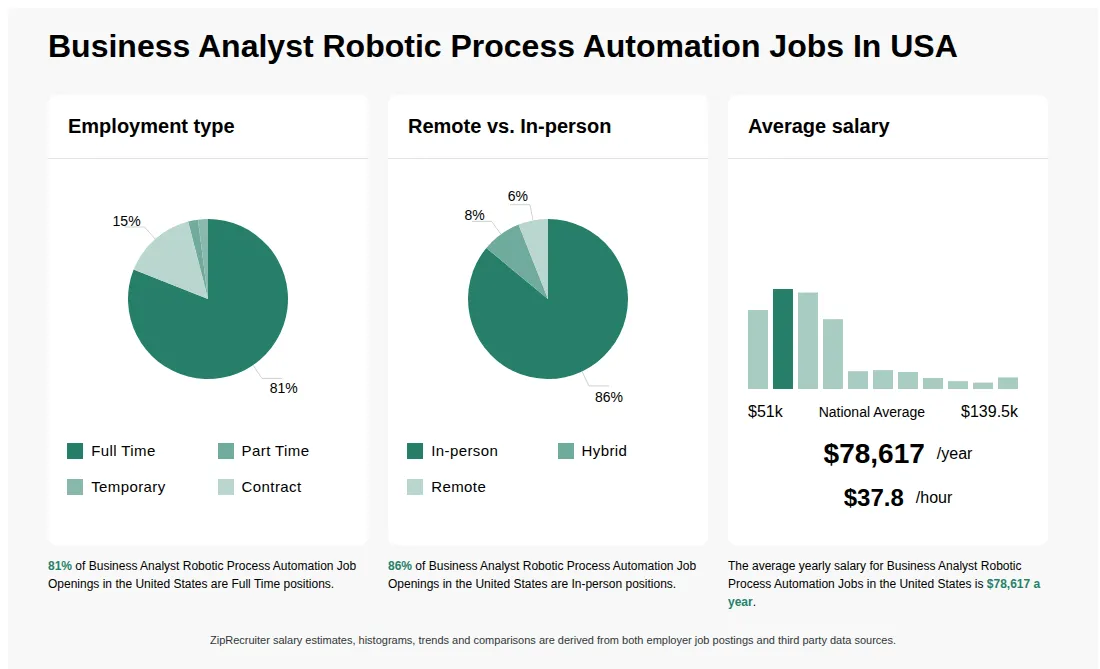
As of Sep 4, 2026, the average yearly pay for business analyst robotic process automation in the United States is $78,617.00, according to ZipRecruiter salary data. Most workers in this role earn between $61,000.00 and $82,000.00 per year, depending on experience, location, and employer.
What is a business analyst Robotic Process Automation (RPA)?
Business Analyst Robotic Process Automation (RPA) professionals are experts who bridge the gap between business operations and RPA technology solutions. They analyze business processes, identify automation opportunities, and design workflows that can be automated using RPA tools. These analysts work closely with stakeholders to gather requirements, document processes, and ensure that RPA implementations align with organizational goals. Their role is crucial in optimizing efficiency, reducing errors, and supporting digital transformation initiatives.
How does a business analyst Robotic Process Automation typically collaborate with technical and business teams during an RPA project?
A Business Analyst in Robotic Process Automation acts as a bridge between business stakeholders and the technical RPA development team. They gather and document process requirements from business users, identify automation opportunities, and translate these requirements into detailed specifications for the developers. Throughout the project, they facilitate communication, manage stakeholder expectations, and often assist with process testing and user training. This collaborative approach ensures that the automated solutions align with business goals and are implemented effectively.
What are the key skills and qualifications needed to thrive as a business analyst Robotic Process Automation (RPA), and why are they important?
To thrive as a Business Analyst in Robotic Process Automation, you need strong analytical skills, process mapping expertise, and a background in business or IT, often supported by a relevant degree. Familiarity with RPA tools like UiPath, Blue Prism, or Automation Anywhere, and certifications such as UiPath Certified RPA Business Analyst are highly valued. Excellent communication, problem-solving abilities, and stakeholder management are essential soft skills in this role. These competencies enable effective identification, documentation, and optimization of business processes, ensuring successful automation implementation and measurable business value.
What is the difference between Business Analyst Robotic Process Automation vs Business Analyst Data Analysis?
| Aspect | Business Analyst Robotic Process Automation | Business Analyst Data Analysis |
|---|---|---|
| Certifications | RPA certifications, Business Analysis certifications | Data analysis certifications, Business Analysis certifications |
| Work Environment | Automation projects, IT teams, process improvement | Data-driven projects, reporting, strategic planning |
| Industry Usage | Finance, healthcare, manufacturing, IT | Finance, marketing, retail, healthcare |
While both roles require strong business analysis skills, Business Analyst Robotic Process Automation focuses on implementing automation solutions using RPA tools, whereas Business Analyst Data Analysis emphasizes interpreting data to inform business decisions. The roles often overlap but differ mainly in their technical focus and project types.
More about Business Analyst Robotic Process Automation jobs
What job categories do people searching Business Analyst Robotic Process Automation jobs look for?
The top searched job categories for Business Analyst Robotic Process Automation jobs are:
Other
This job post has expired today. Applications are no longer accepted.
Job description
Title: RPA Business Analyst (UiPath)
Location: Remote USA
Experience: 5 8 Years
Job Summary
We are looking for an experienced RPA Business Analyst with strong UiPath experience to work with business teams and RPA development teams.
The candidate should have experience identifying automation opportunities, gathering requirements, and supporting end-to-end RPA implementations.
Responsibilities
- Work with business stakeholders to understand processes, pain points, and automation needs.
- Identify and evaluate processes suitable for RPA automation.
- Conduct process discovery and requirement-gathering sessions.
- Prepare PDDs, BRDs, process flows, and business requirements.
- Work closely with UiPath Developers and Solution Architects.
- Support UAT, testing, defect resolution, and production deployment.
- Document current and future-state processes.
- Communicate automation benefits and expected business outcomes.
- Support RPA governance and continuous process improvement.
Required Skills
- 8+ years of Business Analyst experience.
- 3+ years of experience in RPA projects.
- Strong hands-on experience with UiPath.
- Experience with end-to-end RPA implementations.
- Experience creating PDDs, BRDs, process maps, and UAT documentation.
- Strong process mapping and analytical skills.
- Experience working with business and technical teams.
- Excellent communication and stakeholder-management skills.
- Experience with Agile or Waterfall methodologies.
Preferred
- UiPath Business Analyst certification or UiPath Academy training.
- Experience with Process Mining, Task Mining, IDP, or AI automation.
- Experience in Banking, Insurance, Healthcare, Retail, Telecom, Utilities, or Shared Services.