1

Business Analyst Robotic Process Automation Jobs

UiPath, Blue Prism, IBM RPA, Microsoft Power Automate, etc. * Proven ability to collaborate with ... Support the process of translating business needs into formal technical requirement deliverables.

... RPA, ABBYY OCR, SharePoint, and Tableau SSOT reporting. The ideal candidate brings a product-owner mindset, strong business analysis capability, and the ability to influence across business and ...

New

Job Title: RPA Developer with Automation Anywhere exp Location: Pittsburgh, PA(Onsite) Job Type ... Should work closely with business analysts and stakeholders to identify automation opportunities ...

RPA UIpath

Saint Louis, MO ยท On-site

$93K - $128K/yr

RPA UiPath and Blueprism Mandatory Skills Design, develop, test, and deploy RPA solutions using ... Analyze and document business processes to identify automation opportunities. Collaborate with ...

Senior RPA Developer

Lincoln, NE ยท On-site

$47.50 - $62.75/hr

They collaborate with business analysts to gather system requirements, conduct independent research ... Senior RPA Developers engage directly with stakeholders at different organizational levels to ...

Position: RPA Developer Location : Remote Below JD/Skillset: Drive end-to-end testing for RPA ... Collaborate with developers, business analysts, and stakeholders to accurately validate ...

RPA Developer

San Diego, CA ยท Hybrid

$100K/yr

Lead collection, consolidation, and analysis activities to assess automation potential of current business processes and prepare clients for implementation * Develop, test, and deploy UiPath RPA ...

Analyze business processes to identify automation opportunities and recommend optimal RPA solutions * Develop reusable components and frameworks to accelerate automation delivery * Handle exception ...

RPA Analyst

Calhoun, GA ยท On-site

Job Objective: The RPA Analyst is an established performer who facilitates and supports the ... As the team advances its AI and business-intelligence capabilities, this role contributes to AI ...

Job Objective: The RPA Analyst is an established performer who facilitates and supports the ... As the team advances its AI and business-intelligence capabilities, this role contributes to AI ...

next page

Showing results 1-20

Business Analyst Robotic Process Automation information

See salary details

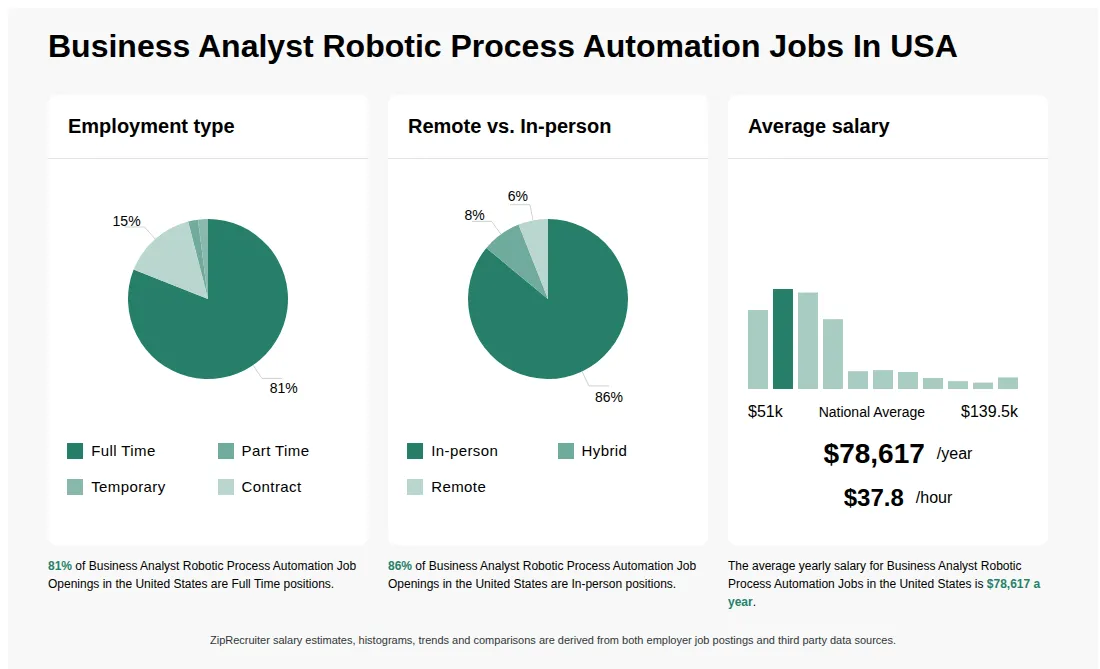
$51K

$78.6K

$139.5K

How much do business analyst robotic process automation jobs pay per year?

As of Jul 6, 2026, the average yearly pay for business analyst robotic process automation in the United States is $78,617.00, according to ZipRecruiter salary data. Most workers in this role earn between $61,000.00 and $82,000.00 per year, depending on experience, location, and employer.

What are the key skills and qualifications needed to thrive as a Business Analyst in Robotic Process Automation (RPA), and why are they important?

To thrive as a Business Analyst in Robotic Process Automation, you need strong analytical skills, process mapping expertise, and a background in business or IT, often supported by a relevant degree. Familiarity with RPA tools like UiPath, Blue Prism, or Automation Anywhere, and certifications such as UiPath Certified RPA Business Analyst are highly valued. Excellent communication, problem-solving abilities, and stakeholder management are essential soft skills in this role. These competencies enable effective identification, documentation, and optimization of business processes, ensuring successful automation implementation and measurable business value.

What are Business Analyst Robotic Process Automation (RPA) professionals?

Business Analyst Robotic Process Automation (RPA) professionals are experts who bridge the gap between business operations and RPA technology solutions. They analyze business processes, identify automation opportunities, and design workflows that can be automated using RPA tools. These analysts work closely with stakeholders to gather requirements, document processes, and ensure that RPA implementations align with organizational goals. Their role is crucial in optimizing efficiency, reducing errors, and supporting digital transformation initiatives.

What does a RPA business analyst do?

A Business Analyst in Robotic Process Automation (RPA) evaluates business processes to identify automation opportunities, gathers requirements, and collaborates with technical teams to design and implement RPA solutions. They also test, document, and ensure the automation aligns with business goals, often using tools like UiPath or Automation Anywhere.

How does a Business Analyst for Robotic Process Automation typically collaborate with technical and business teams during an RPA project?

A Business Analyst in Robotic Process Automation acts as a bridge between business stakeholders and the technical RPA development team. They gather and document process requirements from business users, identify automation opportunities, and translate these requirements into detailed specifications for the developers. Throughout the project, they facilitate communication, manage stakeholder expectations, and often assist with process testing and user training. This collaborative approach ensures that the automated solutions align with business goals and are implemented effectively.

Is RPA still in demand?

Robotic Process Automation (RPA) remains in high demand for Business Analysts specializing in automation, as organizations continue to adopt RPA tools like UiPath, Automation Anywhere, and Blue Prism to improve efficiency. The role often requires knowledge of process analysis, scripting, and workflow design, with job growth driven by digital transformation initiatives across industries.

Will AI replace RPA?

As a Business Analyst specializing in Robotic Process Automation (RPA), AI is seen as a complement rather than a replacement. AI enhances RPA capabilities by enabling more complex decision-making and cognitive tasks, but human oversight and process analysis remain essential for successful automation projects.

What is the difference between Business Analyst Robotic Process Automation vs Business Analyst Data Analysis?

AspectBusiness Analyst Robotic Process AutomationBusiness Analyst Data Analysis
CertificationsRPA certifications, Business Analysis certificationsData analysis certifications, Business Analysis certifications
Work EnvironmentAutomation projects, IT teams, process improvementData-driven projects, reporting, strategic planning
Industry UsageFinance, healthcare, manufacturing, ITFinance, marketing, retail, healthcare

While both roles require strong business analysis skills, Business Analyst Robotic Process Automation focuses on implementing automation solutions using RPA tools, whereas Business Analyst Data Analysis emphasizes interpreting data to inform business decisions. The roles often overlap but differ mainly in their technical focus and project types.

How much do robotic process automation specialists make?

Robotic Process Automation (RPA) specialists typically earn between $70,000 and $120,000 annually, depending on experience, location, and certifications. Entry-level roles may start around $60,000, while experienced professionals with advanced skills in tools like UiPath or Automation Anywhere can earn higher salaries.
More about Business Analyst Robotic Process Automation jobs
What are the most commonly searched types of Business Analyst Robotic Process Automation jobs? The most popular types of Business Analyst Robotic Process Automation jobs are:
What job categories do people searching Business Analyst Robotic Process Automation jobs look for? The top searched job categories for Business Analyst Robotic Process Automation jobs are:
AI Systems Analyst

AI Systems Analyst

CEDENT

Charlotte, NC โ€ข On-site

Contractor

Posted 25 days ago


Job description


AI ANALYST (BPA/AI) REQUIREMENETS:
  • Ideally possess 5+ years of professional experience working as a techno-functional  Analyst throughout their career while possessing recent experience implementing AI tools into a call-center/contact-center environment.
  • Knowledge of Large Language Models (LLM) - primarily seen within a customer service/call-center environment.
  • Must have either hands on experience of functional experience supporting/implementing Robotic Process Automation (RPA) tools including but not limited to: UiPath, Blue Prism, IBM RPA, Microsoft Power Automate, etc.
  • Proven ability to collaborate with cross functional teams, gathering user requirements, documenting processes, suggesting process improvements, and communicating evidence for implementing improvements to higher level management teams.
  • Exudes personable communication skills while being motivated to learn and grow.
  • Local to Charlotte, NC or open to relocating within 2 weeks after acceptance.
 
PLUS SKILLS:
  • Previous Call Center/Contact Center RPA and AI implementation project experience ideally within the Telecommunications industry.
 
AI ANALYST (RPA/AI) RESPONSIBILITIES:
  • Review, analyze, and evaluate information technology systems operations to understand where efficiencies can be implemented to create improvements to the overall customer experience.
  • Determine user needs and requirements and recommend ways to improve RPA systems specifically by implementing the right AI tool/technology that will fill the gaps that are currently missing.
  • Review current manual processes, identify what can be automated using AI tools, and support teams to implement automated processes from a technical perspective by driving timelines throughout the produce lifecycle.
  • Serve as the primary point of contact between users and engineering/development staff
  • Support the process of translating business needs into formal technical requirement deliverables.

Cedent logo

About Cedent

Sourced by ZipRecruiter

CEDENT strives to attract and retain the best people and provide an environment where they can all develop professionally and build a rewarding career. As a result, we create an inclusive environment that is rich in diversity, acknowledges each individual's uniqueness and promotes respect, personal achievement and stewardship. Our clients are global and so is CEDENT. We build and maintain a global workforce that includes people from different backgrounds, with a vast range of skills and experience all united by a common culture and commitment to help our clients achieve high performance. Cultivating a diverse workforce and inclusive work environment makes business sense. Our peoples varied skills are the talent engine that powers CEDENT, enabling it in turn to deliver the innovative solutions that help our clients outperform competitors.

Industry

It services

Company size

11 - 50 Employees

Headquarters location

Plano, TX, US

Year founded

2008