The Building People, LLC, has a position open for a Building Maintenance Engineer to provide facilities support of the Transportation Security Administration in the Alexandria and Herndon Virginia ...
The Building People, LLC, has a position open for a Building Maintenance Engineer to provide facilities support of the Transportation Security Administration in the Alexandria and Herndon Virginia ...
The Building People, LLC, has a position open for a Building Maintenance Engineer to provide facilities support of the Transportation Security Administration in the Alexandria and Herndon Virginia ...
The Building People, LLC, has a position open for a Building Maintenance Engineer to provide facilities support of the Transportation Security Administration in the Alexandria and Herndon Virginia ...
The Building People, LLC, has a position open for a Building Maintenance Engineer to provide facilities support of the Transportation Security Administration in the Alexandria and Herndon Virginia ...
Quick apply
The Building People, LLC, has a position open for a Building Maintenance Engineer to provide facilities support of the Transportation Security Administration in the Alexandria and Herndon Virginia ...
The Building People, LLC, has a position open for a Building Maintenance Engineer to provide facilities support of the Transportation Security Administration in the Alexandria and Herndon Virginia ...
The Building People, LLC, has a position open for a Building Maintenance Engineer to provide facilities support of the Transportation Security Administration in the Alexandria and Herndon Virginia ...

Building Maintenance Engineer
Austin, TX · On-site
$28 - $35/hr
The Building Maintenance Engineer performs skilled work in the operation, minor maintenance and of boilers, chillers, HVAC equipment, compressors, instrumentation, generators, pumps, heating, air ...
Building Maintenance Engineer
Austin, TX · On-site
$28 - $35/hr
The Building Maintenance Engineer performs skilled work in the operation, minor maintenance and of boilers, chillers, HVAC equipment, compressors, instrumentation, generators, pumps, heating, air ...
... maintenance engineer to ensure that all of our visitors have an excellent experience at our property. You'll be in charge of the building's maintenance and preventative programs daily to ensure ...
... maintenance engineer to ensure that all of our visitors have an excellent experience at our property. You'll be in charge of the building's maintenance and preventative programs daily to ensure ...
... maintenance engineer to ensure that all of our visitors have an excellent experience at our property. You'll be in charge of the building's maintenance and preventative programs daily to ensure ...
... maintenance engineer to ensure that all of our visitors have an excellent experience at our property. You'll be in charge of the building's maintenance and preventative programs daily to ensure ...
... maintenance engineer to ensure that all of our visitors have an excellent experience at our property. You'll be in charge of the building's maintenance and preventative programs daily to ensure ...
... maintenance engineer to ensure that all of our visitors have an excellent experience at our property. You'll be in charge of the building's maintenance and preventative programs daily to ensure ...

Our busy hotel is seeking an energetic, customer-oriented maintenance engineer to ensure that all of our visitors have an excellent experience at our property. You'll be in charge of the building ...
Quick apply
Our busy hotel is seeking an energetic, customer-oriented maintenance engineer to ensure that all of our visitors have an excellent experience at our property. You'll be in charge of the building ...

Performs a variety of building maintenance and repair tasks. Complete projects requiring light carpentry, minor building repairs and assists with the upkeep of the buildings. Works with in-house ...
Performs a variety of building maintenance and repair tasks. Complete projects requiring light carpentry, minor building repairs and assists with the upkeep of the buildings. Works with in-house ...
Our busy hotel is seeking an energetic, customer-oriented maintenance engineer to ensure that all of our visitors have an excellent experience at our property. You'll be in charge of the building ...
Quick apply
Our busy hotel is seeking an energetic, customer-oriented maintenance engineer to ensure that all of our visitors have an excellent experience at our property. You'll be in charge of the building ...

Building Maintenance Engineer
Webster, NY · On-site
$36.96/hr
Building Maintenance Engineer - JLL What this job involves: JLL is seeking a skilled Building Maintenance Engineer to join our team in Webster, NY. This position performs critical maintenance, repair ...
Building Maintenance Engineer
Webster, NY · On-site
$36.96/hr
Building Maintenance Engineer - JLL What this job involves: JLL is seeking a skilled Building Maintenance Engineer to join our team in Webster, NY. This position performs critical maintenance, repair ...
Building Maintenance Engineer
Webster, NY · On-site
$36.96/hr
Building Maintenance Engineer - JLL What this job involves: JLL is seeking a skilled Building Maintenance Engineer to join our team in Webster, NY. This position performs critical maintenance, repair ...
Building Maintenance Engineer
Webster, NY · On-site
$36.96/hr
Building Maintenance Engineer - JLL What this job involves: JLL is seeking a skilled Building Maintenance Engineer to join our team in Webster, NY. This position performs critical maintenance, repair ...

Building Maintenance Engineer
Baltimore, MD · On-site
$30 - $40/hr
Minimum two (2) year of commercial building maintenance experience. * Maryland Stationary Engineer Grade 3 License. * Working knowledge of HVAC, electrical, plumbing, and mechanical systems.
Building Maintenance Engineer
Baltimore, MD · On-site
$30 - $40/hr
Minimum two (2) year of commercial building maintenance experience. * Maryland Stationary Engineer Grade 3 License. * Working knowledge of HVAC, electrical, plumbing, and mechanical systems.
Building Maintenance Engineer
Baltimore, MD · On-site
$30 - $40/hr
Minimum two (2) year of commercial building maintenance experience. * Maryland Stationary Engineer Grade 3 License. * Working knowledge of HVAC, electrical, plumbing, and mechanical systems.
Building Maintenance Engineer
Baltimore, MD · On-site
$30 - $40/hr
Minimum two (2) year of commercial building maintenance experience. * Maryland Stationary Engineer Grade 3 License. * Working knowledge of HVAC, electrical, plumbing, and mechanical systems.

Previous maintenance, engineering, facilities, hotel maintenance, painting, plumbing, HVAC, or building operations experience preferred. * Basic knowledge of general maintenance, plumbing, painting ...
Previous maintenance, engineering, facilities, hotel maintenance, painting, plumbing, HVAC, or building operations experience preferred. * Basic knowledge of general maintenance, plumbing, painting ...

The Building Engineer is responsible for completing work orders, grounds maintenance, painting, caulking, HVAC, plumbing, drywall, electrical and completing maintenance on buildings as needed. The ...
The Building Engineer is responsible for completing work orders, grounds maintenance, painting, caulking, HVAC, plumbing, drywall, electrical and completing maintenance on buildings as needed. The ...

Building Maintenance Engineer
Daphne, AL · On-site
Position Type: Full-Time | Engineering & Maintenance Start Date: ASAP (We're ready when you are ... Monitor and operate building systems (HVAC, lighting, elevators, etc.) * Perform preventive ...
Building Maintenance Engineer
Daphne, AL · On-site
Position Type: Full-Time | Engineering & Maintenance Start Date: ASAP (We're ready when you are ... Monitor and operate building systems (HVAC, lighting, elevators, etc.) * Perform preventive ...
The Building Engineer is responsible for completing work orders, grounds maintenance, painting, caulking, HVAC, plumbing, drywall, electrical and completing maintenance on buildings as needed. The ...
The Building Engineer is responsible for completing work orders, grounds maintenance, painting, caulking, HVAC, plumbing, drywall, electrical and completing maintenance on buildings as needed. The ...
Building Maintenance Engineer
$28 - $35/hr
The Building Maintenance Engineer performs skilled work in the operation, minor maintenance and of boilers, chillers, HVAC equipment, compressors, instrumentation, generators, pumps, heating, air ...
Building Maintenance Engineer
$28 - $35/hr
The Building Maintenance Engineer performs skilled work in the operation, minor maintenance and of boilers, chillers, HVAC equipment, compressors, instrumentation, generators, pumps, heating, air ...
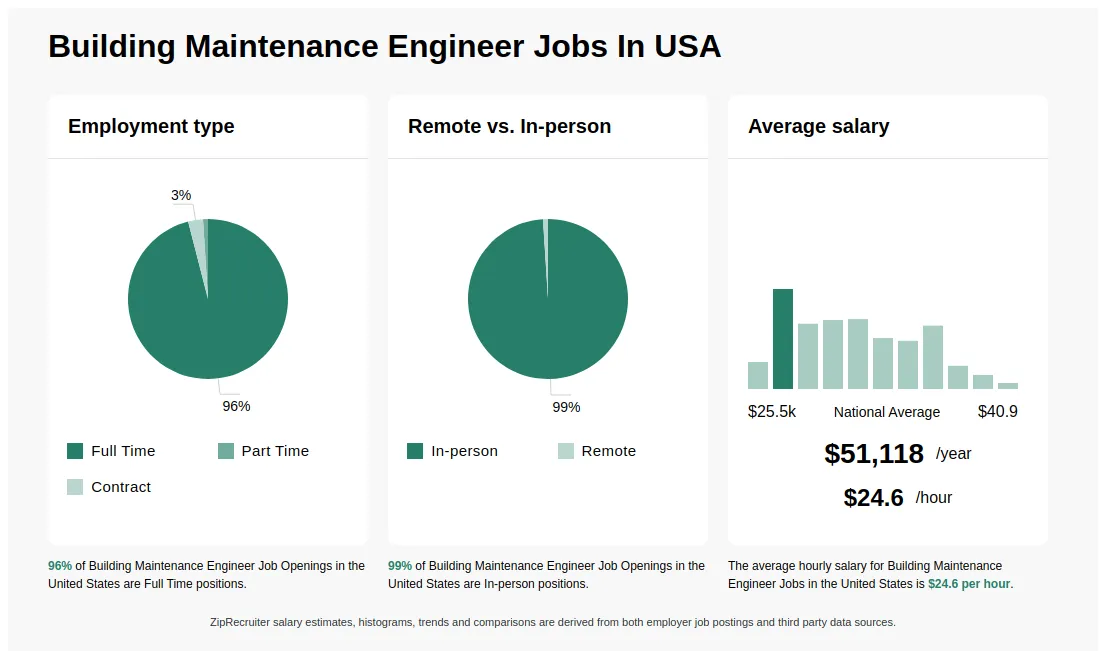
Building Maintenance Engineer information
See salary details
$12.26 - $14.86
5% of jobs
$14.86 - $17.46
19% of jobs
$17.62 is the 25th percentile. Wages below this are outliers.
$17.46 - $20.06
13% of jobs
$20.06 - $22.66
13% of jobs
The median wage is $22.76 / hr.
$22.66 - $25.26
14% of jobs
$25.26 - $27.86
9% of jobs
$28.59 is the 75th percentile. Wages above this are outliers.
$27.86 - $30.46
8% of jobs
$30.46 - $33.06
12% of jobs
$33.06 - $35.66
4% of jobs
$35.66 - $38.26
2% of jobs
$38.26 - $40.87
1% of jobs
$12
$24
$40
How much do building maintenance engineer jobs pay per hour?
As of Sep 13, 2026, the average hourly pay for building maintenance engineer in the United States is $24.58, according to ZipRecruiter salary data. Most workers in this role earn between $17.79 and $30.29 per hour, depending on experience, location, and employer.
What is a building maintenance engineer?
Building maintenance engineers are professionals responsible for ensuring the proper functioning, safety, and efficiency of a building's systems and infrastructure. Their duties typically include inspecting, repairing, and maintaining heating, ventilation, air conditioning (HVAC), plumbing, electrical systems, and other mechanical equipment. They also address routine maintenance tasks, handle emergency repairs, and help implement energy-saving measures. Building maintenance engineers play a critical role in keeping commercial, residential, or industrial facilities operating smoothly and safely.
What does a building maintenance engineer do?
Building maintenance engineers, also known as building maintenance technicians or building mechanics, maintain the structure and systems of a building, such as plumbing, electrical, and air conditioning systems. They work in large buildings, schools, hospitals, and other organizations that have extensive facilities. In this role, you repair or replace equipment, perform regular checks on all systems running through the building, and ensure common areas are clean. Despite the name, this is not an engineering position as most people understand the term. Engineers usually design and build systems, while building maintenance personnel focus on maintaining systems that already exist in a building.
What are the key skills and qualifications needed to thrive as a building maintenance engineer, and why are they important?
To thrive as a Building Maintenance Engineer, you need a solid understanding of HVAC, electrical, plumbing, and mechanical systems, typically backed by a relevant technical diploma or certifications such as EPA or HVAC certification. Experience with building automation systems (BAS), computerized maintenance management systems (CMMS), and power tools is often required. Strong problem-solving skills, attention to detail, and effective communication abilities help engineers respond quickly to issues and coordinate with building occupants or vendors. These skills ensure the safe, efficient, and reliable operation of building facilities, minimizing downtime and costly repairs.
What are some common challenges building maintenance engineers face when managing multiple facilities?
Building Maintenance Engineers often juggle the upkeep of several facilities, which can present challenges such as prioritizing urgent repairs, scheduling preventative maintenance, and coordinating with different departments. Effective time management and clear communication are essential, as engineers need to quickly assess and address equipment failures while minimizing downtime. Familiarity with a wide variety of building systems and adaptability to different environments also help ensure smooth operations across all sites.
What is the difference between Building Maintenance Engineer vs Facility Technician?
| Aspect | Building Maintenance Engineer | Facility Technician |
|---|---|---|
| Certifications | HVAC, electrical, plumbing licenses, technical certifications | HVAC, electrical, plumbing certifications |
| Work Environment | Commercial, industrial, residential buildings | Commercial, industrial, residential facilities |
| Job Responsibilities | Maintains building systems, troubleshooting, repairs | Performs repairs, preventive maintenance, system checks |
| Industry Usage | Real estate, property management, facilities management | Facilities management, property services |
Building Maintenance Engineers and Facility Technicians share similar roles in maintaining building systems, but Building Maintenance Engineers often have more advanced certifications and handle complex systems. Facility Technicians focus on routine repairs and preventive maintenance. Both roles are essential in ensuring building safety and functionality within various industries.
More about Building Maintenance Engineer jobs
What cities are hiring for Building Maintenance Engineer jobs?
Cities with the most Building Maintenance Engineer job openings:
Who are the top companies hiring for Building Maintenance Engineer jobs?
The top employers for Building Maintenance Engineer jobs are:
What states have the most Building Maintenance Engineer jobs?
States with the most job openings for Building Maintenance Engineer jobs include:
What are popular job titles related to Building Maintenance Engineer jobs?
For Building Maintenance Engineer jobs, the most frequently searched job titles are:

Building Maintenance Engineer
Arlington, VA
The Building People
• Facilities Support Services • 51 - 200 employees51 - 200 employees
Full-time
Re-posted 5 days ago
Job description
The Building People, LLC, has a position open for a Building Maintenance Engineer to provide facilities support of the Transportation Security Administration in the Alexandria and Herndon Virginia area.
Responsibilities/Duties
The Building Maintenance Engineer shall:
- Possess facilities technician experience directly dealing with and operating commercial level Mission Critical facilities electrical, mechanical, plumbing, HVAC, HAZMAT and planned preventative maintenance systems and sub-systems; or Equivalent qualifications.
- Possess knowledge of fire codes (e.g. Federal, state, local and MWAA standards), Health and safety (OSHA) and building codes (e.g. Uniform Building Codes and International Building Codes);
- Have the ability to read, interpret and act according to building/plant blueprints/schematic drawings;
- Possess basic computer skills and the ability or aptitude to operate “building control” computer operated programs/software.

About Building People
Sourced by ZipRecruiter
Industry
Facilities support services
Company size
51 - 200 Employees
Headquarters location
Leesburg, VA, US
Year founded
2012