1

Biomedical Field Service Engineer Jobs (NOW HIRING)

Description The Field Service Engineer I installs, troubleshoots, repairs, calibrates, and performs ... Biomedical equipment or medical device experience. * Military technical experience (Electronics ...

Field Service Engineer - PET/CT Imaging Systems Full-Time | Monday-Friday | Occasional Evenings ... Associate's or Bachelor's degree in biomedical engineering, electronics, or related technical field.

Description The Field Service Engineer provides technical service and support for the installation ... Military technical background (electronics, biomedical, or electro-mechanical) Medical and dental ...

IDD Field Service Engineers (FSEs) provide exceptional on-site service on highly complex and ... Experience • Experience in related life sciences, biomedical engineering and/or technical ...

X-ray Field Service Engineer

Houston, TX · On-site +1

$80K - $110K/yr

Job Summary X-ray Field Service Engineer Location: Houston, TX (Full-time, Permanent) Salary: $80 ... Biomedical or Electronics Technology preferred • Strong skills in diagnostics, schematics ...

Description: Reporting to the Area Service Manager, the Field Service Engineer (FSE) performs ... Degree in electronics, biomedical engineering, biomedical technology, electrical engineering or ...

Description The Field Service Engineer I installs, troubleshoots, repairs, calibrates, and performs ... Biomedical equipment or medical device experience. * Military technical experience (electronics ...

X-ray Field Service Engineer

Omaha, NE · On-site

$80K - $100K/yr

Job Summary X-ray Field Service Engineer Location: Omaha, NE (Full-time, Permanent) Salary ... You will work closely with radiology, biomedical, and site leadership to resolve issues efficiently ...

Description Reporting to the Area Service Manager, the Field Service Engineer (FSE) performs ... Degree in electronics, biomedical engineering, biomedical technology, electrical engineering or ...

Provides guidance to Customers to include hospital Biomedical engineers along with Field Service Technicians and/or Representatives and assists when customer satisfaction issues arise. * Provide ...

Provides guidance to Customers to include hospital Biomedical engineers along with Field Service Technicians and/or Representatives and assists when customer satisfaction issues arise. * Provide ...

Provides guidance to Customers to include hospital Biomedical engineers along with Field Service Technicians and/or Representatives and assists when customer satisfaction issues arise. * Provide ...

next page

Showing results 1-20

Biomedical Field Service Engineer information

See salary details

$18

$34

$47

How much do biomedical field service engineer jobs pay per hour?

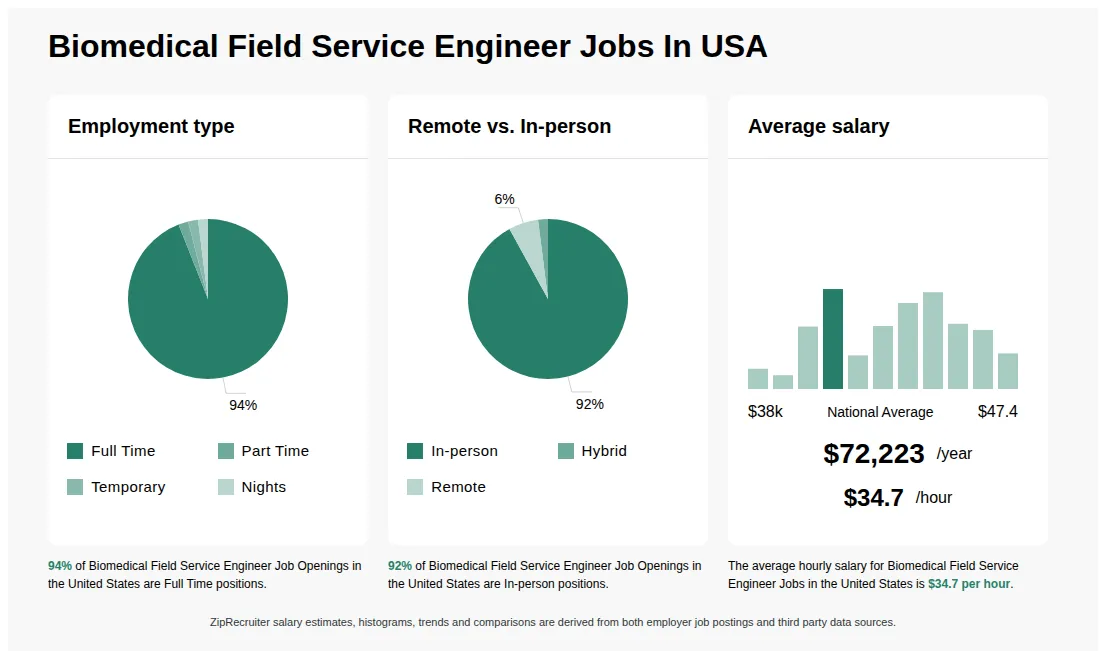
As of Jun 29, 2026, the average hourly pay for biomedical field service engineer in the United States is $34.72, according to ZipRecruiter salary data. Most workers in this role earn between $27.64 and $40.38 per hour, depending on experience, location, and employer.

Is it worth becoming a BMET?

A Biomedical Field Service Engineer (BMET) maintains and repairs medical equipment in healthcare settings, often requiring technical skills and certifications such as the CBET. The role offers stable employment, competitive pay, and opportunities for advancement, making it a worthwhile career for those interested in healthcare technology and problem-solving.

What does a Biomedical Field Service Engineer do?

A Biomedical Field Service Engineer is responsible for installing, maintaining, and repairing medical equipment used in healthcare facilities. They ensure that devices such as MRI machines, ventilators, and patient monitors operate safely and efficiently. These engineers often travel to different hospitals or clinics to provide on-site technical support, perform equipment calibration, and train medical staff on proper usage. Their work helps minimize equipment downtime and ensures compliance with safety standards.

What engineers make $500,000?

Highly experienced biomedical field service engineers working in specialized areas, such as advanced medical imaging or research equipment, can reach salaries around $500,000, especially with extensive certifications, management roles, or working in high-demand environments. Achieving this level often requires years of experience, advanced technical skills, and sometimes leadership responsibilities.

What is the difference between Biomedical Field Service Engineer vs Medical Equipment Technician?

AspectBiomedical Field Service EngineerMedical Equipment Technician
CredentialsTypically requires a degree in biomedical engineering or related field; certifications like BME or OEM-specific trainingUsually requires a certificate or associate degree in biomedical technology or related field
Work EnvironmentServes hospitals, clinics, and medical device companies; often travels to client sitesWorks mainly in healthcare facilities or repair shops, focusing on maintenance and repairs
Employer & IndustryMedical device manufacturers, healthcare providers, biomedical service companiesHospitals, clinics, biomedical service providers

The Biomedical Field Service Engineer and Medical Equipment Technician roles share similar credentials and work environments, focusing on maintaining and repairing medical devices. However, the engineer often handles more complex systems and may be involved in installation and troubleshooting at a higher technical level, while technicians focus on routine maintenance and repairs.

What does a biomedical service engineer do?

A biomedical service engineer installs, maintains, repairs, and calibrates medical equipment used in healthcare settings. They troubleshoot technical issues, ensure devices meet safety standards, and often work with clinical staff to ensure equipment functions properly for patient care. Certification and technical knowledge of medical devices are typically required for this role.

What are the key skills and qualifications needed to thrive as a Biomedical Field Service Engineer, and why are they important?

To thrive as a Biomedical Field Service Engineer, you need a solid background in biomedical engineering or electronics, often supported by a relevant degree or certification. Familiarity with diagnostic equipment, troubleshooting software, and compliance with industry standards like FDA or ISO is typically required. Strong problem-solving abilities, clear communication, and customer service skills help you excel in client-facing situations and urgent repairs. These competencies ensure medical equipment is reliably maintained, supporting patient safety and healthcare efficiency.

What are some common challenges Biomedical Field Service Engineers face when servicing medical equipment in clinical environments?

Biomedical Field Service Engineers often encounter challenges such as working in high-pressure clinical environments where equipment must be repaired quickly to minimize downtime and ensure patient safety. Navigating complex hospital protocols, coordinating with medical staff, and adapting to rapidly changing schedules are common aspects of the role. Engineers may also need to stay updated on various equipment models and regulatory standards, requiring continuous learning and strong problem-solving skills. Successful engineers are those who communicate effectively with hospital staff and prioritize both technical excellence and patient care.

What Is a Biomedical Field Service Engineer?

A biomedical field service engineer is a trained engineer who travels to medical facilities, labs, and other locations to service, install, and repair biomedical engineering equipment. In this career, your duties include setting up and repairing medical devices, sterilizing tools, responding to service calls from your customers, and resolving issues with equipment by either repairing the device on the spot or taking it to a workshop where technicians and engineers can further diagnose the issues. You should have excellent technical and mechanical aptitude and strong customer service skills.

What is the role of a biomedical field service engineer?

A biomedical field service engineer is responsible for installing, maintaining, repairing, and calibrating medical equipment used in healthcare settings. They troubleshoot technical issues, ensure devices meet safety standards, and often work on-site at hospitals or clinics, requiring technical skills and relevant certifications. Their work helps ensure medical devices operate reliably for patient care.
What cities are hiring for Biomedical Field Service Engineer jobs? Cities with the most Biomedical Field Service Engineer job openings:
Who are the top companies hiring for Biomedical Field Service Engineer jobs? The top employers for Biomedical Field Service Engineer jobs are:
What states have the most Biomedical Field Service Engineer jobs? States with the most job openings for Biomedical Field Service Engineer jobs include:
Field Service Engineer I

Field Service Engineer I

Orion Talent

San Diego, CA • On-site

$27/hr

Full-time

Posted 4 days ago


Job description

Description
The Field Service Engineer I installs, troubleshoots, repairs, calibrates, and performs preventative maintenance on advanced medical equipment used in hospitals, laboratories, and healthcare facilities throughout the assigned territory.
This role is ideal for mechanically and electrically inclined technicians who enjoy working independently, solving technical problems, traveling, and providing excellent customer service. Comprehensive factory training is provided, making this an excellent opportunity for military veterans and technicians transitioning into the medical device industry.
Key Responsibilities
  • Install, troubleshoot, repair, and maintain medical equipment at customer locations.
  • Perform preventative maintenance, equipment upgrades, recalls, and Field Modification Instructions (FMIs).
  • Calibrate, test, and verify equipment performance to manufacturer specifications.
  • Install software updates, firmware revisions, and warranty repairs on maternal infant care equipment.
  • Document repairs, parts usage, and service activity using ServiceMax.
  • Travel throughout the assigned territory to complete scheduled service calls.
  • Provide professional technical support while building strong customer relationships.
  • Utilize diagnostic equipment, hand tools, and manufacturer service procedures.
  • Coordinate with dispatch and technical support teams to complete work orders efficiently.
  • Maintain company quality, safety, and documentation standards.

Must-Have Skills, Experience & Education
  • High school diploma or equivalent required.
  • Associate degree, military technical training, or trade school certification preferred.
  • One of the following:
    • 2-4 years of field service, industrial maintenance, electronics, mechanical repair, biomedical equipment, military technical, or similar technical experience.
    • Associate degree or technical certification with at least one year of hands-on technical experience (internships and apprenticeships accepted).
  • Strong mechanical and electrical troubleshooting aptitude.
  • Ability to read and interpret technical manuals, service documentation, and equipment procedures.
  • Excellent customer service and communication skills.
  • Strong organizational skills with the ability to work independently.
  • Valid driver's license.
  • Ability to operate personal or rental vehicles.
  • Proof of automobile liability insurance.
  • Willingness to travel extensively throughout the assigned territory.

Nice-to-Have Skills, Experience & Education
  • Biomedical equipment or medical device experience.
  • Military technical experience (Electronics, Biomedical, Avionics, Communications, Nuclear, Maintenance, etc.).
  • Preventative maintenance and calibration experience.
  • Experience troubleshooting electrical, mechanical, electromechanical, or electronic systems.
  • Experience using ServiceMax or CMMS software.
  • Customer-facing field service experience.
  • Strong problem-solving skills and willingness to learn new technologies.
  • Interest in building a long-term career in healthcare technology.

Ideal Military Backgrounds
  • Army 68A Biomedical Equipment Specialist
  • Army 94 Series Electronics Maintenance
  • Navy Electronics Technician (ET)
  • Navy Electrician's Mate (EM)
  • Navy Interior Communications Electrician (IC)
  • Navy Hospital Corpsman (Biomedical Equipment)
  • Air Force Biomedical Equipment Technician (4A2X1)
  • Air Force Avionics
  • Marine Corps Electronics Maintenance
  • Coast Guard Electronics Technician

Why This Opportunity?
  • Excellent opportunity to enter the growing medical device industry.
  • Extensive paid technical and manufacturer training.
  • Strong overtime earning potential.
  • Independent, customer-facing field service role.
  • Company-paid travel expenses.
  • All tools, diagnostic equipment, and technology provided.
  • Long-term career growth within healthcare technology.
  • Excellent fit for military technicians transitioning into civilian field service careers.