Completion of a biomedical engineering technician or Healthcare Technology Management (HTM) certificate program that included an internship or apprenticeship; OR * Completion of biomedical ...
Completion of a biomedical engineering technician or Healthcare Technology Management (HTM) certificate program that included an internship or apprenticeship; OR * Completion of biomedical ...
Biomedical Equipment Support Specialist
Anchorage, AK · On-site
$46K/yr
Completion of a biomedical engineering technician or Healthcare Technology Management (HTM) certificate program that included an internship or apprenticeship; OR * Completion of biomedical ...
Biomedical Equipment Support Specialist
Anchorage, AK · On-site
$46K/yr
Completion of a biomedical engineering technician or Healthcare Technology Management (HTM) certificate program that included an internship or apprenticeship; OR * Completion of biomedical ...
Completion of a biomedical engineering technician or Healthcare Technology Management (HTM) certificate program that included an internship or apprenticeship; OR * Completion of biomedical ...
Completion of a biomedical engineering technician or Healthcare Technology Management (HTM) certificate program that included an internship or apprenticeship; OR * Completion of biomedical ...
Completion of a biomedical engineering technician or Healthcare Technology Management (HTM) certificate program that included and internship or apprenticeship; OR * Completion of a biomedical ...
Completion of a biomedical engineering technician or Healthcare Technology Management (HTM) certificate program that included and internship or apprenticeship; OR * Completion of a biomedical ...
Biomedical Equipment Support Specialist (Imaging)
Fayetteville, NC · On-site
$106K/yr
Completion of a biomedical engineering technician or Healthcare Technology Management (HTM) certificate program that included an internship or apprenticeship; OR * Completion of biomedical ...
Biomedical Equipment Support Specialist (Imaging)
Fayetteville, NC · On-site
$106K/yr
Completion of a biomedical engineering technician or Healthcare Technology Management (HTM) certificate program that included an internship or apprenticeship; OR * Completion of biomedical ...
Completion of a biomedical engineering technician or Healthcare Technology Management (HTM) certificate program that included an internship or apprenticeship; OR * Completion of biomedical ...
Completion of a biomedical engineering technician or Healthcare Technology Management (HTM) certificate program that included an internship or apprenticeship; OR * Completion of biomedical ...
Lead Biomedical Equipment Support Specialist
Fargo, ND · On-site
$89K/yr
Completion of a biomedical engineering technician or Healthcare Technology Management (HTM) certificate program that included an internship or apprenticeship; OR * Completion of biomedical ...
Lead Biomedical Equipment Support Specialist
Fargo, ND · On-site
$89K/yr
Completion of a biomedical engineering technician or Healthcare Technology Management (HTM) certificate program that included an internship or apprenticeship; OR * Completion of biomedical ...
... an internship or apprenticeship; ~or ~ 6. Completion of biomedical engineering technician or HTM certificate program that did not include an internship AND 1 year of creditable experience; ~or ~ 7. ...
... an internship or apprenticeship; ~or ~ 6. Completion of biomedical engineering technician or HTM certificate program that did not include an internship AND 1 year of creditable experience; ~or ~ 7. ...
Biomedical Equipment Support Specialist - Imaging
Washington, DC · On-site
$121K/yr
Completion of a biomedical engineering technician or Healthcare Technology Management (HTM) certificate program that included an internship or apprenticeship; OR * Completion of biomedical ...
Biomedical Equipment Support Specialist - Imaging
Washington, DC · On-site
$121K/yr
Completion of a biomedical engineering technician or Healthcare Technology Management (HTM) certificate program that included an internship or apprenticeship; OR * Completion of biomedical ...
Completion of a biomedical engineering technician or Healthcare Technology Management (HTM) certificate program that included an internship or apprenticeship; OR * Completion of biomedical ...
Completion of a biomedical engineering technician or Healthcare Technology Management (HTM) certificate program that included an internship or apprenticeship; OR * Completion of biomedical ...

... biomedical engineering or closely related fields (e.g. mechatronics, robotics). * Ideal BS candidates are juniors or seniors with experience in a research lab and/or prior internships. Ideal MS ...
Posted today
Quick apply
... biomedical engineering or closely related fields (e.g. mechatronics, robotics). * Ideal BS candidates are juniors or seniors with experience in a research lab and/or prior internships. Ideal MS ...
Posted today

High School diploma, Associate Degree in electronics, biomedical engineering, or other technical ... Associate degree in Biomedical Equipment Maintenance with supervised internship or Military ...
High School diploma, Associate Degree in electronics, biomedical engineering, or other technical ... Associate degree in Biomedical Equipment Maintenance with supervised internship or Military ...
High School diploma, Associate Degree in electronics, biomedical engineering, or other technical ... Associate degree in Biomedical Equipment Maintenance with supervised internship or Military ...
High School diploma, Associate Degree in electronics, biomedical engineering, or other technical ... Associate degree in Biomedical Equipment Maintenance with supervised internship or Military ...
High School diploma, Associate Degree in electronics, biomedical engineering, or other technical ... Associate degree in Biomedical Equipment Maintenance with supervised internship or Military ...
High School diploma, Associate Degree in electronics, biomedical engineering, or other technical ... Associate degree in Biomedical Equipment Maintenance with supervised internship or Military ...
Completion of biomedical engineering technician or HTM certificate program that did not include an internship AND 1 year of creditable experience; OR * Hold or having ever held certification as a ...
Completion of biomedical engineering technician or HTM certificate program that did not include an internship AND 1 year of creditable experience; OR * Hold or having ever held certification as a ...
High School diploma, Associate Degree in electronics, biomedical engineering, or other technical ... Associate degree in Biomedical Equipment Maintenance with supervised internship or Military ...
High School diploma, Associate Degree in electronics, biomedical engineering, or other technical ... Associate degree in Biomedical Equipment Maintenance with supervised internship or Military ...
Completion of a biomedical engineering technician or Healthcare Technology Management (HTM) certificate program that included an internship or apprenticeship; OR * Completion of biomedical ...
Completion of a biomedical engineering technician or Healthcare Technology Management (HTM) certificate program that included an internship or apprenticeship; OR * Completion of biomedical ...
High School diploma, Associate Degree in electronics, biomedical engineering, or other technical ... Associate degree in Biomedical Equipment Maintenance with supervised internship or Military ...
High School diploma, Associate Degree in electronics, biomedical engineering, or other technical ... Associate degree in Biomedical Equipment Maintenance with supervised internship or Military ...
High School diploma, Associate Degree in electronics, biomedical engineering, or other technical ... Associate degree in Biomedical Equipment Maintenance with supervised internship or Military ...
High School diploma, Associate Degree in electronics, biomedical engineering, or other technical ... Associate degree in Biomedical Equipment Maintenance with supervised internship or Military ...
High School diploma, Associate Degree in electronics, biomedical engineering, or other technical ... Associate degree in Biomedical Equipment Maintenance with supervised internship or Military ...
High School diploma, Associate Degree in electronics, biomedical engineering, or other technical ... Associate degree in Biomedical Equipment Maintenance with supervised internship or Military ...
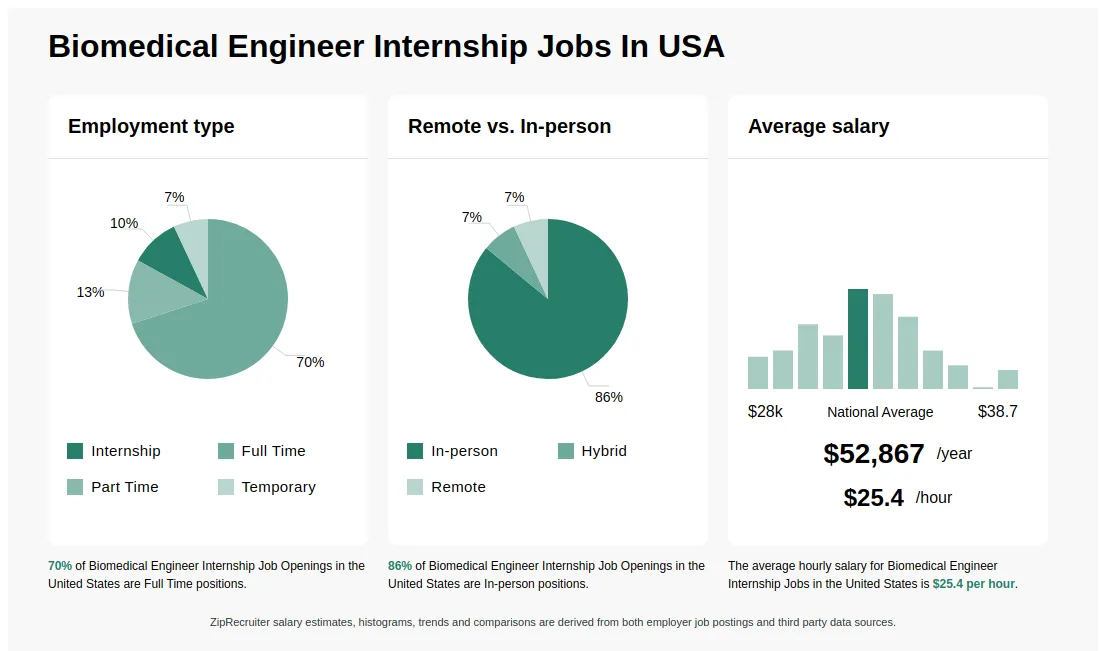
Biomedical Engineer Internship information
See salary details
$13.46 - $15.76
5% of jobs
$15.76 - $18.05
7% of jobs
$20.30 is the 25th percentile. Wages below this are outliers.
$18.05 - $20.35
13% of jobs
$20.35 - $22.64
9% of jobs
The median wage is $24.49 / hr.
$22.64 - $24.93
19% of jobs
$24.93 - $27.23
18% of jobs
$27.80 is the 75th percentile. Wages above this are outliers.
$27.23 - $29.52
14% of jobs
$29.52 - $31.82
7% of jobs
$31.82 - $34.11
4% of jobs
$34.11 - $36.41
0% of jobs
$36.41 - $38.70
3% of jobs
$13
$25
$38
How much do biomedical engineer internship jobs pay per hour?
As of Jul 20, 2026, the average hourly pay for biomedical engineer internship in the United States is $25.42, according to ZipRecruiter salary data. Most workers in this role earn between $20.67 and $28.85 per hour, depending on experience, location, and employer.
What is the difference between Biomedical Engineer Internship vs Biomedical Engineer?
| Aspect | Biomedical Engineer Internship | Biomedical Engineer |
|---|---|---|
| Required Credentials | Enrolled in or recent graduate of a relevant degree program | Bachelor's or higher in biomedical engineering or related field |
| Work Environment | Internship setting, often in labs or hospitals | Full-time professional setting, including labs, manufacturing, or research facilities |
| Employer & Industry Usage | Educational institutions, hospitals, research centers | Medical device companies, healthcare institutions, research organizations |
The Biomedical Engineer Internship is a temporary, educational position designed to provide hands-on experience, while a Biomedical Engineer is a full-time professional responsible for designing and testing medical devices or systems. Internships serve as a stepping stone toward a career in biomedical engineering, which requires more advanced skills and credentials.
What Are the Qualifications to Get a Biomedical Engineer Internship?
The primary qualifications for getting a biomedical engineering internship are enrollment in an appropriate degree-seeking field and meeting any other requirements posted by the company offering the internship. Common requirements include having a cumulative GPA at or above a set level, being a citizen or permanent resident of the United States, and the ability to pass a background check. Some companies accept recent graduates. Fulfilling the duties and responsibilities of a biomedical engineer internship requires communication skills, organization skills, and the ability to work independently or collaboratively as needed. Previous experience working in biological research labs can help you stand out from other applicants.
What does a Biomedical Engineer Intern do?
A Biomedical Engineer Intern typically assists with the design, development, and testing of medical devices and healthcare technologies. Interns may work on projects related to improving medical equipment, analyzing data from clinical trials, or supporting the research and development team. The role often involves collaborating with engineers, scientists, and healthcare professionals to solve real-world problems in medicine. Interns gain hands-on experience and learn about regulatory standards, product development processes, and the application of engineering principles in healthcare.
What are the key skills and qualifications needed to thrive as a Biomedical Engineer Intern, and why are they important?
To thrive as a Biomedical Engineer Intern, you need a solid background in biology, engineering principles, and mathematics, often supported by progress toward a bachelor's degree in biomedical engineering or a related field. Familiarity with CAD software, data analysis tools like MATLAB, and laboratory equipment is typically required. Strong problem-solving abilities, attention to detail, and effective teamwork and communication skills help interns excel in collaborative research and development environments. These competencies are crucial for contributing to innovative healthcare solutions and successfully supporting engineering teams.
What types of projects do biomedical engineering interns typically work on, and how do these projects contribute to their learning and future career growth?
Biomedical engineering interns often participate in projects such as designing medical devices, conducting laboratory testing, analyzing clinical data, or assisting with regulatory documentation. These hands-on experiences allow interns to apply classroom knowledge to real-world challenges, develop technical skills, and understand industry standards. Working alongside experienced engineers and healthcare professionals also helps interns build communication and teamwork skills, which are essential for career advancement. Successfully completing an internship can open doors to full-time roles and specialized career paths within biomedical engineering.
More about Biomedical Engineer Internship jobs
What cities are hiring for Biomedical Engineer Internship jobs? Cities with the most Biomedical Engineer Internship job openings:
What are the most commonly searched types of Biomedical Engineer jobs? The most popular types of Biomedical Engineer jobs are:
What states have the most Biomedical Engineer Internship jobs? States with the most job openings for Biomedical Engineer Internship jobs include:
What job categories do people searching Biomedical Engineer Internship jobs look for? The top searched job categories for Biomedical Engineer Internship jobs are:
- Biomedical Engineering Internships
- Internship Abbott Biomedical Engineering
- Internship Deloitte Chemical Engineering
- Internship Microsoft Biomedical Engineering
- Materials Engineering Internships
- Internship Stoll M1 Plus Programmer
- Intern Google Quantum Ai
- Intern Outdoor Industry Engineering
- Entry Level Amazon Biomedical Engineering
- Industrial Engineering Student
Biomedical Equipment Support Specialist - Information Systems
Grand Junction, CO
$97K/yr
Other
Posted 15 days ago
Job description
Serves as a Biomedical Equipment Support Specialist (BESS) specialized in information systems within a Healthcare Technology Management (HTM) department at a VA facility. Works in support of the medical equipment management program. In addition to duties at the full performance level, the BESS maintains medical servers and networks, diagnostic software, virtual platforms, and clinical applications software.Qualifications:Basic Requirements:
Physical Requirements: The work required does not inherently include any physical requirements essential for successful job performance that could not otherwise be performed with accommodation or workplace adjustment. A pre-placement physical examination is not required.Education:Note: Only education or degrees recognized by the U.S. Department of Education from accredited colleges, universities, schools, or institutions may be used to qualify for Federal employment. You can verify your education here: http://ope.ed.gov/accreditation/. If you are using foreign education to meet qualification requirements, you must send a Certificate of Foreign Equivalency with your transcript in order to receive credit for that education. For further information, visit: https://sites.ed.gov/international/recognition-of-foreign-qualifications/.Employment Type: OTHER
- United States Citizenship: Non-citizens may only be appointed when it is not possible to recruit qualified citizens in accordance with VA Policy.
- Education, Experience, or Certification.
- Associates or higher degree in the biomedical technology or biomedical engineering field; OR
- Associates or higher degree in electronics, a field of information technology, or engineering (other than biomedical engineering) AND 1 year of creditable experience; OR
- Completion of the Department of Defense (DOD) biomedical equipment technician training program; OR
- Completion of a DOD training program in repair and maintenance of electronic systems or information technology AND 1 year of creditable experience; OR
- Completion of a biomedical engineering technician or Healthcare Technology Management (HTM) certificate program that included an internship or apprenticeship; OR
- Completion of biomedical engineering technician or HTM certificate program that did not include an internship AND 1 year of creditable experience; OR
- Hold or having ever held certification as a Certified Biomedical Equipment Technician (CBET), Certified Radiology Equipment Specialist (CRES), Certified Laboratory Equipment Specialist (CLES), or Certified Healthcare Technology Manager (CHTM). Continuous maintenance of certification is not required throughout VHA employment.
- Experience. One year of creditable experience equivalent to the next lower grade.
- Knowledge, Skills, and Abilities. In addition to the experience above, the candidate must demonstrate the following KSAs:
- Knowledge of Health Level 7 (HL7) and Digital Imaging and Communications in Medicine (DICOM) standards.
- Knowledge of advanced testing methods to troubleshoot networked medical equipment and clinical system interfaces.
- Skill in maintaining computer and server based medical equipment, databases, and software.
- Skill in managing medical equipment and clinical system projects that interface with an electronic health record or other information systems.
- Skill in applying cybersecurity standards to medical devices and clinical systems such as Food and Drug Administration (FDA), Federal Information Security Modernization Act (FISMA), and National Institute of Standards and Technology (NIST) guidelines.
- Ability to apply information security tools including virus protection, software updates, and operating system patches.
- Ability to establish a medical network including VLAN configuration, Internet Protocol addressing, and network security.
Physical Requirements: The work required does not inherently include any physical requirements essential for successful job performance that could not otherwise be performed with accommodation or workplace adjustment. A pre-placement physical examination is not required.Education:Note: Only education or degrees recognized by the U.S. Department of Education from accredited colleges, universities, schools, or institutions may be used to qualify for Federal employment. You can verify your education here: http://ope.ed.gov/accreditation/. If you are using foreign education to meet qualification requirements, you must send a Certificate of Foreign Equivalency with your transcript in order to receive credit for that education. For further information, visit: https://sites.ed.gov/international/recognition-of-foreign-qualifications/.Employment Type: OTHER