Potential Internship Project Areas: Based on business needs, location, and team alignment ... biomedical, biomechanical, manufacturing, industrial, plastics engineering, or related major.
Potential Internship Project Areas: Based on business needs, location, and team alignment ... biomedical, biomechanical, manufacturing, industrial, plastics engineering, or related major.

... Biomedical Engineering (with computational focus), or related field * Preference for students who have completed 3+ years of coursework by the internship start date * Experience with object-oriented ...
... Biomedical Engineering (with computational focus), or related field * Preference for students who have completed 3+ years of coursework by the internship start date * Experience with object-oriented ...
Software Engineer Internships
Houston, TX · On-site
... Biomedical Engineering (with computational focus), or related field * Preference for students who have completed 3+ years of coursework by the internship start date * Experience with object-oriented ...
Software Engineer Internships
Houston, TX · On-site
... Biomedical Engineering (with computational focus), or related field * Preference for students who have completed 3+ years of coursework by the internship start date * Experience with object-oriented ...
... Biomedical Engineering (with computational focus), or related field * Preference for students who have completed 3+ years of coursework by the internship start date * Experience with object-oriented ...
... Biomedical Engineering (with computational focus), or related field * Preference for students who have completed 3+ years of coursework by the internship start date * Experience with object-oriented ...
... Biomedical Engineering (with computational focus), or related field * Preference for students who have completed 3+ years of coursework by the internship start date * Experience with object-oriented ...
... Biomedical Engineering (with computational focus), or related field * Preference for students who have completed 3+ years of coursework by the internship start date * Experience with object-oriented ...

Summer 2027 Internship - RA/QA - Post Market Regulatory Affairs - Virtual
Houston, TX · On-site
$35/hr
Scientific or technical disciplines preferred (e.g., Biomedical Engineering, Biological Sciences ... the internship. * Cumulative 3.0 GPA or above (verified at time of hire) * Must be legally ...
Summer 2027 Internship - RA/QA - Post Market Regulatory Affairs - Virtual
Houston, TX · On-site
$35/hr
Scientific or technical disciplines preferred (e.g., Biomedical Engineering, Biological Sciences ... the internship. * Cumulative 3.0 GPA or above (verified at time of hire) * Must be legally ...
Summer 2027 Internship - RA/QA - Post Market Regulatory Affairs - Virtual
The Woodlands, TX · On-site
$35/hr
Scientific or technical disciplines preferred (e.g., Biomedical Engineering, Biological Sciences ... the internship. * Cumulative 3.0 GPA or above (verified at time of hire) * Must be legally ...
Summer 2027 Internship - RA/QA - Post Market Regulatory Affairs - Virtual
The Woodlands, TX · On-site
$35/hr
Scientific or technical disciplines preferred (e.g., Biomedical Engineering, Biological Sciences ... the internship. * Cumulative 3.0 GPA or above (verified at time of hire) * Must be legally ...
Summer 2027 Internship - RA/QA - Post Market Regulatory Affairs - Virtual
Houston, TX · On-site
$35/hr
Scientific or technical disciplines preferred (e.g., Biomedical Engineering, Biological Sciences ... the internship. * Cumulative 3.0 GPA or above (verified at time of hire) * Must be legally ...
Summer 2027 Internship - RA/QA - Post Market Regulatory Affairs - Virtual
Houston, TX · On-site
$35/hr
Scientific or technical disciplines preferred (e.g., Biomedical Engineering, Biological Sciences ... the internship. * Cumulative 3.0 GPA or above (verified at time of hire) * Must be legally ...
Summer 2027 Internship - RA/QA - Post Market Regulatory Affairs - Virtual
The Woodlands, TX · On-site
$35/hr
Scientific or technical disciplines preferred (e.g., Biomedical Engineering, Biological Sciences ... the internship. * Cumulative 3.0 GPA or above (verified at time of hire) * Must be legally ...
Summer 2027 Internship - RA/QA - Post Market Regulatory Affairs - Virtual
The Woodlands, TX · On-site
$35/hr
Scientific or technical disciplines preferred (e.g., Biomedical Engineering, Biological Sciences ... the internship. * Cumulative 3.0 GPA or above (verified at time of hire) * Must be legally ...

Client & Scientific Solutions Intern
Houston, TX · On-site
$13.75 - $18.25/hr
... biomedical engineers, analysts, and client services professionals in support of the clinical trials business for medical device, biologics, and pharmaceutical companies. The internship is designed as ...
Quick apply
Client & Scientific Solutions Intern
Houston, TX · On-site
$13.75 - $18.25/hr
... biomedical engineers, analysts, and client services professionals in support of the clinical trials business for medical device, biologics, and pharmaceutical companies. The internship is designed as ...
Client & Scientific Solutions Intern
Houston, TX · On-site
$13.75 - $18.25/hr
... biomedical engineers, analysts, and client services professionals in support of the clinical trials business for medical device, biologics, and pharmaceutical companies. The internship is designed as ...
Client & Scientific Solutions Intern
Houston, TX · On-site
$13.75 - $18.25/hr
... biomedical engineers, analysts, and client services professionals in support of the clinical trials business for medical device, biologics, and pharmaceutical companies. The internship is designed as ...
Client & Scientific Solutions Intern
Houston, TX · On-site
$13.75 - $18.25/hr
... biomedical engineers, analysts, and client services professionals in support of the clinical trials business for medical device, biologics, and pharmaceutical companies. The internship is designed as ...
Client & Scientific Solutions Intern
Houston, TX · On-site
$13.75 - $18.25/hr
... biomedical engineers, analysts, and client services professionals in support of the clinical trials business for medical device, biologics, and pharmaceutical companies. The internship is designed as ...

Spring + Summer 2027 Co-Op - Manufacturing Science & Technology
Houston, TX · On-site
$16.25 - $21.25/hr
Alcon interns will have the opportunity to not only gain industry experience and network with other ... Biomedical engineering, Chemical Engineering, Mechanical Engineering, Industrial Engineering or ...
Spring + Summer 2027 Co-Op - Manufacturing Science & Technology
Houston, TX · On-site
$16.25 - $21.25/hr
Alcon interns will have the opportunity to not only gain industry experience and network with other ... Biomedical engineering, Chemical Engineering, Mechanical Engineering, Industrial Engineering or ...
Biomedical engineering, Chemical Engineering, Mechanical Engineering, Industrial Engineeringor ... internship * Must be pursuing aBachelor's or Master'sdegree * Academic performance:
Biomedical engineering, Chemical Engineering, Mechanical Engineering, Industrial Engineeringor ... internship * Must be pursuing aBachelor's or Master'sdegree * Academic performance:

Intern, CMC Development (Summer 2027)
The Woodlands, TX · On-site
$20 - $60/hr
Summer Interns will have an opportunity to be part of high-performing project teams developing new ... Engineering, Chemistry, Biochemistry, Biomedical Engineering, Biophysics, Biostatistics ...
Intern, CMC Development (Summer 2027)
The Woodlands, TX · On-site
$20 - $60/hr
Summer Interns will have an opportunity to be part of high-performing project teams developing new ... Engineering, Chemistry, Biochemistry, Biomedical Engineering, Biophysics, Biostatistics ...
Intern, CMC Development (Summer 2027)
The Woodlands, TX · On-site +1
$20 - $60/hr
Summer Interns will have an opportunity to be part of high-performing project teams developing new ... Engineering, Chemistry, Biochemistry, Biomedical Engineering, Biophysics, Biostatistics ...
Intern, CMC Development (Summer 2027)
The Woodlands, TX · On-site +1
$20 - $60/hr
Summer Interns will have an opportunity to be part of high-performing project teams developing new ... Engineering, Chemistry, Biochemistry, Biomedical Engineering, Biophysics, Biostatistics ...
Intern, CMC Development (Summer 2027)
Houston, TX · On-site
$20 - $60/hr
Summer Interns will have an opportunity to be part of high-performing project teams developing new ... Engineering, Chemistry, Biochemistry, Biomedical Engineering, Biophysics, Biostatistics ...
Intern, CMC Development (Summer 2027)
Houston, TX · On-site
$20 - $60/hr
Summer Interns will have an opportunity to be part of high-performing project teams developing new ... Engineering, Chemistry, Biochemistry, Biomedical Engineering, Biophysics, Biostatistics ...
Intern, CMC Development (Summer 2027)
Houston, TX · On-site +1
$20 - $60/hr
Summer Interns will have an opportunity to be part of high-performing project teams developing new ... Engineering, Chemistry, Biochemistry, Biomedical Engineering, Biophysics, Biostatistics ...
Intern, CMC Development (Summer 2027)
Houston, TX · On-site +1
$20 - $60/hr
Summer Interns will have an opportunity to be part of high-performing project teams developing new ... Engineering, Chemistry, Biochemistry, Biomedical Engineering, Biophysics, Biostatistics ...
Summer 2027 Internship - RWE Data Scientist - Virtual
The Woodlands, TX · On-site +1
$35/hr
... Biomedical Informatics, Data Science, or a related quantitative field; must remain enrolled in a ... Proficiency in SQL and at least one statistical/analytical programming language (Python or R)
Summer 2027 Internship - RWE Data Scientist - Virtual
The Woodlands, TX · On-site +1
$35/hr
... Biomedical Informatics, Data Science, or a related quantitative field; must remain enrolled in a ... Proficiency in SQL and at least one statistical/analytical programming language (Python or R)
Summer 2027 Internship - RWE Data Scientist - Virtual
Houston, TX · On-site +1
$35/hr
... Biomedical Informatics, Data Science, or a related quantitative field; must remain enrolled in a ... Proficiency in SQL and at least one statistical/analytical programming language (Python or R)
Summer 2027 Internship - RWE Data Scientist - Virtual
Houston, TX · On-site +1
$35/hr
... Biomedical Informatics, Data Science, or a related quantitative field; must remain enrolled in a ... Proficiency in SQL and at least one statistical/analytical programming language (Python or R)
Biomedical Engineer Internship information
See Houston, TX salary details
$12.86 - $15.05
5% of jobs
$15.05 - $17.24
7% of jobs
$19.38 is the 25th percentile. Wages below this are outliers.
$17.24 - $19.43
13% of jobs
$19.43 - $21.62
9% of jobs
The median wage is $23.39 / hr.
$21.62 - $23.81
19% of jobs
$23.81 - $26
18% of jobs
$26.55 is the 75th percentile. Wages above this are outliers.
$26 - $28.19
14% of jobs
$28.19 - $30.39
7% of jobs
$30.39 - $32.58
4% of jobs
$32.58 - $34.77
0% of jobs
$34.77 - $36.96
3% of jobs
$12
$24
$36
How much do biomedical engineer internship jobs pay per hour?
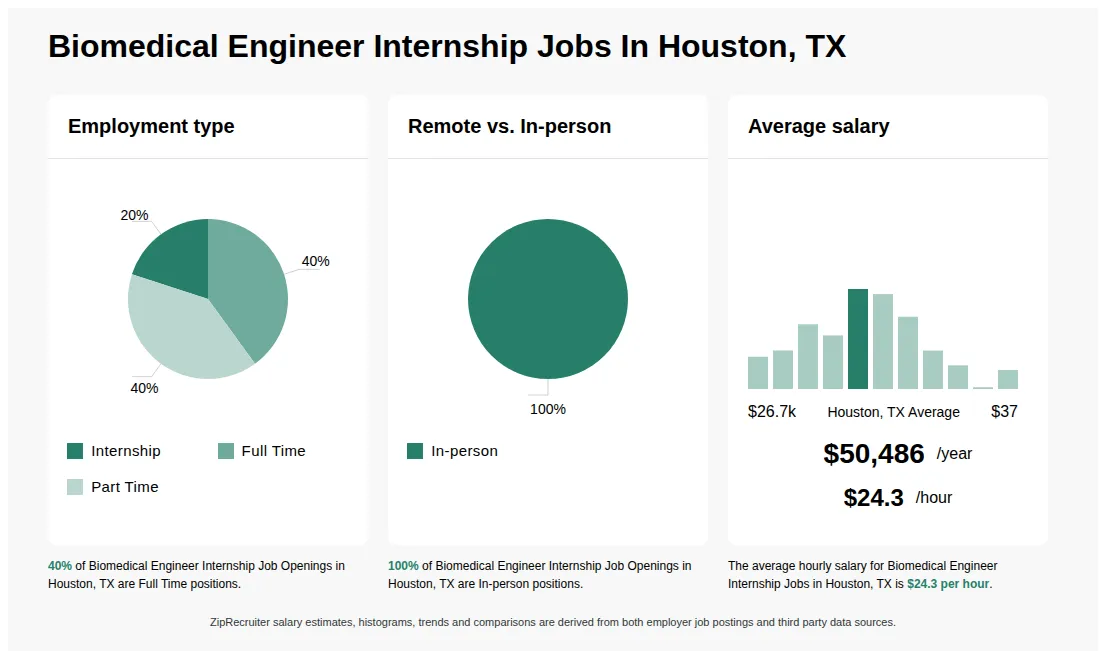
As of Sep 8, 2026, the average hourly pay for biomedical engineer internship in Houston, TX is $24.27, according to ZipRecruiter salary data. Most workers in this role earn between $19.76 and $27.55 per hour, depending on experience, location, and employer.
What does a biomedical engineer intern do?
A Biomedical Engineer Intern typically assists with the design, development, and testing of medical devices and healthcare technologies. Interns may work on projects related to improving medical equipment, analyzing data from clinical trials, or supporting the research and development team. The role often involves collaborating with engineers, scientists, and healthcare professionals to solve real-world problems in medicine. Interns gain hands-on experience and learn about regulatory standards, product development processes, and the application of engineering principles in healthcare.
What are the qualifications to get a biomedical engineer internship?
The primary qualifications for getting a biomedical engineering internship are enrollment in an appropriate degree-seeking field and meeting any other requirements posted by the company offering the internship. Common requirements include having a cumulative GPA at or above a set level, being a citizen or permanent resident of the United States, and the ability to pass a background check. Some companies accept recent graduates. Fulfilling the duties and responsibilities of a biomedical engineer internship requires communication skills, organization skills, and the ability to work independently or collaboratively as needed. Previous experience working in biological research labs can help you stand out from other applicants.
What are the key skills and qualifications needed to thrive as a biomedical engineer intern, and why are they important?
To thrive as a Biomedical Engineer Intern, you need a solid background in biology, engineering principles, and mathematics, often supported by progress toward a bachelor's degree in biomedical engineering or a related field. Familiarity with CAD software, data analysis tools like MATLAB, and laboratory equipment is typically required. Strong problem-solving abilities, attention to detail, and effective teamwork and communication skills help interns excel in collaborative research and development environments. These competencies are crucial for contributing to innovative healthcare solutions and successfully supporting engineering teams.
What types of projects do biomedical engineering interns typically work on, and how do these projects contribute to their learning and future career growth?
Biomedical engineering interns often participate in projects such as designing medical devices, conducting laboratory testing, analyzing clinical data, or assisting with regulatory documentation. These hands-on experiences allow interns to apply classroom knowledge to real-world challenges, develop technical skills, and understand industry standards. Working alongside experienced engineers and healthcare professionals also helps interns build communication and teamwork skills, which are essential for career advancement. Successfully completing an internship can open doors to full-time roles and specialized career paths within biomedical engineering.
What is the difference between Biomedical Engineer Internship vs Biomedical Engineer?
| Aspect | Biomedical Engineer Internship | Biomedical Engineer |
|---|---|---|
| Required Credentials | Enrolled in or recent graduate of a relevant degree program | Bachelor's or higher in biomedical engineering or related field |
| Work Environment | Internship setting, often in labs or hospitals | Full-time professional setting, including labs, manufacturing, or research facilities |
| Employer & Industry Usage | Educational institutions, hospitals, research centers | Medical device companies, healthcare institutions, research organizations |
The Biomedical Engineer Internship is a temporary, educational position designed to provide hands-on experience, while a Biomedical Engineer is a full-time professional responsible for designing and testing medical devices or systems. Internships serve as a stepping stone toward a career in biomedical engineering, which requires more advanced skills and credentials.
Is there a high demand for biomedical engineer internships?
Biomedical engineer internships are in growing demand due to advancements in medical technology and healthcare needs. Internships often require knowledge of engineering principles, medical devices, and relevant software, making them competitive but accessible for students with technical backgrounds.
What is a typical biomedical engineer internship?
A biomedical engineer internship typically involves assisting with the design, testing, and maintenance of medical devices and equipment. Interns often gain hands-on experience with CAD software, laboratory testing, and regulatory compliance, working under the supervision of experienced engineers in a healthcare or research setting. The internship duration usually ranges from a few months to a summer program, and candidates often need a background in biomedical engineering or related fields.
More about Biomedical Engineer Internship jobs
What are the most commonly searched types of Biomedical Engineer jobs in Houston, TX?
The most popular types of Biomedical Engineer jobs in Houston, TX are:
What are popular job titles related to Biomedical Engineer Internship jobs in Houston, TX?
For Biomedical Engineer Internship jobs in Houston, TX, the most frequently searched job titles are:
What job categories do people searching Biomedical Engineer Internship jobs in Houston, TX look for?
The top searched job categories for Biomedical Engineer Internship jobs in Houston, TX are:
- Remote Biomedical Engineering
- Biomedical Engineering Hospital
- Biomedical Engineering Hospital Internship
- Biomedical Training
- Weekend International Biomedical Equipment Technician
- Contractual International Biomedical Engineer
- Internship Biomedical Engineering Volunteer
- Remote Biomedical Engineering Volunteer
- Biomedical Lawyer
- Biomedical Engineer Iii
What cities near Houston, TX are hiring for Biomedical Engineer Internship jobs?
Cities near Houston, TX with the most Biomedical Engineer Internship job openings:
2027 Summer Mechanical & Biomedical Engineering Intern
Houston, TX
$16 - $20.75/hr
Full-time
Posted 4 days ago
Job description
About Alcon:
Alcon helps people see brilliantly. As the global leader in eye care with a heritage spanning more than 75 years, we offer one of the broadest portfolios of products designed to enhance sight and improve people's lives. Our Surgical and Vision Care products touch the lives of more than 260 million people in over 140 countries each year, supporting those living with conditions such as cataracts, glaucoma, retinal diseases, and refractive errors. Our more than 25,000 associates help enhance quality of life through innovative products, partnerships with eye care professionals, and programs that advance access to quality eye care. If you'd like to help change the way the world sees, this is your chance to Be Brilliant!
Position Description:
Alcon is seeking multiple talented and motivated Mechanical & Biomedical Engineering Interns to join our 2027 Summer Internship Program across several U.S. locations, including Johns Creek, GA; Goleta, CA; Lake Forest, CA; Fort Worth, TX; and Houston, TX. Interns will have the opportunity to gain meaningful industry experience, contribute to real-world projects, and collaborate with professionals across Alcon. Through this internship, students will build technical skills, expand their professional network, and receive coaching, mentoring, and development opportunities while helping advance Alcon's mission to help people see brilliantly.
Potential Internship Project Areas:
Based on business needs, location, and team alignment, internship projects may include opportunities such as:
Create rapid prototypes through CAD design, 3D printing, mechanical assembly and laboratory testing.
Support injection-molding setup, process development, machine operation and workflow optimization.
Design or improve custom tabletop equipment for laboratory and research applications.
Evaluate metrology methods, measurement accuracy and process standardization, including updates to procedures and SOPs.
Design mechanical systems that integrate with metrology equipment and robotic arms for automated measurement workflows.
Minimum Qualifications:
Must be enrolled in an accredited university or college for at least one semester prior to internship or co-op, and at least one additional semester following internship or co-op.
Must be pursuing at least a bachelor's degree in mechanical, biomedical, biomechanical, manufacturing, industrial, plastics engineering, or related major.
Academic performance: Minimum cumulative GPA 2.8/4.0
Demonstrated leadership skills (i.e. extracurricular activities or projects)
Must be authorized to work in the U.S. on a permanent basis without requiring sponsorship (students on an F1 visa with CPT can be accommodated)
Ability to commit to a 10-12-week, full-time (40 hours per week) summer internship
ATTENTION: Current Alcon Employee/Contingent Worker
If you are currently an active employee/contingent worker at Alcon, please click the appropriate link below to apply on the Internal Career site.
Find Jobs for Employees
Find Jobs for Contingent Worker
You are applying to be part of the Alcon Talent Pool. We are not currently recruiting for this role but we are building a pipeline for future opportunities. If you would like to be considered for a similar position in future, then please submit your CV or resume.
ALCON IS AN EQUAL OPPORTUNITY EMPLOYER AND PARTICIPATES IN E-VERIFY
Alcon takes pride in maintaining an inclusive environment that values different perspectives and our policies are non-discriminatory in recruitment, hiring, training, promotion or other employment practices for reasons of race, color, religion, gender, national origin, age, sexual orientation, marital or veteran status, disability, or any other legally protected status. Alcon is also committed to working with and providing reasonable accommodation to individuals with disabilities. If, because of a medical condition or disability, you need a reasonable accommodation for any part of the application process, or in order to perform the essential functions of a position, please send an email to alcon.recruitment@alcon.comand let us know the nature of your request and your contact information.