... internships. * Verifiable experience as a Biomedical Engineer for an Original Equipment Manufacturer (OEM). * Verifiable experience as a Field Service Engineer in the medical equipment industry.
... internships. * Verifiable experience as a Biomedical Engineer for an Original Equipment Manufacturer (OEM). * Verifiable experience as a Field Service Engineer in the medical equipment industry.
Biomedical Equipment Support Specialist (Intensive Care)
Dayton, OH · On-site
$105K/yr
Completion of a biomedical engineering technician or Healthcare Technology Management (HTM) certificate program that included an internship or apprenticeship; OR * Completion of biomedical ...
Biomedical Equipment Support Specialist (Intensive Care)
Dayton, OH · On-site
$105K/yr
Completion of a biomedical engineering technician or Healthcare Technology Management (HTM) certificate program that included an internship or apprenticeship; OR * Completion of biomedical ...

Biomedical Technologist Associate - Healthcare Tech Mgmt - Main - Full-Time - Days
Cincinnati, OH · On-site
Associate Degree in Biomedical Engineering Technology within twelve months of hire or equivalent ... YEARS OF EXPERIENCE: 1 year of co-op or internship. REQUIRED SKILLS AND KNOWLEDGE: This position ...
Biomedical Technologist Associate - Healthcare Tech Mgmt - Main - Full-Time - Days
Cincinnati, OH · On-site
Associate Degree in Biomedical Engineering Technology within twelve months of hire or equivalent ... YEARS OF EXPERIENCE: 1 year of co-op or internship. REQUIRED SKILLS AND KNOWLEDGE: This position ...
Biomedical Technologist Associate - Healthcare Tech Mgmt - Main - Full-Time - Days
Cincinnati, OH · On-site
IT and facilities), supervisors, other clinical engineering teams, and Director of Clinical ... YEARS OF EXPERIENCE: 1 year of co-op or internship. REQUIRED SKILLS AND KNOWLEDGE: This position ...
Biomedical Technologist Associate - Healthcare Tech Mgmt - Main - Full-Time - Days
Cincinnati, OH · On-site
IT and facilities), supervisors, other clinical engineering teams, and Director of Clinical ... YEARS OF EXPERIENCE: 1 year of co-op or internship. REQUIRED SKILLS AND KNOWLEDGE: This position ...
Associate Biomedical Field Service Technician - Central Region (Float)
Columbus, OH · On-site
$54K - $92K/yr
Bachelor's degree in Electronics, Biomedical Engineering, or a related field * Prior internship, co‑op, or hands‑on experience in a technical, biomedical, or field service environment * Exposure ...
Associate Biomedical Field Service Technician - Central Region (Float)
Columbus, OH · On-site
$54K - $92K/yr
Bachelor's degree in Electronics, Biomedical Engineering, or a related field * Prior internship, co‑op, or hands‑on experience in a technical, biomedical, or field service environment * Exposure ...
Associate Biomedical Field Service Technician - Central Region (Float)
Zanesville, OH · On-site
$54K - $92K/yr
Bachelor's degree in Electronics, Biomedical Engineering, or a related field * Prior internship, co‑op, or hands‑on experience in a technical, biomedical, or field service environment * Exposure ...
Associate Biomedical Field Service Technician - Central Region (Float)
Zanesville, OH · On-site
$54K - $92K/yr
Bachelor's degree in Electronics, Biomedical Engineering, or a related field * Prior internship, co‑op, or hands‑on experience in a technical, biomedical, or field service environment * Exposure ...

Bachelor's degree in Electronics, Biomedical Engineering, or a related field * Prior internship, co-op, or hands-on experience in a technical, biomedical, or field service environment * Exposure to ...
Bachelor's degree in Electronics, Biomedical Engineering, or a related field * Prior internship, co-op, or hands-on experience in a technical, biomedical, or field service environment * Exposure to ...
Bachelor's degree in Electronics, Biomedical Engineering, or a related field * Prior internship, co-op, or hands-on experience in a technical, biomedical, or field service environment * Exposure to ...
Bachelor's degree in Electronics, Biomedical Engineering, or a related field * Prior internship, co-op, or hands-on experience in a technical, biomedical, or field service environment * Exposure to ...
Bachelor's degree in Electronics, Biomedical Engineering, or a related field * Prior internship, co-op, or hands-on experience in a technical, biomedical, or field service environment * Exposure to ...
Bachelor's degree in Electronics, Biomedical Engineering, or a related field * Prior internship, co-op, or hands-on experience in a technical, biomedical, or field service environment * Exposure to ...
Bachelor's degree in Electronics, Biomedical Engineering, or a related field Prior internship, co-op, or hands-on experience in a technical, biomedical, or field service environment Exposure to ...
Bachelor's degree in Electronics, Biomedical Engineering, or a related field Prior internship, co-op, or hands-on experience in a technical, biomedical, or field service environment Exposure to ...

... Biomedical Engineering (with computational focus), or related field * Preference for students who have completed 3+ years of coursework by the internship start date * Experience with object-oriented ...
... Biomedical Engineering (with computational focus), or related field * Preference for students who have completed 3+ years of coursework by the internship start date * Experience with object-oriented ...
... Biomedical Engineering (with computational focus), or related field * Preference for students who have completed 3+ years of coursework by the internship start date * Experience with object-oriented ...
... Biomedical Engineering (with computational focus), or related field * Preference for students who have completed 3+ years of coursework by the internship start date * Experience with object-oriented ...
... Biomedical Engineering (with computational focus), or related field * Preference for students who have completed 3+ years of coursework by the internship start date * Experience with object-oriented ...
... Biomedical Engineering (with computational focus), or related field * Preference for students who have completed 3+ years of coursework by the internship start date * Experience with object-oriented ...
... Biomedical Engineering (with computational focus), or related field * Preference for students who have completed 3+ years of coursework by the internship start date * Experience with object-oriented ...
... Biomedical Engineering (with computational focus), or related field * Preference for students who have completed 3+ years of coursework by the internship start date * Experience with object-oriented ...
... Biomedical Engineering (with computational focus), or related field * Preference for students who have completed 3+ years of coursework by the internship start date * Experience with object-oriented ...
... Biomedical Engineering (with computational focus), or related field * Preference for students who have completed 3+ years of coursework by the internship start date * Experience with object-oriented ...
... Biomedical Engineering (with computational focus), or related field * Preference for students who have completed 3+ years of coursework by the internship start date * Experience with object-oriented ...
... Biomedical Engineering (with computational focus), or related field * Preference for students who have completed 3+ years of coursework by the internship start date * Experience with object-oriented ...
... Biomedical Engineering (with computational focus), or related field * Preference for students who have completed 3+ years of coursework by the internship start date * Experience with object-oriented ...
... Biomedical Engineering (with computational focus), or related field * Preference for students who have completed 3+ years of coursework by the internship start date * Experience with object-oriented ...
... Biomedical Engineering (with computational focus), or related field * Preference for students who have completed 3+ years of coursework by the internship start date * Experience with object-oriented ...
... Biomedical Engineering (with computational focus), or related field * Preference for students who have completed 3+ years of coursework by the internship start date * Experience with object-oriented ...
... Biomedical Engineering (with computational focus), or related field * Preference for students who have completed 3+ years of coursework by the internship start date * Experience with object-oriented ...
... Biomedical Engineering (with computational focus), or related field * Preference for students who have completed 3+ years of coursework by the internship start date * Experience with object-oriented ...
Software Engineer Internships
Toledo, OH · On-site
... Biomedical Engineering (with computational focus), or related field * Preference for students who have completed 3+ years of coursework by the internship start date * Experience with object-oriented ...
Software Engineer Internships
Toledo, OH · On-site
... Biomedical Engineering (with computational focus), or related field * Preference for students who have completed 3+ years of coursework by the internship start date * Experience with object-oriented ...
Biomedical Engineer Internship information
See Ohio salary details
$12.80 - $14.98
5% of jobs
$14.98 - $17.16
7% of jobs
$19.30 is the 25th percentile. Wages below this are outliers.
$17.16 - $19.34
13% of jobs
$19.34 - $21.52
9% of jobs
The median wage is $23.28 / hr.
$21.52 - $23.71
19% of jobs
$23.71 - $25.89
18% of jobs
$26.43 is the 75th percentile. Wages above this are outliers.
$25.89 - $28.07
14% of jobs
$28.07 - $30.25
7% of jobs
$30.25 - $32.43
4% of jobs
$32.43 - $34.61
0% of jobs
$34.61 - $36.79
3% of jobs
$12
$24
$36
How much do biomedical engineer internship jobs pay per hour?
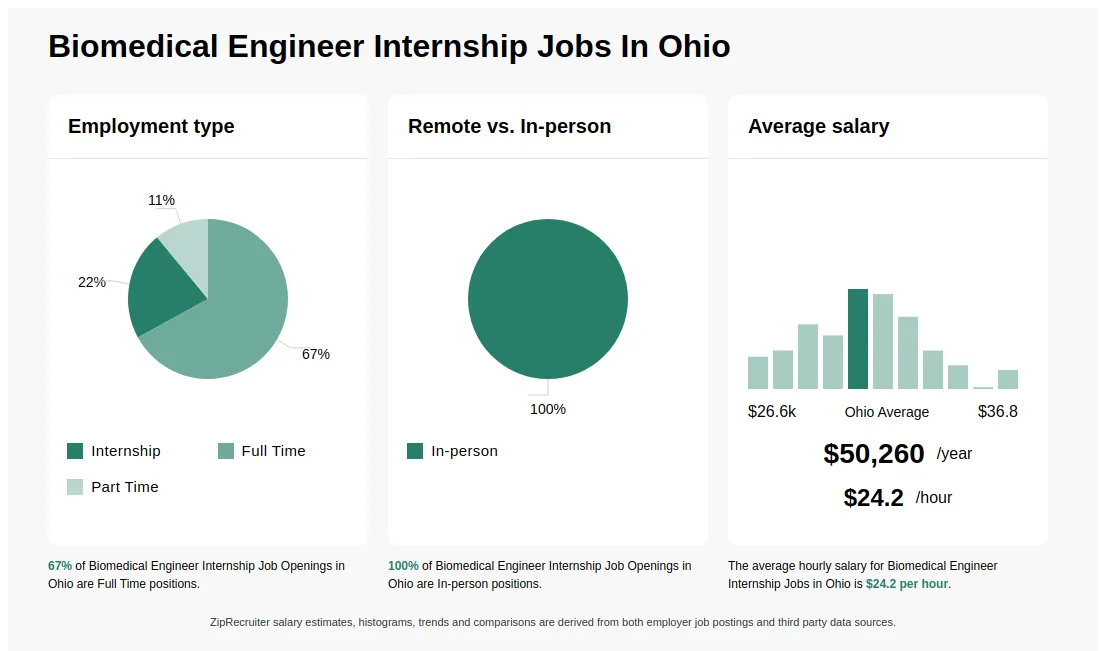
As of Sep 14, 2026, the average hourly pay for biomedical engineer internship in Ohio is $24.16, according to ZipRecruiter salary data. Most workers in this role earn between $19.66 and $27.40 per hour, depending on experience, location, and employer.
What does a biomedical engineer intern do?
A Biomedical Engineer Intern typically assists with the design, development, and testing of medical devices and healthcare technologies. Interns may work on projects related to improving medical equipment, analyzing data from clinical trials, or supporting the research and development team. The role often involves collaborating with engineers, scientists, and healthcare professionals to solve real-world problems in medicine. Interns gain hands-on experience and learn about regulatory standards, product development processes, and the application of engineering principles in healthcare.
What are the qualifications to get a biomedical engineer internship?
The primary qualifications for getting a biomedical engineering internship are enrollment in an appropriate degree-seeking field and meeting any other requirements posted by the company offering the internship. Common requirements include having a cumulative GPA at or above a set level, being a citizen or permanent resident of the United States, and the ability to pass a background check. Some companies accept recent graduates. Fulfilling the duties and responsibilities of a biomedical engineer internship requires communication skills, organization skills, and the ability to work independently or collaboratively as needed. Previous experience working in biological research labs can help you stand out from other applicants.
What are the key skills and qualifications needed to thrive as a biomedical engineer intern, and why are they important?
To thrive as a Biomedical Engineer Intern, you need a solid background in biology, engineering principles, and mathematics, often supported by progress toward a bachelor's degree in biomedical engineering or a related field. Familiarity with CAD software, data analysis tools like MATLAB, and laboratory equipment is typically required. Strong problem-solving abilities, attention to detail, and effective teamwork and communication skills help interns excel in collaborative research and development environments. These competencies are crucial for contributing to innovative healthcare solutions and successfully supporting engineering teams.
What types of projects do biomedical engineering interns typically work on, and how do these projects contribute to their learning and future career growth?
Biomedical engineering interns often participate in projects such as designing medical devices, conducting laboratory testing, analyzing clinical data, or assisting with regulatory documentation. These hands-on experiences allow interns to apply classroom knowledge to real-world challenges, develop technical skills, and understand industry standards. Working alongside experienced engineers and healthcare professionals also helps interns build communication and teamwork skills, which are essential for career advancement. Successfully completing an internship can open doors to full-time roles and specialized career paths within biomedical engineering.
What is the difference between Biomedical Engineer Internship vs Biomedical Engineer?
| Aspect | Biomedical Engineer Internship | Biomedical Engineer |
|---|---|---|
| Required Credentials | Enrolled in or recent graduate of a relevant degree program | Bachelor's or higher in biomedical engineering or related field |
| Work Environment | Internship setting, often in labs or hospitals | Full-time professional setting, including labs, manufacturing, or research facilities |
| Employer & Industry Usage | Educational institutions, hospitals, research centers | Medical device companies, healthcare institutions, research organizations |
The Biomedical Engineer Internship is a temporary, educational position designed to provide hands-on experience, while a Biomedical Engineer is a full-time professional responsible for designing and testing medical devices or systems. Internships serve as a stepping stone toward a career in biomedical engineering, which requires more advanced skills and credentials.
Is there a high demand for biomedical engineer internships?
Biomedical engineer internships are in growing demand due to advancements in medical technology and healthcare needs. Internships often require knowledge of engineering principles, medical devices, and relevant software, making them competitive but accessible for students with technical backgrounds.
What is a typical biomedical engineer internship?
A biomedical engineer internship typically involves assisting with the design, testing, and maintenance of medical devices and equipment. Interns often gain hands-on experience with CAD software, laboratory testing, and regulatory compliance, working under the supervision of experienced engineers in a healthcare or research setting. The internship duration usually ranges from a few months to a summer program, and candidates often need a background in biomedical engineering or related fields.
More about Biomedical Engineer Internship jobs
What are the most commonly searched types of Biomedical Engineer jobs in Ohio?
The most popular types of Biomedical Engineer jobs in Ohio are:
What are popular job titles related to Biomedical Engineer Internship jobs in Ohio?
For Biomedical Engineer Internship jobs in Ohio, the most frequently searched job titles are:
What job categories do people searching Biomedical Engineer Internship jobs in Ohio look for?
The top searched job categories for Biomedical Engineer Internship jobs in Ohio are:
What cities in Ohio are hiring for Biomedical Engineer Internship jobs?
Cities in Ohio with the most Biomedical Engineer Internship job openings:

Clinical Engineering Tech I-Clinical Engineering
Cleveland, OH
MetroHealth
Full-time
Posted 21 days ago
Job description
Location: METROHEALTH MEDICAL CENTER
Biweekly Hours: 80.00
Shift: 7:30a-4p
The MetroHealth System is redefining health care by going beyond medical treatment to improve the foundations of community health and well-being: affordable housing, a cleaner environment, economic opportunity and access to fresh food, convenient transportation, legal help and other services. The system strives to become as good at preventing disease as it is at treating it. Founded in 1837, Cuyahoga County's safety-net health system operates four hospitals, four emergency departments and more than 20 health centers.
Summary:
Provides support services to medical equipment and related systems for departments throughout The MetroHealth System with a focus on electronically technical, lower risk equipment. Interacts with department staff and management in assigned departments as needed to identify and reduce operator errors, equipment failures, down time, and costs. Performs service activities in a moderately stressful environment and often on tight timelines. Upholds the mission, vision, values, and customer service standards of The MetroHealth System.
Qualifications:
Required:
Preferred:
Physical Requirements:
Biweekly Hours: 80.00
Shift: 7:30a-4p
The MetroHealth System is redefining health care by going beyond medical treatment to improve the foundations of community health and well-being: affordable housing, a cleaner environment, economic opportunity and access to fresh food, convenient transportation, legal help and other services. The system strives to become as good at preventing disease as it is at treating it. Founded in 1837, Cuyahoga County's safety-net health system operates four hospitals, four emergency departments and more than 20 health centers.
Summary:
Provides support services to medical equipment and related systems for departments throughout The MetroHealth System with a focus on electronically technical, lower risk equipment. Interacts with department staff and management in assigned departments as needed to identify and reduce operator errors, equipment failures, down time, and costs. Performs service activities in a moderately stressful environment and often on tight timelines. Upholds the mission, vision, values, and customer service standards of The MetroHealth System.
Qualifications:
Required:
- Meets one of the following:
- Associate Degree in Electronics or Biomedical Equipment Technology.
- Completion of a Biomedical Engineering certification program.
- Equivalent military training pertaining to Biomedical Engineering.
- Any equivalent combination of education, training, and experience in addition to the experience stated below. Meets one of the following:
- Completion of at least 250 hours of biomedical engineering experience, which may include internships.
- Verifiable experience as a Biomedical Engineer for an Original Equipment Manufacturer (OEM).
- Verifiable experience as a Field Service Engineer in the medical equipment industry.
- Working knowledge of general biomedical electronics, equipment, and procedures.
- Working knowledge of basic test equipment likely to be used in the calibration, verification, troubleshooting, and repair of general medical devices and systems.
- Awareness of applicable local and federal regulations pertaining to medical devices and systems.
- Possess a current, valid Driver's License for the State of Ohio.
- Strong written, verbal, and interpersonal communication skills.
- Solid technical acumen.
- Ability to think and work independently, and at times with minimal supervision.
- Ability to perform under stressful and/or difficult circumstances.
- Ability to work an on-call rotational schedule, including weekends and non-standard hours.
Preferred:
- Experience in multiple specialty areas.
Physical Requirements:
- May sit, stand, stoop, bend, and ambulate intermittently during the day.
- May need to sit or stand for extended periods.
- See in the normal visual range with or without correction.
- Hear in the normal audio range with or without correction.
- Finger dexterity to operate office equipment required.
- Ability to lift 250-300 pounds with assistance.
- Ability to push/pull up to 500 pounds with assistance.
- Ability to communicate in face-to-face, phone, email, and other communications.
- Ability to see computer monitor and departmental documents.