The role involves conducting assessments using screen readers, providing feedback to product teams, and participating in usability testing sessions for users with visual impairments. Responsibilities ...
The role involves conducting assessments using screen readers, providing feedback to product teams, and participating in usability testing sessions for users with visual impairments. Responsibilities ...

Usability Engineer 2
Annapolis, MD · On-site
Testing 508C Compliance Telework is not available for this position Ten (10) years in this or related field and familiarity with task analyses, user interface design, and usability testing is ...
Usability Engineer 2
Annapolis, MD · On-site
Testing 508C Compliance Telework is not available for this position Ten (10) years in this or related field and familiarity with task analyses, user interface design, and usability testing is ...
Testing 508C Compliance Telework is not available for this position Ten (10) years in this or related field and familiarity with task analyses, user interface design, and usability testing is ...
Quick apply
Testing 508C Compliance Telework is not available for this position Ten (10) years in this or related field and familiarity with task analyses, user interface design, and usability testing is ...
Usability Engineer
San Francisco, CA · On-site
Should have familiarity with task analyses, user interface design, and usability testing. Familiar with each of the usability and software engineering cycle phases (analysis, design, implementation ...
Usability Engineer
San Francisco, CA · On-site
Should have familiarity with task analyses, user interface design, and usability testing. Familiar with each of the usability and software engineering cycle phases (analysis, design, implementation ...
Avid Technology Professionals Usability Engineer 2 * Annapolis Junction, MD Testing 508C Compliance Telework is not available for this position Ten (10) years in this or related field and familiarity ...
Avid Technology Professionals Usability Engineer 2 * Annapolis Junction, MD Testing 508C Compliance Telework is not available for this position Ten (10) years in this or related field and familiarity ...

Design, plan, and execute formal usability testing protocols and studies (formative and summative), ensuring compliance with ISO and regulatory standards (e.g., FDA Human Factors Engineering ...
Quick apply
Design, plan, and execute formal usability testing protocols and studies (formative and summative), ensuring compliance with ISO and regulatory standards (e.g., FDA Human Factors Engineering ...

Direct, conduct usability testing and work closely with product designers and process engineers developing applications * Designing and developing user surveys to obtain user feedback * Use task ...
Direct, conduct usability testing and work closely with product designers and process engineers developing applications * Designing and developing user surveys to obtain user feedback * Use task ...

The role involves coordinating and executing testing efforts for large complex State IT projects and mentoring usability testers. Responsibilities : • Demonstrated ability to coordinate and execute ...
The role involves coordinating and executing testing efforts for large complex State IT projects and mentoring usability testers. Responsibilities : • Demonstrated ability to coordinate and execute ...

Direct, conduct usability testing and work closely with product designers and process engineers developing applications * Designing and developing user surveys to obtain user feedback * Use task ...
Direct, conduct usability testing and work closely with product designers and process engineers developing applications * Designing and developing user surveys to obtain user feedback * Use task ...
Responsibilities : • Demonstrated ability to coordinate and execute the testing effort of large complex State IT projects. • Demonstrated experience mentoring SMEs and Usability Testers in the ...
Responsibilities : • Demonstrated ability to coordinate and execute the testing effort of large complex State IT projects. • Demonstrated experience mentoring SMEs and Usability Testers in the ...

Usability Analyst & Researcher
Jersey City, NJ · On-site
$121K/yr
Create screeners and manage recruiting process that target the right users Conduct concept and usability testing, document results and create insights and recommendations. Develop an understanding of ...
Usability Analyst & Researcher
Jersey City, NJ · On-site
$121K/yr
Create screeners and manage recruiting process that target the right users Conduct concept and usability testing, document results and create insights and recommendations. Develop an understanding of ...
Direct, conduct usability testing and work closely with product designers and process engineers developing applications * Designing and developing user surveys to obtain user feedback * Use task ...
Direct, conduct usability testing and work closely with product designers and process engineers developing applications * Designing and developing user surveys to obtain user feedback * Use task ...

Collaboration in the recruitment of qualified clinicians for usability studies and moderate usability testing sessions in collaboration with engineering resources. Support investigation of usability ...
Collaboration in the recruitment of qualified clinicians for usability studies and moderate usability testing sessions in collaboration with engineering resources. Support investigation of usability ...

Usability/Human Factors Engineer - Level 2
Fort George G Meade, MD · On-site
$126 - $157/hr
Direct, conduct usability testing and work closely with product designers and process engineers developing applications * Designing and developing user surveys to obtain user feedback * Use task ...
Usability/Human Factors Engineer - Level 2
Fort George G Meade, MD · On-site
$126 - $157/hr
Direct, conduct usability testing and work closely with product designers and process engineers developing applications * Designing and developing user surveys to obtain user feedback * Use task ...
Advanced degree in these fields is desired · At least ten (10) years experience in this or related field and have familiarity with task analysis, user interface design, and usability testing · At ...
Quick apply
Advanced degree in these fields is desired · At least ten (10) years experience in this or related field and have familiarity with task analysis, user interface design, and usability testing · At ...
Usability/Human Factors Engineer - Level 2
Fort George G Meade, MD · On-site
$126K - $157K/yr
Advanced degree in these fields is desired • At least ten (10) years experience in this or related field and have familiarity with task analysis, user interface design, and usability testing • At ...
Usability/Human Factors Engineer - Level 2
Fort George G Meade, MD · On-site
$126K - $157K/yr
Advanced degree in these fields is desired • At least ten (10) years experience in this or related field and have familiarity with task analysis, user interface design, and usability testing • At ...
Direct, conduct usability testing and work closely with product designers and process engineers developing applications * Designing and developing user surveys to obtain user feedback * Use task ...
Direct, conduct usability testing and work closely with product designers and process engineers developing applications * Designing and developing user surveys to obtain user feedback * Use task ...
... testing sessions in collaboration with engineering resources. • Support investigation of usability-related issues, including root cause analysis and corrective/preventive actions (CAPA) or ...
... testing sessions in collaboration with engineering resources. • Support investigation of usability-related issues, including root cause analysis and corrective/preventive actions (CAPA) or ...

iOS Automation Tester
Fremont, CA · On-site
The role involves performing regression testing and may include exploratory and usability testing as required, with a focus on mobile testing for iOS. Responsibilities : • Solid performer for ...
iOS Automation Tester
Fremont, CA · On-site
The role involves performing regression testing and may include exploratory and usability testing as required, with a focus on mobile testing for iOS. Responsibilities : • Solid performer for ...

The usability testing includes rapid iterative usability testing and more in-depth validation and summative testing. The candidate will possess the ability to create visual designs for desktop ...
The usability testing includes rapid iterative usability testing and more in-depth validation and summative testing. The candidate will possess the ability to create visual designs for desktop ...
Usability Testing information
See salary details
$81K - $90.1K
7% of jobs
$92.5K is the 25th percentile. Wages below this are outliers.
$90.1K - $99.2K
65% of jobs
$101.2K is the 75th percentile. Wages above this are outliers.
$99.2K - $108.3K
11% of jobs
$108.3K - $117.4K
9% of jobs
$117.4K - $126.5K
3% of jobs
$126.5K - $135.5K
0% of jobs
$135.5K - $144.6K
0% of jobs
$144.6K - $153.7K
0% of jobs
$153.7K - $162.8K
0% of jobs
$162.8K - $171.9K
0% of jobs
$171.9K - $181K
4% of jobs
$81K
$106.4K
$181K
How much do usability testing jobs pay per year?
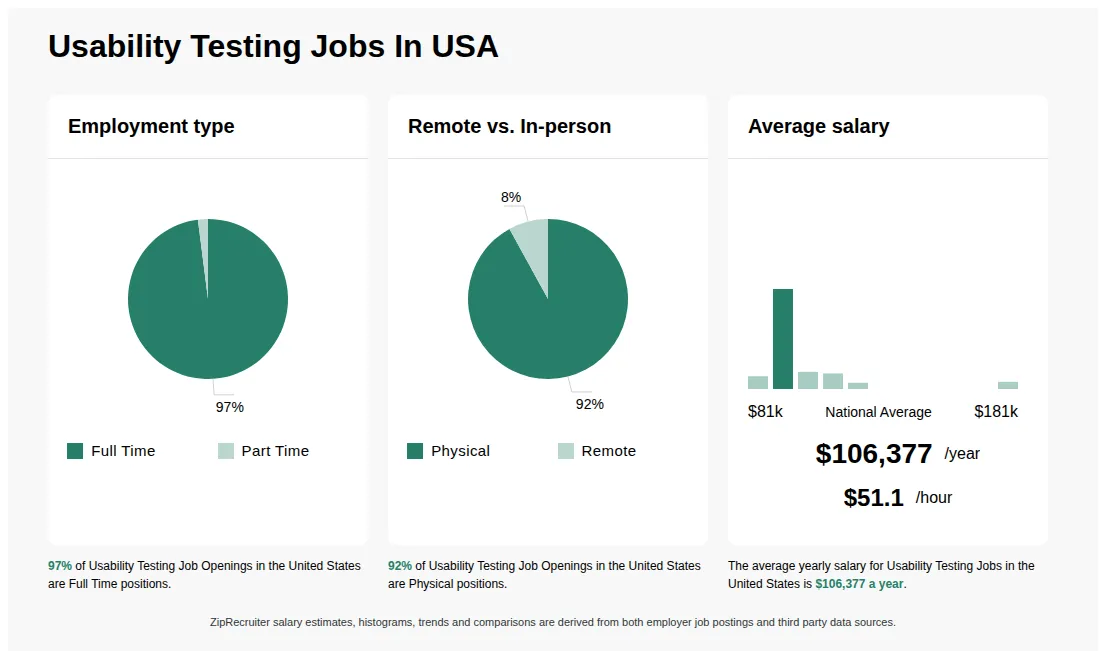
As of Sep 7, 2026, the average yearly pay for usability testing in the United States is $106,377.00, according to ZipRecruiter salary data. Most workers in this role earn between $92,500.00 and $100,000.00 per year, depending on experience, location, and employer.
What is usability testing?
A Usability Testing job involves evaluating digital products, such as websites, apps, or software, to ensure they are user-friendly and easy to navigate. Usability testers observe real users interacting with a product, identify pain points, and provide feedback to improve the overall user experience. This role may involve conducting surveys, interviews, and usability sessions, analyzing results, and collaborating with designers and developers to implement improvements. The goal is to enhance functionality, accessibility, and ease of use for the target audience.
What does a typical usability testing process look like?
A typical usability testing process involves planning test scenarios based on user requirements, recruiting and scheduling participants, moderating tests either in-person or remotely, and collecting both qualitative and quantitative feedback. You’ll often work closely with designers, product managers, and developers to ensure that the tests align with project goals and to relay user insights that inform design decisions. After testing concludes, you'll analyze the data, identify pain points, and present findings through detailed reports or presentations to your team. Collaboration and continuous communication are key, as your feedback directly impacts how products and features are refined to enhance user satisfaction.
What are the key skills and qualifications needed to thrive in usability testing, and why are they important?
To thrive in Usability Testing, you need a strong understanding of user experience (UX) principles, attention to detail, and analytical skills, often supported by a background in design, psychology, or human-computer interaction. Familiarity with usability testing tools such as UserTesting, Optimal Workshop, and remote testing platforms is often required, along with knowledge of survey software and analytics tools. Excellent communication, empathy, and the ability to interpret user behavior are critical soft skills in this position. These competencies are essential to accurately assess product usability, provide actionable feedback, and effectively communicate findings to development teams.
How to become a usability testing professional?
To become a usability testing professional, gain a background in human-computer interaction, psychology, or related fields, and develop skills in user research, testing methods, and data analysis. Familiarity with usability testing tools and platforms, along with certifications such as Certified Usability Analyst (CUA), can enhance job prospects. Practical experience through internships or freelance projects is also valuable.
What does a usability testing do?
A usability tester evaluates how effectively users can interact with a product or website by observing their behavior and collecting feedback. They identify usability issues, suggest improvements, and often use tools like surveys or screen recordings to analyze user experience. This role helps ensure products are user-friendly and meet user needs.
More about Usability Testing jobs
What cities are hiring for Usability Testing jobs?
Cities with the most Usability Testing job openings:
What are the most commonly searched types of Usability Testing jobs?
The most popular types of Usability Testing jobs are:
What states have the most Usability Testing jobs?
States with the most job openings for Usability Testing jobs include:
What job categories do people searching Usability Testing jobs look for?
The top searched job categories for Usability Testing jobs are:

Full-time
Re-posted 17 days ago
Job description
Job Summary:
Syntricate Technologies is looking for an Accessibility Usability Tester to evaluate digital products for accessibility. The role involves conducting assessments using screen readers, providing feedback to product teams, and participating in usability testing sessions for users with visual impairments.
Responsibilities:
• Evaluate digital products, including websites and applications, for accessibility from the perspective of users
• Utilize screen readers and magnification tools to conduct thorough accessibility assessments.
• Provide actionable feedback to product teams, highlighting accessibility issues and suggesting improvements based on WCAG guidelines.
• Participate in usability testing sessions focused on product navigation and interaction for users with visual impairments.
• Create and maintain detailed accessibility documentation, including reports and guidelines tailored to product teams.
• Proficiency in using screen readers (e.g., JAWS, NVDA) and magnification tools (e.g., ZoomText) for product evaluations.
• Strong understanding of WCAG guidelines and ability to apply them effectively to product reviews.
• Experience in usability testing, particularly focused on accessibility for users with visual impairments.
Qualifications:
Required:
• Experience (minimum 2 years) to Evaluate digital products, including websites and applications, for accessibility from the perspective of users
• Utilize screen readers and magnification tools to conduct thorough accessibility assessments.
• Provide actionable feedback to product teams, highlighting accessibility issues and suggesting improvements based on WCAG guidelines.
• Participate in usability testing sessions focused on product navigation and interaction for users with visual impairments.
• Create and maintain detailed accessibility documentation, including reports and guidelines tailored to product teams.
• Proficiency in using screen readers (e.g., JAWS, NVDA) and magnification tools (e.g., ZoomText) for product evaluations.
• Strong understanding of WCAG guidelines and ability to apply them effectively to product reviews.
• Experience in usability testing, particularly focused on accessibility for users with visual impairments.
Company:
Syntricate Technologies offers quality assurance, validation, regulatory, business analysis, and project management services. Founded in 2004, the company is headquartered in Boston, USA, with a team of 51-200 employees. The company is currently Growth Stage.
Syntricate Technologies is looking for an Accessibility Usability Tester to evaluate digital products for accessibility. The role involves conducting assessments using screen readers, providing feedback to product teams, and participating in usability testing sessions for users with visual impairments.
Responsibilities:
• Evaluate digital products, including websites and applications, for accessibility from the perspective of users
• Utilize screen readers and magnification tools to conduct thorough accessibility assessments.
• Provide actionable feedback to product teams, highlighting accessibility issues and suggesting improvements based on WCAG guidelines.
• Participate in usability testing sessions focused on product navigation and interaction for users with visual impairments.
• Create and maintain detailed accessibility documentation, including reports and guidelines tailored to product teams.
• Proficiency in using screen readers (e.g., JAWS, NVDA) and magnification tools (e.g., ZoomText) for product evaluations.
• Strong understanding of WCAG guidelines and ability to apply them effectively to product reviews.
• Experience in usability testing, particularly focused on accessibility for users with visual impairments.
Qualifications:
Required:
• Experience (minimum 2 years) to Evaluate digital products, including websites and applications, for accessibility from the perspective of users
• Utilize screen readers and magnification tools to conduct thorough accessibility assessments.
• Provide actionable feedback to product teams, highlighting accessibility issues and suggesting improvements based on WCAG guidelines.
• Participate in usability testing sessions focused on product navigation and interaction for users with visual impairments.
• Create and maintain detailed accessibility documentation, including reports and guidelines tailored to product teams.
• Proficiency in using screen readers (e.g., JAWS, NVDA) and magnification tools (e.g., ZoomText) for product evaluations.
• Strong understanding of WCAG guidelines and ability to apply them effectively to product reviews.
• Experience in usability testing, particularly focused on accessibility for users with visual impairments.
Company:
Syntricate Technologies offers quality assurance, validation, regulatory, business analysis, and project management services. Founded in 2004, the company is headquartered in Boston, USA, with a team of 51-200 employees. The company is currently Growth Stage.

About Syntricate Technologies
Sourced by ZipRecruiter
Industry
It services
Company size
51 - 200 Employees
Headquarters location
Boston, MA, US