Trauma Coordinator
Beckley, WV · On-site
Trauma Coordinator The Trauma Coordinator is responsible for developing, implementing and maintaining a cost-effective system of care for trauma patients and their families throughout the continuum ...
Beckley, WV · On-site
Trauma Coordinator The Trauma Coordinator is responsible for developing, implementing and maintaining a cost-effective system of care for trauma patients and their families throughout the continuum ...
Beckley, WV · On-site
Trauma Coordinator The Trauma Coordinator is responsible for developing, implementing and maintaining a cost-effective system of care for trauma patients and their families throughout the continuum ...
Beckley, WV · On-site
Overview The Trauma Coordinator is responsible for developing, implementing and maintaining a cost-effective system of care for trauma patients and their families throughout the continuum of care.
Beckley, WV · On-site
Overview The Trauma Coordinator is responsible for developing, implementing and maintaining a cost-effective system of care for trauma patients and their families throughout the continuum of care.
Beckley, WV · On-site
The Trauma Coordinator is responsible for developing, implementing and maintaining a cost-effective system of care for trauma patients and their families throughout the continuum of care. The TPM ...
Beckley, WV · On-site
The Trauma Coordinator is responsible for developing, implementing and maintaining a cost-effective system of care for trauma patients and their families throughout the continuum of care. The TPM ...
Beckley, WV · On-site
Overview The Trauma Coordinator is responsible for developing, implementing and maintaining a cost-effective system of care for trauma patients and their families throughout the continuum of care.
Beckley, WV · On-site
Overview The Trauma Coordinator is responsible for developing, implementing and maintaining a cost-effective system of care for trauma patients and their families throughout the continuum of care.
Beckley, WV · On-site
Overview The Trauma Coordinator is responsible for developing, implementing and maintaining a cost-effective system of care for trauma patients and their families throughout the continuum of care.
Beckley, WV · On-site
Overview The Trauma Coordinator is responsible for developing, implementing and maintaining a cost-effective system of care for trauma patients and their families throughout the continuum of care.
Joliet, IL · On-site
$35.35 - $53.58/hr
The Trauma Coordinator is a registered nurse who is responsible for promoting optimal trauma care, through clinical activities, professional and public education, administrative functions, and ...
Joliet, IL · On-site
$35.35 - $53.58/hr
The Trauma Coordinator is a registered nurse who is responsible for promoting optimal trauma care, through clinical activities, professional and public education, administrative functions, and ...
Joliet, IL · On-site
$35.35 - $53.58/hr
The Trauma Coordinator is a registered nurse who is responsible for promoting optimal trauma care, through clinical activities, professional and public education, administrative functions, and ...
Joliet, IL · On-site
$35.35 - $53.58/hr
The Trauma Coordinator is a registered nurse who is responsible for promoting optimal trauma care, through clinical activities, professional and public education, administrative functions, and ...
Joliet, IL · On-site
$35.35 - $53.58/hr
The Trauma Coordinator is a registered nurse who is responsible for promoting optimal trauma care, through clinical activities, professional and public education, administrative functions, and ...
Joliet, IL · On-site
$35.35 - $53.58/hr
The Trauma Coordinator is a registered nurse who is responsible for promoting optimal trauma care, through clinical activities, professional and public education, administrative functions, and ...
The Trauma Program Coordinator is a professional Registered Nurse who works collaboratively with the Trauma Medical Director (TMD) to assume responsibility and accountability for the oversight of the ...
The Trauma Program Coordinator is a professional Registered Nurse who works collaboratively with the Trauma Medical Director (TMD) to assume responsibility and accountability for the oversight of the ...
The Trauma Program Coordinator is a professional Registered Nurse who works collaboratively with the Trauma Medical Director (TMD) to assume responsibility and accountability for the oversight of the ...
The Trauma Program Coordinator is a professional Registered Nurse who works collaboratively with the Trauma Medical Director (TMD) to assume responsibility and accountability for the oversight of the ...
Sugar Land, TX · On-site
Trauma Coordinator RN Inspired by faith. Driven by innovation. Powered by humankindness. CommonSpirit Health is building a healthier future for all through its integrated health services. As one of ...
Sugar Land, TX · On-site
Trauma Coordinator RN Inspired by faith. Driven by innovation. Powered by humankindness. CommonSpirit Health is building a healthier future for all through its integrated health services. As one of ...
The Trauma Program Coordinator is a professional Registered Nurse who works collaboratively with the Trauma Medical Director (TMD) to assume the responsibility and accountability for the oversight of ...
The Trauma Program Coordinator is a professional Registered Nurse who works collaboratively with the Trauma Medical Director (TMD) to assume the responsibility and accountability for the oversight of ...
Stroke & Trauma Coordinator Under the direction of the Director of Emergency Services, the Stroke & Trauma Coordinator is primarily responsible for quality assurance, developing goals and objectives ...
Stroke & Trauma Coordinator Under the direction of the Director of Emergency Services, the Stroke & Trauma Coordinator is primarily responsible for quality assurance, developing goals and objectives ...
Little Rock, AR · On-site
Trauma System Shift: Day Working Hours: M-F 8-5 Summary: Coordinated and facilitates transition of the trauma patient from inpatient status into the outpatient setting for follow-up. Functions in the ...
Little Rock, AR · On-site
Trauma System Shift: Day Working Hours: M-F 8-5 Summary: Coordinated and facilitates transition of the trauma patient from inpatient status into the outpatient setting for follow-up. Functions in the ...
The Trauma Program Coordinator is a professional Registered Nurse who works collaboratively with the Trauma Medical Director (TMD) to assume responsibility and accountability for the oversight of the ...
The Trauma Program Coordinator is a professional Registered Nurse who works collaboratively with the Trauma Medical Director (TMD) to assume responsibility and accountability for the oversight of the ...
The Trauma Program Coordinator is a professional Registered Nurse who works collaboratively with the Trauma Medical Director (TMD) to assume responsibility and accountability for the oversight of the ...
The Trauma Program Coordinator is a professional Registered Nurse who works collaboratively with the Trauma Medical Director (TMD) to assume responsibility and accountability for the oversight of the ...
The Trauma Program Coordinator is a professional Registered Nurse who works collaboratively with the Trauma Medical Director (TMD) to assume responsibility and accountability for the oversight of the ...
The Trauma Program Coordinator is a professional Registered Nurse who works collaboratively with the Trauma Medical Director (TMD) to assume responsibility and accountability for the oversight of the ...
The Trauma Program Coordinator is a professional Registered Nurse who works collaboratively with the Trauma Medical Director (TMD) to assume responsibility and accountability for the oversight of the ...
The Trauma Program Coordinator is a professional Registered Nurse who works collaboratively with the Trauma Medical Director (TMD) to assume responsibility and accountability for the oversight of the ...
The Trauma Program Coordinator is a professional Registered Nurse who works collaboratively with the Trauma Medical Director (TMD) to assume responsibility and accountability for the oversight of the ...
The Trauma Program Coordinator is a professional Registered Nurse who works collaboratively with the Trauma Medical Director (TMD) to assume responsibility and accountability for the oversight of the ...
The Trauma Program Coordinator is a professional Registered Nurse who works collaboratively with the Trauma Medical Director (TMD) to assume the responsibility and accountability for the oversight of ...
The Trauma Program Coordinator is a professional Registered Nurse who works collaboratively with the Trauma Medical Director (TMD) to assume the responsibility and accountability for the oversight of ...
$18.03 - $20.87
3% of jobs
$20.87 - $23.71
0% of jobs
$23.71 - $26.55
0% of jobs
$26.55 - $29.39
6% of jobs
$29.39 - $32.23
14% of jobs
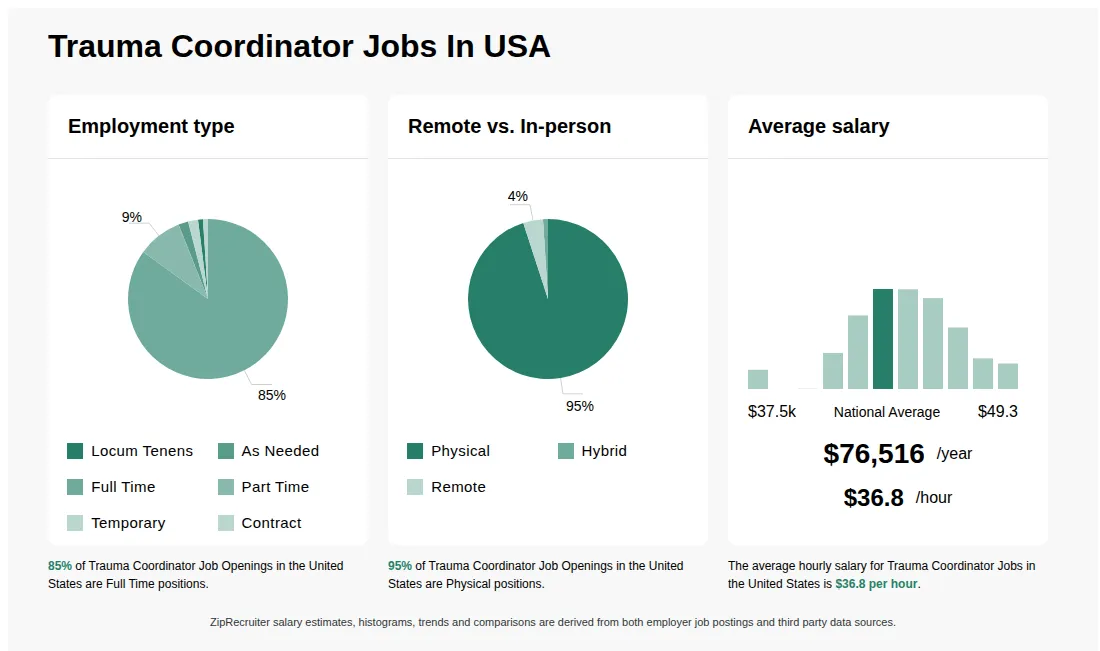
$32.47 is the 25th percentile. Wages below this are outliers.
$32.23 - $35.07
19% of jobs
The median wage is $36.18 / hr.
$35.07 - $37.92
19% of jobs
$40.13 is the 75th percentile. Wages above this are outliers.
$37.92 - $40.76
17% of jobs
$40.76 - $43.60
12% of jobs
$43.60 - $46.44
5% of jobs
$46.44 - $49.28
4% of jobs
$18
$36
$49
A Trauma Coordinator works with hospital patients in a trauma or acute care program to help guide them through the treatment process. As a trauma coordinator, your job duties include communicating with patients and their families, facilitating timely access to the appropriate care, and coordinating timely discharge of patients from the hospital. The qualifications to have a career as a trauma coordinator include a master’s degree and ample experience in nursing. You need excellent management and interpersonal skills as well.
| Trauma Coordinator | Emergency Department Nurse |
|---|---|
| Coordinates trauma care, manages trauma protocols, and facilitates communication among teams | Provides direct patient care in emergency settings, performs assessments, administers treatments |
While both roles work in trauma and emergency settings, Trauma Coordinators focus on organizing and managing trauma programs, whereas Emergency Department Nurses provide direct patient care in urgent situations. Trauma Coordinators often have specialized training in trauma systems, while Emergency Nurses are typically registered nurses with emergency certification. Both roles are essential in hospitals but serve different functions within the trauma care continuum.
Cities with the most Trauma Coordinator job openings:
The most popular types of Trauma jobs are:
The top employers for Trauma Coordinator jobs are:
States with the most job openings for Trauma Coordinator jobs include:
For Trauma Coordinator jobs, the most frequently searched job titles are:
Beckley, WV • On-site
Other
Re-posted 8 days ago
The Trauma Coordinator is responsible for developing, implementing and maintaining a cost-effective system of care for trauma patients and their families throughout the continuum of care. The TPM works both independently and in collaboration with the trauma services medical director and other members of the health care team and the management staff. The TPM is self-directed and self-motivating, plans and conducts work with minimal direction, and reports the progress of work to the director of nursing.
ResponsibilitiesEstablished support individual contributor that executes tasks that are typically routine, with some deviation from standard practice. Follows processes to ensure accuracy, timeliness, and quality of deliverables. Develops and routinely evaluates critical pathways, and/or plan of care for trauma injuries in collaboration with the multidisciplinary trauma team members. Ensures preparedness of trauma units for management of the trauma by identifying individual unit needs and addressing through appropriate channels for successful resolutions. Communicates in a timely manner, issues related to trauma care or individual trauma patients need with Trauma Coordinator, and/or Trauma Medical Director. Demonstrates the organization's mission, vision, and core values of improving health and promoting well-being.
QualificationsAssociates degree in nursing required. Bachelors degree in nursing preferred. Minimum Work Experience: Two years' clinical experience in trauma/emergency care. Required Skills, Knowledge, and Abilities: Ability to establish and maintain effective interpersonal relationships. Ability to accept and implement changes. Ability to solve problems and make decisions. Possession of critical thinking, analytical, teaching/coaching and research skills. Currently certified in TNCC. Currently licensed as a registered nurse in Kentucky.