Responsible for coordinating supplemental engineering service providers and/or contractors performing transport/telecommunications engineering design and implementation * Responsible for providing ...
Responsible for coordinating supplemental engineering service providers and/or contractors performing transport/telecommunications engineering design and implementation * Responsible for providing ...

Telecommunications Analyst
Boston, MA · On-site
$33.65 - $45.29/hr
Manages telecom projects and supervises the work of Telecom Associates and Contractors working for the Telecommunications Department to ensure quality of craftsmanship or to verify and approve the ...
Telecommunications Analyst
Boston, MA · On-site
$33.65 - $45.29/hr
Manages telecom projects and supervises the work of Telecom Associates and Contractors working for the Telecommunications Department to ensure quality of craftsmanship or to verify and approve the ...

This position does not have direct supervisory responsibility but may provide technical direction, training, and oversight to contractors, vendors, and junior IT support staff on telecommunications ...
This position does not have direct supervisory responsibility but may provide technical direction, training, and oversight to contractors, vendors, and junior IT support staff on telecommunications ...

Telecommunications Engineer
San Francisco, CA · On-site
$70K - $150K/yr
Develop engineering design drawing and specification packages for contractor bidding. * Oversee, lead, and perform telecommunications project design efforts for fiber optic, microwave, and two-way ...
Telecommunications Engineer
San Francisco, CA · On-site
$70K - $150K/yr
Develop engineering design drawing and specification packages for contractor bidding. * Oversee, lead, and perform telecommunications project design efforts for fiber optic, microwave, and two-way ...
Telecommunications Engineer
Liverpool, NY · On-site
$70K - $120K/yr
Develop engineering design drawing and specification packages for contractor bidding. * Oversee, lead, and perform telecommunications project design efforts for fiber optic, microwave, and two-way ...
Telecommunications Engineer
Liverpool, NY · On-site
$70K - $120K/yr
Develop engineering design drawing and specification packages for contractor bidding. * Oversee, lead, and perform telecommunications project design efforts for fiber optic, microwave, and two-way ...
Responsible for coordinating supplemental engineering service providers and/or contractors performing transport/telecommunications engineering design and implementation * Responsible for providing ...
Responsible for coordinating supplemental engineering service providers and/or contractors performing transport/telecommunications engineering design and implementation * Responsible for providing ...

Telecommunications Foreman
Chantilly, VA · On-site
$60K - $180K/yr
Hands-on experience & knowledge in the installation of Low-Voltage specialty contracting industries ... Telecommunications Grounding Systems. * Ability to lead the installation of cable from ...
Telecommunications Foreman
Chantilly, VA · On-site
$60K - $180K/yr
Hands-on experience & knowledge in the installation of Low-Voltage specialty contracting industries ... Telecommunications Grounding Systems. * Ability to lead the installation of cable from ...

Telecommunications Specialist IV About Rigil Rigil is an award-winning, woman-owned, small business ... Occasionally, required to perform after-hours maintenance work or escort other vendors/contractors ...
Quick apply
Telecommunications Specialist IV About Rigil Rigil is an award-winning, woman-owned, small business ... Occasionally, required to perform after-hours maintenance work or escort other vendors/contractors ...
SNG is Seneca Holdings' federal government contracting business that meets mission-critical needs ... The Telecommunications Technician Installs and maintains all aspects of communication systems ...
SNG is Seneca Holdings' federal government contracting business that meets mission-critical needs ... The Telecommunications Technician Installs and maintains all aspects of communication systems ...

Telecommunications Specialist
Fort George G Meade, MD · On-site
$121K/yr
Experience conducting evaluations of telecommunications systems, projects, or programs to determine future expenditures, serving as Contracting Officer's Representative (COR), managing ...
Telecommunications Specialist
Fort George G Meade, MD · On-site
$121K/yr
Experience conducting evaluations of telecommunications systems, projects, or programs to determine future expenditures, serving as Contracting Officer's Representative (COR), managing ...
Telecommunications Engineer
Ashland, KY · On-site
$55 - $75/hr
... contractors, and university teams on technical requirements. • Contributes to maintaining telecommunications standards, design guidelines, and specifications. • Supports project managers with ...
Telecommunications Engineer
Ashland, KY · On-site
$55 - $75/hr
... contractors, and university teams on technical requirements. • Contributes to maintaining telecommunications standards, design guidelines, and specifications. • Supports project managers with ...
Landscape Restoration- Construction Labor
Olathe, KS · On-site
$20 - $25/hr
RLM Underground is a rapidly growing telecommunications contractor specializing in underground and aerial construction projects across the nation. Since 2016, we've expanded our operations into ...
Quick apply
Landscape Restoration- Construction Labor
Olathe, KS · On-site
$20 - $25/hr
RLM Underground is a rapidly growing telecommunications contractor specializing in underground and aerial construction projects across the nation. Since 2016, we've expanded our operations into ...

Cellular Technician (Entry-Level)
Goodyear, AZ · On-site
$17.50 - $20.50/hr
About Desert Services International Desert Services International (DSI) is a fast-growing general and telecommunications contractor headquartered in Goodyear, Arizona. We specialize in building and ...
Quick apply
Cellular Technician (Entry-Level)
Goodyear, AZ · On-site
$17.50 - $20.50/hr
About Desert Services International Desert Services International (DSI) is a fast-growing general and telecommunications contractor headquartered in Goodyear, Arizona. We specialize in building and ...

Coordinate with Government personnel, contractors, and customers to complete assigned work ... Technical training in telecommunications, electronics, networking, or a related field preferred.
Coordinate with Government personnel, contractors, and customers to complete assigned work ... Technical training in telecommunications, electronics, networking, or a related field preferred.
SCA Telecommunications Mechanic II
San Angelo, TX · On-site
$65 - $85/hr
Coordinate with Government personnel, contractors, and customers to complete assigned work ... Technical training in telecommunications, electronics, networking, or a related field preferred.
SCA Telecommunications Mechanic II
San Angelo, TX · On-site
$65 - $85/hr
Coordinate with Government personnel, contractors, and customers to complete assigned work ... Technical training in telecommunications, electronics, networking, or a related field preferred.
Telecommunications Engineer
Morehead, KY · On-site +1
... contractors, and university teams on technical requirements. • Contributes to maintaining telecommunications standards, design guidelines, and specifications. • Supports project managers with ...
Telecommunications Engineer
Morehead, KY · On-site +1
... contractors, and university teams on technical requirements. • Contributes to maintaining telecommunications standards, design guidelines, and specifications. • Supports project managers with ...

Collaborates with vendors, contractors, and university teams on technical requirements. Contributes to maintaining telecommunications standards, design guidelines, and specifications. Supports ...
Collaborates with vendors, contractors, and university teams on technical requirements. Contributes to maintaining telecommunications standards, design guidelines, and specifications. Supports ...
Telecommunications Engineer
Morehead, KY · On-site +1
... contractors, and university teams on technical requirements. • Contributes to maintaining telecommunications standards, design guidelines, and specifications. • Supports project managers with ...
Telecommunications Engineer
Morehead, KY · On-site +1
... contractors, and university teams on technical requirements. • Contributes to maintaining telecommunications standards, design guidelines, and specifications. • Supports project managers with ...
Collaborates with vendors, contractors, and university teams on technical requirements. Contributes to maintaining telecommunications standards, design guidelines, and specifications. Supports ...
Collaborates with vendors, contractors, and university teams on technical requirements. Contributes to maintaining telecommunications standards, design guidelines, and specifications. Supports ...

LS Technologies, a Tetra Tech Company, is seeking a Telecommunications Project Engineer with ... Tetra Tech is a VEVRAA federal contractor, and we request priority referral of veterans. We invite ...
LS Technologies, a Tetra Tech Company, is seeking a Telecommunications Project Engineer with ... Tetra Tech is a VEVRAA federal contractor, and we request priority referral of veterans. We invite ...
Telecommunications Contractor information
See salary details
$40K - $48.5K
4% of jobs
$48.5K - $56.9K
2% of jobs
$56.9K - $65.4K
4% of jobs
$65.4K - $73.8K
11% of jobs
$77.1K is the 25th percentile. Wages below this are outliers.
$73.8K - $82.3K
10% of jobs
The median wage is $88.4K / yr.
$82.3K - $90.7K
27% of jobs
$90.7K - $99.2K
12% of jobs
$99.2K - $107.6K
4% of jobs
$109.4K is the 75th percentile. Wages above this are outliers.
$107.6K - $116.1K
7% of jobs
$116.1K - $124.5K
13% of jobs
$124.5K - $133K
6% of jobs
$40K
$93.3K
$133K
How much do telecommunications contractor jobs pay per year?
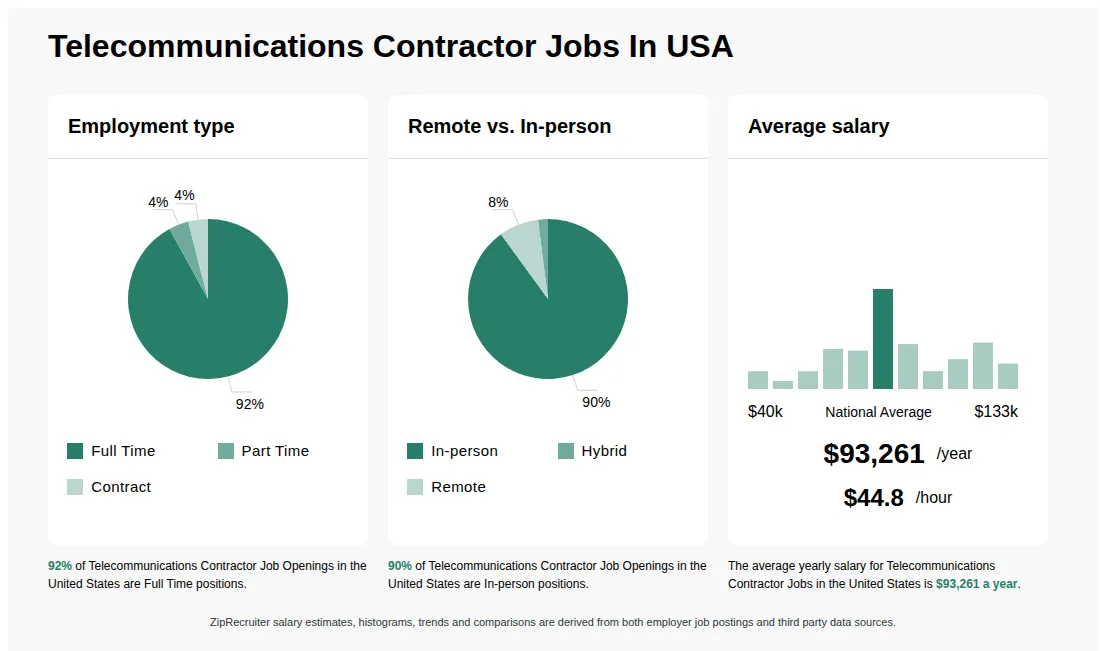
As of Sep 5, 2026, the average yearly pay for telecommunications contractor in the United States is $93,261.00, according to ZipRecruiter salary data. Most workers in this role earn between $81,000.00 and $112,000.00 per year, depending on experience, location, and employer.
What is a telecommunications contractor?
Telecommunications contractors are professionals or companies responsible for installing, maintaining, and repairing communication systems such as phone lines, internet networks, and data cabling. They work with both residential and commercial clients to ensure reliable and efficient communication infrastructure. Their duties often include setting up wiring, configuring network equipment, troubleshooting connectivity issues, and upgrading systems to support new technologies. Telecommunications contractors must adhere to industry standards and safety regulations while working on-site or remotely. Many also provide consultation services for designing and planning new telecommunications projects.
What types of projects and clients can a telecommunications contractor expect to work with on a regular basis?
Telecommunications Contractors often work on a wide range of projects, including installing and maintaining phone systems, data networks, fiber optic cabling, and wireless infrastructure for clients such as corporations, government agencies, educational institutions, and healthcare facilities. The work may involve both new construction and upgrading existing systems. Contractors frequently collaborate with IT teams, project managers, and other trades, requiring strong communication and coordination skills. The variety of projects offers exposure to different technologies and environments, supporting ongoing skills development and potential career advancement.
What are the key skills and qualifications needed to thrive as a telecommunications contractor, and why are they important?
To thrive as a Telecommunications Contractor, you need expertise in network installation, cable splicing, and system troubleshooting, typically supported by relevant certifications such as BICSI or OSHA safety training. Familiarity with telecom testing equipment, fiber optic tools, and industry-standard wiring systems is essential. Strong problem-solving skills, attention to detail, and effective communication with clients and teams help you stand out in this role. These competencies ensure safe, efficient installation and maintenance of telecommunications infrastructure, meeting client and industry requirements.
What is the difference between Telecommunications Contractor vs Telecommunications Technician?
| Aspect | Telecommunications Contractor | Telecommunications Technician |
|---|---|---|
| Credentials | Typically requires certifications like BICSI, OSHA, and relevant licenses | Often requires technical certifications or associate degrees in telecommunications or electronics |
| Work Environment | Works on installation, maintenance, and repair at various sites, often independently or with teams | Performs hands-on installation, troubleshooting, and repair primarily in field or lab settings |
| Employer & Industry Usage | Hired by companies or clients for large projects; operates in construction and telecom sectors | Employed by telecom companies or contractors; focuses on technical support and system setup |
Telecommunications Contractors and Telecommunications Technicians both work in the telecom industry, but contractors typically handle project management and large installations, requiring certifications and licenses. Technicians focus on technical tasks like troubleshooting and repairs, often with specialized technical training. Understanding these differences helps clarify roles and career paths within the telecommunications field.
More about Telecommunications Contractor jobs
What cities are hiring for Telecommunications Contractor jobs?
Cities with the most Telecommunications Contractor job openings:
What states have the most Telecommunications Contractor jobs?
States with the most job openings for Telecommunications Contractor jobs include:
What job categories do people searching Telecommunications Contractor jobs look for?
The top searched job categories for Telecommunications Contractor jobs are:

Full-time
Medical, Retirement
This job post has expired 3 days ago. Applications are no longer accepted.
Southern Company rating

8.4
Based on 23 frontline employees who took The Breakroom Quiz
Job description
Telecommunication Engineer, Sr.
Purpose
The Telecommunications Engineer is responsible for providing tactical planning, engineering design, engineering consulting, documentation, licensing, equipment lifecycle management, and third-level technical support of the telecommunications transport and wireless networks for the Southern Company and associated subsidiaries. The associated telecommunications networks include fiber optics and related optronics environments, WAN and data communications equipment, ancillary systems, and leased telecommunications services.
Job Responsibilities
- Initial alignment for this role will be in the Fiber to Distribution/GPON dimension of our business leveraging the Adtran TA5000 family of equipment.
- Responsible for strategic and tactical plans and engineering designs for all telecom network facilities and services provided.
- Responsible for assisting in the management and prioritization of an annual functional budget and capital budget for transport network improvements in concert with related network planning, business case development, and engineering design.
- Responsible for development and compliance of engineering standards including documentation, product lifecycle plans, and design packages.
- Responsible for coordinating supplemental engineering service providers and/or contractors performing transport/telecommunications engineering design and implementation
- Responsible for providing support to other Southern Company Operating Companies and/or Partners on issues related to transport network planning, engineering design, and engineering consulting.
- Responsible for developing and participation in the successful completion of specified projects within Southern Company territory to include Systems Protection initiatives, long haul fiber, leased service delivery, 3rd party fiber leases, wireless services, and GPON (Gigabit Passive Optical Networks) technology.
- Responsible for providing third-level maintenance (reactive, preventative, and quality assurance) support as well as backup maintenance/installation coverage related to the identified networks/equipment.
- Responsible for recommending and coordinating equipment and service health monitoring activity for any new telecommunications nodes and/or services.
Job Requirements
- Experience in planning and establishment of Distribution SCADA services and other WAN-based services.
- Experience and/or familiarity with telecommunications transport systems such as fiber optics, and RF/MW technology
- Experience in coordinating a cross functional team to achieve customer expectations and deadlines.
- Knowledge of fiber to include OSP across multiple platforms preferred.
- Knowledge in distributed computer networks including but not limited to: routers, switches, hubs, digital transport, fiber optic transport (including GPON and DWDM), microwave radio, wireless, voice (Including VOIP), Systems Protection, SCADA systems, TGBs and firewalls. Including fundamental knowledge of the interconnectivity and convergence between the technologies.
- Knowledge of SONET/TDM, Switched Ethernet, MPLS, GPON and IP WAN technologies.
- Knowledge in SCADA systems and remotely polled RTU devices.
- General knowledge of Transmission Systems Protection services and requirements.
- Understanding of budgeting (capital and functional) and accounting processes to ensure compliance with the budget.
- Demonstrated personal computer skills (i.e. Word, Excel, etc.) / proficient with the Southern Company standard computing applications with technical skills in documentation tools (Visio, drafting, as-builts, prints, etc.)
- Effective oral and written communications skills with the ability to convey complex technical issues in business terms.
- Knowledge and understanding of IT Security requirements preferred.
- Knowledge of layers one, two, and three of the OSI model preferred.
- Self-motivated with the ability to effectively manage multiple project responsibilities simultaneously.
- Team-oriented with a strong work ethic.
- Ability to build relationships, to communicate and work with all levels of management, vendors, and other internal and external groups and customers and exhibit positive influence at all levels.
- Perform other request work that transitions to the department.
- Strategic thinker that can embrace, influence, and lead change.
Competencies
- General knowledge of Southern Company's core business
- General knowledge of information technologies (those currently used within the system and new technologies)
- General knowledge of IT infrastructure components
- Understand engineering/analysis/design discipline and methodology
- Ability to effectively organize tasks, manage multiple priorities/details, meet schedules, and deliver on customer commitments
- Ability to negotiate with and influence others - internally as well as vendors
- Ability to build relationships and work in a team atmosphere
- Ability to provide and accept feedback
- Strong analytical and troubleshooting skills
- Demonstrate Southern Company Core Values
- Professional oral and written communication skills
- Ability to perform each task safely
Education
Bachelor's degree in Engineering required; Electrical Engineering, Telecommunications, or a related field.
Work Location and Hours
The successful candidate must live in the Southern Company footprint and travel to telecom locations, project sites, and meetings throughout the system as required.
Subject to 24x7 call-out rotation and emergency response support.
This position falls under the company's Insider Threat Program and will have access to, and control over sensitive data, systems or assets. Enhanced personnel screening, which includes a background review, drug screen and psychological assessment, will be required if you are selected for this position
About Southern Company
Southern Company (NYSE: SO) is a leading energy provider serving 9 million customers across the Southeast and beyond through its family of companies. Providing clean, safe, reliable and affordable energy with excellent service is our mission. The company has electric operating companies in three states, natural gas distribution companies in four states, a competitive generation company, a leading distributed energy solutions provider with national capabilities, a fiber optics network and telecommunications services. Through an industry-leading commitment to innovation, resilience and sustainability, we are taking action to meet customers' and communities' needs while advancing our goal of net-zero greenhouse gas emissions by 2050. Our uncompromising values ensure we put the needs of those we serve at the center of everything we do and are the key to our sustained success. We are transforming energy into economic, environmental and social progress for tomorrow. Our corporate culture has been recognized by a variety of organizations, earning the company awards and recognitions that reflect Our Values and dedication to service. To learn more, visit www.southerncompany.com.
Southern Company invests in the well-being of its employees and their families through a comprehensive total rewards strategy that includes competitive base salary, annual incentive awards for eligible employees and health, welfare and retirement benefits designed to support physical, financial, and emotional/social well-being. This position may also be eligible for additional compensation, such as an incentive program, with the amount of any bonus/awards subject to the terms and conditions of the applicable incentive plan(s). A summary of the benefits offered for this position can be found here https://seo.nlx.org/southernco/pdf/SOCO-Benefits.pdf. Additional and specific details about total compensation and benets will also be provided during the hiring process.
Southern Company is an equal opportunity employer where an applicant's qualifications are considered without regard to race, color, religion, sex, national origin, age, disability, veteran status, genetic information, sexual orientation, gender identity or expression, or any other basis prohibited by law.
What Southern Company employees say
Pay
Benefits
Hours and flexibility
Workplace
Get the full story on Breakroom