The Telecommunications Engineer will evaluate existing telecommunications environments, develop ... Review contractor designs, technical submittals, installation plans, testing documentation, and as ...
The Telecommunications Engineer will evaluate existing telecommunications environments, develop ... Review contractor designs, technical submittals, installation plans, testing documentation, and as ...
The Telecommunications Engineer will evaluate existing telecommunications environments, develop ... Review contractor designs, technical submittals, installation plans, testing documentation, and as ...
Quick apply
The Telecommunications Engineer will evaluate existing telecommunications environments, develop ... Review contractor designs, technical submittals, installation plans, testing documentation, and as ...
The Telecommunications Engineer will evaluate existing telecommunications environments, develop ... Review contractor designs, technical submittals, installation plans, testing documentation, and as ...
Quick apply
The Telecommunications Engineer will evaluate existing telecommunications environments, develop ... Review contractor designs, technical submittals, installation plans, testing documentation, and as ...
Fiber Technicians
Indianapolis, IN · On-site
$55K - $85K/yr
EZ COMM LLC is a trusted telecommunications contractor serving the Indianapolis, IN area and beyond, dedicated to delivering reliable fiber optic solutions to homes and businesses. Our customers ...
Quick apply
Fiber Technicians
Indianapolis, IN · On-site
$55K - $85K/yr
EZ COMM LLC is a trusted telecommunications contractor serving the Indianapolis, IN area and beyond, dedicated to delivering reliable fiber optic solutions to homes and businesses. Our customers ...
Engineer, Instrument & Controls
Houston, TX · On-site
$100 - $160/hr
Work with the EPC Contractor, the Main Automation Contractor, the Telecommunications contractor and package vendors to implement detailed design specifications for instrumentation and control systems.
Engineer, Instrument & Controls
Houston, TX · On-site
$100 - $160/hr
Work with the EPC Contractor, the Main Automation Contractor, the Telecommunications contractor and package vendors to implement detailed design specifications for instrumentation and control systems.
Landscape Restoration- Construction Labor
Pickford, MI · On-site
$20 - $30/hr
RLM Underground is a rapidly growing telecommunications contractor specializing in underground and aerial construction projects across the nation. Since 2016, we've expanded our operations into ...
Quick apply
Landscape Restoration- Construction Labor
Pickford, MI · On-site
$20 - $30/hr
RLM Underground is a rapidly growing telecommunications contractor specializing in underground and aerial construction projects across the nation. Since 2016, we've expanded our operations into ...

Project Manager
Fort Wayne, IN · On-site
Company Description Premier Communications is a leading telecommunications contractor and integrator based in Fort Wayne, IN. The organization specializes in voice and data systems, fire alarm ...
Project Manager
Fort Wayne, IN · On-site
Company Description Premier Communications is a leading telecommunications contractor and integrator based in Fort Wayne, IN. The organization specializes in voice and data systems, fire alarm ...
Telecom Fiber Splicer
Olathe, KS · On-site
$24.25 - $28.75/hr
RLM has rapidly grown at staggering rates, leading to the expansion of its construction and operating capabilities into a full-turnkey telecommunications contractor. Position Summary: RLM Underground ...
Quick apply
Telecom Fiber Splicer
Olathe, KS · On-site
$24.25 - $28.75/hr
RLM has rapidly grown at staggering rates, leading to the expansion of its construction and operating capabilities into a full-turnkey telecommunications contractor. Position Summary: RLM Underground ...

As a trusted prime contractor with over $160 million in task order awards, we operate across 22 ... This role provides telecommunications systems engineering, design, deployment, and O&M support for ...
Quick apply
As a trusted prime contractor with over $160 million in task order awards, we operate across 22 ... This role provides telecommunications systems engineering, design, deployment, and O&M support for ...

Telecommunications Analyst
Manassas, VA · On-site
$84 - $103/hr
With the assistance of a maintenance contractor, conducts and sets up a regular maintenance schedule on telecommunications systems as required. * Assists with a departmental budget to include ...
Telecommunications Analyst
Manassas, VA · On-site
$84 - $103/hr
With the assistance of a maintenance contractor, conducts and sets up a regular maintenance schedule on telecommunications systems as required. * Assists with a departmental budget to include ...
$120 - $150/hr
The Telecommunications Engineer will evaluate existing telecommunications environments, develop ... Review contractor designs, technical submittals, installation plans, testing documentation, and as ...
$120 - $150/hr
The Telecommunications Engineer will evaluate existing telecommunications environments, develop ... Review contractor designs, technical submittals, installation plans, testing documentation, and as ...

Build the Future with Us - EquipmentShare is Hiring a Telecommunications Administrator At ... Work effectively with 3rd party vendors and contractors to deploy/troubleshoot new and existing ...
Build the Future with Us - EquipmentShare is Hiring a Telecommunications Administrator At ... Work effectively with 3rd party vendors and contractors to deploy/troubleshoot new and existing ...
Telecommunications Engineer New Washington DC/Baltimore MD
Baltimore, MD · On-site
$120 - $150/hr
The Telecommunications Engineer will evaluate existing telecommunications environments, develop ... Review contractor designs, technical submittals, installation plans, testing documentation, and as ...
Telecommunications Engineer New Washington DC/Baltimore MD
Baltimore, MD · On-site
$120 - $150/hr
The Telecommunications Engineer will evaluate existing telecommunications environments, develop ... Review contractor designs, technical submittals, installation plans, testing documentation, and as ...
Build the Future with Us - EquipmentShare is Hiring a Telecommunications Administrator At ... Work effectively with 3rd party vendors and contractors to deploy/troubleshoot new and existing ...
Build the Future with Us - EquipmentShare is Hiring a Telecommunications Administrator At ... Work effectively with 3rd party vendors and contractors to deploy/troubleshoot new and existing ...

Be Seen First
Telecommunications Analyst
Washington, DC · On-site
Collaborate with telecommunications carriers, Microsoft, and third-party vendors to maintain ... VEVRAA Federal Contractor.
Quick apply
Be Seen First
Telecommunications Analyst
Washington, DC · On-site
Collaborate with telecommunications carriers, Microsoft, and third-party vendors to maintain ... VEVRAA Federal Contractor.

Telecommunications Technician
Dover, DE · On-site
... contractors. * Verifies service by testing circuits, equipment, and alarms; and identifying ... BA/BS in Telecommunications or equivalent technical degree or equivalent experience, OSHA ...
Quick apply
Telecommunications Technician
Dover, DE · On-site
... contractors. * Verifies service by testing circuits, equipment, and alarms; and identifying ... BA/BS in Telecommunications or equivalent technical degree or equivalent experience, OSHA ...

Telecommunications Specialist
Fort George G Meade, MD · On-site +1
$121K - $158K/yr
Performs comprehensive technical analysis of contractor deliverables. Analyzes deliverables for ... Conducts evaluations of telecommunications systems, projects, or programs to determine future ...
Telecommunications Specialist
Fort George G Meade, MD · On-site +1
$121K - $158K/yr
Performs comprehensive technical analysis of contractor deliverables. Analyzes deliverables for ... Conducts evaluations of telecommunications systems, projects, or programs to determine future ...

This position does not have direct supervisory responsibility but may provide technical direction, training, and oversight to contractors, vendors, and junior IT support staff on telecommunications ...
This position does not have direct supervisory responsibility but may provide technical direction, training, and oversight to contractors, vendors, and junior IT support staff on telecommunications ...

Telecommunications Technician JOB SUMMARY Candidate will install, splice, tip, terminate, test and ... contractors. * Verifies service by testing circuits, equipment, and alarms; and identifying ...
Telecommunications Technician JOB SUMMARY Candidate will install, splice, tip, terminate, test and ... contractors. * Verifies service by testing circuits, equipment, and alarms; and identifying ...
Telecommunications Technician JOB SUMMARY Candidate will install, splice, tip, terminate, test and ... contractors. * Verifies service by testing circuits, equipment, and alarms; and identifying ...
Telecommunications Technician JOB SUMMARY Candidate will install, splice, tip, terminate, test and ... contractors. * Verifies service by testing circuits, equipment, and alarms; and identifying ...
Telecommunications Contractor information
See salary details
$40K - $48.5K
4% of jobs
$48.5K - $56.9K
2% of jobs
$56.9K - $65.4K
4% of jobs
$65.4K - $73.8K
11% of jobs
$77.1K is the 25th percentile. Wages below this are outliers.
$73.8K - $82.3K
10% of jobs
The median wage is $88.4K / yr.
$82.3K - $90.7K
27% of jobs
$90.7K - $99.2K
12% of jobs
$99.2K - $107.6K
4% of jobs
$109.4K is the 75th percentile. Wages above this are outliers.
$107.6K - $116.1K
7% of jobs
$116.1K - $124.5K
13% of jobs
$124.5K - $133K
6% of jobs
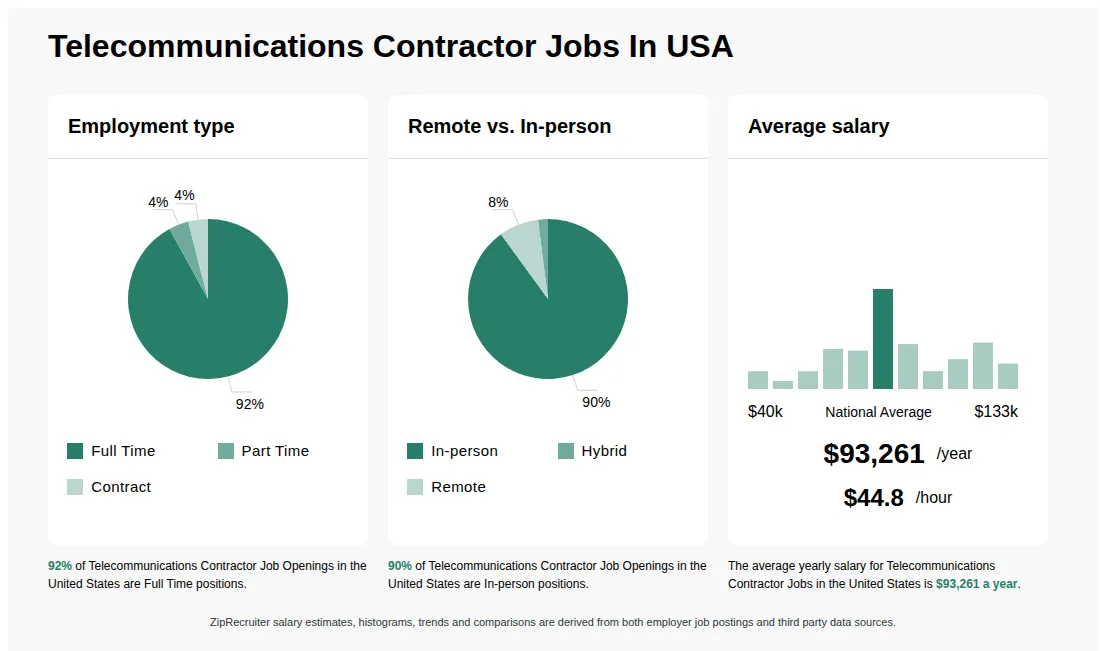
$40K
$93.3K
$133K
How much do telecommunications contractor jobs pay per year?
As of Sep 5, 2026, the average yearly pay for telecommunications contractor in the United States is $93,261.00, according to ZipRecruiter salary data. Most workers in this role earn between $81,000.00 and $112,000.00 per year, depending on experience, location, and employer.
What is a telecommunications contractor?
Telecommunications contractors are professionals or companies responsible for installing, maintaining, and repairing communication systems such as phone lines, internet networks, and data cabling. They work with both residential and commercial clients to ensure reliable and efficient communication infrastructure. Their duties often include setting up wiring, configuring network equipment, troubleshooting connectivity issues, and upgrading systems to support new technologies. Telecommunications contractors must adhere to industry standards and safety regulations while working on-site or remotely. Many also provide consultation services for designing and planning new telecommunications projects.
What types of projects and clients can a telecommunications contractor expect to work with on a regular basis?
Telecommunications Contractors often work on a wide range of projects, including installing and maintaining phone systems, data networks, fiber optic cabling, and wireless infrastructure for clients such as corporations, government agencies, educational institutions, and healthcare facilities. The work may involve both new construction and upgrading existing systems. Contractors frequently collaborate with IT teams, project managers, and other trades, requiring strong communication and coordination skills. The variety of projects offers exposure to different technologies and environments, supporting ongoing skills development and potential career advancement.
What are the key skills and qualifications needed to thrive as a telecommunications contractor, and why are they important?
To thrive as a Telecommunications Contractor, you need expertise in network installation, cable splicing, and system troubleshooting, typically supported by relevant certifications such as BICSI or OSHA safety training. Familiarity with telecom testing equipment, fiber optic tools, and industry-standard wiring systems is essential. Strong problem-solving skills, attention to detail, and effective communication with clients and teams help you stand out in this role. These competencies ensure safe, efficient installation and maintenance of telecommunications infrastructure, meeting client and industry requirements.
What is the difference between Telecommunications Contractor vs Telecommunications Technician?
| Aspect | Telecommunications Contractor | Telecommunications Technician |
|---|---|---|
| Credentials | Typically requires certifications like BICSI, OSHA, and relevant licenses | Often requires technical certifications or associate degrees in telecommunications or electronics |
| Work Environment | Works on installation, maintenance, and repair at various sites, often independently or with teams | Performs hands-on installation, troubleshooting, and repair primarily in field or lab settings |
| Employer & Industry Usage | Hired by companies or clients for large projects; operates in construction and telecom sectors | Employed by telecom companies or contractors; focuses on technical support and system setup |
Telecommunications Contractors and Telecommunications Technicians both work in the telecom industry, but contractors typically handle project management and large installations, requiring certifications and licenses. Technicians focus on technical tasks like troubleshooting and repairs, often with specialized technical training. Understanding these differences helps clarify roles and career paths within the telecommunications field.
More about Telecommunications Contractor jobs
What cities are hiring for Telecommunications Contractor jobs?
Cities with the most Telecommunications Contractor job openings:
What states have the most Telecommunications Contractor jobs?
States with the most job openings for Telecommunications Contractor jobs include:
What job categories do people searching Telecommunications Contractor jobs look for?
The top searched job categories for Telecommunications Contractor jobs are:

Full-time
Dental, Vision, Life, Retirement
Posted 15 days ago
Job description
ITnova is seeking an experienced Telecommunications Engineer to support the assessment, design, integration, modernization, and lifecycle management of telecommunications and communications infrastructure supporting airport operations.
The Telecommunications Engineer will evaluate existing telecommunications environments, develop current- and future-state designs, identify technology and infrastructure gaps, and provide practical recommendations to improve reliability, interoperability, capacity, resiliency, scalability, and operational performance.
Key Responsibilities
- Assess and document existing telecommunications infrastructure, systems, connectivity, and services supporting airport operations.
- Develop current- and future-state telecommunications architectures, modernization strategies, and implementation of roadmaps.
- Evaluate fiber optic, copper, wireless, voice, data, radio, and other communications infrastructure for capacity, reliability, resiliency, and scalability.
- Conduct site surveys and assess communications rooms, pathways, cabling, equipment, and supporting infrastructure.
- Develop telecommunications requirements, technical specifications, designs, diagrams, and engineering documentation.
- Coordinate with airport operations, IT, facilities, engineering teams, vendors, and contractors on design, implementation, upgrades, and troubleshooting.
- Review contractor designs, technical submittals, installation plans, testing documentation, and as-built drawings.
- Support lifecycle planning, capital improvement initiatives, cost estimates, and technology modernization for airport telecommunications systems
Required Qualifications
- Bachelor's degree in Telecommunications, Electrical Engineering, Computer Engineering, Information Technology, Computer Science, or a related field.
- 7+ years of telecommunications, network engineering, systems engineering, or communications infrastructure experience.
- Experience designing, implementing, assessing, or supporting complex telecommunications or network environments.
- Strong knowledge of TCP/IP, LAN/WAN, fiber optics, copper cabling, wireless technologies, routing, switching, and telecommunications infrastructure.
- Experience developing technical designs, diagrams, specifications, requirements, and engineering documentation.
- Experience conducting technical assessments and translating findings into practical recommendations.
- Strong understanding of telecommunications infrastructure lifecycle planning, capacity management, redundancy, and system availability.
- Ability to work effectively with technical and non-technical stakeholders, contractors, and vendors.
- Strong written, verbal, analytical, and problem-solving skills.
Preferred Qualifications
- Experience supporting airport, aviation, transportation, public safety, or other mission-critical environments.
- CCNA and/or CCNP certification preferred.
- Experience with airport telecommunications infrastructure, including fiber optic backbone, outside plant (OSP), inside plant (ISP), wireless, radio, voice, data, and communications systems.
- Experience supporting FAA, Airports Authority, airport operator, airline, or other aviation-related organizations.
- Experience with airport communications facilities, communications rooms, pathways, conduit, handholes/manholes, and structured cabling.
- BICSI certifications such as RCDD, OSP Designer, or related credentials.
- Experience with telecommunications infrastructure design and documentation tools.
- Experience reviewing engineering drawings, construction documents, contractor submittals, and as-built documentation.
- Experience supporting major telecommunications modernization or capital improvement programs
**Must be a US Citizen
**This position is Hybrid, must be in the Washington DC/Baltimore MD area.
Benefits:
- Dental & Vision benefits
- Company paid life Insurance
- 401k
- Paid-time-off
- Paid holidays
ITnova is an Equal Opportunity Employer. All qualified applicants will receive consideration for employment without regard to race, color, religion, sex, pregnancy, sexual orientation, age, national origin, disability, status as a protected veteran, or any other protected characteristic.

About ITNOVA
Sourced by ZipRecruiter
Industry
It services
Company size
11 - 50 Employees
Headquarters location
Annapolis, MD, US
Year founded
2011