1

Stationary Engineer Jobs (NOW HIRING)

POSITION SUMMARY The Stationary Engineer ensures the efficient operation and maintenance of all equipment in the Boiler Room and mechanical rooms according to established standards. The Engineer ...

POSITION SUMMARY The Stationary Engineer ensures the efficient operation and maintenance of all equipment in the Boiler Room and mechanical rooms according to established standards. The Engineer ...

Stationary Engineer Location: Marina del Rey, CA 90292 Start Date: 05/25/2026 Duration: 26 weeks Shift: Rotating (3×12-hour shifts, Day/Night; 07:00-06:59) Facility: Cedars-Sinai Marina Hospital Pay ...

Stationary Engineer (Full Time) SUMMARY: The Stationary Engineer will operate and maintain stationary engines, boilers, and mechanical equipment that provide utilities such as light, heat, or power ...

Stationary Engineer (Full Time) SUMMARY: The Stationary Engineer will operate and maintain stationary engines, boilers, and mechanical equipment that provide utilities such as light, heat, or power ...

Stationary Engineer (Full Time) SUMMARY: The Stationary Engineer will operate and maintain stationary engines, boilers, and mechanical equipment that provide utilities such as light, heat, or power ...

Third Class Stationary Engineers License from the State of Ohio. * Military experience as a Machinists Mate (MM), Electric Power Production (3E0X2) or a similar role will be considered. * Knowledge ...

The Stationary Engineer is responsible for servicing and maintaining our electro-mechanical equipment, including Daniels' robotic washline, autoclaves, boilers, and various other equipment to support ...

POSITION SUMMARY We are pleased to offer the opportunity to work as a Stationary Engineer for the DuPage County Facilities Management Department. ***The posting will only consider internal candidates ...

Stationary Engineer

Schenectady, NY · On-site

$27 - $29.90/hr

The Stationary Engineer will assist with the operations, maintenance, and repair of the equipment within the central plant facility, as well as the downstream steam and chilled water distribution.

Performs power plant stationary engineer duties as required. * Responsible through specific assignment for a County facility or group of facilities to provide stationary engineer duties for ...

next page

Showing results 1-20

Stationary Engineer information

See salary details

$17

$37

$58

How much do stationary engineer jobs pay per hour?

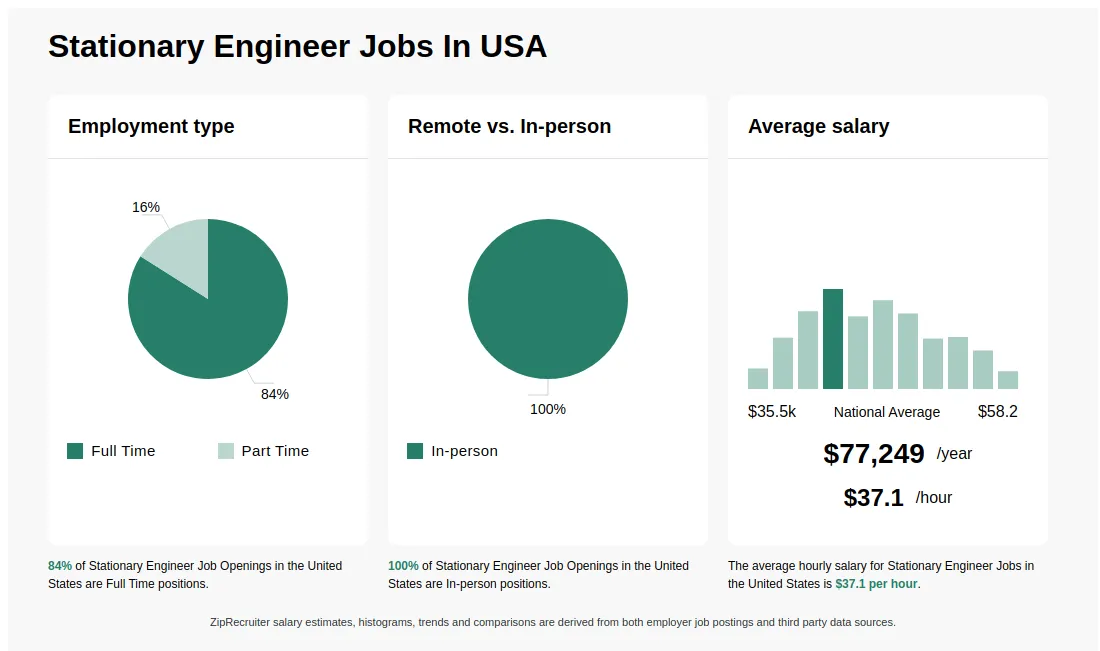
As of Jun 8, 2026, the average hourly pay for stationary engineer in the United States is $37.14, according to ZipRecruiter salary data. Most workers in this role earn between $28.61 and $44.47 per hour, depending on experience, location, and employer.

What Does a Stationary Engineer Do?

As a stationary engineer, you are in charge of the stationary motors, boilers, turbines, ventilation, air conditioning and heating systems for large facilities. Your responsibilities include checking the system pressure and water levels and performing general maintenance, such as replacing worn parts with new ones before they become a problem. The duties of a stationary engineer may vary somewhat depending on where they work. Some examples of facilities that hire stationary engineers are hotels, malls, factories, and warehouses.

What are stationary engineers and what do they do?

Stationary engineers operate, maintain, and repair stationary engines, boilers, and other mechanical equipment that provide utilities such as heat, cooling, and electricity in buildings and industrial facilities. They ensure these systems run efficiently and safely by monitoring gauges, performing routine inspections, and troubleshooting issues. Stationary engineers are often employed in factories, hospitals, power plants, and large commercial buildings. Their work is essential to keeping vital systems running smoothly and preventing equipment failures.

What are some typical challenges Stationary Engineers face when maintaining older equipment in large facilities?

Stationary Engineers often encounter challenges when working with aging infrastructure, such as outdated boilers or HVAC systems that may not have readily available replacement parts. Troubleshooting and maintaining older equipment requires a deep understanding of mechanical systems and creative problem-solving to ensure continuous operation. Additionally, they must stay up-to-date on safety regulations and retrofit equipment as needed to comply with modern standards. Collaborating with building managers and other maintenance staff is also essential to coordinate repairs without disrupting facility operations.

What is the difference between Stationary Engineer vs Boiler Operator?

AspectStationary EngineerBoiler Operator
CredentialsLicensing or certification often requiredTypically requires boiler operator license or certification
Work EnvironmentIndustrial plants, power plants, large buildingsBoiler rooms, manufacturing facilities, power plants
Job DutiesOperate and maintain large heating and cooling systems, turbines, generatorsMonitor and operate boilers, perform routine maintenance
Industry UsageCommon in energy, manufacturing, and large facilitiesPrimarily in facilities with large boilers, often overlapping with stationary engineers

Both roles involve operating and maintaining boilers and related systems, often requiring similar certifications. While a Stationary Engineer typically handles a broader range of equipment and complex systems, a Boiler Operator focuses mainly on boiler operation. The roles often overlap, especially in large facilities, but Stationary Engineers usually have more extensive responsibilities and credentials.

What are the key skills and qualifications needed to thrive as a Stationary Engineer, and why are they important?

To thrive as a Stationary Engineer, you need a solid background in mechanical systems, boiler operation, and HVAC, typically supported by a high school diploma or equivalent and a Stationary Engineer license. Familiarity with building automation systems, computerized maintenance management systems (CMMS), and regulatory compliance certifications is often required. Strong problem-solving skills, attention to detail, and effective communication help engineers respond quickly to emergencies and coordinate with building staff. These skills and qualifications are vital for ensuring the safe, efficient, and continuous operation of critical facility systems.
What cities are hiring for Stationary Engineer jobs? Cities with the most Stationary Engineer job openings:
What are the most commonly searched types of Stationary Engineer jobs? The most popular types of Stationary Engineer jobs are:
Who are the top companies hiring for Stationary Engineer jobs? The top employers for Stationary Engineer jobs are:
What states have the most Stationary Engineer jobs? States with the most job openings for Stationary Engineer jobs include:
What are popular job titles related to Stationary Engineer jobs? For Stationary Engineer jobs, the most frequently searched job titles are:
Infographic showing various Stationary Engineer job openings in the United States as of May 2026, with employment types broken down into 74% Full Time, 13% Part Time, and 13% Contract. Highlights an 86% Physical, 5% Hybrid, and 9% Remote job distribution, with an average salary of $77,249 per year, or $37.1 per hour.

Stationary Engineer

J & J Worldwide Services

Gunpowder, MD

Full-time

Posted 23 days ago


Job description

General Summary

The Stationary Engineer is responsible for the operation of all central energy plant utility systems, including high-pressure steam boilers, hot-water boilers, heat-recovery chillers, centrifugal refrigeration chillers, cooling towers, centrifugal air compressors, medical compressed air, and HVAC systems. The Stationary Engineer must have multi-craft skills (mechanical, electrical, and plumbing) and be able to troubleshoot and repair a wide variety of equipment. The Stationary Engineer is expected to complete preventive maintenance on equipment and identify/implement continuous improvement opportunities.

Essential Duties and Responsibilities

  • Responsible for maintaining the safe and efficient operation of equipment, including boilers, chillers, centrifugal air compressors, cooling towers, pumps, steam, chilled water, and HVAC systems.
  • Adjusts controls to ensure safe, efficient operation of systems to meet facility demands.
  • Logs various aspects of the system’s operation.
  • Monitors and logs temperature, hours of operation, fuel consumption, and water levels.
  • Feed chemicals and caustics into systems and devices, then record and report actions taken.
  • Observe the results of water tests.
  • May direct and coordinate activities of other workers in performing tasks directly related to operating and maintaining the system or systems.
  • Responds to calls for emergency repairs.
  • Conducts routine inspections of mechanical equipment (such as hot water boilers, which heat water for building use; high-pressure steam boilers, which generate steam for heating or industrial processes; centrifugal chillers, which cool water for air conditioning; pumps to move fluids; controls that automate equipment; cooling towers that disperse heat; and variable frequency drives (VFDs), which regulate the speed of motors).
  • Performs minor repairs or replaces broken or worn parts on mechanical equipment.
  • Maintain logs of all completed work.
  • Maintain a clean, safe, and orderly work area.
  • Study manuals and journals to increase technical competency.
  • Have expertise in mechanical, electrical, and control systems to identify and repair equipment issues.
  • Follow safety and LOTO procedures.
  • Conduct routine audits of operating equipment.
  • Maintain open, professional communication with associates.
  • Conduct routine maintenance activities.
  • Inspect and monitor equipment condition.
  • Spot and pursue improvement opportunities.
  • Complete scheduled preventive maintenance (regular checks and minor repairs to prevent issues) and/or planned work orders (scheduled maintenance tasks).
  • Provide assistance during routine shutdowns.
  • Performs preventive (proactive inspections and minor repairs to avoid breakdowns) and corrective (repairs after an issue has occurred) maintenance on the mechanical production and distribution systems (systems that generate and distribute steam, hot water, or chilled water in the facility).
  • Maintain inspection and testing records.
  • Assesses the condition of MEP (Mechanical, Electrical, and Plumbing) systems and recommends actions for repair or replacement.
  • Assist outside contractors performing scheduled maintenance or repairs.
  • Responds to emergency events, assesses the situation, and takes appropriate action to stabilize the situation.
  • Traces out proposed utility service shutdowns, identifies affected areas, and initiates shutdowns and reactivation.
  • Monitors outside contractor repairs and records observed deficiencies on the punch list.
  • Participates in new system start-up, training, and commissioning.

Knowledge, Experience, and Skill Requirements

  • Must hold a Maryland Grade 1 Stationary Engineer license.
  • Individuals performing operations, repairs, maintenance, modifications, and installations of the Facility's Central Energy Plant (CEP) steam and chilled water generating systems and associated controls shall be qualified "Stationary Engineer" possessing and maintaining a current "Grade 2 " or equivalent license approved by the COR. This license shall be a Maryland Stationary Engineer Grade 2 license or equivalent as approved by the COR.
  • Must be able to pass the Federal background check required for this job site.
  • Ability to perform work safely under hazardous conditions.
  • Able to troubleshoot and repair most complex problems.
  • Better-than-average knowledge of software programs, including Word, Excel, PowerPoint, and Outlook, is required.
  • Excellent oral and written communication skills.
  • High school graduate; technical or trade school certificate in a related field desired.
  • Basic construction knowledge.
  • Ability to read blueprints

Work Environment

  • Must be able to lift 50 lbs., squat, bend, stoop, and kneel for short periods, climb a ladder, stand for long periods of time, and perform constant arm extensions.
  • Occasional exposure to elements such as heat, cold, noise, dust, dirt, chemicals, but none to the point of being disagreeable. May involve minor safety hazards, with the likely result being cuts, bruises, etc.
  • Must be able to pass a local background check and have the ability to obtain and maintain NAC/LAC clearance (National Agency Check/Local Agency Check—security clearances required for access) after hire.

Disclaimer

CBRE Government and Defense is thrilled at the opportunity for you to apply to one of our roles. The rate for this position is $46.85. This position may also be eligible for a wide range of benefits based on applicable bargaining unit agreements.

This description is not intended to be an “all inclusive” list of the accountabilities of the job described. Rather, it describes the general nature of the job. In addition, some aspects of this job may change over time, according to business needs, and these changes may not be recorded immediately. The requirements stated represent the minimum levels of knowledge, skills and/or abilities to qualify and satisfactorily perform this job.

THIS DOCUMENT SHOULD NOT BE CONSTRUED AS CREATING A CONTRACT OF EMPLOYMENT BETWEEN CBRE GOVERNMENT & DEFENSE SERVICES AND ANY OF ITS EMPLOYEES OR OTHERWISE ALTERING AN EMPLOYEE’S AT WILL EMPLOYMENT RELATIONSHIP WITH CBRE GOVERNMENT & DEFENSE SERVICES.