2

Remote Medical Coder Jobs in Pennsylvania (NOW HIRING)

Experience with electronic medical records and familiarity with coding systems such as ICD-10 and ... remote environment while maintaining high standards of accuracy and productivity.

Electrical Designer | Remote

Pittsburgh, PA · On-site +1

$48.08 - $67.31/hr

Working knowledge of the National Electrical Code (NEC) * Ability to manage multiple projects and ... Medical, dental & vision * Critical Illness, Accident, and Hospital * 401(k) Retirement Plan - Pre ...

New

Showing results 21-40

Remote Medical Coder information

See Pennsylvania salary details

$17

$21

$23

How much do remote medical coder jobs pay per hour?

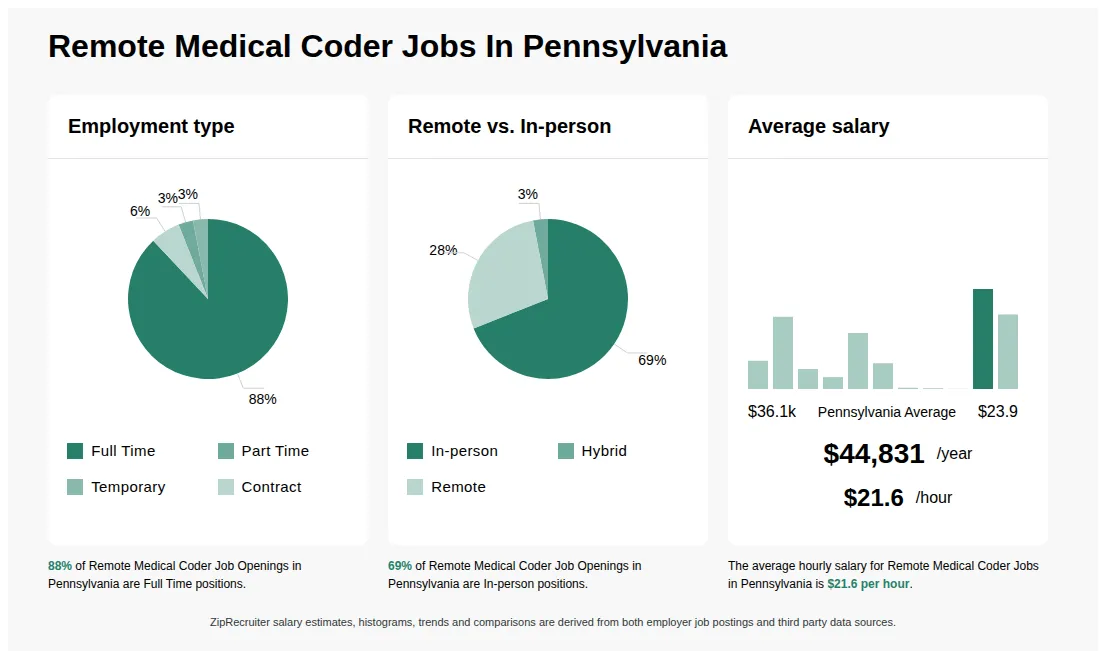
As of Aug 8, 2026, the average hourly pay for remote medical coder in Pennsylvania is $21.55, according to ZipRecruiter salary data. Most workers in this role earn between $18.08 and $22.88 per hour, depending on experience, location, and employer.

How much can a remote medical coder make working from home?

Remote medical coders typically earn between $40,000 and $70,000 annually, depending on experience, certifications, and the complexity of coding tasks. Some experienced professionals or those with specialized skills can earn higher salaries, especially if working for large healthcare organizations or as independent contractors.

Is remote medical coding worth it?

Remote medical coding is a legitimate career that offers flexibility and the ability to work from home. It requires certification, attention to detail, and knowledge of coding systems like ICD-10 and CPT. Many find it a rewarding option with steady demand in healthcare administration.

How do remote medical coders typically communicate and collaborate with healthcare providers and team members?

Remote Medical Coders often collaborate with healthcare providers, billing teams, and other coders through secure digital platforms, email, and scheduled video conferences. Clear communication is essential to clarify documentation, resolve coding discrepancies, and ensure accurate billing. Many employers use specialized health information systems and project management tools to streamline workflow and maintain HIPAA compliance. Frequent virtual meetings and messaging help foster teamwork and keep everyone aligned, even when working from different locations.

What are the key skills and qualifications needed to thrive as a remote medical coder, and why are they important?

To thrive as a Remote Medical Coder, you need a solid understanding of medical terminology, anatomy, and coding systems such as ICD-10 and CPT, usually supported by a coding certification (e.g., CPC, CCS). Familiarity with electronic health records (EHRs) and coding software like 3M or Epic is essential for accurate and efficient work. Attention to detail, time management, and strong written communication skills help remote coders excel in independent, deadline-driven environments. These abilities ensure accurate billing, compliance with regulations, and minimal claim denials, which are critical for healthcare organizations' operational and financial success.

What is the difference between Remote Medical Coder vs Remote Medical Biller?

AspectRemote Medical CoderRemote Medical Biller
CertificationsCertified Professional Coder (CPC), CCSCertified Medical Reimbursement Specialist (CMRS), CPC
Work EnvironmentAnalyzing medical records, coding diagnoses and proceduresSubmitting claims, following up on payments
Industry UsageHealthcare providers, hospitals, clinicsInsurance companies, billing services, healthcare providers

Remote Medical Coders and Remote Medical Billers often work together but focus on different tasks. Coders assign codes based on medical records, while Billers handle claims submission and payment follow-up. Both roles require similar certifications and are essential in healthcare revenue cycle management.

How to get a remote job as a remote medical coder?

To secure a remote medical coder position, obtain relevant certifications such as CPC or CCS, gain experience with coding software and medical records, and build a strong resume highlighting your accuracy and attention to detail. Job seekers should search on online job boards, network with industry professionals, and tailor applications to remote coding roles that specify telecommuting options.

What is a remote medical coder?

A remote medical coder is a healthcare professional who reviews clinical documents and assigns standardized codes for diagnoses, procedures, and medical services, all while working from a remote location such as their home. These codes are essential for billing, insurance claims, and maintaining patient records. Remote medical coders typically use electronic health records (EHR) and must have a strong understanding of medical terminology, coding systems like ICD-10 and CPT, and relevant regulations. Working remotely offers flexibility but still requires attention to detail, confidentiality, and adherence to industry standards.

What does a remote medical coder do?

Remote medical coders are medical coders who work from home or locations outside of healthcare facilities. They process patient information, such as diagnosis, services rendered, and equipment used to conduct tests, in order to translate it into medical codes consisting of numbers and letters. Billing and coding specialists manage this information so that patients or their insurance companies can be billed appropriately. Remote medical coders may be self-employed or work for large coding firms that contract with hospitals or healthcare facilities.

What are the most commonly searched types of Medical Coder jobs in Pennsylvania? The most popular types of Medical Coder jobs in Pennsylvania are:
What are popular job titles related to Remote Medical Coder jobs in Pennsylvania? For Remote Medical Coder jobs in Pennsylvania, the most frequently searched job titles are:
What cities in Pennsylvania are hiring for Remote Medical Coder jobs? Cities in Pennsylvania with the most Remote Medical Coder job openings:
What are popular job titles related to Remote Medical Coder jobs in PA? For Remote Medical Coder jobs in PA, the most frequently searched job titles are:
Infographic showing various Remote Medical Coder job openings in Pennsylvania as of August 2026, with employment types broken down into 78% Full Time, and 22% Part Time. Highlights an 100% Remote job distribution, with an average salary of $44,831 per year, or $21.6 per hour.

Coder III - Technical (Interventional Radiology and Cardiovascular Coding)

Corporate Revenue Cycle

Pittsburgh, PA • Remote

Full-time

Posted 18 days ago


Job description

UPMC Corporate Revenue Cycle is hiring a Coder III to join our Coding Department! This position will be a work-from-home position, working Monday through Friday during business hours.
In this role. you will monitor and respond to accounts on Pre-Bill edit and error reports. You will assist with training other coders as requested. The Coder III will perform PHC4 coding corrections; provide feedback to coders who made errors as well as monitor the Daily Cirius Error report to ensure that there are zero accounts exceeding the expected completion timeframe. Review and respond to the Pre-Bill Edit report issues to ensure timely billing. Additionally, you will assist with special projects as requested.

We are seeking experienced Coders with a strong background in Interventional Radiology (IR) and Interventional Cardiology (IC) CPT coding. Qualified applicants should possess a minimum of three years of IR/IC CPT coding experience and demonstrate a high level of proficiency in this specialty. Preference will be given to candidates who hold the CIRCC (Certified Interventional Radiology and Cardiovascular Coder) credential.

If you are ready to take the next step in your coding career, look no further!
Responsibilities:

  • Determine diagnoses that were treated, monitored and evaluated and procedures done during the episode of care and assign appropriate codes. Review appropriate documents in the patients' charts to accurately assign a diagnosis and/or procedure. Ensure the diagnoses and procedures are sequenced in order of their clinical significance to accurately assign the appropriate DRG/APC/ASC or payment tier under the Prospective Payment system or DSM IV methodology to guarantee accurate reimbursement on UPMC patients.
  • Make forward progress within the training period toward meeting coding accuracy standards of 98% within the first year of employment. Meet appropriate coding productivity standards within the time frame established by management staff.
  • Code all diagnoses and procedures by assigning and verifying the proper ICD-10-CM and CPT codes (DSM IV if applicable). Assign the principal and secondary diagnoses and procedures by thoroughly reviewing all documentation available at the time of coding.
  • Adhere to internal department policies and procedures to ensure efficient work processes. Actively participate in monthly coding meetings and share ideas and suggestions for operational improvements. Maintain continuing education by attending seminars, reviewing updated CPT assistant guidelines and updated coding clinics.
  • Complete work assignments in a timely manner and understand the workflow of the department. Maintain daily productivity statistics and submit a weekly productivity sheet to management clearly indicating the number of hours worked, the number of coding hours, the number of average charts per hour, and number of minutes/hours spent on non-coding tasks.
  • Identify incomplete documentation in the medical record and formulate a physician query to obtain missing documentation and/or clarification to accurately complete the coding process. Consult with DRG Specialist when applicable during query process.
  • Refer problem accounts to appropriate coding or management personnel for resolution.
  • Review coding for accuracy and completeness prior to submission to billing system utilizing CCI edits. Utilize standard coding guidelines, principles and coding clinics to assign the appropriate ICD-10-CM, CPT and DSM IV codes for all record types to ensure accurate reimbursement. (i.e. use of coding clinics, CPT Assistant, etc). Utilize the ACEP acuity level guidelines for assigning the correct acuity level for ED coding, or hospital specific acuity level module as needed.
  • Utilize computer applications and resources essential to completing the coding process efficiently, such as hospital information systems (Medipac/SMS/Meditech), encoders and electronic medical record repositories. If applicable, abstract required medical and demographic information from the medical record and enter the data into the appropriate information system to ensure accuracy of the database. Correct any data to be in error after reviewing the medical record and comparing with system entries.
  • High School or GED equivalent.
  • Completed an AHIMA or AACP-certified Coding program or certificate, Bidwell Training School or equivalent program with a curriculum that includes Anatomy and Physiology, Pharmacology, Pathophysiology, Medical Terminology, ICD-10-CM and CPT Coding Guidelines and Procedures.
  • Three years of hospital coding experience.

Licensure, Certifications, and Clearances:

  • Certified Coding Specialist (CCS) OR Certified Professional Coder (CPC) OR Nationally Registered Certified Coding Specialist (NRCCS) OR Registered Health Information Administrator OR Registered Health Information Technician (RHIT) required
  • Act 34
  • CIRCC (Certified Interventional Radiology and Cardiovascular Coder) credential preferred


UPMC is an Equal Opportunity Employer/Disability/Veteran