2

Remote Downstream Process Development Scientist Jobs

The R&D Scientist is responsible for managing research and development projects involving new product and process development, production trials, least-cost formulation, product/process improvement ...

Process Development Sr Scientist

Juncos, PR · On-site +1

$89K - $121K/yr

We are looking for a Process Development Sr Scientist for the completion of the cycle development and as a technical resource SUMMARY To independently conceive, design, implement and advance ...

The individual will support advanced remote sensing exploitation functions through detailed ... Perform algorithm development for complex data exploitation processes Required Skills and ...

R&D Scientist - US

Oak Brook, IL · On-site +1

$90K - $100K/yr

Stay current on emerging food technologies, ingredients, processing methods and industry trends ... Oak Brook, Illinois | Monday-Thursday onsite & Friday remote $90,000-$100,000 base salary + 10% ...

R&D Scientist - US

Oak Brook, IL · On-site +1

$90K - $100K/yr

Stay current on emerging food technologies, ingredients, processing methods and industry trends ... Oak Brook, Illinois | Monday-Thursday onsite & Friday remote $90,000-$100,000 base salary + 10% ...

We are part of Micron's Technology Development Group, turning advanced materials into ... Strong foundation in process science including thermodynamics or transport phenomena * Experience ...

next page

Showing results 1-20

Remote Downstream Process Development Scientist information

See salary details

$20

$38

$61

How much do remote downstream process development scientist jobs pay per hour?

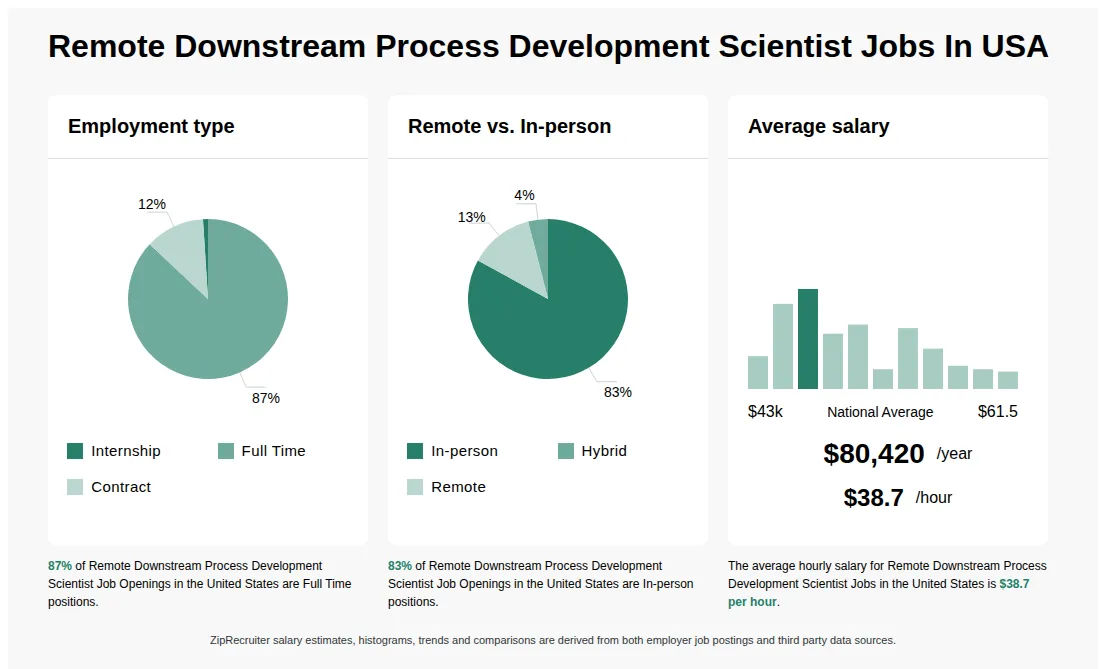
As of Sep 14, 2026, the average hourly pay for remote downstream process development scientist in the United States is $38.66, according to ZipRecruiter salary data. Most workers in this role earn between $28.37 and $46.15 per hour, depending on experience, location, and employer.

What is a remote downstream process development scientist?

A Remote Downstream Process Development Scientist is a professional who designs, optimizes, and scales processes for purifying and isolating biological products, such as proteins or antibodies, often in the biotechnology or pharmaceutical industries. They work remotely, leveraging digital tools to collaborate with teams, analyze data, and guide laboratory operations. Their responsibilities include developing protocols, troubleshooting purification steps, and ensuring that processes meet quality and regulatory standards. This role is critical for transforming lab-scale discoveries into commercially viable products.

What are the key skills and qualifications needed to thrive as a remote downstream process development scientist?

To thrive as a Remote Downstream Process Development Scientist, you need a strong background in biochemistry, chemical engineering, or a related field, often supported by an advanced degree and experience in bioprocessing. Familiarity with chromatography systems, filtration technologies, and data analysis software, as well as knowledge of regulatory standards like GMP, is typically required. Exceptional problem-solving, project management, and cross-functional communication skills are crucial for remote collaboration and effective process optimization. These competencies ensure the efficient development, scale-up, and transfer of purification processes critical to biopharmaceutical manufacturing success.

How does a remote downstream process development scientist typically collaborate with onsite laboratory teams?

As a Remote Downstream Process Development Scientist, collaboration with onsite laboratory teams is essential to ensure the smooth transfer of process knowledge, data interpretation, and troubleshooting. Communication is often facilitated through regular video meetings, shared digital lab notebooks, and project management tools. While you may not be physically present for hands-on experiments, you play a crucial role in designing studies, analyzing results, and providing guidance on process optimization. Building strong virtual relationships and maintaining clear, timely communication are key to overcoming challenges related to distance and ensuring project success.

What is the difference between Remote Downstream Process Development Scientist vs Remote Upstream Process Development Scientist?

AspectRemote Downstream Process Development ScientistRemote Upstream Process Development Scientist
Required CredentialsBachelor's or Master's in Biochemistry, Chemical Engineering, or related field; experience in chromatography and purification techniquesBachelor's or Master's in Biochemistry, Chemical Engineering, or related field; experience in cell culture and bioreactor operations
Work EnvironmentLaboratory and pilot plant settings, often collaborative teamsLaboratory and bioreactor environments, often collaborative teams
Industry UsagePharmaceutical and biotech companies focusing on drug purificationPharmaceutical and biotech companies focusing on bioprocessing

The main difference between a Remote Downstream Process Development Scientist and a Remote Upstream Process Development Scientist lies in their focus areas. Downstream scientists specialize in purification and separation techniques, while upstream scientists focus on cell culture and bioreactor processes. Both roles require similar educational backgrounds and are vital in biopharmaceutical development, but they target different stages of the production process.

How much does a remote downstream process development scientist make?

A remote downstream process development scientist typically earns between $80,000 and $130,000 annually, depending on experience, education, and the specific employer. Salaries in California tend to be higher due to the cost of living and demand for biotech and pharmaceutical expertise. Compensation may also include benefits such as bonuses, stock options, and flexible work arrangements.
More about Remote Downstream Process Development Scientist jobs

What cities are hiring for Remote Downstream Process Development Scientist jobs?

Cities with the most Remote Downstream Process Development Scientist job openings:

What are the most commonly searched types of Downstream Process Development Scientist jobs?

The most popular types of Downstream Process Development Scientist jobs are:

What states have the most Remote Downstream Process Development Scientist jobs?

States with the most job openings for Remote Downstream Process Development Scientist jobs include:

What are popular job titles related to Remote Downstream Process Development Scientist jobs?

For Remote Downstream Process Development Scientist jobs, the most frequently searched job titles are:

Infographic showing various Remote Downstream Process Development Scientist job openings in the United States as of September 2026, with employment types broken down into 1% Internship, 1% As Needed, 81% Full Time, 15% Part Time, and 2% Contract. Highlights an 85% Physical, 3% Hybrid, and 12% Remote job distribution, with an average salary of $80,420 per year, or $38.7 per hour.

Senior Director, Process Development

Lexington, MA • On-site, Remote

Keros Therapeutics
Biotechnology Research and Development • 1 - 10 employees

Full-time

Posted 3 days ago

New


Job description

At Keros, our mission is to deliver significant clinical benefit to a wide range of patients with disorders that are linked to dysfunctional signaling of the transforming growth factor-beta (TGF-ß) family of proteins. With a focus on developing differentiated product candidates that are designed to alter TGF-β signaling, we aim to target the pathways critical for the growth, repair and maintenance of blood cells and a number of tissues, including bone, skeletal muscle, adipose and heart tissue. We believe our product candidates have the potential to unlock the full therapeutic benefits of modulating the TGF-β superfamily and provide disease-modifying benefit to patients.
Job Summary
The Senior Director of Biologics Process Development will provide strategic and operational leadership for the Process Development group, with a specialized focus on complex biologics utilizing CHO cell culture platforms. This leadership role requires a deep technical background in running bioreactors within a process development setting alongside the ability to lead a high-performing group of Process Scientists and Engineers.
The successful candidate will oversee the development, optimization, and technology transfer of robust manufacturing processes across multiple biologics programs from early to late-stage development. This role coordinates closely with internal research, analytical, and manufacturing teams to ensure the seamless transition of programs from Research to Development, the successful execution of internal PD studies, and the timely production of material for toxicology and clinical studies.
Primary Responsibilities
  • Serves as Process Development department head overseeing planning, execution, resource allocation, and project delivery in a fast-paced environment
  • Manage, mentor and facilitate the development of the staff in Upstream and Downstream Process Development
  • Provide deep subject matter expertise in CHO cell culture development, including media optimization, feeding strategies, and cell line evaluation for complex biologics (e.g., bispecifics, fusion proteins, heavily glycosylated proteins)
  • Oversee upstream bioreactor operations (from bench-top to pilot scale), leveraging strong hands-on experience in bioreactor design, scale-up dynamics, and process characterization within a PD setting
  • Drive innovation and development of process technologies that can result in significant increases in efficiency and purity
  • Maintain a strong working knowledge of downstream purification technologies to ensure cohesive, end-to-end integrated process development
  • Oversee the execution of process development studies, data review, and comprehensive documentation according to established laboratory procedures and data integrity standards
  • Facilitate early program transitions from Research to Development, ensuring processes are scalable and fit for development realities
  • Operate within a cross-functional project team environment and coordinate efforts with all relevant internal functional areas including Quality, Manufacturing, Analytical Development, Program Management, Research, non-Clinical (Tox)
  • Have direct experience with establishing production processes for biologics in cGMP manufacturing settings
  • Assure cGMP success through effective tech transfer and support of cGMP manufacturing. Coordinate efforts with manufacturing to achieve program success
  • Lead tech transfer to CDMOs and mentor team members to support tech transfers
  • Determine areas for gaining efficiency, coordinates with individual groups and ensure harmonized implementation of best practices
  • Experience throughout the biopharmaceutical product life-cycle including process characterization studies, in-process control strategy and process validation is preferred but not required

Preferred Skills
  • Management experience must include managing a team of at least 5
  • Experience reviewing and/or authoring CMC sections for regulatory submissions
  • Demonstrated ability to work cross functionally to achieve goals
  • Knowledge of upstream and downstream process development for biologics
  • Ability to multi-task and handle successful execution of multiple parallel programs
  • Knowledge of cGMP and manufacturing operations
  • Knowledge of tech transfer
  • Knowledge of good lab practices including hands-on implementation
  • Knowledge of regulatory guidelines, particularly those for IND filing

Education Requirements
  • Ph.D. in Chemical Engineering, Bioengineering, Biochemistry, or a related scientific discipline with 10+ years of industry experience; or an M.S./B.S. with 14+ years of relevant biopharmaceutical experience
  • Minimum of 5+ years of experience successfully managing and developing technical teams of scientists and engineers in a biopharmaceutical setting

This pay range represents the base hourly rate or base annual full-time salary for all positions in the job grade within which this position falls. The actual base salary offer will depend on a variety of factors including experience, education, and other relevant factors.
Potential base pay range
$240,000-$277,000 USD
Our Diversity, Equity & Inclusion Mission Statement:Keros is an inclusive company. We believe that diversity drives innovation. We continue to build an inclusive culture that encourages, supports, and celebrates the diverse voices of our employees. As such, Keros takes a holistic approach in mentoring, coaching, and developing all of our Keros team members.
Keros Therapeutics is an Equal Opportunity employer. All qualified applicants will receive consideration for employment without regard to race, color, religion, sex including sexual orientation and gender identity, national origin, disability, protected veteran status, or any other characteristic protected by applicable federal, state, or local law.
Recruitment & Staffing Agencies:Keros Therapeutics does not accept unsolicited resumes from any source other than the candidate directly. Any unsolicited submission by an agency to Keros is prohibited. Any resume submitted by an agency without a signed contract or expressed consent by a member of the Keros Therapeutics Human Resources Department, will be considered property of Keros Therapeutics, and no fee shall be owed with respect thereto.