2

Remote Data Abstractor Jobs (NOW HIRING)

The Trauma Data Abstractor is responsible for remote abstracting and registry operations. They follow the guidelines of the engagement via Registry Partners (RP) specific documents, such as but not ...

$32/hr

Position: Flexible Schedule Clinical Data Abstractor Location: 100% Remote (Non-Benefit Position) Are you experienced in clinical data abstraction? Carta Healthcare Inc. is seeking talented ...

As a work from home, Trauma Data Abstractor, you will be responsible for the abstraction of data for complex trauma data. What you will do in this role: * Complete abstraction process for assigned ...

As a work from home Cardiovascular Data Abstractor II ,  you will be responsible for abstraction of data for complex cardiovascular services. What you will do in this role: * Completes ...

As a work from home, Trauma Data Abstractor, you will be responsible for the abstraction of data for complex trauma data. What you will do in this role: * Complete abstraction process for assigned ...

next page

Showing results 1-20

Remote Data Abstractor information

See salary details

$14

$25

$39

How much do remote data abstractor jobs pay per hour?

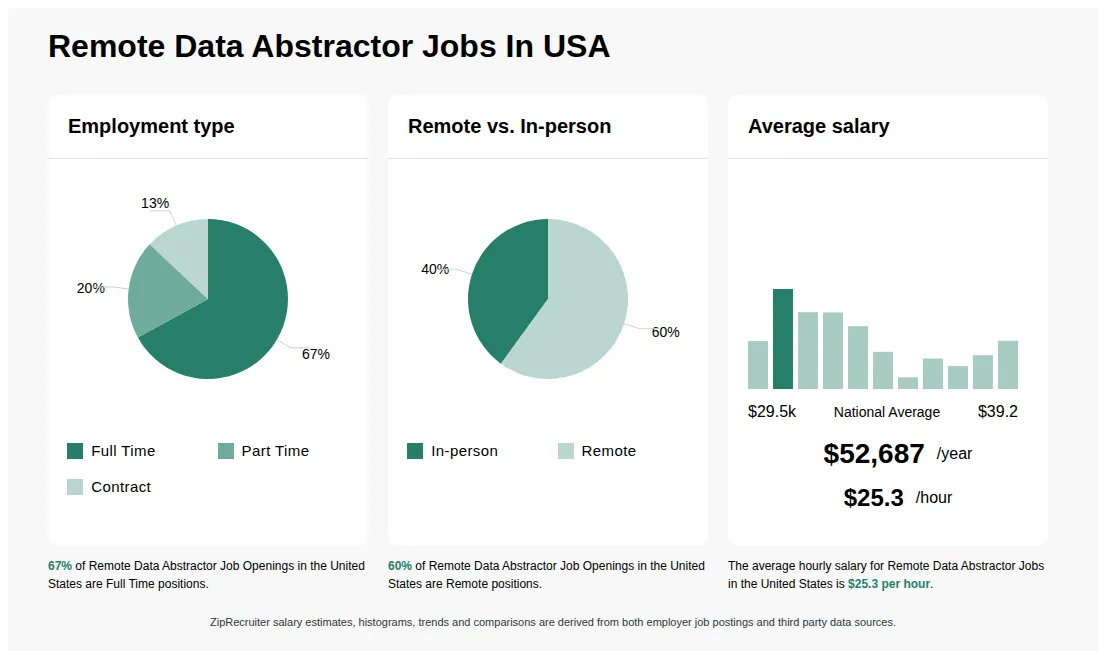
As of May 29, 2026, the average hourly pay for remote data abstractor in the United States is $25.33, according to ZipRecruiter salary data. Most workers in this role earn between $18.51 and $31.97 per hour, depending on experience, location, and employer.

What Does a Remote Data Abstractor Do?

As a remote data abstractor, you work from home to review and assess clinical data in medical records to verify compliance with health care standards and company regulations. Your duties and responsibilities include abstracting key information from charts, performing clinical auditing, and entering data into a database. You are also responsible for ensuring that electronic records are complete and accurate, and for identifying opportunities for improvement in the data collection and auditing workflow. Patient safety initiatives and quality of care are at the top of your priorities, so you must be meticulously analytical, with strong strategic-thinking skills.

What are the key skills and qualifications needed to thrive as a Remote Data Abstractor, and why are they important?

To thrive as a Remote Data Abstractor, you need a detail-oriented approach, strong analytical skills, and a background in healthcare or clinical data—often supported by a relevant degree or certification. Familiarity with electronic health record (EHR) systems, medical coding software, and secure data transfer platforms is typically required. Excellent written communication, time management, and the ability to work independently make someone stand out in this position. These skills ensure accurate, timely extraction and reporting of critical healthcare data, directly impacting patient care and regulatory compliance.

What are the typical challenges faced by a Remote Data Abstractor, and how can they be addressed?

Remote Data Abstractors often encounter challenges such as interpreting inconsistent documentation, maintaining data accuracy, and managing time effectively when working independently. To overcome these issues, it's important to develop strong attention to detail, become familiar with common data sources and terminology, and establish clear communication channels with supervisors or clinical teams for clarification. Utilizing secure and reliable technology, as well as following established protocols, also helps ensure data quality and workflow efficiency.

What is a Remote Data Abstractor?

A Remote Data Abstractor is a professional who reviews and extracts specific information from data sources, such as medical records or databases, while working remotely. Their primary role is to identify and collect relevant data points, ensuring accuracy and completeness for reporting, research, or compliance purposes. They often work in healthcare, insurance, or research settings and must adhere to privacy regulations like HIPAA. Strong attention to detail, data entry skills, and knowledge of electronic health records (EHR) systems are typically required. Remote Data Abstractors play a critical role in supporting data-driven decision-making from a remote location.

What is the difference between Remote Data Abstractor vs Remote Data Entry Clerk?

AspectRemote Data AbstractorRemote Data Entry Clerk
Required CredentialsHigh school diploma or equivalent; familiarity with medical records or databasesHigh school diploma or equivalent; basic computer skills
Work EnvironmentHealthcare or research organizations; remoteVarious industries; remote
Employer & Industry UsageHospitals, research firms, insurance companiesRetail, finance, healthcare, general administrative tasks
Common Search & ComparisonYesNo

The main difference is that Remote Data Abstractors focus on reviewing and summarizing complex data, often in healthcare or research settings, requiring specific knowledge of records. Remote Data Entry Clerks primarily input data into systems, with less emphasis on data analysis or review. Both roles are remote and require basic computer skills, but their responsibilities and industry applications differ.

What cities are hiring for Remote Data Abstractor jobs? Cities with the most Remote Data Abstractor job openings:
What are the most commonly searched types of Data Abstractor jobs? The most popular types of Data Abstractor jobs are:
What states have the most Remote Data Abstractor jobs? States with the most job openings for Remote Data Abstractor jobs include:
Infographic showing various Remote Data Abstractor job openings in the United States as of May 2026, with employment types broken down into 50% Full Time, and 50% Part Time. Highlights an 100% Remote job distribution, with an average salary of $52,687 per year, or $25.3 per hour.
Trauma Data Abstractor

Full-time, Part-time

Posted 29 days ago


Job description

Vacancy Name
Trauma Data Abstractor
Vacancy No
VN440
Employment Type
Part Time/Full Time
Education Level
N/A
Experience Level
1 year
Location
US - Remote
Additional Information
Job Details
General Description:
The Trauma Data Abstractor is responsible for remote abstracting and registry operations. They follow the guidelines of the engagement via Registry Partners (RP) specific documents, such as but not limited to: project parameters/roadmap, Quality Control policies and procedures, and productivity guidelines, as well as industry related reference manuals. The Trauma Data Abstractor is accountable for their committed hours to ensure the planned objectives are met for each assigned engagement(s).
Qualifications:
  • Minimum of one-year current Trauma Data Abstraction experience, required
  • Maintain the following Trauma certification and recertification requirements:
    • Completion of Trauma Registry Course, required
    • Completion of AIS Course, required
    • Completion of Trauma Specific ICD 10 Coding Course (and renewal as required)
    • Minimum of 8 Trauma CEU's annually
    • CAISS/CSTR, preferred
  • Proficient in registry related manuals, industry related registry software systems, and electronic medical record applications, required
Essential Duties/Responsibilities:
  • Abstracting and registry operations
  • Completion of timesheet and case log per company standard
  • Provide timely responses to questions and/or concerns
  • Follows all RP internal corporate policies and procedures as well as client specific policies and procedures
  • Other duties as assigned

The tasks outlined in this job description are not all inclusive but are the core responsibilities of the position. The tasks are subject to change at any given time and employees will be notified by the corporate office, if/when updates and changes are made to the job description.
Work Environment & Physical Demands