2

Remote Cloud Computing Jobs (NOW HIRING)

Lead organization to adopt / incorporate cloud computing correctly and in the most effective manner * Develop and coordinate the cloud architecture * Coordinate cloud architecture across all ...

NLM Cloud Engineer I

Bethesda, MD · Remote

$59.50 - $79.50/hr

The Cloud Engineer I will have a firm understanding of cloud computing platforms, CI/CD pipelines ... Knowledge of FedRAMP requirements and secure remote access administration * Prior experience ...

NLM Cloud Engineer I

Bethesda, MD · Remote

$59.75 - $79.75/hr

The Cloud Engineer I will have a firm understanding of cloud computing platforms, CI/CD pipelines ... Knowledge of FedRAMP requirements and secure remote access administration * Prior experience ...

Showing results 41-60

Remote Cloud Computing information

See salary details

$10

$61

$84

How much do remote cloud computing jobs pay per hour?

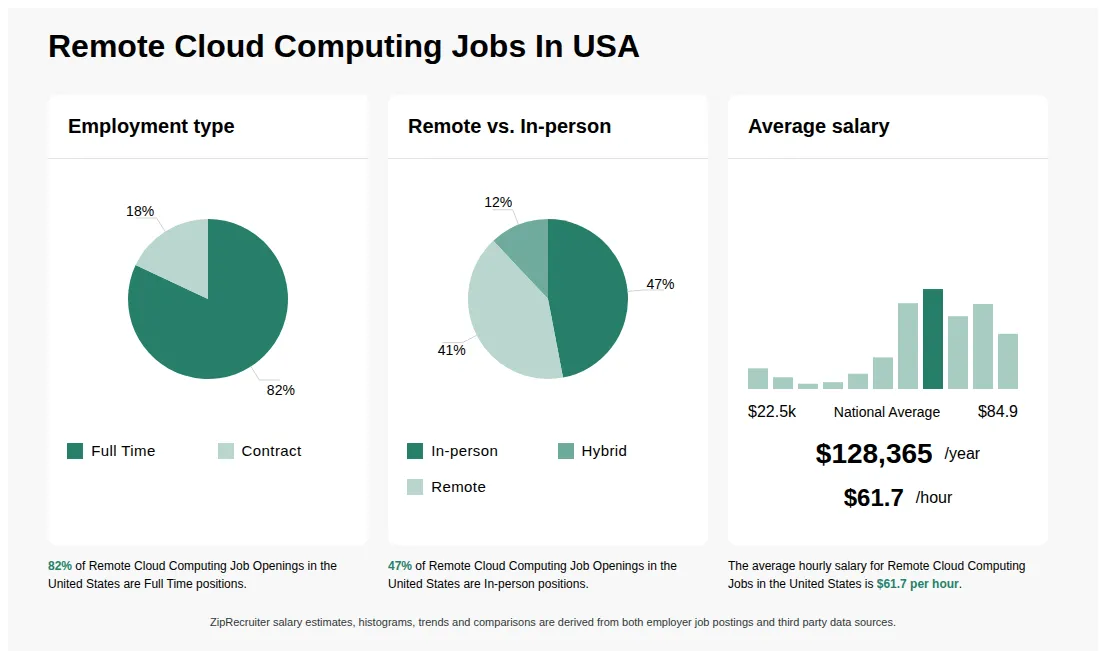
As of Sep 13, 2026, the average hourly pay for remote cloud computing in the United States is $61.71, according to ZipRecruiter salary data. Most workers in this role earn between $54.09 and $74.04 per hour, depending on experience, location, and employer.

What is remote cloud computing?

Remote cloud computing refers to the delivery of computing services—such as servers, storage, databases, networking, software, and analytics—over the internet instead of using local servers or personal devices. Professionals in this field work from remote locations and help businesses manage, deploy, and maintain cloud-based infrastructure and services. This allows companies to scale resources, improve collaboration, and reduce IT costs while enabling employees to work from anywhere with an internet connection.

What are the key skills and qualifications needed to thrive as a remote cloud computing professional?

To thrive as a Remote Cloud Computing professional, you need a strong background in IT infrastructure, cloud architecture, and virtualization, typically supported by a degree in computer science or a related field. Familiarity with major cloud platforms like AWS, Azure, or Google Cloud, as well as certifications such as AWS Certified Solutions Architect or Microsoft Certified: Azure Administrator, is highly valuable. Excellent problem-solving, communication, and self-management skills help you effectively collaborate and troubleshoot in a distributed work environment. These skills ensure secure, scalable, and efficient cloud solutions that meet organizational needs, especially when working remotely.

What are some common challenges faced by professionals working in remote cloud computing roles, and how can they be addressed?

Remote cloud computing professionals often encounter challenges related to communication, collaboration across time zones, and ensuring robust security practices when accessing sensitive data remotely. To address these issues, it's important to establish clear communication channels, use collaborative tools like Slack or Microsoft Teams, and follow company security protocols such as VPN usage and multi-factor authentication. Regular check-ins with your team and continuous learning about emerging cloud security trends can also help maintain productivity and safeguard data in a remote environment.

What is the difference between Remote Cloud Computing vs Remote Cloud Support Specialist?

AspectRemote Cloud ComputingRemote Cloud Support Specialist
Required CredentialsCloud certifications (AWS, Azure, GCP), technical degreesCloud certifications, technical knowledge, customer service skills
Work EnvironmentDesigning, deploying, managing cloud infrastructureProviding technical support, troubleshooting cloud issues
Employer & Industry UsageTech companies, cloud service providers, enterprisesIT support firms, cloud service providers, enterprise IT teams
Common Search & Comparison IntentUnderstanding cloud roles, career paths in cloud computingSupport roles, troubleshooting cloud problems, customer assistance

Remote Cloud Computing involves designing and managing cloud infrastructure, requiring technical certifications and a focus on deployment. In contrast, Remote Cloud Support Specialists focus on troubleshooting and assisting users with cloud issues, emphasizing customer service skills. Both roles are integral to cloud services but differ in responsibilities and skill sets.


Are remote cloud computing jobs still in demand?

Remote cloud computing jobs remain in high demand due to ongoing digital transformation and increased reliance on cloud services. Skills in platforms like AWS, Azure, or Google Cloud, along with certifications, enhance job prospects in this field.

Can remote cloud computing work remotely?

Remote cloud computing jobs are common and typically involve managing cloud infrastructure, deploying applications, and monitoring systems from a remote location. These roles often require familiarity with cloud platforms like AWS, Azure, or Google Cloud, and can be performed entirely online with a reliable internet connection. Many employers offer flexible schedules, making remote work a standard option in this field.
More about Remote Cloud Computing jobs

What cities are hiring for Remote Cloud Computing jobs?

Cities with the most Remote Cloud Computing job openings:

What are the most commonly searched types of Cloud Computing jobs?

The most popular types of Cloud Computing jobs are:

What states have the most Remote Cloud Computing jobs?

States with the most job openings for Remote Cloud Computing jobs include:

Infographic showing various Remote Cloud Computing job openings in the United States as of September 2026, with employment types broken down into 93% Full Time, 3% Part Time, and 4% Contract. Highlights an 76% Physical, 6% Hybrid, and 18% Remote job distribution, with an average salary of $128,365 per year, or $61.7 per hour.

Cloud Solutions Architect 1735

Austin, TX • On-site, Remote

Sistema Technologies, Inc.
51 - 200 employees

$63.25 - $86.50/hr

Full-time

Re-posted 5 days ago


Key responsibilities

  • Designs and implements cloud computing infrastructure and applications.

  • Supports multi-cloud enterprise environments by monitoring performance, reliability, and security.

  • Supports and maintains cloud platforms, data pipelines, and analytics workloads in production environments.


Job description

Austin, TX
Cloud Solutions Architect - Solicitation# 529701735
Texas Health and Human Services Commission (HHSC)
The cloud architect is responsible for the cloud computing initiatives within an organization and for directing the architectural aspects of a cloud brokering team across all aspects of IT and the business. Responsible for the planning and engineering of an organization's cloud computing infrastructure and applications. Implements and designs hardware and software. Familiar with standard concepts, practices, and procedures of cloud technology, including Software as Service (SaaS), Platform as Service (PaaS), or Infrastructure as a Service (IaaS).
Supports a regulated, multi-cloud enterprise environment, requiring expertise in data/AI platforms, vendor coordination, monitoring, and 24x7 operations, while ensuring security, compliance, and system reliability.
Position will be 3 days remote with 2 days (Mon & Wed) required to be onsite at the location listed above. **Subject to change per the hiring team**
Program will only allow candidates who are LOCAL TO THE AUSTIN AREA ONLY (Within 50-mile radius).
Minimum Requirements: Candidates that do not meet or exceed the minimum stated requirements (skills/experience) will be displayed to customers but may not be chosen for this opportunity. Actual
Years
Experience Years
Experience
Needed Required/
Preferred Skills/Experience 8 Required MultiCloud Platform Expertise (Azure + GCP) 8 Required GenAI & Enterprise AI Platform Knowledge (Gemini, Vertex AI) 8 Required Expertise in Azure Monitor, Log Analytics, GCP Cloud Monitoring, and logging frameworks to track performance, reliability, and usage. 8 Required Experience using Logstash for log ingestion, transformation, and integration with Azure Log Analytics for proactive monitoring and alerting 8 Required Ability to design alerting solutions using Twilio (SMS/voice) for ETL failures and operational notifications. 8 Required Experience with Blob Storage, Data Lakes, and structured storage systems enabling analytics and AI workloads. 8 Required Hands-on experience supporting data pipelines, data platforms, and analytics workloads in enterprise environments 8 Required Experience with Informatica Cloud (IICS), Secure Agents, APIs, and integration patterns, including handling monitoring and integration challenges. 8 Required Strong implementation of IAM (least privilege), network security, audit logging, and compliance (FedRAMP/regulated env.). 8 Required Ability to support Tier 2/3 issues, debug logs, resolve platform access issues, and maintain stability in production environments 3 Preferred Familiarity building and managing Tableau Cloud environments 3 Preferred Experience integrating ArcGIS or geospatial data systems with cloud data platforms. 3 Preferred Knowledge of scripting (Python, Bash) and automation (serverless, CI/CD pipelines). [https://ou...essageItem | Outlook] 3 Preferred Exposure to GKE, AKS, Docker, and microservices architectures. 3 Preferred Familiarity with data mesh, ETL/ELT architectures, API integrations, and enterprise data standards. 3 Preferred Strong analytical thinking to assess platform issues, make timely architectural decisions, and drive resolution in high-pressure environments. 3 Preferred Ability to take end-to-end ownership of platform stability, reliability, and delivery, proactively identifying risks and driving outcomes 2 Preferred Ability to clearly translate complex technical concepts into business-friendly language and actively engage with stakeholders, leadership, and end users 2 Preferred Proven ability to lead and coordinate across engineering, data, infrastructure, and business teams, ensuring alignment and delivery of platform initiatives.
I need Three References
Reference Name (Required): Title (Optional) Company Name (Required): Phone Number (Required include area code): E-mail address (Optional): Professional Relationship (Optional):
PeerCo-WorkerSupervisor
CustomerEnd-UserSubordinate
Reference Name (Required): Title (Optional) Company Name (Required): Phone Number (Required include area code): E-mail address (Optional): Professional Relationship (Optional):
PeerCo-WorkerSupervisor
CustomerEnd-UserSubordinate
Reference Name (Required): Title (Optional) Company Name (Required): Phone Number (Required include area code): E-mail address (Optional): Professional Relationship (Optional):
PeerCo-WorkerSupervisor
CustomerEnd-UserSubordinate